

Last Updated: November 18, 2026
Quick Summary
Identifying quality craftsmanship in Moroccan furniture means checking for hand-carved depth variation, chisel tool marks, solid cedar or hardwood, and real joinery like dovetails and mortise-and-tenon instead of staples and screws. Flip the piece over, test the drawers and frame, and request close-ups of end grain, joinery, and inlay gaps before you buy.
- Hand-carved patterns sit at varying depths, while stamped or routed copies look flat and uniform.
- Solid cedar or walnut feels dense when you lift a corner; veneered particleboard feels lighter and sounds hollow.
- Push a frame diagonally to test racking; a well-built frame resists movement without creaking.
- Ask sellers five direct questions and request workshop photos, tool-mark close-ups, and material details in writing.
- Accept slight carving depth differences and tone shifts, but walk away from structural cracks and wobbly frames.
Table of Contents
- What Separates Handcrafted Moroccan Furniture From Showroom Copies
- The Visual Signatures of Authentic Moroccan Craftsmanship
- Moroccan Furniture Materials: What the Wood, Leather, and Inlay Should Tell You
- Moroccan Furniture Joinery: Reading Construction Beyond the Carving
- How to Identify Handmade Furniture When Photos Are All You Have
- Questions to Ask Sellers and the Evidence to Request
- Your Moroccan Furniture Quality Checklist
- Acceptable Handmade Variation vs. Actual Defects
- Choosing Pieces That Fit Your Space and Climate
- Request a Custom Quote Before You Commit
- Frequently Asked Questions
What Separates Handcrafted Moroccan Furniture From Showroom Copies
Identifying quality craftsmanship in Moroccan furniture starts with one question: did a person's hands shape this piece, or did a machine? The answer shows up in small, repeatable details. Look for tool marks, uneven depth in the carving, and joinery that holds up under real use. A showroom copy can mimic the outline of a Moorish cabinet. It rarely copies the labor behind it.
Here is what to compare side by side:
- Carving depth: Hand-carved patterns sit at varying depths. Stamped or routed copies look flat and uniform.
- Tool marks: Look for fine chisel lines inside recessed areas.
- Joinery: Dovetails and mortise-and-tenon joints beat staples and screws.
- Materials: Solid cedar or hardwood versus veneer and engineered board.
- Weight: Real hardwood feels heavy when you lift a corner.
For a deeper side-by-side breakdown, read our guide on handcrafted versus mass-produced Moroccan furniture. It walks through the same signals with more examples.
The Visual Signatures of Authentic Moroccan Craftsmanship
Authentic Moroccan craftsmanship leaves visible evidence. You just need to know where to look. The decoration gets all the attention, but the truth hides in the edges, the recesses, and the back of the piece.
Tool Marks, Depth Variation, and Geometric Precision
Run your fingers across a carved panel. On a handmade piece, the surface rises and falls. Chisel marks show up as thin, angled grooves inside the recesses. On a machine-routed copy, the walls of each cut are smooth and identical.
Geometric precision works differently than most buyers expect. A skilled artisan lays out hand-carved patterns with compasses and dividers. The star motifs line up across the whole panel, but no two cuts are perfectly identical. That small variation is a signature, not a flaw.
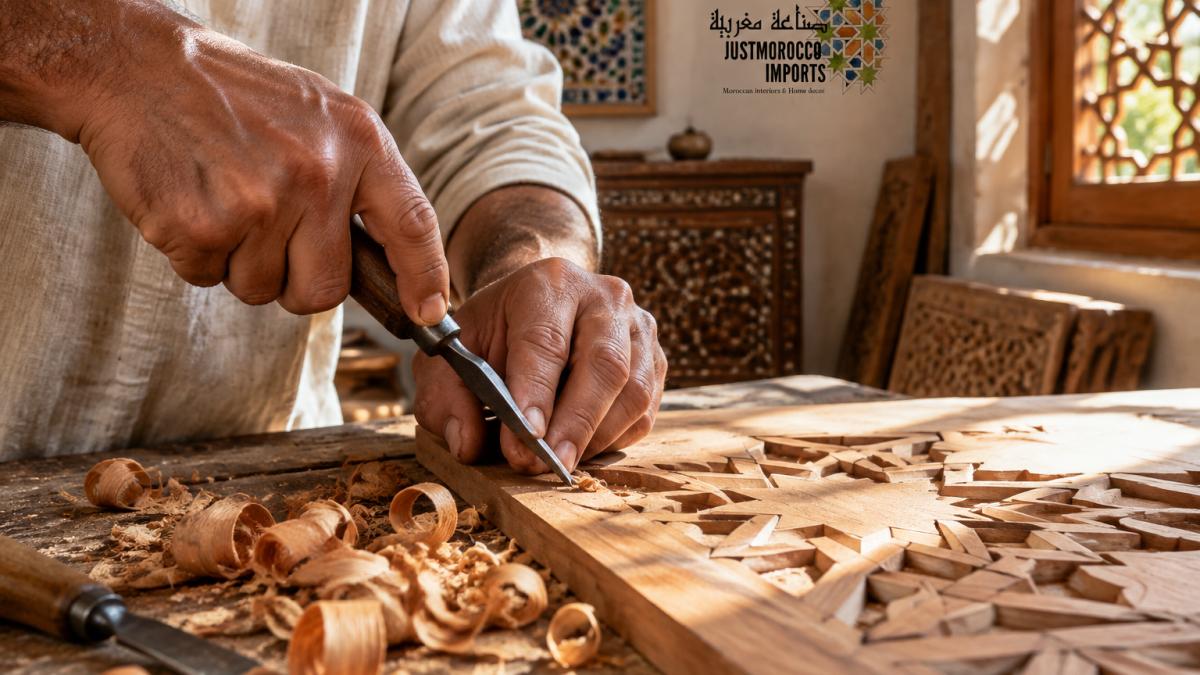
Want to see real carving up close? Study the depth and shadow work on our hand-carved Moroccan credenza. The lattice panels show exactly how hand-worked wood behaves under light.
Moroccan Furniture Materials: What the Wood, Leather, and Inlay Should Tell You
Moroccan furniture materials tell you the real story of a piece, often faster than the carving does. Solid cedar, walnut, and hardwood form the frame. Natural leather covers seating and panel accents. Bone inlay and mother-of-pearl sit set into wood by hand, piece by piece. The problem is that a showroom copy can imitate the look of each material without the substance. This section gives you verification methods, not just descriptions, so you can confirm what a piece is actually made of before you pay for it.
Wood: Solid Versus Veneer
Start with the end grain. On a solid wood board, end grain shows growth rings and pores that continue the face grain around the corner. On a veneered edge, you see a thin line of face material over a core that looks different, often particleboard, MDF, or a softwood block. Run your fingernail across an inconspicuous edge; a veneer seam catches slightly, while solid wood feels continuous.
Look at the grain across joints. Solid wood grain flows from one board into the next and changes direction naturally. Veneer often shows a repeating pattern or a mirror-image match because sheets are sliced from the same flitch. Check the underside of a tabletop or the inside of a cabinet side: manufacturers veneer the show faces and leave the core exposed where you are less likely to look.
Weight is a rough but useful test. A solid cedar or walnut cabinet feels dense when you lift one corner. A veneered particleboard piece of the same size feels lighter and often sounds hollow when you knock on a side panel. A solid hardwood frame with quality joinery generally weighs more than a comparable engineered-board piece.
Watch out: heavy polyurethane over "carved" panels often covers stamped decoration and engineered board. A thick, glassy coating can hide veneer seams and fill grain, so evaluate the wood before you judge the finish.
Leather: Natural Versus Faux
Natural leather has grain variation, faint scars, and soft creases that develop with use. Faux leather looks uniform and feels plastic. To verify, press a thumb into an inconspicuous area: natural leather wrinkles and springs back with a soft, irregular pattern, while polyurethane or vinyl tends to crease sharply or stay smooth. Smell matters too, natural leather has an earthy, slightly animal scent, while faux leather often smells chemical.
Check the edges and the back of the upholstery. Genuine leather shows a suede-like nap or a finished edge that reveals fiber structure. Bonded leather, ground leather fibers pressed with binder, can look like leather on the face but shows a uniform, papery back and tends to peel at wear points. Ask the seller directly whether the seating surface is top-grain, split, bonded, or synthetic, and request a close-up of an edge and the underside.
Bone Inlay and Mother-of-Pearl
Individual inlay pieces vary slightly in color and shape. The setting should sit flush, with tight, even gaps. Run a fingertip across the surface: hand-set inlay sits level with the wood or slightly proud, and each piece has its own tone and figure. Machine-cut resin or plastic inlay looks identical piece to piece and often sits in a uniform bed of filler.
Look at the gaps. Hand-cut bone and shell leave small, irregular lines of dark filler or wood between pieces. Perfectly even, wide gaps filled with a single color suggest a molded or printed imitation. Our handcrafted bone inlay mirror shows what proper inlay work looks like: each piece cut and set by hand, with natural tone shifts across the surface.
Finish Safety and Durability
A hand-rubbed finish shows subtle sheen changes and lets you see and feel the grain. A thick plastic-like coat hides the grain and can trap moisture. Ask what the finish is: oil, wax, shellac, lacquer, or polyurethane. Oil and wax finishes are breathable and repairable; heavy polyurethane is durable but can conceal defects and is harder to repair.
Ask how long the piece has cured and whether the finish is water-based or solvent-based.
What to Ask and What to Request
Ask the seller to confirm, in writing, the frame wood, any veneered surfaces, the leather type on seating, and the finish. Request close-ups of end grain, an upholstery edge, and an inlay gap. A seller who cannot provide these is telling you something.
Moroccan Furniture Joinery: Reading Construction Beyond the Carving
Moroccan furniture joinery decides whether a piece lasts decades or two moves. Beautiful carving on weak construction is a warning sign. Flip the piece over, open the doors, and look at the back and the drawer boxes. This section goes beyond naming joints and shows you how to test the structure the way a furniture maker would.
Start With the Frame
A solid frame should feel rigid when you push it. Place one hand on a front corner and the other on the opposite back corner, then apply gentle pressure diagonally. A well-built frame resists racking with little movement. A frame that flexes, creaks, or shifts means the joints are loose or the corner blocks are inadequate.
Check the corner blocks. Handmade pieces often use glued and pinned corner blocks for strength. Look for blocks that are glued and screwed or pinned, not just stapled. A block that moves when you press it is doing little work.
Look at the back panel. Solid wood or quality plywood beats thin hardboard. A back panel that is nailed rather than set in a groove can loosen over time and let the frame rack.
Test the Drawers
Open and close every drawer fully. A well-built drawer runs smoothly without binding, and it should not wobble when you pull one corner. Pull the drawer out and look at the joints: dovetails interlock like puzzle pieces, while staples and brads mean factory assembly. Check the drawer bottom, it should sit in a groove or be screwed, not stapled to the sides.
Load test matters. A drawer that sags under a stack of linens or shifts when you push it closed will fail under daily use. If the piece is in a showroom, ask to load a drawer with weight and operate it. If you are buying from photos, request a short video of the drawer opening and closing under load.
Doors, Hinges, and Hardware
Handmade doors may sit a hair off square, but they should close smoothly and stay closed. Open each door to its full range and watch the hinge line. Hand-forged hinges and traditional ring pulls suggest artisan work, but check that hinges are seated firmly and screws are not stripped. A door that sticks, sags, or will not stay closed is a defect, not character.
Weight-Bearing Capacity
Ask what the piece is designed to hold. A carved credenza built for linens and display is not the same as a bench built for seating. Look at the span: a long unsupported shelf or seat rail will sag over time unless it has a center support or an apron. Press down gently on shelves and seat rails to feel for flex. A shelf that bows under light hand pressure will bow more under real weight.
Upholstery Attachment
On seating and upholstered panels, the attachment matters as much as the leather. Lift a cushion and look at how the cover is fixed. Hand-tacked or stapled webbing, coil springs, or foam wrapped and secured by hand suggest traditional upholstery. A cover that is glued rather than tacked, or foam that shifts under your hand, will wear poorly. Press the seat and listen for creaks or feel for a hard frame edge through the padding.
Watch out: a seller who calls a structural crack "rustic character" is hiding a defect. Cracks running through structural wood, wobbly frames, and failing joints are not handmade variation, they are damage or poor construction. Ask for a replacement or walk away.
The Takeaway
A common mistake is judging a piece only from the front. Turn it around. Construction quality beyond visible decoration is where copies fall apart. Test the frame, the drawers, the doors, the weight-bearing surfaces, and the upholstery attachment before you commit.
How to Identify Handmade Furniture When Photos Are All You Have
How to identify handmade furniture from photos comes down to zooming in on the right spots. Online listings hide a lot, but they cannot hide everything. Crop into the carving, the joints, and the material edges.
Use these photo checks:
- Zoom on recesses: Look for chisel marks and uneven depth.
- Check pattern repeats: Hand-carved patterns vary slightly. Printed or stamped ones repeat exactly.
- Study the wood grain: Grain should flow naturally, not stop at a seam.
- Look at shadows: Deep carving casts real shadows. Printed patterns stay flat.
- Request close-ups: Ask for shots of the back, drawer sides, and hardware.
A seller who cannot send a close-up of a drawer joint is telling you something. Real artisans and importers keep detail photos on hand.
Questions to Ask Sellers and the Evidence to Request
Ask direct questions, then ask for proof. Vague answers about "authentic artisan work" mean little without documentation. A serious seller will answer these without hesitation.
Ask these five questions:
- Where was this piece made, and in which workshop?
- Is the carving cut by hand or routed by machine?
- What wood is the frame, and is any of it veneer?
- Can you send photos of the joinery and the back panel?
- What is your policy if the piece arrives damaged?
Evidence to request includes workshop photos, close-ups of tool marks, and material details in writing. As documented in U.S. Customs and Border Protection guidance on country-of-origin marking, imported goods must carry clear origin marking, so a legitimate importer can speak plainly about where a piece was made.
Your Moroccan Furniture Quality Checklist
Use this checklist before you commit to any piece. It turns a gut feeling into a repeatable test.
| Check | What to Look For | Red Flag |
|---|---|---|
| Carving | Varying depth, chisel marks | Flat, uniform cuts |
| Wood | Solid grain, heavy weight | Veneer seams, light feel |
| Joinery | Dovetails, mortise-and-tenon | Staples, brads, glue only |
| Inlay | Flush setting, natural variation | Loose pieces, plastic sheen |
| Leather | Grain, creases, soft feel | Uniform surface, plastic feel |
| Finish | Visible grain, hand-rubbed sheen | Thick, glassy coating |
| Hardware | Hand-forged, traditional pulls | Thin stamped metal |
| Seller | Answers questions, sends photos | Avoids detail requests |
Print it, save it, and run through it on every listing or showroom visit.
Acceptable Handmade Variation vs. Actual Defects
Handmade furniture is not factory-perfect, and it should not be. Small irregularities prove hand-work. But some flaws are not charm, and you should know the difference before you buy.
Acceptable variation includes:
- Slight depth differences in carving
- Minor tone shifts in wood and inlay
- Small gaps where natural materials meet
- Doors that sit a hair off square but work smoothly
Actual defects include:
- Cracks running through structural wood
- Loose or lifting inlay pieces
- Doors that stick, sag, or will not stay closed
- Strong chemical odor from a fresh finish
- Wobbly frames or failing joints
Watch out: a seller who calls a structural crack "rustic character" is hiding a defect. Ask for a replacement or walk away.
Choosing Pieces That Fit Your Space and Climate
Climate matters more than most buyers expect. Wood moves with humidity, and coastal air tests every joint and finish. In humid areas, solid cedar and hardwoods with breathable finishes hold up better than particleboard and heavy plastic coatings.
Measure before you fall in love with a piece. Check doorways, stair turns, and ceiling height. A carved cabinet that cannot make the turn into your hallway is a costly mistake.
For buyers near the coast, our article on Moroccan furniture durability in coastal climates covers humidity, salt air, and finish care in detail. It is worth reading before you order anything large.
Request a Custom Quote Before You Commit
Custom work solves the fit problem that ready-made pieces cannot. If your space has odd dimensions or your architect has a plan, a custom piece gets built to those numbers instead of forcing your room to adapt.
The benefits of custom furniture design go beyond fit. You choose the wood, the carving pattern, and the finish. You also get a piece sized for your actual doorway and ceiling.
Before you request a quote, gather three things:
- Room measurements, including door and stair widths
- Photos of the space and its light
- Your architect's plans, if you have them
Then read about the benefits of custom furniture design so you know what to ask for. At Justmorocco, we build custom doors, lighting, ceiling panels, and cabinetry, and we ship directly to California, Texas, New York, and Florida. If you would rather have a piece made to your own dimensions than adapt a ready-made one, our custom furniture imports service is built around exactly that.
The hardest part of buying Moroccan furniture is trusting what you cannot touch. Run the checklist, ask the five questions, and demand close-ups. That is how you separate artisan work from a showroom copy.
At Justmorocco, we import vintage and newly handmade Moroccan furniture, including mother-of-pearl and bone-inlay pieces, custom doors, lighting, and ceiling panels. Get started with Justmorocco and furnish your home with pieces you can verify, not just admire.
Frequently Asked Questions
How can you tell whether Moroccan furniture is genuinely handcrafted?
Look for slight depth variation in the carving, tiny tool marks along the edges of motifs, and small asymmetries between repeating patterns. Ask for close-up photos of the back, the drawer interiors, and the underside, where finishing is usually less polished on mass-produced pieces. Provenance matters too: a seller who can name the workshop, the region, and the wood species is showing you evidence, not just adjectives.
What should I inspect when buying Moroccan furniture online?
Request photos of the joinery at corners and under the top, the drawer runners, and any hardware. Check that Moroccan furniture materials are described specifically, such as cedar or natural leather, rather than vaguely. Ask about finish type and whether it is safe for indoor use. Ask the seller to confirm shipping, insurance, and return terms in writing. A practical Moroccan furniture quality checklist plus a video walkaround of the actual piece will catch most problems before money changes hands.
Which materials are commonly used in Moroccan furniture?
Cedar is a traditional choice for carved panels and cabinets. Ask the seller to name the wood species used in any piece. Ask the seller to name the species and confirm whether inlay is real shell or resin. Material quality shows in the grain, the weight of the piece, and how the finish responds to light rather than in a glossy catalog photo.
What details distinguish authentic Moroccan craftsmanship from mass-produced decor?
Hand-carved patterns often show subtle depth variation, while machine-made copies may use uniform motifs and veneer-over-board construction. Ask for the maker's name, the workshop location, and photos of the unfinished back. Those three pieces of evidence separate artisan work from a factory import faster than any stylistic claim.
