
Table of Contents
- Handcrafted vs Mass-Produced Moroccan Furniture: Key Differences
- Quality, Durability, and Material Integrity
- What Makes Authentic Moroccan Decor Stand Out
- Handmade Furniture Benefits and Long-Term Value
- Identifying Fake Moroccan Rugs and Furniture: Authentication Checklist
- Sustainable Furniture Choices: Environmental Impact
- Cost Analysis and Value Proposition
- Handcrafted Moroccan Furniture: Making Your Decision
Handcrafted vs Mass-Produced Moroccan Furniture: Key Differences
Last Updated: July 29, 2026
When evaluating handcrafted moroccan furniture vs mass produced options, the differences extend far beyond aesthetics. At Justmorocco, we understand that discerning homeowners seeking authentic Moroccan décor must navigate a landscape where this choice represents a fundamental decision about quality, longevity, and cultural integrity.
Handcrafted pieces originate from artisan workshops where skilled woodworkers, carvers, and inlay specialists create each item individually. Mass-produced furniture emerges from factories using standardized molds, CNC machinery, and assembly-line processes designed to maximize output and minimize labor costs.
Defining Handcrafted and Mass-Produced Moroccan Pieces
Handcrafted Moroccan furniture is individually created by skilled artisans using traditional techniques passed down through generations. Each piece begins as raw material and is shaped, carved, inlaid, and finished by hand, with the artisan adjusting for wood movement and material quality throughout.
Mass-produced Moroccan furniture uses industrial manufacturing: CNC routers cut standardized shapes, injection molding creates uniform components, and assembly lines combine pre-manufactured parts. Individual pieces are interchangeable and identical.
Handcrafted pieces display surface-level variations and subtle color shifts signaling authenticity. Mass-produced pieces appear uniformly perfect with mathematically precise patterns, even when materials are genuine wood.
Production Scale and Labor
A single artisan or small workshop produces 10-15 pieces monthly, each requiring 40-80 hours of skilled labor. Mass production scales to thousands of units monthly. A handcrafted Moroccan side table with mother-of-pearl inlay might contain $40-60 in raw materials but require 50 hours of skilled labor, while a mass-produced equivalent uses $25-35 in materials and 3-4 hours of assembly-line labor.
Quality, Durability, and Material Integrity
Handcrafted moroccan furniture exhibits durability that compounds over decades. Solid wood joinery, mortise and tenon joints, dovetails, hand-fitted frames, distributes stress across multiple surfaces and adjusts naturally as wood seasons. Mother-of-pearl inlays are set into solid wood with adhesives and mechanical fasteners that accommodate wood movement.
Mass-produced furniture prioritizes initial appearance over longevity. Veneers replace solid wood in structural areas. Joints use dowels or pocket-hole screws that fail when wood expands and contracts. Inlays are glued to surfaces without mechanical anchoring; they crack and separate within years.
Woodworking Techniques and Traditional Joinery
Traditional Moroccan joinery relies on techniques refined over centuries. Mortise and tenon joints create strong connections where one piece fits precisely into a cavity in another, with no nails or screws. Dovetail joints interlock like fingers, creating enormous surface area for glue adhesion and mechanical strength that increases when wood moves.
Hand-carved details require the artisan to understand wood grain direction and how different wood species respond to carving. A sharp chisel in skilled hands creates crisp lines and smooth surfaces. Mass production uses CNC routers that cut identical patterns without adjusting for grain direction or wood hardness variations.
Heirloom Quality vs Fast Furniture
Heirloom quality describes furniture built to be passed down, assuming 50+ years of use, movement, refinishing, and repair. Handcrafted Moroccan furniture meets heirloom standards. A 40-year-old handmade Moroccan cedar chest can be restored to like-new condition because the wood is still solid and joinery remains tight.
Fast furniture is designed for 3-5 years of use, then replacement. Veneer can't be refinished. Joints can't be tightened. Mass-produced "Moroccan" furniture falls squarely into this category.
What Makes Authentic Moroccan Decor Stand Out
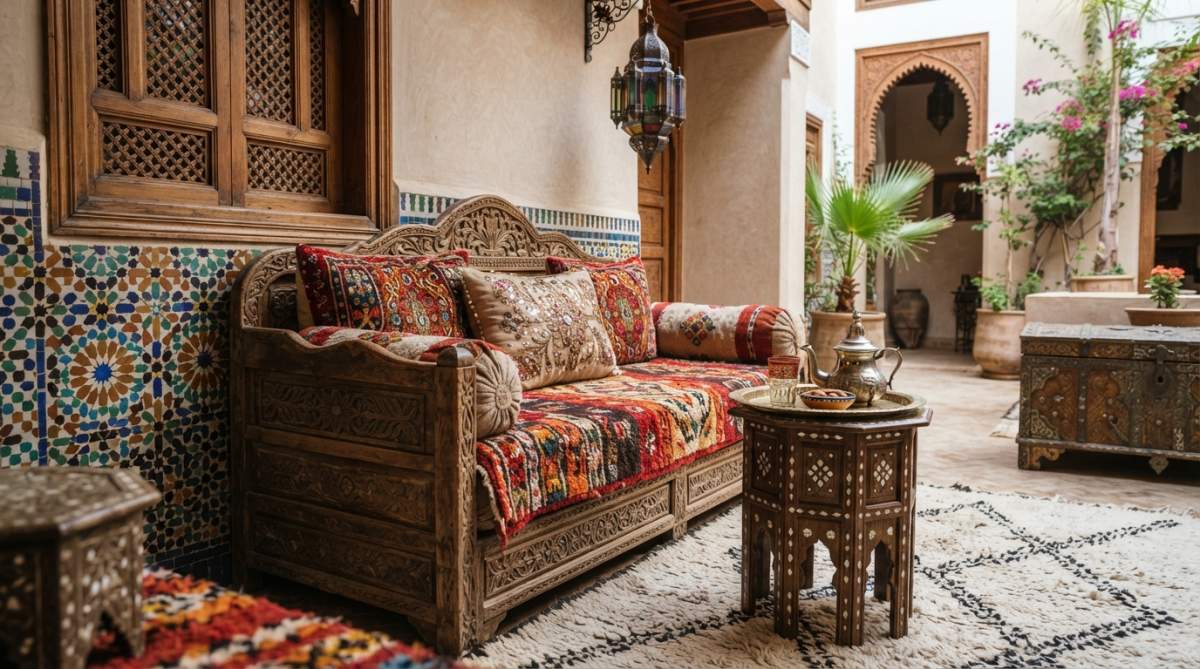
Authentic Moroccan décor carries cultural weight that mass-produced replicas cannot replicate. The geometric patterns, color palettes, and construction methods emerge from centuries of Moroccan artistic tradition. When you own handcrafted moroccan furniture, you own a piece of that cultural heritage.
Cultural Heritage and Artisan Workshops
Moroccan furniture traditions developed over centuries in the medinas and villages of Morocco. Specific regions became known for specific crafts: Fez for leather and metalwork, Marrakech for carved wood, Essaouira for thuya wood inlay. An apprentice spends years learning to see wood grain, sharpen tools, and execute joinery, knowledge that is embodied, not documented.
Mass-produced "Moroccan" furniture is designed in offices by people who may never have visited Morocco. The patterns are borrowed from photographs and construction methods are chosen for efficiency, not authenticity.
Unique Character and Geometric Patterns
Handcrafted Moroccan furniture showcases unique character that emerges from the interaction between artisan skill and material reality. Geometric patterns follow mathematical principles but are executed by hand, creating a paradox: patterns are precisely geometric in concept but naturally irregular in execution. Straight lines are nearly straight but not perfectly so. Repeating elements are similar but not identical.
Mass production creates geometrically perfect patterns that are mathematically identical across every piece, resulting in a sterile appearance lacking the visual warmth of human execution. Color variations in authentic pieces also signal handcrafted quality, wood stain applied by hand shows variation in absorption, and mother-of-pearl inlays vary in tone depending on which part of the shell they came from.
Handmade Furniture Benefits and Long-Term Value
Investing in handcrafted moroccan furniture delivers benefits extending beyond the initial purchase. These pieces appreciate in value and function better over time.
Customization and Bespoke Design
Handcrafted furniture allows true customization. You can commission a piece designed specifically for your space, aesthetic preferences, and functional needs. An artisan can adjust dimensions, modify colors, or incorporate personal design elements.
Justmorocco specializes in custom kitchen and bathroom remodeling projects that exemplify this advantage. Rather than selecting stock cabinetry, clients work with artisans to design pieces that integrate with their home's architecture and incorporate custom details, hand-carved doors, custom lighting, ceiling panels with intricate tilework, that transform functional spaces into luxurious sanctuaries.
Investment ROI and Resale Potential
Handcrafted moroccan furniture appreciates in value. A piece purchased for $3,000 might be worth $4,500-5,000 in ten years. Mass-produced furniture depreciates immediately, a $1,500 factory-made side table is worth $300-400 within a year.
Over 50 years, the handcrafted piece is significantly cheaper when considering total cost of ownership. A handcrafted piece costs more initially but lasts 50+ years and appreciates. A mass-produced piece costs less initially but requires replacement every 5-7 years and depreciates to near-zero value.
Identifying Fake Moroccan Rugs and Furniture: Authentication Checklist
Distinguishing authentic handcrafted moroccan furniture from mass-produced imitations requires knowing what to look for.
Visual and Tactile Authentication Markers
Examine the wood grain and finish. Handcrafted pieces show natural wood grain variation. Stain color varies across the surface based on wood density. Run your hand across carved details, handcrafted carving produces smooth, refined surfaces. Mass-produced CNC carving often leaves micro-splinters.
Check joinery closely. Open drawers and examine construction. Handcrafted drawers use dovetail or mortise-and-tenon joints. Mass-produced drawers use dowels, pocket-hole screws, or staples.
Examine inlays carefully. Mother-of-pearl inlays in handcrafted pieces are set into solid wood with mechanical anchoring plus adhesive. Tap gently on an inlay; it should feel solid and immobile. Mass-produced inlays are glued to veneer surfaces without mechanical anchoring and will eventually crack.
Assess overall weight and density. Handcrafted moroccan furniture uses solid wood throughout structural areas. A handmade cedar chest weighs 60-80 pounds. Mass-produced furniture uses veneer over particleboard and feels light and hollow.
Supply Chain Transparency and Sourcing
Legitimate handcrafted furniture sellers can trace pieces back to specific artisans or workshops. Ask sellers directly: "Who made this piece? Where was it made?" Legitimate sellers have detailed answers.
Justmorocco maintains direct relationships with artisan workshops across Morocco, allowing us to verify authenticity and ensure fair compensation for artisans. Request documentation. Authentic handcrafted pieces often come with information about the artisan, workshop, and materials. Verify material claims. Handcrafted Moroccan furniture uses specific materials: cedar, thuya wood, argan wood, bone, mother-of-pearl, and traditional leather.
Sustainable Furniture Choices: Environmental Impact
Handcrafted moroccan furniture and mass-produced alternatives have dramatically different environmental footprints.
Ethical Sourcing and Skilled Artisan Support
Handcrafted furniture supports artisan livelihoods. When you purchase a handmade piece, you're paying for skilled labor that sustains families and communities. Mass production externalizes labor costs, with factory workers earning a fraction of what handcrafted artisans earn.
Handcrafted moroccan furniture typically uses sustainably harvested local wood species. Artisans have incentives to source responsibly because their reputation depends on quality. Handcrafted pieces last 50+ years, reducing total environmental cost per year of use compared to mass-produced pieces replaced every 5 years.
Cost Analysis and Value Proposition
Why Handcrafted Moroccan Furniture Costs More
Skilled labor is expensive. A master artisan might earn $15-20 per hour. A piece requiring 60 hours of skilled labor costs $900-1,200 in labor alone. Add materials ($200-400), overhead, and profit, and the final price is $1,500-2,500 for a single piece.
Materials are often premium quality. Handcrafted furniture uses solid wood selected for grain, color, and stability. Mother-of-pearl inlays are sourced from sustainable shell suppliers.
Production is slow. An artisan produces 10-15 custom pieces monthly versus 500 identical factory pieces. Fixed costs are spread across fewer units.
Customization adds expense. Custom pieces require specific design work and material sourcing.
Quality control is rigorous. Handcrafted producers inspect each piece before shipping. Defective pieces are repaired or discarded, not sold at discount.
Mass production achieves low prices through scale, cheap labor, and material shortcuts.
Maintenance and Care Guide for Long-Term Durability
Handcrafted moroccan furniture requires basic maintenance to preserve its beauty and function.
Wood care: Dust regularly with a soft, dry cloth. Once or twice yearly, apply a wood conditioner appropriate to the finish type.
Mother-of-pearl inlays: Clean gently with a soft, slightly damp cloth. If an inlay cracks or separates, it can be repaired by an artisan.
Leather components: Condition leather annually with appropriate leather conditioner. Avoid direct sunlight.
Joints and hardware: Check joints periodically to ensure they remain tight.
A professional restoration of a 30-year-old handcrafted piece might cost $500-1,000, a small fraction of the original purchase price.
Handcrafted Moroccan Furniture: Making Your Decision
Choosing between handcrafted moroccan furniture vs mass produced ultimately depends on your priorities, timeline, and budget.
Comparison Table: Handcrafted vs Mass-Produced
| Criterion | Handcrafted | Mass-Produced |
|---|---|---|
| Initial Cost | $1,500-5,000+ per piece | $300-1,500 per piece |
| Material Quality | Solid wood, premium inlays | Veneer, particleboard, synthetic inlays |
| Joinery | Mortise-tenon, dovetails | Dowels, pocket holes, staples |
| Production Time | 4-12 weeks | Immediate (in stock) |
| Customization | Full, design to your specs | None, select from inventory |
| Lifespan | 50+ years with maintenance | 5-10 years typical |
| Repairability | Excellent, can be restored | Poor, usually replaced |
| Resale Value | Appreciates 20-40% over 10 years | Depreciates 70-90% within 1 year |
| Environmental Impact | Low per-year-of-use | High per-year-of-use |
| Artisan Support | Direct support to craftspeople | Minimal labor benefit |
Which Option Is Right for Your Home
Choose handcrafted moroccan furniture if:
You value longevity and are willing to invest upfront for a piece lasting decades. You want customization reflecting your specific aesthetic and functional needs. You appreciate the cultural and artistic significance of Moroccan craftsmanship. You view furniture as an investment that should appreciate over time. You want to support artisans and preserve traditional craft knowledge.
Choose mass-produced if:
Your budget is severely limited and you need furniture immediately. You anticipate moving frequently. You prioritize current trends over timeless design. You're furnishing a rental property or temporary space.
For most homeowners, handcrafted moroccan furniture represents better long-term value. The initial cost premium is recovered through longevity, appreciation, and reduced replacement expenses.
Justmorocco offers an exquisite collection of handcrafted Moroccan furniture and custom home remodeling services that bring the timeless beauty of Morocco into your living space. From vintage and newly handmade beds with mother-of-pearl accents to custom kitchen and bathroom projects featuring intricate tilework and hand-carved details, our pieces are designed to elevate your home with authentic, luxurious craftsmanship. We serve clients across California, Texas, New York, and Florida, providing direct access to artisan-made furniture that will remain beautiful and functional for generations. Explore our collection and discover how handcrafted Moroccan design can transform your home into a sophisticated sanctuary.
The choice between handcrafted moroccan furniture and mass-produced alternatives is ultimately a choice between temporary and permanent, between extractive and sustainable, between commodity and art. Handcrafted pieces carry the skill, vision, and cultural knowledge of the artisans who created them. They improve with age, appreciate in value, and connect you to centuries of Moroccan artistic tradition. For homeowners seeking to create lasting beauty and support authentic craftsmanship, handcrafted moroccan furniture represents an investment that pays dividends for decades.
Frequently Asked Questions
What are the main differences between handcrafted and mass-produced Moroccan furniture?
Handcrafted Moroccan furniture is made by skilled artisans using traditional joinery and hand-carved techniques, often with unique character and customization options. Mass-produced versions are factory-made with surface-level design elements, prioritizing affordability and consistency over artisanal quality. Handcrafted pieces feature material integrity through sustainable materials and ethical sourcing, while mass-produced items often use cheaper materials and assembly-line methods. Handcrafted furniture typically offers heirloom quality and longevity, while mass-produced pieces are considered fast furniture designed for short-term use.
How can you tell if Moroccan furniture is genuinely handmade and not a mass-produced replica?
Authentic handcrafted Moroccan furniture shows visible artisan marks, hand-finished surfaces, and slight variations in geometric patterns, these imperfections indicate human craftsmanship. Check for traditional joinery techniques, quality inlay work with real mother-of-pearl or bone, and hand-carved details. Mass-produced replicas often have uniform, perfect patterns, hollow construction, and surface-level decorative elements. Request documentation of the artisan or workshop origin, ask about supply chain transparency, and examine the wood grain and finish closely. Genuine pieces from Moroccan Medina artisans will have provenance and craftsmanship details the seller can verify.
Is handcrafted Moroccan furniture worth the higher price compared to mass-produced options?
Yes, handcrafted Moroccan furniture typically offers superior long-term value. While mass-produced pieces cost less upfront, handcrafted furniture provides heirloom quality that lasts decades with proper care, making the per-year cost lower. Handcrafted pieces appreciate in aesthetic warmth and character over time, while mass-produced items deteriorate quickly. Additionally, investment ROI is stronger with authentic artisanal pieces, they retain resale value and appeal to buyers seeking unique décor. Skilled labor, sustainable materials, and customization justify the premium. For custom kitchen or bathroom projects, handcrafted pieces integrate seamlessly with your specific layout and design vision, preventing costly replacements.
What maintenance and care do handcrafted Moroccan furniture pieces require?
Handcrafted Moroccan furniture with mother-of-pearl and bone inlays requires gentle cleaning with a soft, dry cloth, avoid excess moisture that can damage inlay work. For wooden pieces, use furniture polish suited to the wood type and apply sparingly every few months. Protect from direct sunlight, which can fade hand-finished surfaces and cause wood warping. In humid climates like Florida coastal areas, use a dehumidifier to prevent wood swelling and inlay separation. Avoid placing hot items directly on surfaces, and use coasters and pads. Annual professional inspection of joinery and inlay integrity helps catch damage early. Proper care extends heirloom potential and preserves the artisanal craftsmanship for generations.
Why should I choose handcrafted Moroccan furniture over competitors offering similar mass-produced styles?
Handcrafted Moroccan furniture from authentic artisan sources offers supply chain transparency, ethical sourcing that supports skilled labor communities, and bespoke customization impossible with factory-made items. Artisanal pieces feature cultural heritage and traditional techniques passed down through generations, delivering aesthetic warmth and unique character that mass-produced replicas cannot replicate. You're investing in heirloom quality with documented craftsmanship, not surface-level design. Custom cabinetry and remodeling services ensure pieces fit your specific layout and architectural plans perfectly. Handcrafted furniture provides longevity and investment ROI, while supporting artisan workshops directly rather than factory production systems.