

Table of Contents
- Why Coastal Climates Test Moroccan Furniture Durability
- Specific Moroccan Wood Species and Their Coastal Performance
- Best Wood Finishes for Coastal Furniture
- Protecting Mosaic Tile from Humidity and Salt Spray
- Maintaining Outdoor Furniture in Salt Air: A Seasonal Schedule
- How Metalwork and Mother-of-Pearl Inlays Handle Coastal Conditions
- Signs of Corrosion and Weather Damage to Watch For
- Comparing Material Durability: Teak vs. Aluminum vs. Synthetic Resin
- Conclusion: Investing in Climate-Resilient Moroccan Furniture
- Frequently Asked Questions
Last Updated: September 15, 2026
Why Coastal Climates Test Moroccan Furniture Durability
Salt air, humidity, and intense sun exposure make coastal climates one of the harshest environments for any furniture, and Moroccan furniture durability in coastal climates depends on understanding how these three forces interact. Solid wood, properly sealed metalwork, and glazed tile survive salt air for decades, while untreated pieces show wear within a few seasons.
Moroccan furniture durability in coastal climates is the measure of how well handcrafted wood, metal, and tile components resist saltwater corrosion, UV degradation, and moisture absorption over time. The good news is that traditional Moroccan craftsmanship, built for hot, dry conditions, adapts well to coastal living when the right protective finishes are applied.
The core problem is that coastal air carries dissolved salt. Salt particles settle on surfaces, draw moisture from the air, and accelerate the weathering process on any material that isn't sealed against it. Add humidity levels that rarely drop below 60% in many coastal areas, and you have conditions that punish anything porous.
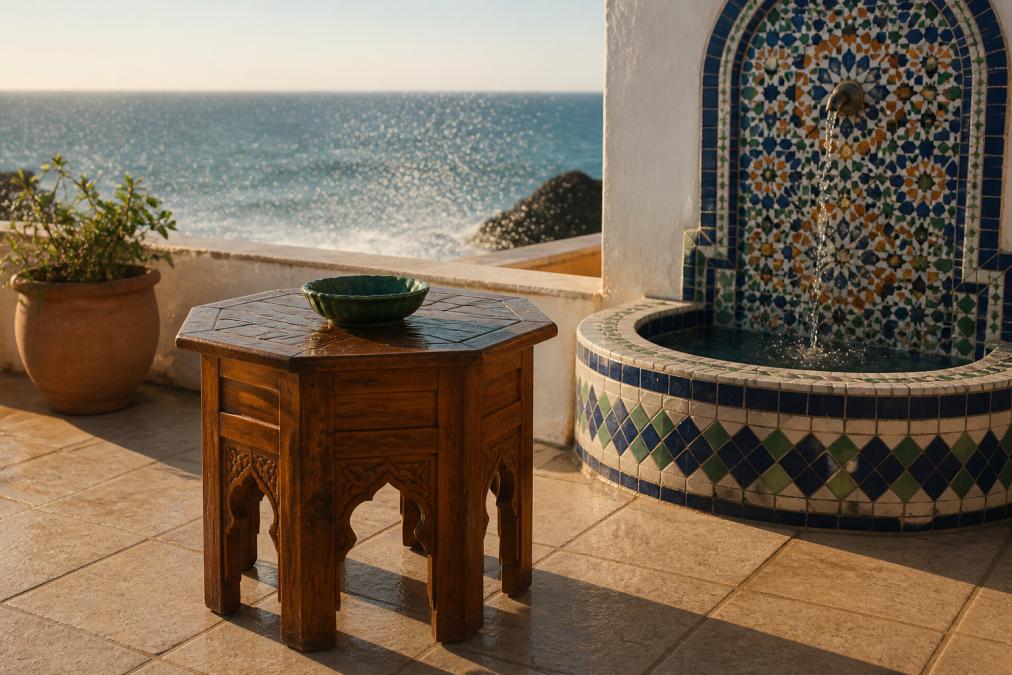
Here's what most guides get wrong: they treat all wood the same. It isn't. Material density and natural oil content vary enormously between species, and that difference decides whether a piece lasts five years or fifty on a salt-exposed porch.
Specific Moroccan Wood Species and Their Coastal Performance
The woods used in authentic Moroccan furniture fall into three practical tiers for coastal use, and knowing which tier you're buying matters more than any marketing claim. Most coastal guides stop at teak and aluminum; the species below are where Moroccan pieces actually live or die.
Atlas cedar (Cedrus atlantica) sits at the top for structural pieces. It is a softwood by botanical classification but behaves like a durable one: moderate density, high natural resin and oil content, and a pronounced cedar scent that comes from those same oils. The oil content is the mechanism that matters near the water, because it slows the rate at which the wood takes on and releases moisture. Cedar has been used in Moroccan doors, ceiling coffers, and chests for centuries for exactly this reason. On a covered coastal porch, a well-sealed cedar piece commonly holds up for decades; fully exposed to wind-driven spray, expect to refinish it more often than you would teak.
Thuya (Tetraclinis articulata) is the denser, more prized option, grown in the Atlas region and valued for its burled, swirling grain. Thuya is an aromatic softwood as well, but its density and oil content are higher than cedar's, and it takes a penetrating sealant deeply. It is also the species most often faked, so buy from a maker who can tell you the source. Thuya is typically reserved for smaller statement pieces, boxes, and inlay work rather than large outdoor tables, partly because the burl is scarce and expensive and partly because the grain figure is the point.
Walnut and mahogany form the middle tier. Both are hardwoods with good dimensional stability, they carve cleanly, and they perform well indoors or on a covered porch. Left fully exposed to salt spray, they need more frequent refinishing than cedar and are more prone to surface checking as they cycle between wet and dry.
Painted or soft woods used in some decorative and budget pieces are the most vulnerable. Paint hides the species, and once it cracks, moisture gets in and stays in. These are fine for interior coastal rooms but should not live on an open deck.
A few identification and sourcing notes that most guides skip:
- Smell is a real test. Genuine cedar and thuya carry a distinct resinous scent when cut or sanded. If a piece smells like nothing, be suspicious.
- Ask for the species by name, not the region. "Moroccan wood" is not a species. "Atlas cedar" and "thuya" are.
- Weight is a weak proxy. A thick softwood table can outweigh a slim cedar one. Density and oil content, not heft, drive coastal performance.
- Compare against the benchmark. Teak is the coastal standard because of its natural oils; cedar and thuya are the closest Moroccan equivalents, which is why they belong in the same conversation rather than being treated as decorative-only.
The practical takeaway: for exposed coastal positions, prioritize cedar or thuya and confirm the species in writing. For covered porches, walnut and mahogany are reasonable. For anything painted or unlabeled, assume the lowest tier and place it indoors.
Best Wood Finishes for Coastal Furniture
Choosing the best wood finishes for coastal furniture comes down to one requirement: the finish must block moisture without trapping it. Oil-based finishes penetrate the wood and let it breathe, while film-forming finishes sit on top and can trap water underneath if they crack.
For coastal pieces, a penetrating teak oil or a marine-grade tung oil blend is the safer default. These finishes feed the wood, maintain its natural flexibility, and can be reapplied without stripping the surface. A protective sealant with UV inhibitors adds another layer of defense against sun damage, which bleaches and dries unprotected wood faster near the water.
What most guides miss is that over-sealing causes as many problems as under-sealing. A thick polyurethane coat on a piece that expands and contracts with humidity will eventually crack, and once water gets under it, the damage spreads. Breathable oils fail more gracefully.
Protecting Mosaic Tile from Humidity and Salt Spray
Protecting mosaic tile from humidity and salt spray starts with the grout, not the tile. Glazed zellige tiles themselves are fired clay with a glass-like surface, so they shed water and resist salt reasonably well. The weak point is the space between them.
Sealing the grout with a penetrating stone and tile sealer closes the pores that would otherwise wick moisture inward. On outdoor fountains, tables, and wall panels, this single step does more for longevity than any surface treatment on the tile face.
Salt spray leaves a residue that, left alone, etches grout over time. A monthly rinse with fresh water removes the buildup before it can bond. Avoid acidic cleaners, which dull glaze and degrade grout; mild soap and water handle almost everything.
Maintaining Outdoor Furniture in Salt Air: A Seasonal Schedule
Maintaining outdoor furniture in salt air works best on a seasonal rhythm rather than a reactionary one. The table below lays out a practical schedule you can adapt to your exposure level.
| Season | Task | Frequency | Why It Matters |
|---|---|---|---|
| Spring | Inspect joints, reapply oil finish | Once | Repairs winter moisture damage before summer sun |
| Summer | Rinse salt residue, check metal fittings | Every 2-4 weeks | Removes salt before it bonds to surfaces |
| Fall | Seal grout, tighten hardware | Once | Preps pieces for wetter, cooler months |
| Winter | Cover or move under shelter | Once | Reduces direct exposure to wind-driven salt |
Pieces under a covered porch or an overhang need roughly half this attention. Fully exposed pieces near the water need the full routine. The single biggest mistake is skipping the spring inspection, because small joint failures caught early cost nothing to fix and cost plenty once water has been sitting in them all winter.
How Metalwork and Mother-of-Pearl Inlays Handle Coastal Conditions
Metalwork and inlay are where coastal conditions separate well-made Moroccan furniture from the rest, and they are also the two components generic coastal guides never address. Understanding the mechanism behind each failure is what lets you prevent it.
Ferrous metal (iron and steel). Iron and steel fittings are common in traditional piecework, and in salt air they corrode through an electrochemical process: chloride ions from salt spray break down the passive oxide layer that would otherwise protect the metal, and moisture carries the reaction deeper. Rust on a hinge or a decorative strap is not cosmetic, because the corrosion product expands and can split the wood around it. The fix is a barrier finish: powder coating, a proper lacquer, or a rust-inhibiting primer topped with paint. Bare or thinly finished iron should not be specified for exposed coastal positions.
Brass and bronze. These are the better coastal choices because they oxidize into a stable, adherent patina rather than flaking away. The greenish film that forms on brass and bronze is a protective carbonate layer, not active corrosion, and it slows further attack. Many Moroccan pieces use brass studs, handles, and trim precisely because the material ages gracefully. The trade-off is appearance: if you want the bright gold look, you will be polishing, and polishing removes the protective layer each time.
Mother-of-pearl and bone inlay. The inlay material itself is mineral or keratin and is fairly stable. The failure point is the interface: inlay, adhesive, and surrounding wood absorb and release moisture at different rates. As humidity swings, the wood moves more than the inlay does, and the adhesive bond is stressed at every cycle. On a covered porch with stable humidity, this is rarely an issue. On an open, salt-exposed deck, the constant wet-dry cycling eventually works individual pieces loose. This is a slow mechanical failure, not a chemical one, which is why it shows up as lifting edges rather than discoloration.
Practical placement rules that follow from the mechanisms above:
- Fully exposed positions: plain solid wood, sealed metal, or tile only. No inlay, no bare iron.
- Covered porch or overhang: inlaid pieces are safe here, and brass trim will patina rather than corrode.
- Interior coastal rooms: everything is fine; the concern is only salt spray and direct rain.
- Fountains and wet zones: specify brass or bronze fittings, never bare steel.
This placement decision, more than any single finish, determines whether an inlaid or metal-trimmed piece becomes an heirloom or a repair project. Match the component to the exposure, and the piece will outlast the deck it sits on.
Signs of Corrosion and Weather Damage to Watch For
Catching damage early keeps small issues from becoming structural ones. Walk your pieces once a season and look for these specific signals:
- White or chalky residue on metal: early oxidization, treat before it pits
- Rust streaks at joints: water is pooling where fittings meet wood
- Cracked or lifting finish: moisture is trapped under the film
- Gray, dry wood surface: lost oil content, needs refinishing
- Loose inlay or tile: adhesive failure from humidity cycling
- Soft spots in wood: advanced moisture damage, act immediately
Most of these are reversible if you catch them in the first season. Once wood goes soft, the structural integrity is compromised and repair options narrow sharply.
Comparing Material Durability: Teak vs. Aluminum vs. Synthetic Resin
The honest comparison isn't which material is "best" in the abstract; it's which one fits how you actually use the space. Here's how the three most common coastal patio materials stack up against handcrafted wood.
| Material | Coastal Durability | Maintenance | Best For | Trade-off |
|---|---|---|---|---|
| Teak | Excellent | Oil annually | Open, sun-exposed decks | Higher upfront cost |
| Powder-coated aluminum | Very good | Rinse occasionally | Low-maintenance patios | Less warmth, lighter feel |
| Synthetic resin | Good | Soap and water | Budget, casual seating | Can fade and crack over years |
| Handcrafted Moroccan wood | Excellent when sealed | Oil 2-4 times yearly | Covered porches, statement pieces | Needs consistent care |
Powder-coated aluminum is the lowest-effort option and holds up well against saltwater corrosion, which is why it dominates generic coastal guides. Teak is the traditional champion, and its natural oils make it genuinely low-maintenance compared with most woods. Synthetic resin is the budget pick, and it shows: UV degradation eventually dulls the color and makes the material brittle.
Where handcrafted wood wins is character. No aluminum frame will ever look like a hand-carved cedar door or a mother-of-pearl console. The trade-off is that you're signing up for a maintenance routine, and if you won't do it, buy the aluminum.
Conclusion: Investing in Climate-Resilient Moroccan Furniture
Coastal living doesn't have to mean settling for generic patio furniture. Handcrafted pieces built from dense, resinous woods and finished with breathable oils hold up remarkably well when they're placed and cared for correctly.
Justmorocco specializes in exactly this kind of piece, from custom cabinetry and mother-of-pearl inlays to mosaic tile fountains and hand-carved doors, shipped directly to coastal homes. Our team works with you on material selection and finish choices suited to your climate and exposure, and our custom furniture imports service handles the details from design through delivery.
If you want furniture that survives salt air and still looks like a piece of art, start with the right materials and the right finish. Get started with Justmorocco and bring authentic Moroccan craftsmanship into your coastal home.
Frequently Asked Questions
Does salt air damage handcrafted wood furniture?
Salt air accelerates moisture absorption and oxidization in untreated wood, leading to warping, cracking, and surface degradation. However, dense hardwoods with high oil content, such as those used in authentic Moroccan furniture, resist salt air better than softer woods. A protective sealant and regular maintenance routine can extend outdoor longevity significantly. Without proper care, even durable woods will show weathering within a few seasons.
How do you protect mosaic tile fountains from salt spray?
Apply a penetrating stone and tile sealant every 6 to 12 months to reduce moisture absorption and protect grout lines. Rinse the fountain with fresh water weekly to remove salt buildup, and dry with a soft cloth. Avoid acidic cleaners that erode tile glaze. For coastal installations, consider a marine-grade sealant designed for salt spray exposure. These steps preserve both the structural integrity and the decorative finish of the tilework.
How often should Moroccan wood furniture be sealed in coastal areas?
In coastal climates, seal Moroccan wood furniture every 3 to 6 months. High humidity levels and salt air break down protective coatings faster than inland conditions. Look for water beading on the surface; when it stops, it's time to reseal. Use a UV-resistant, breathable sealant or teak oil. Pieces under covered patios may need sealing less often, while fully exposed outdoor dining sets require the most frequent attention.
Can authentic Moroccan metalwork withstand high humidity?
Authentic Moroccan metalwork, including brass, iron, and nickel silver, can withstand high humidity if properly finished. Powder-coated aluminum and rust-proof treatments prevent oxidization. Unprotected iron will rust in salt air, so look for pieces with a lacquer or enamel coating. Clean metalwork monthly with a dry cloth and apply a thin layer of wax to brass and copper. With routine care, metal accents maintain their appearance for years.