

Table of Contents
- The Scent and Touch Test for Leather
- Identifying Hand-Carved Wood Details
- Distinguishing Synthetic vs. Natural Materials
- Recognizing Traditional Berber Patterns
- The Role of Mother-of-Pearl Inlay
- Signs of Mass-Produced Imitations
- Understanding Camel Bone vs. Plastic
- The Importance of Imperfections in Handmade Goods
- Chemical and Material Testing
- Geographic Origin Verification
- Frequently Asked Questions
Last Updated: September 10, 2026
The Scent and Touch Test for Leather
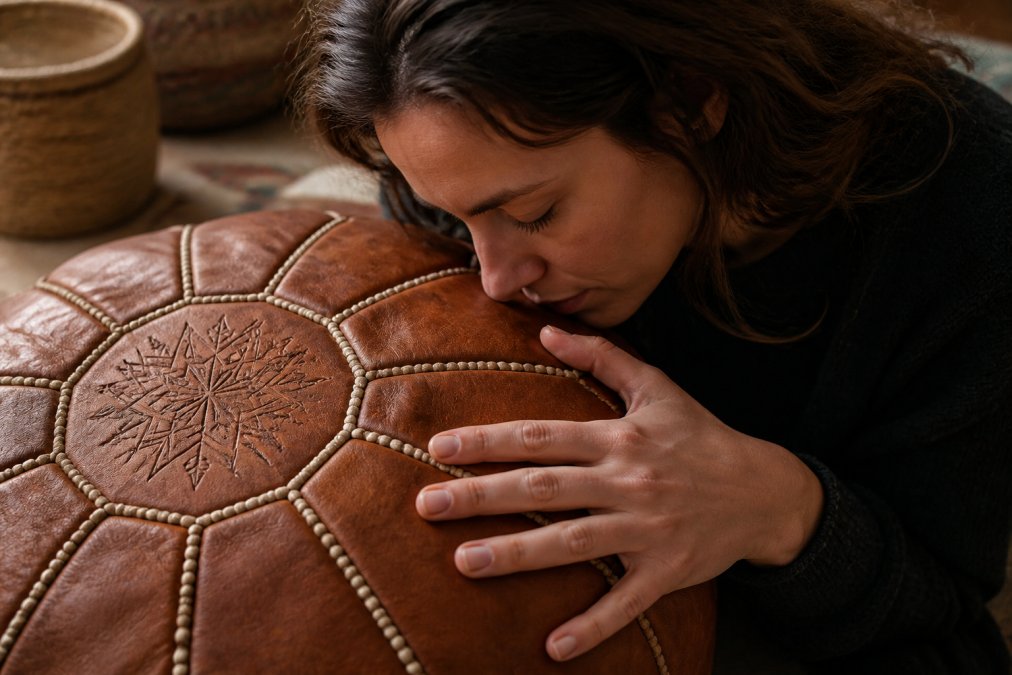
Genuine Moroccan leather smells like earth and tannin, never like plastic or glue. Press your thumb into the surface and watch what happens: real leather wrinkles softly and springs back, while synthetic faux leather stays rigid or creases sharply.
That single test eliminates most imitations before you look at anything else, which is why it is the first step in evaluating authentic Moroccan furniture. The leather tanning methods overview from the American Leather Chemists Association explains why vegetable-tanned hides behave so differently from chrome-tanned or synthetic ones.
Run your fingers along the edge of a leather pouf or bench. Hand-stitched seams show slightly uneven spacing because an artisan worked them by hand, not a machine. Feel for warmth: leather absorbs body heat within seconds, while vinyl stays cool. Flip the piece over and check the underside, where authentic makers rarely hide their work.
Identifying Hand-Carved Wood Details
Hand-carved wood reveals itself in the tool marks. Look at the recessed areas of a cedar panel or table leg and you will see faint chisel gouges, slight variations in depth, and edges that taper unevenly. Machine-carved reproductions produce identical cuts repeated across every inch.
Wood grain tells the second half of the story. Authentic pieces use solid cedar or walnut, so the grain runs continuously through the carving. Run your fingernail across a groove: solid wood feels dense and slightly irregular, while resin or composite imitations feel uniformly smooth and hollow when tapped.
A common mistake is judging carving quality by how ornate it looks. Mass producers replicate intricate patterns precisely because precision is cheap for a machine. The giveaway is repetition. Count the leaves in a border or the petals in a rosette. If every unit is pixel-identical, it was cut by a router, not a craftsman.
Distinguishing Synthetic vs. Natural Materials
Synthetic materials betray themselves through weight, temperature, and smell, but the order in which you run those tests matters. Work from least invasive to most invasive so you never damage a piece you are still evaluating.
Step one: the lift test. Pick the piece up. Solid cedar, walnut, and camel bone feel dense and slightly cold for their size. Resin, polyresin, and molded plastic feel light and hollow. A hand-carved cedar side table of average size will feel noticeably heavier than a resin replica of the same dimensions. If the piece feels light but looks heavy, that mismatch is your first red flag.
Step two: the temperature hold. Press your palm flat against an unfinished or low-traffic area for five seconds. Wood and stone pull heat from your hand slowly and stay cool. Plastic and resin warm up almost immediately because they have low thermal mass and insulate rather than conduct. This test is most reliable on thick sections like table legs and chair frames, not thin veneers.
Step three: the fingernail scratch. Choose an inconspicuous spot, ideally underneath or on the back edge. Drag your fingernail across the grain or surface:
- Solid wood leaves a fibrous, slightly rough mark that follows the grain direction.
- Camel bone leaves a chalky white line that powders slightly.
- Plastic and resin leave a waxy curl or a smooth smear with no texture.
- Veneer over particleboard may scratch through to a different color underneath, which tells you the surface is a skin, not the material itself.
Step four: the join inspection. Turn the piece over or open a door. Artisans building authentic Moroccan furniture use mortise-and-tenon joints, wooden dowels, or hand-cut dovetails. Mass producers rely on staples, Phillips-head screws, and glue blocks. Uniform staple spacing every few inches is a factory signature. So is hardware that matches a standard metric or imperial screw size rather than a hand-forged fitting.
| Material | Weight | Temperature | Scratch Test | Join Style |
|---|---|---|---|---|
| Solid cedar | Heavy, dense | Stays cool | Fibrous mark | Mortise-and-tenon, dowels |
| Resin composite | Light | Warms quickly | Waxy curl | Molded, glued |
| Camel bone | Dense, solid | Cool | Chalky white line | Hand-set, pinned |
| Plastic imitation | Very light | Warm | Smooth smear | Snap-fit, screws |
| Veneer over MDF | Medium | Cool surface, warm core | Cuts through to substrate | Staples, glue |
Step five: the smell check. Cedar, walnut, and bone have distinct, faint, natural odors when you scratch or warm them. Resin and plastic smell chemical or neutral. This is a supporting test, not a primary one, because finishes and storage can mask natural smells.
A common pattern buyers miss is the mixed-material piece: a genuine cedar frame with a resin inlay, or a real bone handle on a plastic body. Test each component separately rather than judging the whole piece by one part. If the frame passes but the inlay fails, you are looking at a hybrid built to hit a price point, not an authentic piece.
Recognizing Traditional Berber Patterns
Berber patterns follow a visual grammar that mass producers rarely understand. Authentic hand-woven and hand-knotted textiles use geometric motifs, diamonds, zigzags, and cross shapes, arranged with deliberate asymmetry. Each symbol traditionally carried meaning tied to protection, fertility, or tribal identity.
Look for irregularities in the weave. A genuine hand-knotted rug or hand-woven textile shows slight variations in knot density and dye saturation. Vegetable-dyed wool shifts subtly in tone across the surface, because natural dyes never produce perfectly uniform color. Synthetic dyes applied in a factory produce flat, even color across the entire piece.
The pattern should also make structural sense. Traditional Berber designs build outward from a central motif, with borders that frame rather than merely decorate. If the pattern looks like it was printed onto the surface rather than woven into it, check the reverse side. Hand-woven pieces show the pattern's negative image on the back.
The Role of Mother-of-Pearl Inlay
Mother-of-pearl inlay is one of the hardest elements to fake convincingly. Genuine inlay uses real shell cut into thin pieces and set into recessed wood or bone, then sanded flush with the surface. Run your fingertip across the transition between shell and surrounding material. On authentic pieces, the joint feels smooth and continuous.
Fake inlay is usually printed, painted, or applied as a veneer. Look at the shell under angled light. Real mother-of-pearl shifts color as you move, showing iridescent blues, pinks, and greens. Printed imitations look flat and static from every angle.
Check the edges of each inlay piece. Hand-cut shell has slightly irregular outlines that follow the natural contours of the material. Laser-cut or molded imitations have perfectly uniform edges. The Smithsonian's conservation guidance on shell and inlay materials notes that authentic shell inlay also feels cooler and denser than resin substitutes.
Signs of Mass-Produced Imitations
Mass-produced imitations share a set of tells once you know where to look. Identical units are the first clue: if a retailer has twenty of the same "one-of-a-kind" table, none of them are one of a kind. Authentic artisanal work varies slightly from piece to piece.
Hardware is the second clue. Handmade Moroccan furniture uses hand-forged iron, brass, or leather fittings. Factory pieces use standardized screws, plastic caps, and powder-coated metal. Look at hinges, handles, and corner brackets.
Finishing is the third. Artisans hand-finish surfaces with oil, wax, or shellac, leaving subtle brush or cloth marks and a soft sheen. Mass producers spray a uniform polyurethane coat that looks glossy and feels slick. Flip the piece over: if the underside is unfinished particleboard or MDF, the top is decoration, not craftsmanship.
- Identical units sold as "unique"
- Standardized screws and plastic hardware
- Sprayed, uniform glossy finish
- Particleboard or MDF undersides
- Printed patterns instead of woven or carved ones
Understanding Camel Bone vs. Plastic
Camel bone and plastic look similar in photographs but feel completely different in person. Real camel bone is dense, slightly porous, and cool to the touch. Plastic imitations are lighter, warmer, and feel slick rather than smooth.
Look at the surface under bright light. Bone shows fine, irregular lines and small dark flecks where blood vessels once ran. Plastic is uniformly opaque or, if molded to imitate bone, shows repeating patterns that look too regular. The U.S. Fish and Wildlife Service guidance on legal bone and ivory materials is a useful reference for understanding which animal materials are legal to trade and how to tell them apart.
Tap the piece gently. Bone gives a sharp, almost ceramic click. Plastic gives a dull thud. On inlaid tables and chairs, check where the bone meets the wood: hand-cut bone pieces sit at slightly different depths and angles, while molded plastic inserts are perfectly uniform.
The Importance of Imperfections in Handmade Goods
Imperfections are the signature of handmade work, not a defect. A slight wobble in a hand-carved leg, a small variation in dye across a hand-woven textile, a barely visible seam where two pieces of leather meet: these are evidence of a human hand.
Mass-produced furniture is engineered for uniformity, which is exactly why it looks sterile next to artisanal work. When you evaluate a piece, ask whether the irregularities look intentional and structural or sloppy and accidental. A hand-carved cedar panel with subtle depth variation is craftsmanship. A panel with a gouge that cuts through the grain is damage.
What most guides miss is that buyers often reject the very features that prove authenticity. If you want a piece that looks like it came off a factory line, you do not want handmade furniture. If you want a piece with cultural heritage and patina, learn to read the imperfections as a signature.
Chemical and Material Testing
Chemical and material testing gives you objective answers when visual inspection is not enough. A few simple tests, done carefully on inconspicuous areas, can confirm or rule out natural materials.
For wood, apply a drop of water to an unfinished spot. Solid wood absorbs slowly and darkens the grain; sealed composite beads up immediately. For leather, a tiny dab of water on the surface will soak into genuine hide but sit on top of vinyl. For metal hardware, a magnet will stick to iron and steel but not to brass or copper.
For deeper verification, independent labs can run material analysis, but that is rarely practical for a single purchase. A more useful approach is to ask the seller for provenance documentation: origin records, artisan names, and material sourcing. A seller who cannot answer basic questions about where a piece was made and by whom is telling you something.
Geographic Origin Verification
Geographic origin verification separates pieces actually made in Morocco from those assembled elsewhere and labeled 'Moroccan style.' Most guides stop at 'ask for documentation.' The useful skill is knowing which questions produce verifiable answers and which produce marketing language.
Start with the paperwork, not the story. For any piece described as imported, ask for the country-of-origin marking required on imports into the United States. U.S. Customs and Border Protection requires most imported articles to be marked with their country of origin in a conspicuous place. A seller who cannot point to that marking, or who says the marking is 'on the packaging only,' is giving you a reason to slow down. The U.S. Customs and Border Protection guidance on country-of-origin marking explains what that marking is supposed to look like.
Then ask region-specific questions. Generic answers signal a generic supply chain. Specific answers signal a real one. Compare these pairs:
- Weak answer: 'It's from Morocco.' Strong answer: 'The cedar is carved in a workshop in Fez; the zellige tile is cut in the same medina.'
- Weak answer: 'Berber style.' Strong answer: 'This is a Beni Ourain-style weave from the Middle Atlas, knotted in wool, not a flat-weave imitation.'
- Weak answer: 'Handmade by artisans.' Strong answer: 'The artisan's name is on the workshop receipt; here is the workshop contact.'
Match the technique to the region. Different regions produce distinctive methods, and a piece that claims one origin but shows another region's technique is suspect:
- Fez: intricate zellige tilework, hand-carved cedar panels, and fine bone inlay. Look for tight, geometric tile fits and deep, tapered chisel marks.
- Marrakesh: leather goods, inlaid bone and mother-of-pearl furniture, and painted wood. Look for hand-stitched leather seams and shell set flush into wood.
- Atlas Mountain communities: hand-woven and hand-knotted wool textiles. Look for irregular knot density and vegetable-dyed color variation.
- Essaouira and coastal workshops: thuya wood marquetry and inlay. Look for the distinctive burl grain and citrus-wood inlay lines.
Check consistency across the seller's inventory. A genuine importer will have coherent sourcing stories, matching finishes, and pieces that reflect real regional traditions. A reseller buying from wholesale catalogs will have pieces that look unrelated to any specific place, with finishes that do not match and origin claims that change depending on which item you ask about. Ask the same origin question about three different pieces and see whether the answers hold together.
Look for the paperwork trail, not just the label. Provenance documentation can include workshop receipts, artisan names, export records, and, for some imports, customs entry summaries. You do not need all of these for every purchase, but a seller who can produce at least one verifiable document is a different category of seller than one who can only produce a story.
The unique angle most guides miss: origin verification is a supply-chain interview, not a visual test. The piece in front of you can look perfect and still be a factory product with a regional story attached. The only way to separate the two is to ask questions that have checkable answers and to notice when the answers stay vague. Justmorocco works directly with artisans and can trace each piece back to its workshop, which is why our U.S. Customs and Border Protection guidance on country-of-origin marking documentation is available for every import. If you would rather skip the guesswork entirely, our custom furniture imports service sources pieces directly from Moroccan workshops, so every item arrives with its provenance intact.
Frequently Asked Questions
How can you tell if a piece of Moroccan furniture is handmade?
Look for slight variations in carving depth, tool marks, and asymmetrical details that indicate handwork. Authentic pieces often have imperfections like uneven dye lots or minor chips in inlay. Check for signatures or stamps from artisans. Mass-produced items are uniform and lack these organic traits. For example, a hand-carved cedar table will show distinct chisel marks, while a factory-made one is perfectly smooth.
What materials are commonly used in traditional Moroccan furniture?
Traditional Moroccan furniture uses cedar, walnut, and thuya wood, along with camel bone, mother-of-pearl, and leather. Wool and silk are common in textiles. Vegetable-dyed leather and hand-woven fabrics are hallmarks of authenticity. Synthetic materials like plastic or resin are used in imitations. For instance, genuine camel bone has a porous texture, while plastic feels smooth and uniform.
Why does authentic Moroccan furniture cost more than mass-produced alternatives?
Authentic pieces are handcrafted by skilled artisans using traditional techniques, which takes time and commands higher labor costs. Materials like camel bone and mother-of-pearl are expensive and often sourced ethically. Mass-produced items use cheap synthetic materials and machine processes. For example, a hand-carved bone table from Justmorocco costs $13,500, reflecting hundreds of hours of work, while a factory-made replica might sell for a fraction.
How do I distinguish between vintage and reproduction Moroccan furniture?
Vintage pieces show patina, wear on high-touch areas, and aged wood grain. Reproduction items may have artificially distressed finishes but lack consistent wear patterns. Check joinery: vintage often uses hand-cut dovetails or mortise-and-tenon, while reproductions use screws or staples. Also, vintage hardware may be tarnished or replaced. For example, an antique bench will have softened edges from years of use, unlike a new replica.