
Table of Contents
- How to Verify Authentic Moroccan Furniture: Key Inspection Points
- Understanding Moroccan Craftsmanship and Artisan Techniques
- Moroccan Furniture Materials: What Quality Looks Like
- Moroccan Leather Authenticity: Chemical and Sensory Tests
- Buying Moroccan Furniture Tips: Provenance and Documentation
- Vetting Moroccan Furniture Retailers and Dealers
- Common Mistakes When Verifying Moroccan Furniture Authenticity
- Conclusion
Verify Authentic Moroccan Furniture: A 2026 Buyer's Guide
Last Updated: July 27, 2026
How to verify authentic moroccan furniture has become essential knowledge for American homeowners investing in high-end décor. The market for Moroccan home furnishings has grown substantially, but so has the flood of mass-produced imitations designed to look handcrafted. At Justmorocco, we've spent years sourcing and authenticating genuine pieces. This guide breaks down the precise inspection methods, material markers, and sourcing verification techniques that separate authentic Moroccan craftsmanship from expensive fakes.
How to Verify Authentic Moroccan Furniture: Key Inspection Points
The scent and touch test separates genuine Moroccan leather and textiles from synthetic imitations within seconds. Real leather tanned with vegetable dyes produces a distinctive earthy, slightly spiced aroma that synthetic materials cannot replicate. Run your fingers across the surface: authentic hand-tooled leather feels slightly irregular, with subtle variations in texture that indicate artisan handiwork rather than uniform machine pressing.
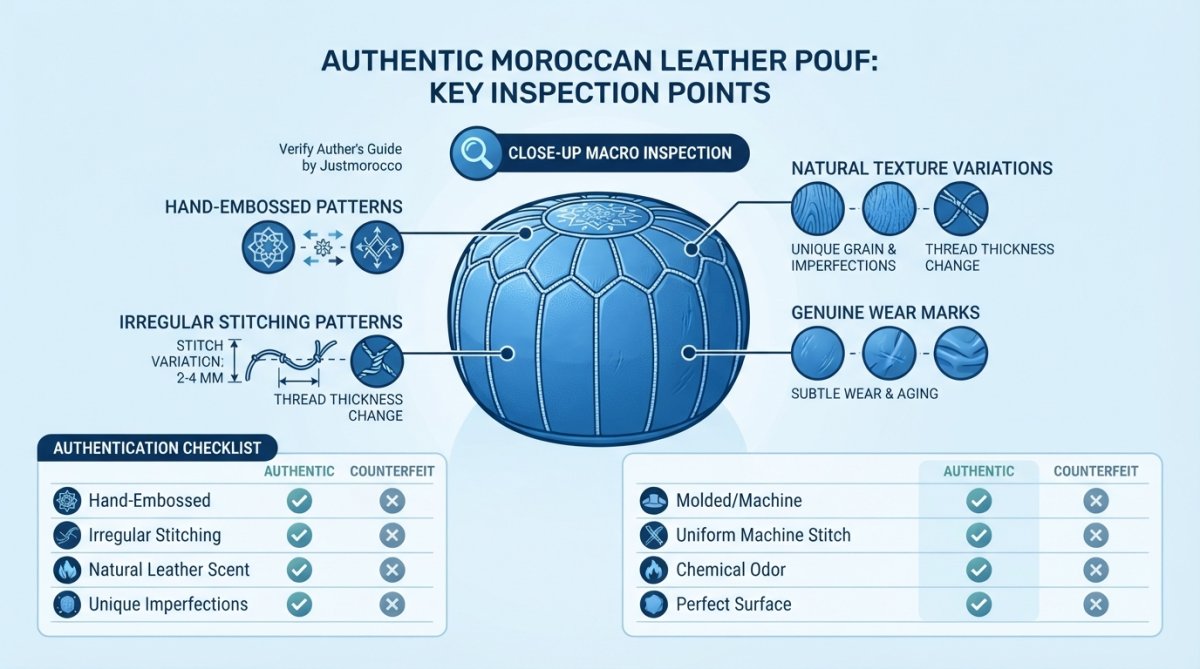
Genuine Moroccan pieces display visible irregularities that mass production eliminates. Hand-embossed patterns show depth variation because human hands cannot apply uniform pressure. When you run your thumb across authentic bone inlay work, you'll feel slight gaps between the bone and surrounding wood, a result of traditional hand-setting techniques. Machine-produced imitations sand everything smooth and level, creating an unnaturally perfect surface.
Stitching patterns reveal authenticity immediately. Examine seams on leather poufs, cushions, and upholstered pieces with a magnifying glass. Authentic hand-stitching shows:
- Slightly uneven stitch spacing (typically 4-8mm apart, but varying)
- Thread color that fades naturally over time
- Occasional double-stitches where artisans corrected their work
- Knots visible at seam ends rather than hidden industrial finishing
Machine-stitched pieces maintain perfect 3mm spacing throughout, use uniform thread colors, and hide all knots beneath finished edges.
Understanding Moroccan Craftsmanship and Artisan Techniques
Moroccan craftsmanship traditions span centuries, with specific techniques passed through family workshops in cities like Fes, Marrakech, and Essaouira. Understanding these methods helps you recognize when a piece truly reflects this heritage versus when manufacturers simply apply Moroccan aesthetics to mass-produced goods.
Hand-embossed patterns require artisans to press metal stamps into leather by hand, one strike at a time. This technique creates slight variations in depth and pressure that define authentic work. A skilled embosser completes perhaps 20-30 pieces per week, spending 2-4 hours per item on pattern work alone. Machine-printed patterns apply designs through heat transfer or screen printing, processes that cost pennies per unit and take minutes.
An authentic Moroccan bed frame shows hand-carved wood with grain variations visible in the carving depth, irregular spacing between carved elements, natural wood color variations, visible tool marks from chisels and hand planes, and joints that fit tightly but show signs of manual adjustment. A mass-produced bed frame displays CNC-carved wood with identical spacing and depth, uniform wood color from stained surfaces, perfectly smooth carving edges, and joints that fit too perfectly.
Moroccan Furniture Materials: What Quality Looks Like
Natural leather and vegetable dyes represent the foundation of authentic Moroccan furniture. Vegetable tanning uses tannins from tree bark, a process that takes 4-6 weeks compared to chemical tanning's 24 hours. The result is leather that develops rich patina over time.
Examine leather color closely. Vegetable-tanned leather displays natural color variation reflecting the tanning process's inherent inconsistency. Chemical-tanned leather shows uniform color because synthetic tannins distribute evenly. Authentic pieces often display a slight sheen from natural oils rather than the plastic-like gloss of synthetic finishes.
Bone inlay work involves cutting thin strips of bone or mother-of-pearl and hand-fitting them into routed wood channels. Inspect bone inlay by looking at the edges where bone meets wood. Authentic work shows slight gaps (1-2mm) between bone and wood from natural wood movement, bone that sits flush with the wood surface, natural color variation in the bone, and evidence of hand-sanding around the bone edges. Machine-produced bone inlay displays perfect flush fit with no gaps, bone that sits slightly recessed or raised, uniform bone color, and perfectly smooth edges.
Hand-carved wood shows grain direction changes that indicate the artisan followed the wood's natural grain. Examine the underside of carved elements; genuine hand-carved work shows tool marks and varying surface texture. Machine-carved pieces show uniform surface finish and identical depth regardless of grain direction.
Textile quality in Moroccan rugs reflects dye type and weaving technique. Natural dyes produce colors that appear slightly muted compared to synthetic dyes. Hold a genuine Moroccan rug up to light and you'll see color variation within individual threads, a result of natural dyeing's inherent inconsistency. Authentic Moroccan rugs use wool from Moroccan sheep breeds, which produce fibers with specific characteristics: slightly coarser texture, natural lanolin content, and color ranging from cream to deep brown.
Moroccan Leather Authenticity: Chemical and Sensory Tests
The smell test and texture assessment provide immediate sensory verification. Genuine vegetable-tanned leather smells distinctly earthy, similar to tree bark or aged wood. Some describe it as slightly spiced or tobacco-like. Synthetic leather smells chemical or plastic-like, sometimes with a strong artificial fragrance applied to mask the base material.
Perform the smell test by opening the piece and inhaling deeply near the leather. The scent should be present but not overwhelming. Texture assessment involves running your fingers across the leather surface. Authentic vegetable-tanned leather feels slightly warm to the touch, slightly waxy or oily from natural leather fats, responsive to pressure (pressing your finger leaves a temporary indentation), and variable in texture across the surface. Synthetic materials feel cool, uniform, and often slightly sticky.
Identifying synthetic materials requires examining the piece's construction. Faux leather is typically bonded to a fabric backing. Look at the edge of the material; if you can see a fabric layer beneath the leather-like surface, it's synthetic. Genuine leather is uniform throughout.
Check for coating finishes that mask lower-quality leather. Run your fingernail gently across the surface; if it feels like you're scraping plastic rather than leather, a coating is present. Examine the underside of leather pieces. Authentic leather shows the natural fiber structure, a slightly fuzzy or textured back surface. Synthetic materials show a smooth, uniform backing.
The water test reveals coating presence. Place a drop of water on an inconspicuous area of leather. On genuine uncoated leather, the water soaks in slowly over 10-15 seconds. On coated leather, the water beads up and sits on the surface.
Buying Moroccan Furniture Tips: Provenance and Documentation
Verifying artisan origin requires understanding how authentic Moroccan furniture reaches American buyers. The most reliable pieces come from importers who work directly with artisan workshops in Morocco, not from middlemen who source from multiple suppliers including factories.
Ask sellers to provide documentation of origin: workshop identification, purchase invoices from Moroccan suppliers, import documentation showing country of origin, and written description of techniques used. Souk shopping represents traditional sourcing; sellers claiming souk sourcing should describe the specific souk location and often the artisan's name. Vague claims like "sourced from Morocco" suggest middleman sourcing rather than direct artisan relationships.
Authentic Moroccan furniture imported into the United States requires U.S. Customs and Border Protection documentation showing country of origin (Morocco), Harmonized Tariff Code classification, and import declaration forms. Request these documents from your seller. Legitimate importers maintain them and can provide copies.
Authenticity certificates from recognized organizations add credibility, though their absence doesn't indicate inauthenticity. Many artisans don't pursue formal certification. Documentation from a reputable importer matters more than a third-party certificate.
Vetting Moroccan Furniture Retailers and Dealers
Examine the retailer's full catalog. Do they specialize in Moroccan furniture or carry dozens of unrelated home décor styles? Specialists typically source from a limited number of trusted artisans, resulting in consistent quality. Generalists often purchase from multiple wholesalers, including factories.
Review product descriptions for specificity. Authentic importers describe exact materials (vegetable-tanned leather, hand-carved cedarwood, bone inlay), specific techniques (hand-embossed, hand-woven, hand-painted), artisan or workshop information, dimensions, weight, care instructions, and honest limitations. Generic descriptions like "handcrafted Moroccan style" signal mass-produced imitations. The word "style" is particularly telling.
Suspiciously low prices indicate either lower-quality materials than claimed, mass production rather than artisan work, or dropshipping from factories. Compare prices across retailers. Genuine bone-inlay furniture typically costs $2,000-$8,000+ for substantial pieces because of labor intensity. Prices significantly below this range suggest lower-quality alternatives.
Inventory sourcing patterns reveal business practices. Retailers with consistent, limited inventory that changes slowly typically work with specific artisans. Retailers with massive inventory that changes daily likely purchase from wholesalers. Request information about lead times; authentic imports typically require 4-8 weeks.
U.S. Customs and Border Protection country of origin marking requirements
Check retailer credentials and customer feedback. Look for years in business (importers with 10+ years have developed reliable supplier relationships), customer reviews mentioning authenticity and quality, return policies accommodating inspection (30+ days is standard), and willingness to provide documentation. Retailers who avoid questions, pressure quick purchases, or refuse to provide sourcing documentation should be avoided.
Common Mistakes When Verifying Moroccan Furniture Authenticity
Many buyers assume high prices guarantee authenticity. Price reflects brand reputation, retail markup, materials, and labor, but not necessarily authenticity. Focus on material and construction evidence rather than price alone.
Another common error involves trusting seller claims without verification. Statements like "handmade by Moroccan artisans" lack specificity. Legitimate sellers provide details: which artisan, which workshop, which specific techniques.
Buyers often overlook the importance of documentation. Without customs paperwork, workshop information, or import records, you cannot verify that a piece actually came from Morocco.
Many people misjudge imperfections. Slight color variations, minor stitching irregularities, and small gaps in bone inlay are authenticity markers, not defects. Understanding that inconsistency indicates authenticity prevents this mistake.
Failing to inspect pieces in person represents a significant risk when purchasing high-value items. If buying online, request detailed photos from multiple angles, including close-ups of stitching, carving, and inlay work. Ask about return policies allowing inspection before final payment.
Finally, assume that "vintage" automatically means authentic. Apply the same authentication standards to vintage pieces as you would new ones.
Distinguishing authentic Moroccan furniture from convincing imitations requires understanding artisan techniques, material markers, and sourcing verification. At Justmorocco, we specialize in curated collections of hand-embossed leather pieces, bone-inlay cabinetry, and hand-carved wooden furnishings sourced directly from Moroccan artisan workshops. Our custom kitchen and bathroom remodeling services bring this authentic craftsmanship to American homes through mother-of-pearl accents, intricate tilework, and hand-painted ceiling panels. When you invest in verified authentic Moroccan furniture, you're acquiring pieces that develop character and patina over decades rather than deteriorate. Justmorocco's authentication and sourcing standards for Moroccan furniture ensures every piece meets the material and construction standards outlined in this guide.
| Verification Method | What It Reveals | Red Flag If... |
|---|---|---|
| Scent and texture test | Vegetable tanning vs. synthetic material | Leather smells chemical or feels plastic-like |
| Stitching examination | Hand vs. machine construction | Stitches are perfectly uniform in spacing |
| Bone inlay inspection | Hand-fitted vs. machine-routed | Bone sits recessed or has perfect flush fit |
| Carving analysis | Hand-carved vs. CNC-carved | Carving depth is identical across all elements |
| Documentation review | Authentic sourcing vs. factory origin | Seller cannot provide customs or workshop info |
| Retailer background | Specialist vs. generalist sourcing | Inventory changes daily or prices seem too low |
Moroccan traditional craftsmanship and artisan techniques
Guide to authenticating hand-woven textiles and natural dyes
Frequently Asked Questions
What are the key characteristics of authentic Moroccan furniture that prove it's handcrafted?
Authentic Moroccan craftsmanship shows irregularities in stitching, hand-embossed patterns with slight depth variations, and natural leather scent. Look for bone inlay work with individual placement variations, hand-carved wood grain inconsistencies, and vegetable dye color variations across the piece. Artisan-made pieces exhibit minor imperfections that mass production cannot replicate, these are marks of authenticity, not defects. Check for documentation of artisan origin and provenance to verify authentic Moroccan heritage.
How can I tell if Moroccan leather is genuine or synthetic?
Genuine Moroccan leather has a distinctive natural scent, earthy, slightly musky, and free of chemical odors. Synthetic materials smell plasticky or have no scent at all. Touch the surface: authentic leather develops a patina and feels supple, warming to your hand, while faux leather feels uniform and cold. Examine the back side, real leather shows natural fiber texture and variation. Vegetable-dyed leather may have slight color inconsistencies. Request documentation of leather sourcing and ask retailers about tanning methods used in their artisan workshops.
What should I look for when buying Moroccan furniture to avoid mass-produced imitations?
When buying Moroccan furniture, request provenance documentation showing artisan origin or souk sourcing. Compare pricing across retailers, suspiciously low prices often indicate machine-printed patterns and synthetic materials. Examine hand-tooled details under macro photography or magnification; authentic pieces show tool marks and depth variation. Ask the retailer about their curated collection sourcing and whether they work directly with artisan workshops. Verify shipping documentation and customs papers for international pieces. Be wary of identical inventory across multiple sellers, authentic pieces are unique and limited in quantity.
How do shipping and customs verification help confirm authentic Moroccan furniture?
Legitimate Moroccan furniture imports require proper customs documentation showing country of origin, material composition, and artisan certification when available. Request shipping records and customs declarations from your retailer, these prove the piece traveled from Morocco or verified artisan sources. Examine packaging for signs of proper protection during international transit; authentic high-end pieces are carefully wrapped to preserve bone inlay, hand-painted details, and natural leather. Retailers offering custom kitchen and bathroom remodeling projects with authentic pieces should provide full provenance trails and shipping documentation. This transparency demonstrates commitment to cultural heritage and craftsmanship authenticity.