
Table of Contents
- Moroccan Furniture as an Investment: Beyond the Price Tag
- Handcrafted vs. Mass-Produced: What Are You Paying For?
- How to Identify High-Quality Moroccan Furniture
- Durability of Handcrafted Moroccan Wood Furniture
- Moroccan Decor Resale Value Tips for Future Buyers
- Matching Timeless Design to Modern Interiors
- Key Considerations and Logistics Before You Buy
- Authenticity Checklist: Verifying Provenance
- The Verdict: A Worthy Investment for the Discerning Buyer
- Frequently Asked Questions
Last Updated: September 8, 2026
Moroccan Furniture as an Investment: Beyond the Price Tag
Determining whether Moroccan furniture is worth the investment requires looking past the initial price tag and evaluating longevity, material quality, and design relevance over time. Authentic Moroccan furniture is handcrafted using traditional techniques that have been refined over centuries, which fundamentally changes how these pieces age compared to factory-made alternatives. At Justmorocco, we import these handcrafted works directly from Moroccan artisans to the United States, and we understand how the distinction between authentic craftsmanship and mass-produced replicas shapes long-term value.
The real question is not whether the furniture is beautiful, because it unquestionably is. The question is whether a handcrafted piece justifies its premium against cheaper lookalikes. The answer depends on how you weigh durability, resale potential, and timeless design against upfront cost. Below, we will break down exactly what you are paying for, how to verify quality, and which pieces hold their value.
Handcrafted vs. Mass-Produced: What Are You Paying For?
The gap between handcrafted Moroccan furniture and mass-produced replicas comes down to material integrity and labor intensity. A genuine handcrafted piece involves weeks of work from artisans who carve wood, apply camel bone inlay, and tool leather by hand. Mass-produced versions use veneers, printed patterns, and adhesive-applied details that mimic the look but lack the structural depth.
Consider the UNESCO documentation on Moroccan craft traditions, which recognizes these artisanal techniques as part of intangible cultural heritage. When you purchase a handcrafted piece, you are paying for that heritage: the hours of skilled labor, the quality of solid wood and genuine bone, and the uniqueness of a piece that no machine can replicate. The Smithsonian's analysis of global craft markets notes that heritage crafts carry artistic value precisely because they resist industrial replication.
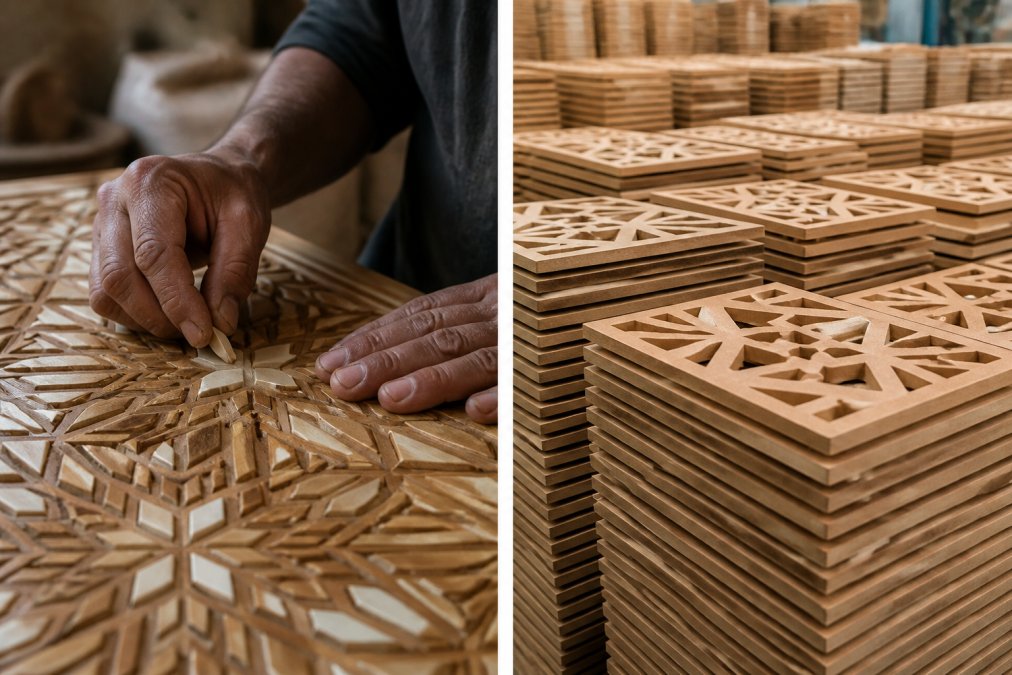
The most honest way to frame the cost difference is simple: you are paying for material substance and human skill, not just a design. A mass-produced chair may cost a fraction of the price, but it carries none of the textural detail, structural integrity, or provenance that defines authentic craftsmanship.
How to Identify High-Quality Moroccan Furniture
Learning how to identify high-quality Moroccan furniture starts with examining the construction methods that mass production cannot easily fake. Look at the joinery: handcrafted pieces use mortise-and-tenon joints and solid wood construction, while cheaper items rely on screws, staples, and particle board hidden under finish.
Run your hand across the surface. Authentic bone inlay, whether camel bone or mother-of-pearl, feels cool and slightly irregular because each piece is cut and fitted by hand. Mass-produced inlay is uniform, thin, and often printed to resemble bone. The Federal Trade Commission guidance on product origin claims reminds buyers that origin and material claims must be truthful, so ask for provenance documentation when a piece is marketed as authentic.
Check the underside and back panels. Handcrafted furniture is finished on all visible sides, and even hidden areas show tool marks rather than raw, unfinished material. Weight is another indicator: solid wood and genuine bone make these pieces substantially heavier than hollow replicas. A common mistake is assuming that visual complexity equals quality, but the real test is how the piece was assembled, not just how it looks.
Durability of Handcrafted Moroccan Wood Furniture
The durability of handcrafted Moroccan wood furniture is not a single answer, it depends entirely on which wood species you choose and how that material responds to your specific US climate zone. Unlike factory furniture made from uniform particle board or softwoods, traditional Moroccan pieces use three primary hardwoods, each with distinct performance characteristics.
Thuya wood (Tetraclinis articulata) is the most prized and the most delicate. Harvested from the Atlas Mountains, thuya features dramatic burl grain patterns that cannot be replicated. Its density makes it resistant to everyday wear, but it is also the most sensitive to humidity fluctuation. In arid climates like Arizona or Nevada, thuya can develop surface checks within two years without regular conditioning. In humid Gulf Coast states, it can warp if the finish is compromised. Thuya is often recommended for display pieces or low-traffic accent furniture rather than daily-use dining tables.
Cedar (Cedrus atlantica) is the workhorse of Moroccan furniture. Naturally insect-repellent and dimensionally stable, cedar handles the temperature swings of US climates better than any other traditional option. It resists the cupping and twisting that affects less stable woods when central heating or air conditioning creates dry indoor conditions. Cedar's open grain accepts hand-rubbed oil finishes well, and with annual conditioning, a cedar piece can realistically last 30 to 50 years in normal household use. This is the wood to choose if you want a functional heirloom piece like a dining table or cabinet that will see daily use.
Walnut (Juglans regia) offers the best balance of hardness and workability. It is denser than cedar, giving it superior scratch resistance for tabletop surfaces. However, walnut is more reactive to humidity than cedar. In the humid Southeast, walnut pieces need consistent indoor humidity, ideally between 40 and 50 percent relative humidity, to prevent the bone inlay from loosening as the wood expands and contracts seasonally. A dehumidifier in summer and a humidifier in winter will protect walnut pieces in states like Florida, Louisiana, or coastal Texas.
The finish matters as much as the wood. Traditional Moroccan pieces use natural oils and waxes, which penetrate the wood and allow it to breathe. Many imported replicas use polyurethane or lacquer, which seals the surface and traps moisture, ironically making the piece more prone to cracking in dry climates. When evaluating a piece, ask whether the finish is oil-based or film-based. Oil finishes require reapplication every 12 to 18 months but allow the wood to acclimate naturally. Film finishes look glossy initially but fail faster in extreme climates.
Rug materials follow a similar logic. Hand-knotted wool rugs from Morocco use high-lanolin wool that naturally repels stains and resists crushing. A 100 percent wool rug with a knot density above 100 knots per square inch will typically outlast a synthetic rug by 3 to 5 times. Synthetic 'Moroccan-style' rugs made from polypropylene may cost less upfront but flatten permanently in high-traffic areas within 3 to 5 years, while wool rugs recover their pile with regular vacuuming and professional cleaning every 2 to 3 years. The Carpet and Rug Institute's durability standards for wool vs. synthetic provides comparative testing data showing wool's superior resilience in residential applications.
The practical takeaway: durability is not a single attribute but a match between material, climate, and use. A thuya jewelry chest in a climate-controlled Denver home will outlast a cedar dining table in an unconditioned garage. The investment case strengthens when you match the wood species to your specific environment and maintenance capacity, not when you assume all Moroccan wood furniture performs identically.
Moroccan Decor Resale Value Tips for Future Buyers
The claim that Moroccan furniture 'holds its value' is common in marketing content, but the actual resale market operates on specific mechanics that most articles never explain. Understanding these mechanics before you buy determines whether your piece becomes a depreciating asset or a recoverable investment.
The resale market has three tiers. At the top are museum-grade antique pieces, pre-1950 originals with documented workshop provenance, which regularly sell at auction through houses like Heritage Auctions or via specialized dealers. These represent a tiny fraction of what most buyers purchase. The middle tier consists of high-quality contemporary handcrafted pieces with verifiable artisan provenance; these can resell on platforms like Chairish, 1stDibs, or through regional antique dealers. The bottom tier, mass-produced 'Moroccan-style' furniture, follows standard furniture depreciation, losing 70 to 90 percent of value within five years.
Provenance documentation is the single largest value driver. A piece with a certificate of origin, artisan name, workshop location, and dated photographs can sell for more than an identical unverified piece. This reflects how professional buyers assess risk. Without documentation, a buyer cannot distinguish a genuine handcrafted piece from a high-quality replica, so they discount accordingly. Keep every document from your original purchase: the invoice, any artisan information, shipping records, and photographs of the piece in your home. Store these digitally and physically.
Condition rules the secondary market. Professional furniture buyers evaluate three things: structural integrity, surface patina, and originality. Structural issues, loose joints, cracked wood, damaged inlay, reduce value because repairs require specialized craftspeople. Original patina is a value-positive feature; collectors pay premiums for surfaces that show authentic age. Conversely, a poor refinishing job can cut value in half. The Appraisers Association of America guidance on furniture condition assessment emphasizes that 'original finish and untouched surfaces consistently outperform refinished pieces in resale transactions.'
Authenticity verification is the hidden gatekeeper. Resale platforms and dealers increasingly require proof of authenticity before listing high-value furniture. The verification process typically involves: close-up photographs of joinery showing mortise-and-tenon construction, macro shots of inlay material showing natural bone grain rather than uniform resin, and documentation of wood species. If you cannot provide these, most professional platforms will either reject your listing or force a significant price reduction.
The realistic resale timeline matters. Handcrafted Moroccan furniture does not appreciate quickly. The typical holding period for value retention is often several years, after which well-maintained authentic pieces can sell at or near their original purchase price in nominal dollars. The investment case is not about financial returns; it is about recovering a meaningful portion of your cost while enjoying the piece for decades.
What actually sells fastest? Based on patterns across major resale platforms, three categories dominate: bone-inlaid dining tables (because they serve as statement pieces), carved palace chairs (because they are portable and photograph well), and hand-knotted wool rugs (because they ship easily). Oversized custom cabinetry and built-in pieces have the weakest resale market, they are difficult to transport and require specific room dimensions. If resale potential matters to you, prioritize portable statement pieces over large custom commissions.
Before you buy, ask the supplier three questions. First, will they provide written provenance documentation suitable for future resale? Second, do they offer repair services or can they recommend a specialist in the US who works with traditional Moroccan techniques? Third, what is their buyback or trade-in policy? Some importers offer buyback within a defined period, which provides a floor on your downside. A supplier who cannot answer these questions is signaling that they do not participate in the long-term value ecosystem, a warning sign for the investment thesis. Working with a provider that specializes in custom furniture imports can make a meaningful difference here, since dedicated importers are more likely to have established relationships with artisans and clear documentation practices.
Matching Timeless Design to Modern Interiors
Moroccan furniture is a functional art form that adapts to modern interiors when used deliberately rather than as thematic decoration. The timeless design of these pieces, characterized by geometric patterns, arabesque carvings, and rich material palettes, works because it introduces textural contrast and visual anchor points into contemporary spaces.
A single statement piece, such as a bone-inlaid dining set or a carved palace chair, transforms a neutral modern room without requiring a full Moroccan theme. Interior designers often use these pieces as focal points, pairing them with minimalist furniture to let the craftsmanship stand out. The American Society of Interior Designers resource on global design influence highlights how integrating heritage pieces adds depth to interiors that purely contemporary furnishings lack.
The key is restraint. One or two authentic pieces create an eclectic, curated look. Overloading a room with matching Moroccan furniture can make the space feel like a showroom rather than a home. Consider the Marrakech living set as a centerpiece for a seating area, then build the rest of the room around neutral tones and natural textures that let the handcrafted details breathe.
Key Considerations and Logistics Before You Buy
Before committing to a significant purchase, consider the logistics of importing, shipping, and installing handcrafted furniture. These pieces are heavy, fragile, and often require white-glove delivery. Buyers in California, Texas, New York, and Florida should confirm that their chosen supplier handles direct shipping with proper insurance and protective packaging.
Shipping damage is a real risk with items featuring intricate tilework or bone inlay. Confirm the supplier's policy on damage claims before purchase, and photograph the packaging upon delivery before signing for the shipment. Custom pieces, such as a Moroccan dining room set, may require additional lead time for production, so plan purchases around renovation timelines rather than expecting immediate delivery.
Timelines for custom work vary significantly. A standard in-stock piece may ship within weeks, while a fully custom commission can take months from design to installation. Factor this into any remodeling schedule, and communicate your deadline clearly with your supplier before committing.
Authenticity Checklist: Verifying Provenance
Use this checklist before purchasing any piece marketed as authentic Moroccan furniture to verify provenance and avoid paying premium prices for replicas:
- Request documentation of the artisan or workshop that created the piece
- Inspect joinery for mortise-and-tenon construction rather than screws or staples
- Verify that inlay material is genuine bone or mother-of-pearl, not resin or printed veneer
- Check the underside and back for unfinished surfaces or signs of mass production
- Ask about the wood species and whether it has been properly seasoned
- Compare the weight of the piece against its size; solid construction is heavy
- Confirm the supplier's shipping, insurance, and damage claim policies in writing
For significant investments, request a video call or additional photographs showing the piece from multiple angles before purchase. Reputable suppliers will accommodate this request. If a seller hesitates to provide provenance or detailed construction information, treat that as a red flag.
The Verdict: A Worthy Investment for the Discerning Buyer
Moroccan furniture is worth the investment for buyers who value material quality, cultural heritage, and design longevity over immediate cost savings. The premium pricing reflects weeks of artisan labor and materials that mass-produced alternatives simply do not contain. When you choose authentic handcrafted pieces, you acquire functional art that can appreciate in value and serve as a lasting focal point in your home.
The investment makes sense under specific conditions: you verify provenance, you understand the care requirements for your climate, and you purchase from a supplier who properly handles shipping and insurance. For those who treat these pieces as disposable decor, the cost is hard to justify. For those who recognize the durability of handcrafted Moroccan wood furniture and its potential as an heirloom, the value is clear.
At Justmorocco, we bring this authentic craftsmanship directly to US homes, offering everything from statement Alhambra palace chairs to custom cabinetry that blends traditional artistry with modern function. Whether you are furnishing a single room or undertaking a full remodel, our collection represents the difference between buying furniture and acquiring heritage.
Frequently Asked Questions
Does high-end Moroccan furniture appreciate in value over time?
Authentic, handcrafted Moroccan furniture can retain or increase in value, unlike typical mass-produced pieces that depreciate. The resale market for unique, antique, or limited-edition artisan furniture is strong. Pieces with provenance and high-quality materials like camel bone and Thuya wood are particularly sought after. To maximize appreciation, focus on timeless designs and maintain the piece's condition, as damage can significantly reduce its value.
How do I distinguish between mass-produced and authentic Moroccan decor?
Authentic Moroccan furniture is rarely symmetrical. Look for slight irregularities in carving and inlay that prove handwork. Check the back and underside for unfinished edges, which are common in handmade pieces. Ask for proof of provenance and photos from the workshop. Mass-produced items typically have perfect symmetry, uniform finishes, and a lower price point that doesn't reflect the hours of labor involved in true artisanal creation.
What materials are most durable in traditional Moroccan furniture?
For long-term durability, prioritize hardwoods like Thuya, cedar, or walnut, which resist warping. Camel bone inlay, when properly applied with a dark resin, is surprisingly robust. Solid brass and wrought iron, especially when sealed, withstand daily use well. Avoid pieces with thin veneers over particleboard, as these will not survive humid climates or heavy use. Always inquire about the protective finish used on wood to ensure it suits your environment.
How should I care for handcrafted Moroccan wood and metal pieces?
Dust regularly with a soft, dry cloth. For wood, use a high-quality furniture polish or lemon oil every few months to prevent drying, especially in air-conditioned homes. Clean metal accents with a dedicated brass or silver cleaner and a soft cloth, avoiding abrasive pads. Keep pieces out of direct, prolonged sunlight to prevent fading. For spills, wipe immediately to prevent stains on bone inlay or leather.
Authentic Moroccan furniture asks more of the buyer: more research, more patience, more investment. In return, it delivers a level of material quality, artistic value, and timeless design that mass production cannot match. The discerning buyer who verifies craftsmanship and understands the logistics will find that handcrafted Moroccan pieces are not just decor, but lasting assets. Get started with Justmorocco and bring the enduring beauty of handcrafted Moroccan design into your home.