
Table of Contents
- Why Authenticity Matters in Moroccan Home Decor
- Material Quality and Composition: The Foundation of Authenticity
- Handmade vs. Machine-Made Production: Spotting the Difference
- Signs of Authentic Moroccan Rugs and Textiles
- How to Identify Zellige Tile Quality
- Design Symmetry and Pattern Variations
- Provenance, Labeling, and Supply Chain Transparency
- Chemical Testing and Smell: Detecting Synthetic Treatments
- Maintenance and Longevity: Signs of Durability
- Price and Provenance: What Authentic Craftsmanship Costs
Last Updated: August 13, 2026
Why Authenticity Matters in Moroccan Home Decor
Authentic Moroccan decor has become increasingly difficult to distinguish from mass-produced imitations. The difference between a hand-knotted rug made by Berber artisans in the Atlas Mountains and a factory-produced knockoff isn't just about price, it's about craftsmanship, durability, and cultural integrity.
When you invest in authentic Moroccan home decor, you're acquiring pieces with soul. Each hand-woven textile, hand-carved door, and hand-cut zellige tile carries the mark of an individual artisan's skill developed over decades. Factory-made alternatives prioritize speed and profit margins over quality, resulting in pieces that fade, fray, and deteriorate within years.
At Justmorocco, we've spent years sourcing directly from artisans and cooperatives across Morocco to ensure every piece meets rigorous authenticity standards. A $7,200 bone inlay cabinet or a $13,500 hand-carved cedar door represents significant financial commitment. Knowing what separates genuine handcrafted pieces from factory imitations is essential due diligence before spending that kind of money.
Material Quality and Composition: The Foundation of Authenticity
The materials used in authentic Moroccan decor tell the story of its origin. Genuine pieces rely on natural fibers and traditional material selections used for centuries, while factory-made imitations often substitute cheaper synthetics that compromise both appearance and longevity.
Natural Fibers vs. Synthetic Materials
Authentic Moroccan rugs and textiles are almost exclusively made from natural fibers: wool, cotton, and occasionally silk. These materials age beautifully, developing a subtle patina that enhances their appeal. Wool from Moroccan sheep has natural lanolin that resists staining and provides inherent durability.
Run your hand across a genuine piece. Natural wool feels warm and slightly textured, with visible variations in fiber thickness. Factory-made rugs using synthetic polyester or acrylic feel plasticky and uniform. Check the back of any textile. Authentic pieces show the natural knot structure and backing material, typically cotton or jute. Synthetic rugs often display a plastic-like backing that reveals industrial manufacturing rather than handcrafted construction.
Vegetable Dyes vs. Synthetic Dyes
Vegetable dyes, derived from plants, minerals, and insects, have been used in Morocco for over a thousand years. They create colors with depth and complexity that synthetic chemical dyes cannot replicate.
Vegetable-dyed pieces display subtle color shifts depending on light and viewing angle. Walk around an authentic rug and you'll notice the colors seem to shift and breathe. Factory-made pieces dyed with synthetic chemicals maintain uniform, flat color regardless of lighting.
Smell matters too. Authentic vegetable-dyed textiles have a mild, earthy scent that fades over time. Synthetic dyes produce a chemical smell that persists for months or years. Vegetable dyes fade gracefully over decades, while synthetic dyes often fade unevenly, creating blotchy patches that make pieces look damaged rather than aged.
Handmade vs. Machine-Made Production: Spotting the Difference
The production method determines whether you're buying a piece with generations of skill embedded in it or a product stamped out by machinery. Machine-made pieces can mimic the appearance of handcrafted work, but they lack the structural integrity and subtle character that define authentic Moroccan decor.
Hand-Knotted and Hand-Woven Techniques
Hand-knotted rugs are created by tying individual knots onto a warp and weft foundation, a process that can take months or years for a single piece. Machine-made rugs are tufted by automated looms that follow a single pattern repeatedly, producing soulless results.
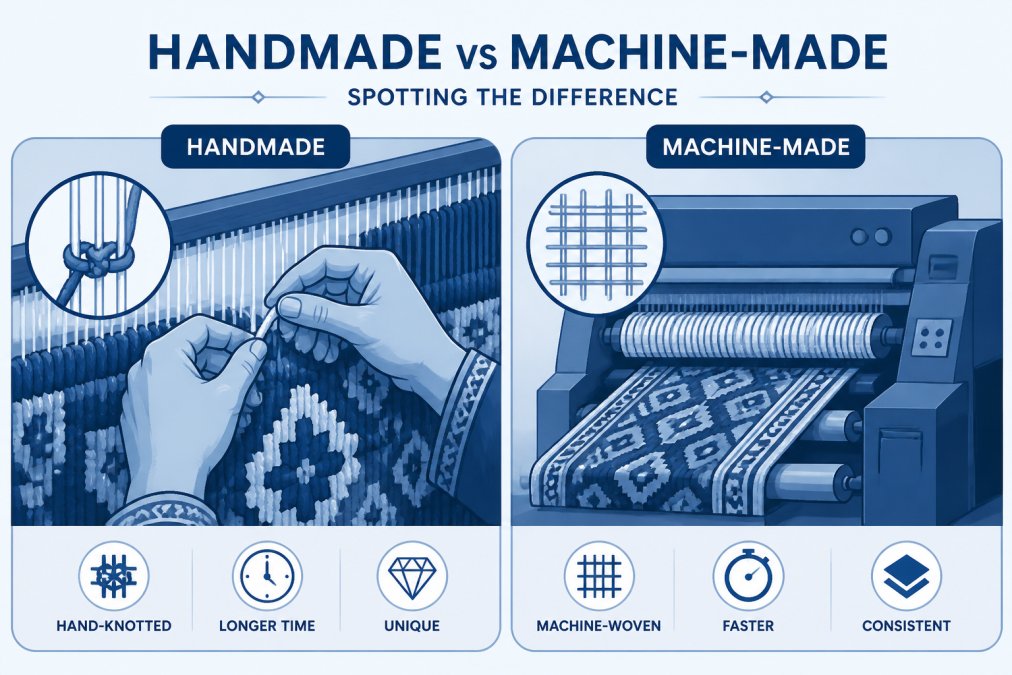
Examine the back of any rug. Hand-knotted pieces show visible knots tied individually, with slight irregularities depending on the artisan's hand pressure. Machine-made pieces show perfectly uniform tufts, identical in spacing and tension. Run your fingers along the fringe. Hand-made fringes are tied individually, with slight variations in knot size. Factory fringes are sewn or glued on as a uniform strip.
Knot Density and Weave Patterns
Knot density, measured in knots per square inch, indicates both the fineness of the work and time invested. Authentic Moroccan rugs typically range from 80 to 200 knots per square inch. Count the knots in a small section to verify consistency.
Examine the pattern closely. Hand-woven designs often contain intentional pattern breaks or variations, these are signatures of the artisan, not mistakes. Moroccan weavers traditionally include small deliberate imperfections as a spiritual practice. Factory patterns repeat with mechanical precision, never varying.
Signs of Authentic Moroccan Rugs and Textiles
Beyond production method and materials, several specific characteristics reveal whether you're looking at authentic handcrafted work or factory imitation.
Color Variation and Natural Imperfections
Authentic rugs display noticeable color variation across the piece. No two sections dyed with vegetable dyes will be exactly identical. This variation proves the piece was dyed in batches using traditional methods.
Natural imperfections are signatures of authenticity. A slightly off-center pattern, an uneven edge, or a knot that's slightly tighter than surrounding ones proves a human made this piece, not a machine. Look for what collectors call "abrash", subtle horizontal color stripes that appear when an artisan switches from one dye batch to another. Abrash is highly prized because it proves hand-dyeing in traditional batches. Factory pieces have zero abrash.
Backing and Fringe Quality
The backing of a rug reveals production method immediately. Authentic hand-knotted pieces have a backing made from natural warp and weft fibers, usually cotton or jute. You can see the individual knots tied to this backing.
Factory rugs often have a synthetic backing glued or sewn on top. This backing feels plasticky and separates over time. Examine the fringe carefully. Hand-tied fringes show individual knots or twists with slight variations. Factory fringes are usually a uniform strip sewn or glued on as an afterthought. Pull gently on the fringe. Authentic hand-tied fringes resist pulling because each one is knotted individually to the warp threads.
How to Identify Zellige Tile Quality
Zellige tiles represent some of the most intricate and labor-intensive Moroccan decor available. These hand-cut and hand-glazed tiles have decorated palaces, mosques, and riads for centuries.
Hand-Cut vs. Machine-Cut Zellige
Authentic zellige begins with hand-cutting. Artisans take raw clay tiles and cut them into geometric shapes using traditional chisels and mallets. Each cut is deliberate but imperfect, edges vary slightly and angles aren't precisely measured.
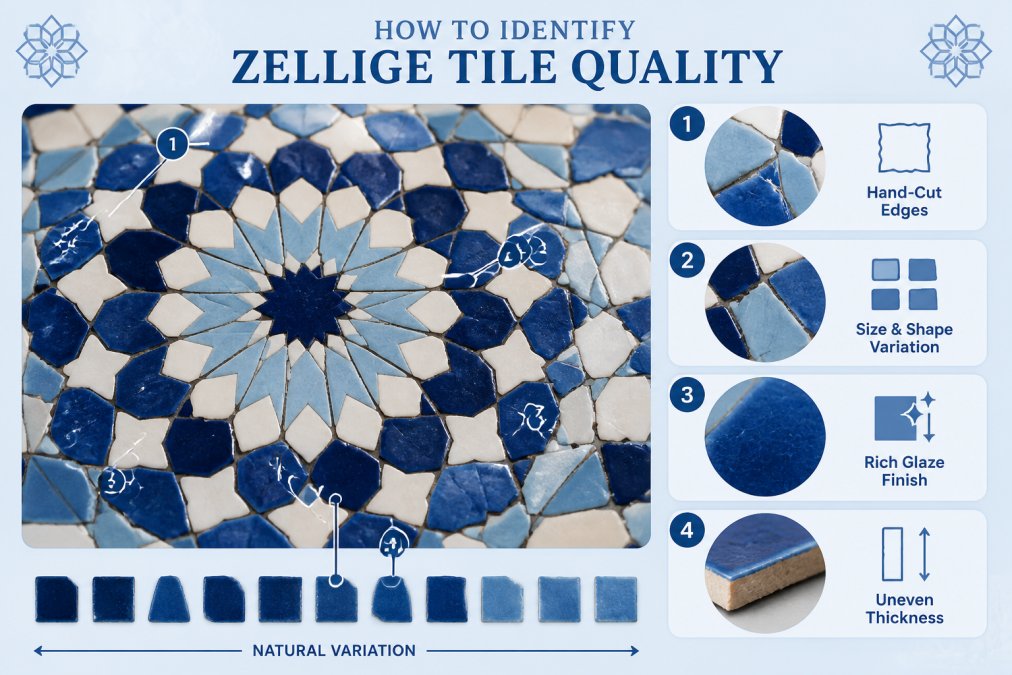
Machine-cut zellige tiles are produced by industrial equipment with mathematical precision. The edges are perfectly uniform and tiles fit together with factory consistency. Examine the edges closely. Authentic hand-cut tiles show variation in edge thickness and slight irregularities. Factory-cut tiles have perfectly uniform edges that feel industrial.
Look at how tiles fit together. Hand-cut zellige tiles fit with small, visible gaps filled with grout because no two are exactly identical. Factory tiles fit with minimal gaps because they're cut to precise measurements.
Color Saturation and Glaze Finish
Authentic zellige tiles are hand-painted before glazing, using mineral pigments and vegetable-based dyes. The colors are rich and display natural variation in depth and tone. Machine-printed zellige uses industrial printing that applies color uniformly.
Run your fingers across the surface. Authentic zellige has a slightly textured glaze with subtle variations in smoothness. Factory-glazed tiles feel uniformly smooth. Authentic zellige tiles may show minor crazing, fine cracks in the glaze surface. These aren't defects; they're a natural result of traditional firing methods and prove authentic techniques.
Design Symmetry and Pattern Variations
Moroccan design traditionally emphasizes geometric patterns with mathematical precision, yet authentic pieces display subtle variations that reveal human creation rather than mechanical reproduction.
Perfect symmetry is actually a red flag for factory production. Authentic Moroccan artisans create symmetrical designs, but hand-execution introduces minor variations. A pattern might be slightly off-center, one side marginally different from the other, or proportions might vary subtly.
Study the pattern across the entire piece. If every section is identical, you're looking at machine-produced design. If you notice slight differences, a motif positioned differently, a border varying in width, colors shifting in intensity, you're seeing the hand of an artisan. Traditional Moroccan design includes intentional imperfections as a spiritual practice or signature. Compare multiple pieces if possible. Authentic handcrafted items from the same artisan will share design DNA but never be identical.
Provenance, Labeling, and Supply Chain Transparency
Where a piece comes from matters as much as how it was made. Authentic Moroccan decor should come with clear provenance, documentation of its origin, the artisan or cooperative that created it, and its journey to you.
Reputable sellers like Justmorocco provide detailed provenance information. You should know the region where a rug was woven, the cooperative or artisan who made it, and the materials used. Factory-made pieces often lack provenance information. Sellers might describe them vaguely as "Moroccan-inspired" or "Moroccan-style" rather than claiming authenticity.
Check labeling carefully. Authentic pieces should be labeled with specifics: "Hand-woven wool rug from the Middle Atlas region, vegetable-dyed, created by artisans in [specific cooperative or region]." Ask sellers direct questions about supply chain. Where exactly was this piece made? Who made it? Authentic sellers welcome these questions and have detailed answers.
Chemical Testing and Smell: Detecting Synthetic Treatments
Your senses provide immediate, reliable indicators of authenticity. Chemical smell and synthetic treatments reveal factory production faster than almost any other test.
Synthetic dyes produce harsh chemical odors that linger for months. When you receive a new piece, smell it carefully. Authentic vegetable-dyed textiles smell earthy, slightly musty, or neutral. If you detect strong chemical smells, you're holding a factory-produced piece.
Place a piece in direct sunlight for several hours. Authentic vegetable dyes may shift slightly but remain stable. Synthetic dyes often fade noticeably or shift color when exposed to UV light. Test colorfastness with a damp white cloth. Rub gently across the surface. If significant color transfers, the dyes aren't properly set, a sign of factory production.
Chemical treatments used in factory production often leave residue. Some factory rugs are treated with flame retardants or mothproofing chemicals that create a stiff, plasticky feel. Authentic pieces feel naturally soft and flexible from day one.
Maintenance and Longevity: Signs of Durability
How a piece ages reveals whether it was built to last or designed for short-term use. Authentic Moroccan decor improves with age; factory pieces deteriorate.
Authentic hand-knotted rugs become more durable with use. The wool fibers compress slightly, creating a tighter weave that resists wear. After 10 years, a genuine rug is often in better condition than when new. Factory rugs show the opposite pattern, fraying and deteriorating as use breaks down weak synthetic fibers.
Hand-carved wooden pieces like doors and cabinets age gracefully. Authentic cedar doors develop a richer patina and become harder over decades. Factory-made wooden pieces often warp, crack, or splinter as cheap wood responds to humidity changes. Zellige tiles maintain their glaze integrity for centuries. Authentic tiles don't chip easily because the glaze is properly fired. Factory tiles often chip or crack from minor impacts.
Bone inlay work on cabinets shows durability through authentic craftsmanship. Genuine bone inlay is set using traditional joinery techniques refined for centuries. The bone and wood move together slightly with humidity changes, preventing cracking. Factory-made bone inlay is often glued on, and the glue fails over time.
Price and Provenance: What Authentic Craftsmanship Costs
Authentic Moroccan decor commands premium pricing for legitimate reasons. Understanding the cost structure helps you evaluate whether a price is reasonable or a red flag.
Hand-knotted rugs require hundreds or thousands of hours of labor. A large rug can take one artisan six months to a year to complete. This labor cost alone justifies prices in the hundreds or thousands of dollars. A hand-knotted rug priced at $800 or more reflects realistic labor costs. Rugs priced significantly lower are likely machine-made.
Hand-carved doors and architectural elements involve master artisans with decades of training. The Bab Taza door from Justmorocco, hand-carved from cedar by a master artisan in Fes, costs $13,500 because it represents months of skilled work by someone with lifetime expertise. Bone inlay cabinets like the Royal bone inlay cabinet at $7,200 reflect the painstaking process of hand-cutting bone pieces and fitting them precisely into wood.
Zellige tile fountains involve hand-cutting hundreds or thousands of individual tiles, hand-painting each one, and assembling them into complex designs. Factory-made pieces priced cheaply, $200 for what looks like a hand-knotted rug, $500 for what appears to be a zellige fountain, are red flags. These prices are only possible with industrial production.
Provenance adds value. A piece with documented history, known maker, and clear supply chain transparency commands higher prices because you're paying for authenticity verification.
Investing in authentic Moroccan home decor means choosing pieces built to last generations rather than seasons. The difference between handcrafted authenticity and factory imitation determines not just initial quality but long-term value, durability, and the cultural integrity of what you bring into your home.
Justmorocco specializes in sourcing directly from Moroccan artisans and cooperatives, offering pieces like the hand-woven Moroccan tribal rug, hand-carved Bab Taza door, and hand-painted moroccan pottery sink, each with documented provenance and authentic craftsmanship. When you choose Justmorocco, you're acquiring pieces with verified authenticity and the confidence that your investment supports traditional Moroccan artistry rather than industrial mass production.
Frequently Asked Questions
What are the most common signs of machine-made Moroccan rugs?
Machine-made rugs show uniform knot density throughout, perfectly symmetrical patterns with no variations, and synthetic backing that feels plastic or stiff. The fringe is often glued or stitched mechanically in straight lines. Hand-knotted rugs display natural color variations, slight asymmetries in design, and backing that feels like natural fabric. Machine-made pieces also lack the weight and texture of authentic wool rugs, and their pile feels uniform rather than slightly irregular.
How can I tell if a Moroccan rug is real wool versus synthetic fiber?
Authentic wool rugs feel warm and slightly textured to the touch, while synthetic materials feel cool and plastic-like. Wool rugs have a natural sheen that changes with light angle; synthetic rugs have a flat, consistent shine. Burn a small hidden fiber sample: wool smells like burnt hair and leaves ash, while synthetics melt and smell chemical. Genuine wool rugs from artisans typically cost $800 and up, reflecting the labor-intensive hand-knotting process used in traditional Moroccan production.
Do authentic Moroccan goods have imperfections?
Yes, imperfections are a hallmark of authentic handcrafted Moroccan decor. Hand-woven textiles show slight color variations where dyes were applied in batches, asymmetrical patterns that differ subtly between sections, and irregular knot spacing. Hand-carved wooden pieces like doors have grain variations and tool marks. Hand-painted tiles display brushstroke differences and glaze thickness variations. These imperfections prove artisan creation; factory-made items are perfectly uniform because machines replicate identical patterns endlessly.
What should I look for when buying authentic Moroccan home decor?
Verify material composition: natural wool, vegetable-dyed fibers, solid wood, and hand-hammered brass. Examine construction closely for hand-knotting, hand-weaving, or hand-carving evidence. Check provenance documentation showing the artisan cooperative or region of origin. Ask about supply chain transparency and whether the maker can be identified. Authentic pieces often come with higher price tags reflecting skilled labor; items priced significantly below market value are likely factory-made. Request detailed photos showing backing, fringe, and construction details before purchasing.