
Table of Contents
- Understanding Home and Why Alternatives Matter
- What Makes Authentic Moroccan Home Decor Different from Mass-Market Boho
- Price-Point Comparison: Handcrafted vs. Mass-Produced Moroccan Furniture
- Mother-of-Pearl Inlay Furniture: The Premium Artisan Option
- Sourcing Authentic Moroccan Home Decor Online Store Options
- Custom Moroccan Kitchen and Bathroom Remodeling for High-End Projects
- How to Style Moroccan Furniture in Modern Homes
- Evaluating Authenticity: Handcrafted Markers and Artisan Credentials
- Shipping, Climate Durability, and Logistics Considerations
- Investment Value: Resale Appeal and Long-Term Design Trends
- Conclusion: Choosing the Right Moroccan Decor Alternative
- Frequently Asked Questions
Last Updated: September 17, 2026
Understanding moroccan Home and Why Alternatives Matter
When you search for best Moroccan home alternatives, you're likely looking for authentic Moroccan furniture that delivers the same level of craftsmanship and aesthetic appeal as higher-end boutique brands. At Justmorocco, we've spent years sourcing and curating handcrafted pieces that capture the essence of North African design without the markup of mass-market boho retailers.
The problem most homeowners face is distinguishing between genuine artisan work and factory-produced items marketed as "handcrafted." Sheherazade Home built its reputation on offering curated, ethically sourced decor. But similar quality exists elsewhere, often at better price points or with more customization options. Understanding what makes authentic Moroccan furniture different is the first step to finding the right alternative for your space.
This guide breaks down the key differences between mass-produced bohemian decor and genuine artisan pieces, walks you through pricing tiers, and shows you how to evaluate authenticity markers that separate real craftsmanship from clever marketing.
What Makes Authentic Moroccan Home Decor Different from Mass-Market Boho
The distinction between authentic Moroccan home decor and mass-market bohemian alternatives comes down to sourcing, materials, and construction methods. Authentic pieces are handcrafted using traditional techniques passed down through generations of artisans. Mass-produced boho decor mimics the aesthetic but cuts corners on materials and labor.
Real Moroccan furniture features hand-woven textiles, hand-carved wood, and hand-inlaid materials like mother-of-pearl or camel bone. These pieces take weeks or months to complete. Factory alternatives use machine-woven fabrics, laser-cut components, and adhesive-applied veneers that look similar from a distance but lack durability and character.
The aesthetic difference is subtle but meaningful. Handcrafted pieces show intentional variation, slight asymmetries, and visible tool marks that signal authenticity. Mass-produced items have uniform perfection, consistent spacing, and identical repeating patterns. When you run your hand across a genuine zellige tile or hand-painted panel, you feel the texture of human labor. Factory pieces feel smooth and plastic.
Beyond appearance, authentic Moroccan decor tells a story. Each piece reflects a specific regional style, artisan tradition, or historical period. A bespoke cabinet from Justmorocco might feature inlay patterns inspired by Damascus workshops or carved details reflecting Moroccan geometric philosophy. Mass-market boho items are designed by committees to appeal to the widest audience possible, which means they appeal to no one deeply.
Price-Point Comparison: Handcrafted vs. Mass-Produced Moroccan Furniture
Understanding pricing tiers helps you identify what you're actually buying. But price alone doesn't tell the full story, shipping costs, lead times, and import logistics can double or triple your effective investment. Here's how the market breaks down across all cost factors:
| Price Range | Product Type | Construction | Base Price | Typical Shipping | Lead Time | Total Cost | Best For |
|---|---|---|---|---|---|---|---|
| $200-$800 | Mass-produced boho decor | Machine-made, adhesive inlay, particle board | $200-$800 | $50-$150 (domestic) | 5-14 days | $250-$950 | Budget-conscious renters, quick refreshes |
| $1,200-$3,500 | Semi-artisan pieces | Hand-finished, mixed materials, some handwork | $1,200-$3,500 | $300-$800 (domestic + import) | 6-12 weeks | $1,500-$4,300 | Mid-range homeowners, statement pieces |
| $4,000-$8,000+ | Fully handcrafted artisan | Hand-carved, hand-inlaid, solid wood, custom | $4,000-$8,000+ | $800-$2,500 (international shipping + insurance) | 10-16 weeks | $4,800-$10,500+ | Collectors, designers, custom renovations |
Why shipping costs matter more than sticker price:
Mass-produced boho furniture ships domestically via standard carriers. A $400 dresser costs $75-$150 to ship via UPS or FedEx ground. Handcrafted pieces from Syria, Morocco, or Central Asia require international freight, customs clearance, and specialized handling for fragile inlay work. A $3,200 cabinet might cost $600-$1,200 to ship safely, plus 2-3% customs duties on the declared value.
Justmorocco's mother-of-pearl inlay pieces range from $1,600 for a Syrian mother of pearl nightstand to $7,999 for a Syrian mother of pearl inlay cabinet Aleppo. But the true cost includes international freight insurance, customs processing, and domestic delivery to your location.
Lead time as a hidden cost:
Mass-produced items ship in days. Handcrafted pieces take weeks or months because artisans work to order. If you're renovating a kitchen or bathroom on a deadline, a 14-week lead time for custom cabinetry can delay your entire project. This hidden cost, the cost of waiting, of living in a construction zone longer, often exceeds the price difference between mass-produced and artisan alternatives.
Semi-artisan pieces (the $1,200-$3,500 tier) typically have 6-12 week lead times. Fully custom work can stretch to 16 weeks or longer, especially if the artisan is booked or if your design requires sourcing specific materials.
Cost-per-year calculation with logistics included:
The durability and resale value still favor authentic pieces.
The sweet spot for most homeowners:
The $1,600-$3,500 range offers genuine handcraftsmanship, solid construction, and reasonable total investment without requiring a six-figure budget. When you add $600-$1,000 in shipping and logistics, your all-in cost lands between $2,200-$4,500. This is still significantly less than custom kitchen or bathroom remodeling, but delivers authentic artisan quality that mass-produced alternatives cannot match.
For those considering custom remodeling projects, budget for international sourcing, customs, and specialized installation.
Mother-of-Pearl Inlay Furniture: The Premium Artisan Option
Mother-of-pearl inlay represents the pinnacle of Moroccan furniture craftsmanship. This technique involves cutting abalone shell or camel bone into intricate geometric patterns and embedding them into solid wood frames. The result is furniture that catches light differently depending on the angle and time of day.
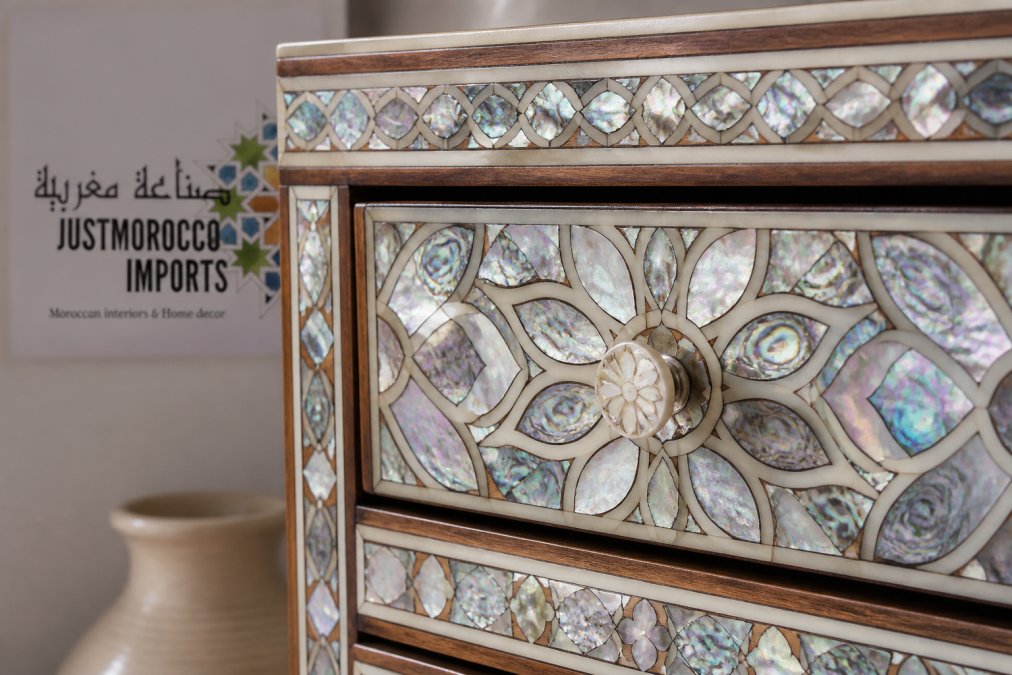
Creating mother-of-pearl inlay furniture requires specialized skills. Artisans must hand-cut each shell piece to exact dimensions, then carefully embed them using traditional adhesive methods. A single cabinet drawer can take 40-60 hours of labor. This is why pieces from Justmorocco command premium pricing.
The Aisha mother of pearl drawers cabinet at $3,200 exemplifies this craftsmanship. Handmade in Syria, it features a marble top and measures 44" x 25" x 21" deep. Each drawer showcases the geometric precision that separates authentic work from factory imitation.
For collectors, the Antique mother of pearl cabinet at $5,500 offers vintage character alongside modern construction quality. These pieces become family heirlooms, gaining value as genuine artisan work becomes scarcer.
The durability of mother-of-pearl inlay is exceptional when properly cared for. The shell doesn't fade, warp, or deteriorate like painted finishes.
Sourcing Authentic Moroccan Home Decor Online Store Options
Finding authentic Moroccan home decor online requires knowing where to look. Direct importers like Justmorocco offer curated collections with verifiable sourcing. The advantage is quality control and the ability to ask questions about origins and artisan credentials before purchasing.
Syrian White Mother of Pearl Inlay →
When evaluating an online store, check for these markers of authenticity:
- Detailed sourcing information: Legitimate retailers specify which region or country pieces come from. "Handmade in Syria" or "Moroccan zellige tiles" beats vague "artisan-crafted" language.
- Artisan attribution: Some stores name specific workshops or artisans. This transparency indicates real relationships with makers.
- High-resolution photography: Authentic pieces are photographed from multiple angles showing construction details, inlay patterns, and wear marks.
- Honest descriptions of variations: Handmade items vary slightly. Stores that acknowledge this ("design may vary due to handmade nature") are being truthful.
- Custom options: Retailers offering custom sizing, color modifications, or bespoke designs have direct artisan relationships.
Justmorocco provides all of these. Beyond the standard catalog, we offer custom furniture imports for clients with specific architectural needs. This is particularly valuable for high-end kitchen and bathroom projects where standard pieces won't fit existing layouts.
The shipping logistics matter more than most buyers realize. Authentic pieces are heavy, fragile, and valuable. Justmorocco's direct shipping to California, Texas, New York, and Florida ensures proper handling.
Custom Moroccan Kitchen and Bathroom Remodeling for High-End Projects
For homeowners and designers tackling major renovations, custom Moroccan design offers unmatched aesthetic impact. Rather than retrofitting standard pieces into existing spaces, custom remodeling integrates Moroccan elements into the architectural framework itself.
A high-end kitchen remodel might feature custom cabinetry with mother-of-pearl inlay, zellige tile backsplashes, and hand-carved wooden door frames. Bathrooms become sanctuaries with mosaic tile work, carved mirrors, and custom lighting fixtures. These projects transform functional spaces into gallery-quality environments.
The investment is substantial. But these projects increase home value, create genuinely unique spaces, and deliver satisfaction that standard renovations cannot match.
Working with Justmorocco on custom projects means collaborating with designers who understand both traditional Moroccan aesthetics and modern functionality. We work from your architect's plans, ensuring custom pieces fit precisely and integrate seamlessly with existing infrastructure. This eliminates the guesswork that causes costly delays in other custom projects.
How to Style Moroccan Furniture in Modern Homes
Integrating Moroccan pieces into contemporary interiors requires intentionality. The aesthetic can feel jarring if you simply drop artisan furniture into minimalist spaces without considering flow and balance.
Start with one statement piece. A handcrafted cabinet, a carved wooden screen, or an ornate mirror anchors the room and sets the design direction. Build around it rather than competing with it. If your statement piece features intricate geometric patterns, keep surrounding elements simpler.
Textiles are crucial. Moroccan design relies heavily on hand-woven rugs, embroidered cushions, and layered fabrics. These soften hard architectural lines and add warmth. Pair your furniture with textiles in complementary colors. If your cabinet features natural wood with pearl inlay, choose rugs and cushions in warm earth tones or jewel tones rather than pastels.
Lighting transforms Moroccan pieces. Hand-carved screens cast beautiful shadows. Brass lanterns with colored glass create ambient warmth. Justmorocco's custom lighting options let you design fixtures that complement your furniture and enhance the overall aesthetic.
The key is restraint. Moroccan design is rich and detailed, so you don't need much. One statement cabinet, layered textiles, strategic lighting, and minimal additional decor creates impact. More pieces often dilutes the effect.
Evaluating Authenticity: Handcrafted Markers and Artisan Credentials
Before investing in high-end Moroccan furniture, you need confidence that you're buying genuine artisan work. Here's how to evaluate authenticity:
Wood quality and construction: Run your hand along the piece. Solid wood should feel substantial, with slight grain variation visible. Particle board or plywood feels hollow and uniform. Check joints and seams. Hand-joined pieces show slight gaps and asymmetries. Factory joints are perfectly uniform.
Inlay work: Examine mother-of-pearl or bone inlay closely. Hand-cut pieces show slight variations in size and fit. Factory-cut inlay is mechanically perfect. Look at the edges where shell meets wood. Hand-inlaid work shows careful finishing. Adhesive-applied veneers show gaps or bubbling.
Paint and finish: Handpainted details should show brushstrokes and slight color variation. Factory-painted pieces have uniform, plastic-looking finishes. Run your finger along painted areas. Hand-applied finishes feel slightly textured. Factory finishes feel perfectly smooth.
Artisan credentials: Legitimate retailers can tell you which workshop created the piece, how long it took, and what materials were used. They have relationships with artisans and can provide photos of the makers. Vague "artisan-crafted" language without specifics is a red flag.
Pricing honesty: If a piece seems too cheap for the apparent quality, it probably is. Mother-of-pearl inlay furniture requires hundreds of labor hours. Prices below $1,500 for substantial pieces typically indicate factory production disguised as artisan work.
Shipping, Climate Durability, and Logistics Considerations
Authentic Moroccan furniture travels thousands of miles to reach your home. Understanding shipping logistics and regional climate challenges prevents costly damage and ensures your investment survives for decades.
Shipping and handling standards:
Handcrafted pieces are fragile. Mother-of-pearl inlay can crack if mishandled during transit. Carved wood can split if exposed to rapid temperature swings in shipping containers. Justmorocco ships with professional packaging. Your piece arrives in the same condition as it left the artisan's workshop.
International freight typically takes 3-6 weeks by ocean container. During this time, your furniture experiences temperature fluctuations, humidity changes, and vibration. When your piece arrives, inspect it immediately for damage before signing off on delivery.
Regional climate challenges and durability:
Climate has a dramatic impact on how long your Moroccan furniture lasts. Solid wood expands and contracts with humidity changes. Inlay work can separate if the wood base shifts. Here's how to evaluate durability by region:
High-humidity regions (Florida, Louisiana, coastal areas, Pacific Northwest): Humidity above 60% causes wood to swell. Inlay pieces are particularly vulnerable because the wood frame and shell or bone inlay expand at different rates. If you live in Miami, New Orleans, or Seattle, prioritize solid carved pieces over extensive inlay work. If you must have inlay furniture, choose pieces with sealed finishes and stainless steel hardware. Place your new piece in its final room for 2-3 weeks before final positioning, this acclimation period allows wood to adjust to local humidity before you stress the joints by moving it.
Syrian White Mother of Pearl Inlay →
In high-humidity climates, run a dehumidifier in rooms with valuable pieces during summer months. Target humidity between 40-55%. This prevents mold growth on textiles and reduces wood movement that can crack inlay work.
Dry climates (Southwest, Mountain West, High Plains): Dry air causes wood to shrink and crack. Humidity below 30% is dangerous for handcrafted furniture. If you live in Arizona, New Mexico, Colorado, or Utah, avoid pieces with extensive carved detail that might split along grain lines. Solid, thick-wood pieces withstand dryness better than thin veneered work.
In dry climates, use a humidifier to maintain 35-45% humidity in rooms with valuable pieces, especially during winter when heating systems dry out indoor air. This is particularly important for pieces with hand-painted details, which can crack if the wood base shrinks too rapidly.
Moderate climates (most of the Midwest, Northeast, Mid-Atlantic): These regions experience seasonal humidity swings (40-60% year-round) but rarely extreme conditions. Most Moroccan furniture thrives in these climates with basic care. Avoid placing pieces directly against exterior walls where temperature swings are most extreme.
Salt-air coastal environments (California coast, Gulf Coast, Atlantic seaboard): Salt air accelerates oxidation of metal hardware and can damage bone inlay over time. If you're within 5 miles of the ocean, prioritize pieces with sealed finishes and stainless steel or brass hardware that resists corrosion. Avoid untreated wood or pieces with exposed iron hardware. Dust more frequently (weekly rather than monthly) because salt deposits accumulate on surfaces.
Specific durability concerns by material:
Mother-of-pearl inlay: Extremely durable in stable climates (40-55% humidity, 65-75°F). Shell doesn't fade, warp, or deteriorate like painted finishes. However, if humidity swings exceed 20% (e.g., 35% to 55% seasonally), the wood base can shift enough to crack the adhesive bond between shell and wood. Pieces can last 30-50 years in ideal conditions, but only 10-15 years in unstable climates.
Hand-carved wood: Solid carved pieces are more forgiving than inlay work. They withstand humidity swings better because there's no adhesive bond to fail. However, extreme dryness (below 25% humidity) can cause radial cracking along grain lines. These pieces typically last 40+ years even in challenging climates if not placed in direct sunlight.
Hand-painted details: Water-based paints used in traditional Moroccan work can fade in direct sunlight and can bubble if humidity spikes above 70%. Keep painted pieces away from windows and use UV-filtering curtains if they must be near natural light.
Bone or camel-bone inlay: More fragile than mother-of-pearl. Bone yellows over time and can crack if humidity drops below 30%. These pieces are best suited for stable, moderate climates.
Proper care extends life dramatically:
Dust regularly with soft, lint-free cloths, weekly for pieces in high-traffic areas, monthly for others. Avoid direct sunlight that fades wood and shell. Use furniture polish formulated specifically for wood, never harsh chemicals or silicone sprays that build up residue. For inlay work, use a soft brush to gently clean grooves where dust accumulates.
Address spills immediately. Water rings on wood are difficult to remove. Wipe spills with a slightly damp cloth, then dry immediately. Never use water on inlay pieces, moisture can seep into adhesive joints and cause separation.
Investment Value: Resale Appeal and Long-Term Design Trends
Authentic Moroccan furniture holds value better than mass-produced decor. This matters if you ever sell your home or need to relocate.
Design trends shift constantly, but handcrafted artisan pieces transcend trends. A hand-carved Moroccan cabinet from the 1970s is as beautiful today as when it was made. Mass-produced boho furniture from five years ago looks dated. This is why authentic pieces appreciate or hold value while factory items depreciate rapidly.
Real estate markets increasingly value distinctive design elements. Homes with custom Moroccan kitchens or bathrooms command premium prices in competitive markets. Buyers recognize that custom artisan work cannot be replicated elsewhere. They're paying for uniqueness and quality that will outlast their ownership.
Collector markets for vintage Moroccan furniture are growing.
Conclusion: Choosing the Right Moroccan Decor Alternative
Choosing between Sheherazade Home alternatives comes down to understanding what you actually value. If you want the aesthetic of Moroccan design at the lowest price, mass-produced boho decor delivers. But if you want pieces that last decades, tell authentic stories, and increase in value, handcrafted artisan work is the only real option.
Justmorocco specializes in exactly this: sourcing genuine mother-of-pearl inlay furniture, custom kitchen and bathroom remodeling, and bespoke design pieces that transform spaces. Our pieces come with verifiable artisan credentials and the confidence that you're investing in quality that will outlast trends.
When you're ready to elevate your space with authentic Moroccan design, Justmorocco delivers handcrafted pieces like our Syrian White Mother of Pearl Inlay Wedding Dresser and custom remodeling services that bring traditional craftsmanship into modern homes.
Frequently Asked Questions
How can I identify high-quality, handcrafted Moroccan home decor versus mass-produced imitations?
Authentic handcrafted Moroccan furniture shows visible artisan marks, inconsistent patterns (a sign of hand-work rather than machine production), and quality materials like solid wood with mother-of-pearl or bone inlay. Examine seams, joints, and drawer construction closely. Mass-produced pieces have uniform, perfect finishes and lighter materials. Request photos of the craftsmanship process or artisan credentials. Pieces from established importers who specialize in authentic Moroccan decor typically provide documentation of origin and construction methods.
What are the best online sources for authentic Moroccan home decor?
Authentic moroccan home decor online stores that specialize in handcrafted pieces offer curated collections directly from artisans and importers. Look for retailers offering detailed product descriptions, artisan origin information, and high-resolution images showing craftsmanship details. Established importers provide shipping transparency and documentation of authenticity. Avoid marketplaces mixing handmade and mass-produced items without clear distinction. Premium options include specialists offering custom orders and direct communication with craftspeople, ensuring you receive genuine pieces rather than factory reproductions.
How do I know if Moroccan furniture will work in my modern home without looking out of place?
Moroccan furniture integrates beautifully into modern homes when styled with intentionality. Use pieces as statement accents rather than filling entire rooms. Pair handcrafted mother-of-pearl cabinets with minimalist walls and neutral flooring to let the artistry stand out. Mix Moroccan textiles like hand-woven rugs with contemporary furniture. Layer lighting with traditional lanterns and modern fixtures. Balance ornate carved pieces with clean-lined contemporary elements. The key is treating Moroccan decor as curated design moments, not overwhelming the space. This approach makes pieces feel intentional and elevated rather than themed.
What should I expect regarding shipping costs and timelines for handcrafted Moroccan pieces?
Handcrafted Moroccan furniture requires careful shipping due to delicate inlay work and heavy construction. Timelines typically span 2-8 weeks for imported pieces, longer for custom orders. Heavy items like mother-of-pearl cabinets require specialized packaging. Ask about packaging methods and whether pieces arrive fully assembled or require setup. Direct importers often provide faster turnaround than marketplace sellers. Plan accordingly if you have time-sensitive installation deadlines.