
Table of Contents
- What Defines Authentic Moroccan Architectural Elements?
- The Hallmarks of Moorish Architectural Design Alternative
- Custom Zellige Tile Installation: Precision Meets Artistry
- Hand-Carved Moroccan Wood Cabinetry for Kitchens and Beyond
- Sourcing and Verifying Authentic Handcrafted Pieces
- Structural Engineering and Building Codes for Moroccan Features
- Installation Guide for Non-Traditional Spaces
- Cost-Benefit: Bespoke Craftsmanship vs. Mass-Produced Replicas
- Conclusion: Building a Timeless Home with Moroccan Elements
- Frequently Asked Questions
Last Updated: September 7, 2026
What Defines Authentic Moroccan Architectural Elements?
Bespoke Moroccan architectural elements are custom-crafted, hand-built features rooted in centuries-old Islamic and North African design traditions, distinguished by intricate geometric patterning, artisanal materiality, and a deliberate rejection of mass production. When you commission these pieces, you are investing in a process where master artisans translate cultural heritage into structural and decorative forms.
The core distinction lies in the hand. A hand-chiseled zellige tile carries slight variations in glaze and edge that no machine replicates; a hand-carved cedar panel holds the tool marks of the artisan who shaped it. These imperfections are not flaws; they are the signature of authenticity that elevates a space from decorated to curated.
Below, we break down the essential elements, the sourcing process, and the technical realities of installing these features in modern American homes.
The Hallmarks of Moorish Architectural Design Alternative
For those seeking a moorish architectural design alternative to standard colonial or modern millwork, the visual language is remarkably consistent. The horseshoe arch, also known as the Moorish arch, is the most recognizable structural element, framing doorways and creating a symbolic transition between spaces. Alongside this, the moucharabieh or mashrabiya, a projecting wood lattice screen, filters light and provides privacy without sacrificing airflow.
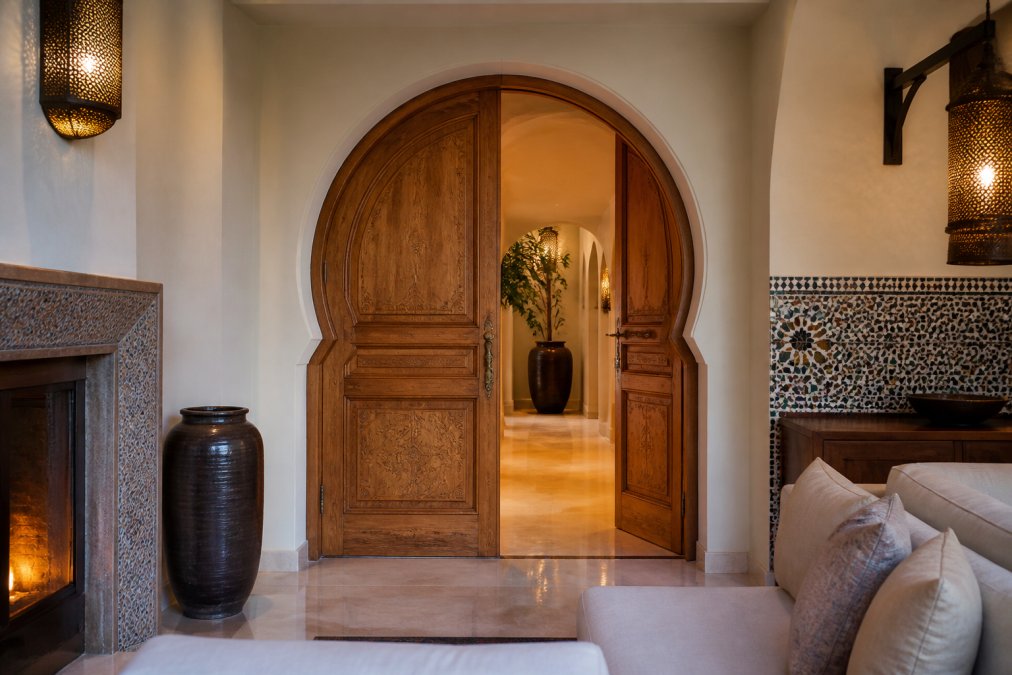
The material palette is equally specific. Tadelakt, a polished lime plaster, delivers a waterproof, satin-smooth finish used in baths and hammams. Zellige tilework forms complex geometric patterns through individually cut, hand-glazed pieces. Carved plaster and arabesque motifs add ornamental depth, while rammed earth and traditional brick construction provide thermal mass.
What makes a bespoke approach superior is the integration. A mass-produced arch is a hollow shell; a custom-built arch, engineered to your wall depth and load requirements, becomes a genuine structural element.
Custom Zellige Tile Installation: Precision Meets Artistry
Custom zellige tile installation is the single most demanding craft in the Moroccan architectural repertoire. Each tile is hand-chiseled from a larger glazed slab, resulting in irregular edges that must be set with consistent grout joints to create the final geometric pattern. This is not a weekend DIY project; a standard backsplash can take a skilled installer several days.
The technical challenge is the variance. Because each piece is hand-cut, dimensions can vary by millimeters. A competent installer must sort and grade tiles before setting, adjusting the joint width to accommodate the natural drift. We provide detailed installation guidance with our tile orders, including recommended thinset and grout types.
For the geometric patterns to read correctly, the layout must be drawn out first. Whether you are installing a simple border or a full star-and-polygon composition, a full-scale mock-up on the floor saves hours of rework.
Hand-Carved Moroccan Wood Cabinetry for Kitchens and Beyond
Hand-carved Moroccan wood cabinetry transforms a kitchen or library into a showcase of artisanal woodwork, but it requires a shift in planning. Unlike stock cabinetry, these pieces are built to your exact dimensions, so the design phase must be locked down before carving begins. Lead time is substantial, often 8 to 16 weeks for a full kitchen.
The woods used are typically cedar, thuya, or oak, chosen for their density and ability to hold fine detail. Carving styles range from deep geometric relief to intricate floral and arabesque motifs. For a modern application, you can specify a simpler, lower-relief carving that nods to tradition without overwhelming a contemporary interior.
A key consideration for US homes is climate. In humid states like Florida or coastal Texas, wood movement is a real concern; the artisan must use traditional joinery that allows panels to expand and contract without cracking.
For a striking entry point, consider the Cordobesa door, a riad inlay bone traditional door featuring geometric and floral motifs with intarsia and copper or brass metalwork. At $3,200, it anchors a hallway or entryway, demonstrating the level of detail possible in custom work.
Sourcing and Verifying Authentic Handcrafted Pieces
The market is flooded with pieces that look Moroccan but are not, so verifying authenticity requires asking the right questions. A genuine handcrafted item will show asymmetry in the pattern, slight color variation in the glaze, and tool marks on the back or underside.
But visual inspection alone is insufficient for a bespoke commission. This matters because a single hand-carved door can run $3,000 to $12,000, and a full zellige installation can exceed $15,000 before labor.
The Four-Layer Verification Protocol
Layer 1: Workshop Provenance Documentation
Reputable importers work directly with specific artisan cooperatives and can provide provenance. But you should demand more than a single photo. Ask for:
- The name and location of the workshop (e.g., a specific cooperative in Fes for zellige, or a woodworking atelier in Marrakech for carved doors).
- A dated series of photos showing the piece at three stages: raw material, mid-carving or mid-assembly, and finished.
- The name of the master artisan (maalem) who supervised the work. In Moroccan craft hierarchy, a maalem is a master who has completed a formal apprenticeship, this title is not casually assigned.
If a supplier cannot provide workshop-level documentation, treat that as a red flag. Mass-market importers often buy from middlemen who aggregate from multiple anonymous workshops.
Layer 2: Material Authentication
Authenticity extends beyond craftsmanship to the raw materials. For wood pieces, specify the species and ask how it was dried. Traditional Moroccan joinery uses air-dried cedar or thuya, which behaves differently from kiln-dried lumber common in US millwork. If a supplier claims solid cedar, ask whether the piece uses quarter-sawn or plain-sawn stock.
For zellige, the question is whether the tile is hand-chiseled or machine-cut. Hand-chiseled tiles have irregular backs and edges that vary by 1-2 millimeters. Machine-cut tiles are uniform and often cheaper by 30-40%. Both have their place, but you should know which you are paying for. A reputable supplier will tell you the expected breakage rate during shipping, typically 3-8% for hand-chiseled zellige.
Layer 3: Finish and Coating Verification
A common failure point is the finish. Traditional Moroccan pieces use natural oils, beeswax, and lime-based paints. Mass-produced replicas often use polyurethane or acrylic lacquers that mimic the look but fail differently over time. Ask your supplier:
- What is the exact finish composition? (e.g., hand-rubbed linseed oil and beeswax, versus a sprayed nitrocellulose lacquer)
- Is the finish food-safe if the piece is a dining table or kitchen cabinet?
- What is the recommended maintenance schedule in a US climate? A natural oil finish may need reapplication every 12-18 months in dry, heated interiors, whereas a lacquer will not, but the lacquer will also not allow the wood to breathe, increasing the risk of cracking in large panels.
Layer 4: Third-Party Inspection Options
For high-value commissions above $5,000, consider a third-party inspection before the piece ships. Some US-based interior designers specializing in Moroccan decor offer remote inspection services, they will video-call the workshop, examine the piece, and provide a written condition report. This costs $200-500 but can catch issues before they become your problem.
Ethical Sourcing as a Supply-Chain Standard
The ethical dimension is equally important. Authentic Moroccan craftsmanship supports traditional livelihoods and keeps ancient skills alive. By choosing handcrafted pieces, you contribute to the preservation of this heritage, a direct contrast to mass-produced alternatives that replicate the look while undercutting the artisans.
But ethical sourcing is not just a moral position, it is a quality signal. Workshops that pay fair wages and maintain stable employment retain their best artisans; high turnover produces inconsistent work. Ask your supplier whether their workshops are Fair Trade certified or affiliated with the Moroccan Ministry of Handicrafts.
Red Flags in Supplier Communication
Finally, the way a supplier communicates is itself a signal. Reputable importers who understand the US market will:
- Provide weight and dimensional data for every piece, because they know you need it for structural engineering.
- Offer guidance on acclimation, solid wood pieces should sit in your home for 48-72 hours before installation to adjust to ambient humidity.
- Disclose lead times honestly, including the 8-16 week fabrication window plus 2-4 weeks for ocean freight and customs clearance.
A supplier who cannot answer basic questions about wood moisture content, tile absorption rates, or finish VOC levels is not equipped to support a bespoke architectural installation.
Structural Engineering and Building Codes for Moroccan Features
Installing heavy, handcrafted features like a solid wood arch or a marble-tile fountain demands compliance with US building codes and a structural engineering review. A solid hardwood door can weigh several hundred pounds, so the wall framing must be reinforced to carry the load, especially for oversized pivot or double doors. The M'karbass Door, priced at $7,600, features hand-hammered copper and brass panels and requires a header engineered for its significant weight.
Similarly, a tadelakt plaster finish in a shower requires a waterproof substrate and a specific curing process to meet code. Any structural arch, whether load-bearing or decorative, must be reviewed by a licensed structural engineer to ensure it meets local seismic and wind load requirements. This is not a hurdle; it is a necessary step to ensure your investment is safe and permanent.
Your contractor or a structural consultant should review the plans before fabrication begins. This is where a supplier who understands the US market is invaluable. We provide the technical specifications and weight data needed for your engineer to sign off on the design, and our custom furniture imports service ensures your pieces are built to the exact structural standards your project requires.
Installation Guide for Non-Traditional Spaces
Adapting Moroccan elements to a standard American home, which lacks the high ceilings and thick walls of a traditional riad, requires creative engineering and careful planning. The most common challenge is scale: a massive, hand-carved door designed for a 12-foot palace entrance will overwhelm a standard 8-foot residential opening. The solution is to commission a piece scaled to your space.
But scale is only the first hurdle.
Climate Zone 1: High-Humidity Coastal (Florida, Gulf Coast, Southeast)
In humid coastal regions, the primary enemy is moisture vapor drive. A solid wood door or carved panel on an exterior wall will absorb ambient humidity and expand. The traditional Moroccan solution, air-dried wood with oil finishes, assumes a dry desert climate; in Florida, the same wood can swell by 2-3% across the grain, enough to cause a door to stick or a panel to crack.
The adaptation: Specify quarter-sawn stock for any exterior-facing wood element, as it expands only about half as much as plain-sawn across the grain. Insist on a two-part finish system: a penetrating oil base coat followed by a microcrystalline wax top coat. Avoid polyurethane entirely, it traps moisture inside the wood.
For zellige installations in humid climates, the substrate matters more than the tile. Use a cementitious backer board (not green drywall) and a polymer-modified thinset rated for high-moisture environments. The grout should be epoxy-based, not cement-based, because cement grout will wick moisture and develop efflorescence.
Climate Zone 2: Cold-Climate Thermal Cycling (Northeast, Midwest, Mountain West)
In cold climates, the issue is not humidity but thermal cycling. A home in Minnesota may see interior temperatures swing from 68°F during the day to 55°F at night, with humidity dropping below 20% in winter. This dry, fluctuating environment causes wood to shrink and develop surface checks.
The adaptation: For interior wood elements, specify a higher moisture content at delivery, around 8-10% rather than the 6-8% typical for kiln-dried stock. For carved panels, request that the artisan incorporate expansion gaps in the joinery, a traditional technique where panels float in their frames.
For tadelakt plaster in cold climates, the concern is freeze-thaw if applied in an unconditioned space like a mudroom or three-season porch. Tadelakt is not rated for exterior freeze-thaw exposure. If you want the look in a cold-climate entryway, use it on an interior wall only.
Retrofit Installations in Apartments and Condos
For moucharabieh screens, consider using them as room dividers or window treatments rather than full architectural projections, capturing the light-filtering effect without major structural work. For arches, a non-load-bearing veneer arch can be framed into an existing doorway, creating the horseshoe shape without altering the roofline.
In apartment buildings, you cannot cut into a concrete slab or remove a load-bearing wall without engineering approval. The workaround is a self-supporting portal frame, a freestanding structure built from steel studs or engineered lumber that creates the arch or doorway surround without touching the building's structural system. This frame can be removed at the end of a lease.
For ceiling-mounted elements like pendant lanterns or carved wood ceiling medallions, the mounting point must be rated for the fixture weight. A hand-hammered brass lantern can weigh 40-80 pounds. Standard residential ceiling boxes are rated for 50 pounds. If your fixture exceeds that, you need a ceiling fan-rated box (rated for 70 pounds) or a structural reinforcement plate.
Floor Loading for Heavy Stone and Tile Features
A full zellige feature wall with a stone fountain at its base can add 200-400 pounds of dead load to a floor system. In a single-family home with standard 16-inch-on-center floor joists, this is usually fine, but in older buildings with 2x8 joists spanning 14 feet or more, you may approach design limits. If installing a heavy feature on an upper floor, have a structural engineer calculate the dead load addition. Zellige tile weighs approximately 4-5 pounds per square foot installed; a 50-square-foot feature wall adds 200-250 pounds.
The Bab Alkadi door at $2,800 is an excellent example of an adaptable piece. Its horseshoe arch frame can be installed as a dramatic interior passageway, creating the illusion of a transition between spaces without requiring the ceiling height of a palace. Measure your rough opening carefully and provide those dimensions to your supplier. For retrofit installations, also measure the wall depth, a standard 2x4 wall is 3.5 inches deep, which may be too shallow for a door frame designed for a 6-inch-thick riad wall. If so, specify a custom jamb extension.
Cost-Benefit: Bespoke Craftsmanship vs. Mass-Produced Replicas
The price difference between a bespoke, handcrafted Moroccan element and a mass-produced replica is significant, but the value proposition extends far beyond the initial purchase price. A hand-carved door or a custom zellige installation is a permanent architectural feature that adds uniqueness and potential resale value; a replica will likely need replacement within a decade.
The table below summarizes the key differences to consider during your planning:
| Consideration | Bespoke Handcrafted | Mass-Produced Replica |
|---|---|---|
| Material Quality | Solid wood, natural stone, authentic plaster | MDF, resin, printed patterns |
| Longevity | 50+ years with proper care | 5-15 years before visible wear |
| Aesthetic Value | Unique, with artisan tool marks | Uniform, repetitive |
| Structural Role | Can be load-bearing or engineered | Decorative only |
| Resale Impact | High, adds architectural distinction | Low, seen as a trend item |
| Lead Time | 8-16+ weeks | Immediate or short ship time |
The higher upfront cost of bespoke work buys permanence and authenticity. When you consider cost per year of ownership, a $7,600 hand-carved door that lasts a century is a better investment than a $1,500 replica that needs replacing in a decade. The bespoke piece is a conversation piece, a work of art that cannot be replicated.
For those concerned about climate durability, particularly in humid coastal regions, the investment in proper materials is non-negotiable. A hand-painted door using traditional Zouaq techniques, like the Marrakesh extra large Painted door at $12,000, uses pigments and sealants designed to withstand the elements, a testament to the longevity of authentic craft.
Conclusion: Building a Timeless Home with Moroccan Elements
Bringing bespoke Moroccan architectural elements into a home is a commitment to craftsmanship, heritage, and quality that transcends fleeting design trends. The challenge is navigating the sourcing, engineering, and installation complexities to achieve a result that is both authentic and functional in a modern American context.
Justmorocco is that partner. We offer direct access to authentic, handcrafted pieces, from intricate mosaic tile fountains to custom cabinetry and hand-carved doors, with specialized expertise in custom kitchen and bathroom remodeling. Our direct shipping to California, Texas, New York, and Florida, combined with our understanding of US installation standards, ensures your project is a success from design to final install.
Frequently Asked Questions
What is the difference between Moroccan and Moorish architectural design?
Moorish design refers to the Islamic architecture of Al-Andalus (Spain and Portugal) and North Africa, characterized by horseshoe arches and intricate geometric patterns. Moroccan architecture is a living tradition within Morocco, encompassing Moorish influences alongside Amazigh (Berber) styles, riad courtyard layouts, and regional materials like tadelakt plaster and zellige tile. When choosing bespoke Moroccan architectural elements, you are selecting pieces rooted in this broader heritage, while a Moorish architectural design alternative often emphasizes Andalusian-specific motifs like the multilobed arch.
How do I verify that bespoke Moroccan woodwork is genuinely hand-carved?
Authentic hand-carved Moroccan woodwork shows irregular, subtle variations in depth and line that a machine cannot replicate. Ask your supplier for process photos or video from the workshop. Look at the back of a panel: hand-carving often shows tool marks or a slightly rough texture, while CNC routing leaves a uniformly smooth, hollowed surface. For high-value items like our Cordobesa door, request documentation of the artisan's workshop and the wood source. Reputable importers will share this transparency before you commit.
Are custom Moroccan architectural elements suitable for modern home renovations?
Yes, and they work best as focal points rather than full-room treatments. A hand-carved Moroccan door, like the Bab Alkadi with its horseshoe arch, makes a strong statement in a modern entryway. Custom zellige tile installation can transform a kitchen backsplash or bathroom floor into a work of art. For a cohesive look, pair these elements with minimalist furniture and neutral walls. The contrast between the intricate, artisanal piece and clean modern lines creates a sophisticated, curated interior without overwhelming the space.
Will custom zellige tile installation hold up in humid climates like Florida?
Zellige is fired clay, and its durability depends on the quality of the glaze and the installation method. In high-humidity or coastal environments, proper sealing is essential to prevent moisture absorption. A professional installer experienced with custom zellige tile installation will use a suitable primer and grout. The tiles themselves are not purely decorative; they are a durable, waterproof surface when correctly installed. Discuss your climate concerns with your supplier to ensure the right finish and installation materials are specified for your project.