
Table of Contents
- What to Expect From Custom Moroccan Architectural Design Services
- 1. Justmorocco: Handcrafted Doors and Custom Kitchen Remodeling
- 2. Artisan-Led Design Firms Specializing in Riad Interiors
- 3. Full-Service Moroccan Architectural Consultants
- 4. Specialized Moroccan Architectural Elements for Home Remodeling
- Hiring Moroccan Design Consultants: What to Ask
- Custom Moroccan Tile Installation and Zellige Craftsmanship
- Budgeting, Timelines, and Structural Compliance
- Authenticating Handcrafted Work and Building Confidence
- Conclusion
What to Expect From Custom Moroccan Architectural Design Services
Custom moroccan architectural design services blend centuries of Islamic geometric tradition with modern functionality. When you commission a project through specialists in this field, you're investing in handcrafted artistry, from intricate zellige tilework to hand-carved cedar doors, executed by master artisans who understand both cultural significance and structural requirements.
The process differs fundamentally from standard interior design. Rather than selecting pre-made items, you work with artisans, architects, and consultants who source materials directly, oversee custom fabrication, and ensure every element integrates seamlessly with your home's architecture and climate. Expect timelines measured in months, not weeks. A custom zellige backsplash or handcrafted door requires design approval, artisan production time, and careful shipping logistics. A single carved cedar door ranges from $1,600 to $12,000 depending on size and complexity.
1. Justmorocco: Handcrafted Doors and Custom Kitchen Remodeling
Justmorocco stands as the premier option for importing authentic Moroccan architectural elements directly into US homes. The company specializes in sourcing and commissioning handcrafted doors, custom kitchen and bathroom remodeling, and artisanal tilework from master craftsmen in Morocco, then managing the entire logistics chain to your doorstep.
Every door is handmade, no mass production. The Cordobesa door ($3,200) features camel bone inlay and hand-tooled metal sheets crafted by master artisans in the Marrakesh souks, with geometric and floral motifs reflecting authentic Islamic geometric principles. The Bab Alkadi ($2,800) showcases horseshoe arch framing and Arabic calligraphy carved into cedar. For larger projects, the Marrakesh extra large painted door ($12,000) or Fez royal palace door ($12,000) are statement pieces executed in Moroccan Zouaq art.
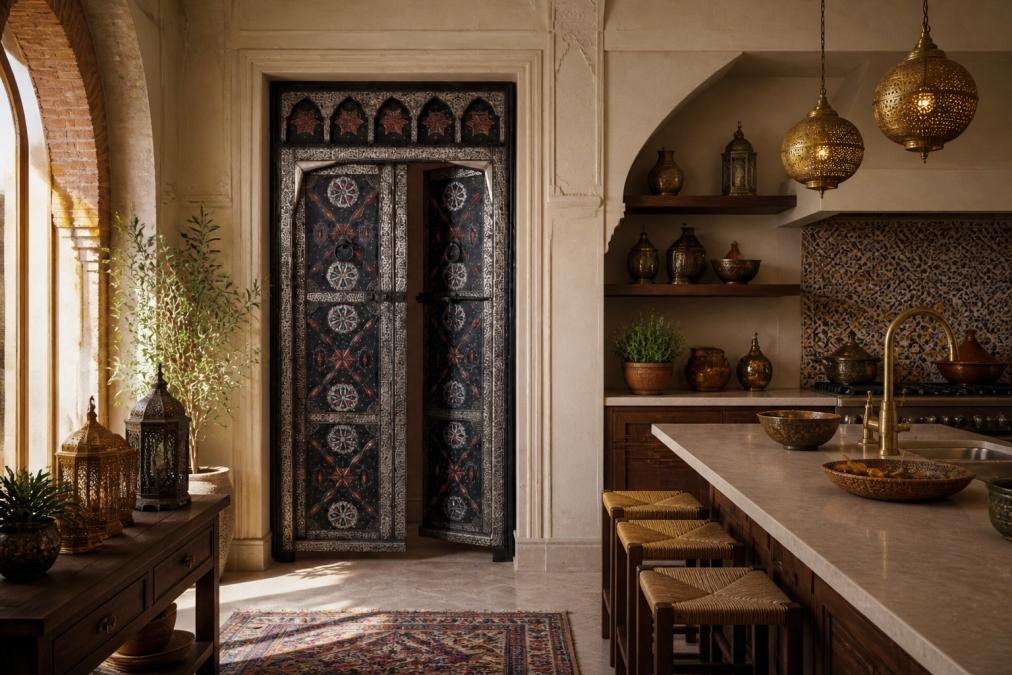
Beyond doors, Justmorocco handles full kitchen and bathroom remodeling projects, sourcing custom cabinetry, zellige tile installations, and bespoke fixtures. The company ships directly to California, Texas, New York, and Florida, managing crating and packing in-house to protect delicate mother-of-pearl inlays and intricate tilework during transit. Justmorocco provides documentation of artisan work, photographs from production, and can arrange video calls with craftspeople during creation.
The company's strength lies in bridging authentic Moroccan craftsmanship with US structural requirements. Their team understands local building codes, can work with your architect's plans, and sources materials that withstand US climate conditions, critical for homeowners in humid or coastal environments.
2. Artisan-Led Design Firms Specializing in Riad Interiors
Specialized design firms focus on creating entire riad-inspired interiors, the traditional Moroccan courtyard home aesthetic adapted to US floor plans. These firms typically employ architects trained in Moroccan design principles alongside artisans who execute custom plasterwork, stucco detailing, and spatial planning.
The riad design approach centers on a central courtyard with rooms arranged around it, often featuring a fountain, arcaded walkways, and carefully orchestrated light through zellige screens and lattice work. These firms excel at understanding how Moroccan architectural elements function structurally and aesthetically within Western homes. They handle permitting conversations with local building departments, specify materials meeting fire codes and seismic requirements, and coordinate with contractors familiar with plasterwork and custom cabinetry installation. The cost for a full riad-inspired interior renovation typically starts at $150,000 and scales upward depending on square footage and custom element density.
3. Full-Service Moroccan Architectural Consultants
Full-service consultants function as your project manager, designer, and artisan liaison combined. They assess your space, develop a design plan aligned with authentic moroccan architectural design services principles, source materials and craftspeople, manage timelines, and oversee installation.
These consultants typically charge either a flat project fee or a percentage of the total project cost (usually 15-25%). They handle the complexity of coordinating multiple vendors, ensuring cohesion across materials and execution quality. The best consultants maintain relationships with specific artisans and can speak to their work quality, reliability, and timeline accuracy. They also understand regional variations in Moroccan style, geometric patterns and color palettes differ between Fez, Marrakesh, and Tangier, and can advise which aesthetic suits your home's existing architecture.
4. Specialized Moroccan Architectural Elements for Home Remodeling
When you're not doing a full renovation but want to integrate moroccan architectural design services into specific rooms, specialized suppliers focus on individual components: zellige tile, carved doors, plasterwork panels, and lighting fixtures.
Justmorocco's tile offerings exemplify this category. The Cordobesa tile ($68 per piece) and Moroccan kitchen backsplash tileUI ($72 per piece) are handcrafted mosaic tiles suitable for backsplashes, accent walls, or floor installations. Each tile carries variations in glaze and pattern reflecting artisanal production. A kitchen backsplash using zellige tiles typically runs 40-80 square feet, translating to $2,720-$5,760 in tile alone, plus installation labor Specialized suppliers often provide design consultation for free or at a reduced rate, helping you determine the right scale and placement of elements. For homeowners seeking to complement these tiles with coordinating furnishings, custom moroccan kitchen can provide handcrafted pieces that echo the zellige's geometric patterns and authentic Moroccan craftsmanship, creating a cohesive interior aesthetic.
Hiring Moroccan Design Consultants: What to Ask
Understanding your options and their trade-offs is essential before you commit.
Three Supply-Chain Models
Model 1: Full-Service Design Firm
A design firm employs architects, interior designers, and project managers in-house. They handle everything: initial consultation, design development, permitting, artisan sourcing, project management, and installation oversight.
Advantages:
- Single point of accountability for the entire project
- Integrated design process; the architect understands structural requirements
- Permitting and code compliance handled in-house
- Centralized quality control
Disadvantages:
- Higher overhead; you're paying for staff and infrastructure
- Less direct access to artisans; the firm acts as middleman
- Longer initial timeline; design process adds 2-4 weeks
- Cost: Design fees typically run 10-20% of total project cost, plus material and labor markups (15-25%)
Model 2: Independent Consultant or Project Manager
An independent consultant is a freelancer or small firm (1-3 people) specializing in Moroccan design. They develop the design, source artisans, manage timelines, and oversee installation, but don't employ artisans or handle permitting directly.
Advantages:
- Lower overhead; consultants charge 8-15% of project cost
- Direct artisan relationships; many have worked with specific Maâlems for years
- Greater flexibility; more responsive to design changes
- Authenticity; deep cultural knowledge and regional sourcing expertise
Disadvantages:
- Divided responsibility if something goes wrong
- Permitting burden falls on you; you'll need to hire an architect separately
- Less quality control; you rely on installer's competence
- Risk concentration if consultant becomes unavailable mid-project
Model 3: Direct Artisan Sourcing (Maâlem-to-Homeowner)
You work directly with a master craftsperson in Morocco, either through an importer like Justmorocco or by traveling to Morocco. The artisan produces the piece, and you arrange shipping and installation.
Advantages:
- Lowest material cost; no middleman markup
- Maximum authenticity; commissioning from the source
- Direct communication about design details and timeline
- Greater flexibility; artisans accommodate custom requests readily
Disadvantages:
- Language and cultural barriers; most artisans don't speak English fluently
- No accountability if the piece arrives damaged or doesn't meet expectations
- Shipping and logistics are your responsibility
- Installation is your problem; you must hire and oversee a local installer
- Timeline uncertainty; artisans may prioritize local commissions
Vetting Consultants and Artisans: The Right Questions
Experience and Track Record
- How many moroccan architectural design services projects have you completed in the last 3 years? Request a portfolio with before-and-after photos.
- Can you provide three client references from projects completed in the last 18 months?
- For artisans: How long have you been practicing your craft? Do you have photographs of work for other US clients?
Sourcing and Authenticity
- Where do you source materials and artisans? Do you work with specific craftspeople or broker relationships each project?
- Can you provide documentation of handcrafted work? This includes production photographs, video calls with the artisan during creation, and material certifications.
- For zellige tile: Is it newly handcrafted or vintage (salvaged from Moroccan riads)?
- For carved doors: Can you show me examples of the specific artisan's work?
- What happens if I want to modify the design mid-project? Can the artisan accommodate changes, and what's the cost?
Timeline and Contingency
- What's the realistic timeline from design approval to installation completion? Break this down: design, artisan production, shipping, installation.
- What happens if an artisan misses a deadline? Do you have a backup artisan?
- What happens if a shipment is damaged in transit? Do you carry insurance?
Structural and Code Compliance
- Have you worked with my local building department? Can you navigate permitting for custom architectural elements?
- For my climate zone, what modifications are needed to ensure Moroccan elements perform well?
- Will you coordinate with my architect on structural calculations and fire-rating documentation?
Budget and Change Orders
- Provide a detailed estimate broken into: materials, artisan labor, shipping and logistics, installation labor, design/consulting fees, and contingency (10-15%).
- What's included in your fee? Are you charging a flat fee, a percentage of project cost, or hourly?
- What's the process if I want to modify the design mid-project? How are change orders priced?
Warranty, Insurance, and Maintenance
- What warranty do you offer on your work?
- Do you carry liability insurance? Can you provide a certificate of insurance?
- What maintenance does handcrafted Moroccan work require in my climate?
Red Flags: When to Walk Away
- The consultant can't provide three recent references or is evasive about past projects.
- They can't explain how they'll handle permitting or code compliance.
- They pressure you to commit before you've seen samples or production documentation.
- They can't articulate climate-specific requirements for your region.
- They offer a fixed price without a detailed breakdown or contingency.
- They have no insurance or can't provide proof of it.
The Artisan Relationship: Direct Sourcing Considerations
If you're sourcing directly from a Maâlem (master craftsperson), understand that the relationship operates on different timelines and communication norms than Western design firms.
Communication and Language: Most Moroccan artisans don't speak English. You'll need a translator or intermediary like Justmorocco. This adds cost ($500-$2,000) but prevents misunderstandings.
Payment Terms: Moroccan artisans typically require 50% upfront and 50% upon completion. Establish clear payment terms in writing, ideally through an intermediary who can hold funds in escrow.
Timeline Expectations: Moroccan artisans prioritize local commissions. An international order may take longer than quoted. Build 2-4 weeks of buffer into your timeline.
Quality Control: Request progress photographs weekly. Video calls with the artisan during production provide reassurance but require scheduling around time zones.
Shipping and Customs: International shipping from Morocco involves customs clearance, adding 1-2 weeks and $500-$1,500 in fees. Work with a logistics coordinator or importer; don't attempt this yourself unless experienced with international trade.
Authenticity Verification: Ask the artisan for documentation: photographs of their workshop, examples of completed pieces, and references from other international clients. Reputable artisans are proud of their work and provide this readily.
Making the Decision
Start by defining your project scope and budget. If you're doing a single custom door or small zellige accent, direct artisan sourcing or an independent consultant makes sense. If you're doing a major renovation with multiple custom elements, structural modifications, and permitting complexity, a design firm's accountability justifies the cost. If you want a middle ground, lower cost than a firm but more accountability than direct sourcing, an independent consultant with a track record in your region is ideal.
Once you've chosen a model, vet thoroughly. References matter more than credentials. Ask about climate-specific challenges and code compliance. Request production documentation and samples. Establish clear expectations in writing: timeline, budget, change-order process, warranty, and maintenance. moroccan modern home design trends.
Custom Moroccan Tile Installation and Zellige Craftsmanship
Zellige represents the pinnacle of Moroccan tilework, geometric mosaics hand-cut and arranged to create intricate patterns. Unlike mass-produced ceramic tile, zellige is labor-intensive: artisans cut each piece individually, then set them in plaster using traditional methods refined over centuries.
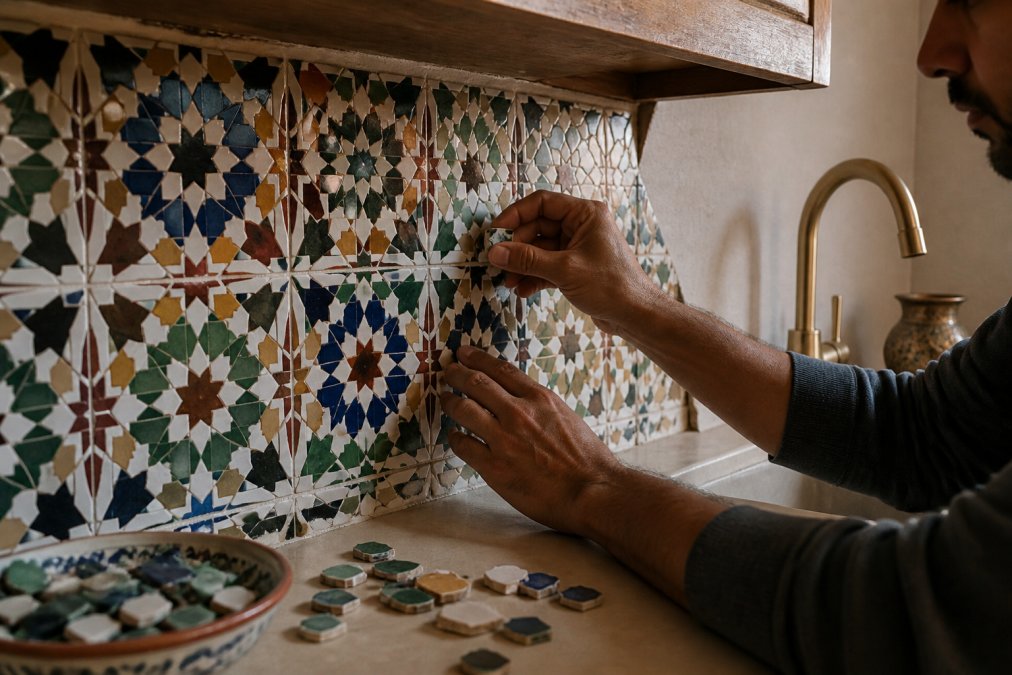
A zellige installation begins with design incorporating Islamic geometric principles like eight-pointed stars (Khatim) or interlocking hexagons. The pattern is hand-cut from glazed ceramic pieces, each one slightly irregular due to the handmade process. This irregularity signals authenticity and craftsmanship. The tiles are then set in a lime-based plaster bed, a technique differing from standard thin-set mortar used in US tile work.
Installation requires artisans experienced in zellige methods. A standard kitchen backsplash (40 square feet) takes 2-4 weeks to install properly. The cost per square foot ranges $150-$400 depending on pattern intricacy and whether you're using vintage zellige (salvaged from Moroccan riads) or newly handcrafted pieces. Maintenance is straightforward: zellige doesn't require sealing like natural stone, but grout lines should be sealed to prevent moisture penetration, especially in kitchens and bathrooms.
Budgeting, Timelines, and Structural Compliance
A realistic budget for moroccan architectural design services projects spans a wide range depending on scope. Understanding the cost structure, what drives price variation and where hidden expenses emerge, separates informed homeowners from those surprised by invoices.
Cost Estimation Framework
Moroccan architectural elements break into four cost categories: materials, artisan labor, shipping and logistics, and installation.
Materials form the foundation. A handcrafted zellige tile costs $68-$72 per piece. A 40-square-foot kitchen backsplash requires roughly 60-80 tiles, totaling $4,080-$5,760 in tile alone. Carved cedar doors range from $1,600 for a standard single door to $12,000 for statement pieces. Custom plasterwork (arches, corbels, wall panels) runs $150-$400 per linear foot. These material costs reflect genuine artisanal production; mass-produced "Moroccan-style" alternatives cost 40-60% less but lack authenticity and longevity.
Artisan labor and production time is where custom work diverges from off-the-shelf products. A master carpenter (Maâlem) in Morocco charges $15-$40 per hour, but a single carved door requires 80-200 hours depending on complexity, translating to $1,200-$8,000 in labor. Custom tile patterns designed and hand-cut by a zellige artisan add 2-4 weeks to production and $2,000-$6,000 to the project cost.
Shipping and logistics are often underestimated. A carved door weighs 150-300 pounds and requires custom crating. Shipping from Morocco to the US costs $800-$2,500 depending on weight and destination. Zellige tiles incur shipping costs of $0.50-$1.50 per tile. Large plasterwork panels or custom cabinetry can incur $2,000-$8,000 in freight. Insurance during transit (recommended for pieces over $5,000) adds 2-5% to shipping costs.
Installation labor varies by region and complexity. Zellige tile installation requires an artisan experienced in traditional plaster-bed methods. Expect $50-$100 per square foot for labor, meaning a 40-square-foot backsplash costs $2,000-$4,000 to install. Hanging a carved door and fitting it to your frame runs $500-$1,500. Plasterwork installation (arches, corbels) costs $100-$250 per linear foot.
Sample Project Budgets
Single Accent Door + Zellige Backsplash
- Carved cedar door: $2,800
- Zellige tiles (60 pieces): $4,200
- Door installation: $800
- Tile installation (40 sq ft): $2,500
- Shipping and logistics: $1,200
- Total: $11,500
- Timeline: 14-18 weeks
Full Kitchen Remodel
- Custom cabinetry (40 linear feet): $18,000-$28,000
- Zellige backsplash (60 sq ft): $9,000-$14,400
- Handcrafted lighting and fixtures: $3,000-$8,000
- Brass hardware and door handles: $1,500-$3,000
- Installation labor: $6,000-$10,000
- Shipping and logistics: $2,500-$4,000
- Design consultation and project management: $3,000-$6,000
- Total: $43,000-$73,400
- Timeline: 18-26 weeks
Riad-Inspired Interior
- Architectural design and planning: $8,000-$15,000
- Plasterwork (200 linear feet): $16,000-$40,000
- Zellige tile (200 sq ft): $30,000-$80,000
- Custom doors and screens (4-6 pieces): $8,000-$30,000
- Handcrafted lighting and fixtures: $5,000-$15,000
- Cabinetry and built-ins: $10,000-$25,000
- Installation labor: $15,000-$35,000
- Shipping and logistics: $5,000-$12,000
- Project management and contingency (10%): $10,000-$25,000
- Total: $107,000-$277,000
- Timeline: 24-36 weeks
Structural Compliance and Building Code Integration
Moroccan architectural elements must meet current building codes. The challenge is that most building inspectors are unfamiliar with traditional Moroccan construction methods, and some elements don't fit standard code categories.
Fire Rating and Materials is the first hurdle. Moroccan carved wooden doors must meet fire-rating requirements in most jurisdictions (fema.gov). A traditional carved cedar door may not have a fire rating; you'll need either a fire-rated door with Moroccan-style cladding applied, or documentation from your architect that the door meets equivalent safety standards. Plasterwork and zellige tile are inherently fire-resistant, but the adhesive and grout must meet fire codes.
Seismic and Structural Requirements vary by region. In California, Oregon, and Washington, seismic codes are stringent. Heavy plasterwork, zellige tile installations, and carved wooden screens must be properly anchored to prevent failure in an earthquake. A consultant or architect must specify attachment methods, typically using modern fasteners hidden behind the Moroccan aesthetic. This adds cost ($2,000-$8,000) and requires coordination with the building department early in design.
Moisture and Humidity Control is critical in humid climates. Moroccan homes were designed for hot, dry conditions; zellige tile, lime-based plaster, and cedar wood can deteriorate in Florida, Louisiana, or the Pacific Northwest without proper moisture barriers. Your architect or consultant must specify vapor barriers behind plasterwork, ensure zellige grout is sealed annually, and confirm that cedar doors have protective finishes suitable for your climate. In coastal areas, all metal hardware must be stainless steel or brass to resist corrosion. This climate adaptation adds $3,000-$10,000 but prevents costly damage later.
Permitting Strategy should begin before design is finalized. Submit a detailed scope of work and material specifications to your local building department, ideally with drawings from a licensed architect. Include material certifications, fire-rating documentation, structural calculations, and moisture management plans. Most building departments will either approve the plan or request modifications.
Timeline Impact of Compliance should be factored into your project schedule. Permitting adds 2-6 weeks upfront. Structural calculations or fire-rating documentation add 1-2 weeks. A 20-week project can become 24-28 weeks once permitting is included.
Change Orders and Cost Control
Establish a change-order process upfront: any design modification must be documented in writing and priced before work begins. Material costs are fixed once approved; labor and shipping adjustments are itemized separately. Changes requested after artisan production has begun incur a rush fee (typically 15-25%).
ROI and Long-Term Value
Handcrafted Moroccan elements are an investment. Authentic architectural details can increase home value in design-conscious markets. A $60,000 investment in a custom kitchen remodel with zellige and handcrafted cabinetry can add value. These elements don't trend; they're timeless. Maintenance costs are minimal: zellige tile requires annual grout sealing ($200-$500), cedar doors need refinishing every 5-7 years ($800-$2,000), and plasterwork may need touch-ups if cracks appear ($500-$2,000 per repair).
Authenticating Handcrafted Work and Building Confidence
The customer objection is fundamental: "How do I know these pieces are actually handcrafted and not just mass-produced items marked up as artisanal?"
Authentic handcrafted moroccan architectural design services elements display specific markers. Carved wooden doors show tool marks and slight irregularities; each piece is unique. Mass-produced doors exhibit perfect uniformity and CNC-routed precision. Zellige tiles vary slightly in glaze color and thickness; factory tiles are identical. Plasterwork features organic curves and hand-modeled details; machine-cast plasterwork is uniform.
Request production documentation: photographs or video from the artisan's workshop showing the piece being made. Justmorocco can arrange this for custom commissions. Ask about the artisan's background and training. Have they completed work for other US clients? References matter.
Examine samples in person before committing. A zellige sample tile in your lighting reveals glaze depth, color variation, and surface texture. A door sample shows wood grain, carving detail, and finish quality. Reputable suppliers encourage this examination.
For high-value pieces (doors over $5,000, extensive tile installations), request a third-party authentication or appraisal. Some consultants have relationships with Moroccan cultural organizations or art experts who can verify authenticity. This cost ($500-$1,500) is reasonable insurance on a $50K+ project. Insurance and shipping protection matter equally. Confirm that your supplier carries insurance during transit and that pieces are properly crated. Request photographic documentation before and after shipment. Have a clear process for replacement or refund if damage occurs.
Choosing the right provider for custom moroccan architectural design services comes down to three factors: authenticity verification, timeline realism, and climate adaptation. Justmorocco excels because they source directly from Moroccan artisans, provide production documentation, and understand US structural and climate requirements. Their handcrafted doors, from the Moorish single door at $1,600 to the Fez royal palace door at $12,000, represent genuine artisanal work. For homeowners serious about bringing authentic Moroccan craftsmanship into their homes, starting with a reputable importer and custom design partner eliminates the risk of investing in pieces that won't endure.
| Service Type | Timeline | Budget Range | Best For |
|---|---|---|---|
| Single custom door | 10-14 weeks | $1,600-$12,000 | Accent entryways, riad-inspired entries |
| Zellige backsplash (40 sq ft) | 4-6 weeks | $6,000-$16,000 | Kitchen or bathroom focal points |
| Full kitchen remodel | 16-24 weeks | $40,000-$100,000+ | Comprehensive Moroccan aesthetic |
| Riad-inspired interior | 20-28 weeks | $150,000-$300,000+ | Major renovation with courtyard design |
| Plasterwork and archways | 8-12 weeks | $8,000-$25,000 | Spatial definition and architectural detail |
The investment in moroccan architectural design services yields homes that feel intentional, culturally grounded, and built to last. Homes with authentic cultural architectural elements retain value better than those with generic finishes, particularly in markets where design-conscious buyers cluster. Start by clarifying your project scope and budget. Engage a consultant who can speak credibly about artisan sourcing and climate requirements. Request production documentation and samples. Verify insurance and shipping protection. Then commit to the timeline, authentic work cannot be rushed, and trust the process that has created beautiful homes for centuries.
Frequently Asked Questions
How can I verify that custom Moroccan architectural design services are using authentic handcrafted pieces?
Authentic handcrafted Moroccan work shows individual variation, tool marks, and natural patina that mass-produced items lack. Request documentation of the artisans' work, photos of their workshop, and examples of completed projects. Justmorocco, for instance, sources directly from master craftsmen in traditional souks and provides detailed product descriptions showing the handmade construction. Ask your service provider for certificates of authenticity, artisan credentials, and the ability to communicate directly with makers when possible.
What should I budget for custom Moroccan architectural elements for home remodeling?
Costs vary dramatically based on scope and materials. A handcrafted Moroccan door ranges from $1,600 to $12,000 depending on size and intricacy. Custom kitchen or bathroom remodeling with authentic zellige tile, carved cabinetry, and architectural features typically starts at $15,000 and can exceed $200,000 for comprehensive projects. Factor in design consultation (usually 10-15% of project cost), shipping for international pieces, and installation labor. Get detailed quotes that itemize materials, artisan fees, and structural work separately.
How long does a custom Moroccan architectural design project typically take?
Timeline depends on complexity and sourcing. Simple tile installation or single-door installation may take 2-4 weeks. Full custom kitchen or bathroom remodeling with handcrafted elements typically requires 4-6 months from design approval to completion. This includes design consultation (2-4 weeks), artisan fabrication (6-12 weeks for custom pieces), shipping (2-4 weeks internationally), and on-site installation (2-4 weeks). Discuss timelines early, as handcrafted work cannot be rushed without compromising quality.
Will handcrafted Moroccan architectural pieces hold up in humid climates or coastal environments?
Authentic Moroccan pieces are built to endure, but climate matters. Cedar and other traditional woods used in Moroccan doors and cabinetry are naturally resistant to pests and moderate humidity. However, coastal salt air and extreme humidity require protective finishes and maintenance. Zellige tiles are extremely durable and actually improve with age. Ask your designer about climate-appropriate sealants, wood treatments, and maintenance schedules for your specific environment. Justmorocco can advise on finishing options suitable for different regions.
What makes hiring Moroccan design consultants different from working with a standard interior designer?
Moroccan design consultants bring deep knowledge of authentic architectural principles, traditional craftsmanship, cultural symbolism, and sourcing networks that standard designers lack. They understand how zellige, arabesque patterns, horseshoe arches, and riad courtyards function structurally and aesthetically. They have relationships with master artisans and can authenticate handcrafted work. They also navigate permitting and structural compliance for authentic elements in modern homes. This expertise prevents costly mistakes like installing pieces that don't fit your layout or purchasing mass-produced items marketed as handcrafted.