

Last Updated: November 20, 2026
Quick Summary
A Moroccan home office is worth the investment when you choose the functional pieces first: a carved wood desk, layered lighting, and a wool rug that absorbs sound. Start with lighting and a rug, then add handcrafted furniture as your budget allows, since light and floor cover change the feel of a room fastest.
- Aim for task lighting in the 3000K to 4000K range so paper and screens read accurately.
- Keep the palette to two textile colors so Moroccan weaving does not tip the room from layered to busy.
- Standard desk height in the United States is about 29 to 30 inches, so measure your seated elbow height first.
- Keep a patterned pierced lantern off to the side of your screen, not directly above it.
- The entry tier is one lantern, one wool rug, and one textile, which reads Moroccan without new furniture.
Table of Contents
- Why a Modern Luxury Home Office with Moroccan Accents Works
- Modern Moroccan Home Office Ideas That Balance Style and Function
- Choosing Moroccan Lighting for Home Office Tasks
- Moroccan Rugs and Textiles That Anchor the Workspace
- Moroccan-Inspired Custom Cabinetry for a Seamless Workspace
- Color Palettes and Metallic Accents for a Professional Look
- Ergonomics and Comfort in a Moroccan-Styled Office
- Budget Tiers and Sourcing Alternatives for Moroccan Office Pieces
- Planning Your Moroccan Home Office with Justmorocco
- Frequently Asked Questions
Why a Modern Luxury Home Office with Moroccan Accents Works
A modern luxury home office with Moroccan accents works because it pairs clean, contemporary lines with hand-worked materials that add warmth and depth. The contrast is the point. A plain desk against a carved wood screen, or a sleek laptop on a hand-painted table, feels considered rather than themed. This guide from Justmorocco walks through the practical side of building that room.
Design coverage of Moroccan interiors keeps returning to the same idea: material honesty and visible making. Arabastta's Moroccan home decor trend coverage describes growing demand for handcrafted furniture rather than mass-produced lookalikes. That shift matters in a workspace you sit in every day.
Here is what most guides get wrong. They treat Moroccan style as a layer of decoration added last. In practice, the pieces that carry the room, the desk, the rug, the lighting, are the ones you choose first.
For a deeper grounding in authentic style before you commit, read our guide to authentic Moroccan style for custom furniture.
Modern Moroccan Home Office Ideas That Balance Style and Function
The strongest modern Moroccan home office ideas start with function and let the craft follow. You need a work surface, storage, good light, and a comfortable chair. Moroccan details then go where they add texture without blocking the work.
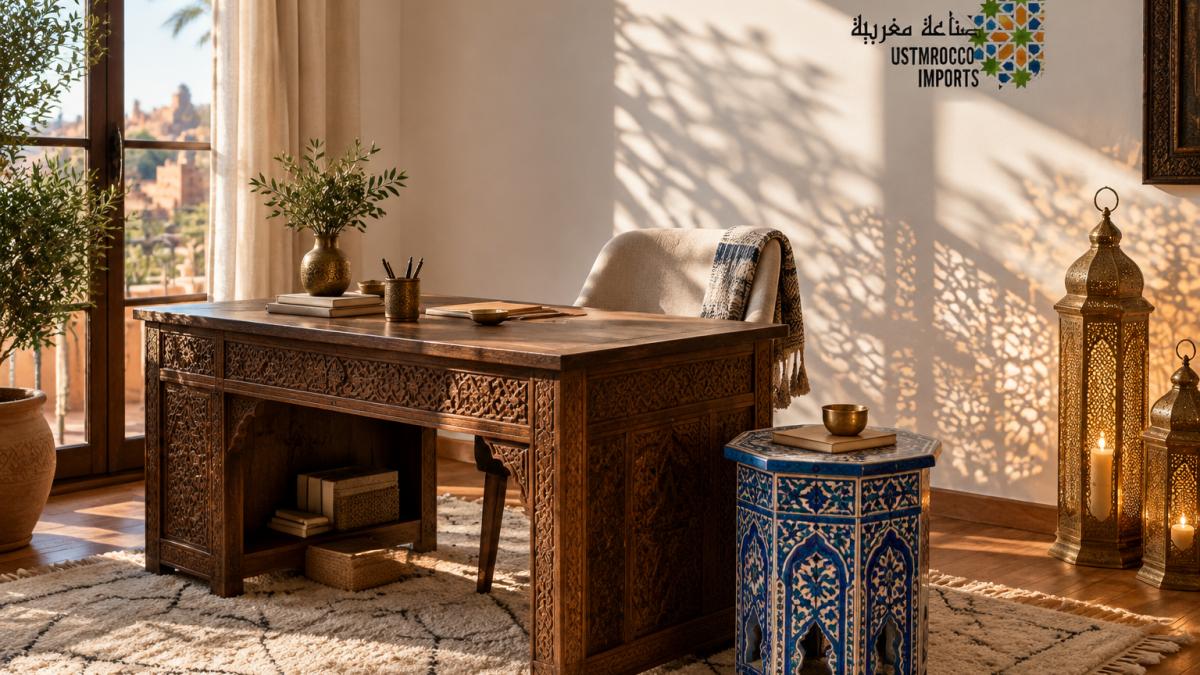
Five ideas that hold up in daily use:
- A carved wood desk as the anchor. Choose one with visible joinery and keep the surface clear.
- One bold accent table. A hand-painted hexagonal piece beside the desk adds color without clutter.
- A pierced metal lantern overhead. The light pattern does the decorating for you.
- A wool rug under the chair. It softens sound and protects the floor.
- A single textile on one wall. One hanging, not five.
The rule we give clients: one statement piece per sightline. Walk into the room and count what competes for attention. If it is more than one thing, remove something.
Choosing Moroccan Lighting for Home Office Tasks
Moroccan lighting for home office work needs two jobs done at once: task light you can actually see by, and ambient light that sets the mood. Decorative lanterns alone will not carry a workday. Plan them as layers, not as your only source.
Start with a desk lamp that puts light where your hands are. Add an overhead fixture for general brightness. Then bring in the Moroccan piece as the character layer.
- Task layer: an adjustable desk lamp, positioned to the side of your writing hand
- Ambient layer: a pierced brass or bone-inlaid pendant, hung above the desk or seating area
- Accent layer: a small lantern on a shelf for evening warmth
Most practitioners find that a workable office lighting plan comes down to three numbers: color temperature, brightness, and fixture position. For a home office, aim for task lighting in the 3000K to 4000K range so paper and screens read accurately without the blue cast of cooler bulbs. Ambient light can sit warmer, around 2700K, which flatters brass, bone inlay, and hand-painted wood. A desk lamp in the 400 to 600 lumen range is a common starting point for close work; an overhead fixture should add general brightness without becoming the only source on the desk.
Position matters as much as output. Put the desk lamp on the side opposite your writing hand so your arm does not cast a shadow across the page.
Watch out: pierced metal lanterns throw patterned light that looks beautiful and reads badly on paper. Keep the patterned fixture off to the side of your screen, not directly above it. The same rule applies to video calls, a lantern directly behind your monitor puts a moving pattern on your face and on the wall behind you, which reads as visual noise to everyone on the call.
A real piece to build around is our Johara chandelier, a camel bone and multicolor glass hanging fixture. It measures 33 inches tall by 26 inches wide, so it suits a room with height. For a smaller office, browse the large vintage Moroccan lantern instead.
For evening work, dim the ambient layer and rely on the task lamp plus one accent lantern.
Moroccan Rugs and Textiles That Anchor the Workspace
Moroccan rugs and textiles anchor a workspace by defining the zone and absorbing sound. An office with hard floors and bare walls echoes on every call. A wool rug under the desk fixes most of that.
Choose by size first, pattern second. The rug should extend past the desk and chair so the chair rolls fully on it, not half on and half off. A common mistake is buying a small rug for a large desk and leaving a border of bare floor that looks unintentional.
Textiles do the rest:
- A wool or cotton rug in cream, charcoal, or a muted jewel tone
- One cushion on the accent chair, in a contrasting weave
- A single wall hanging if the room needs softness on a hard surface
Keep the palette to two textile colors. Moroccan weaving already carries pattern, and a third color tips the room from layered to busy. For sizing help, our guide on how to choose the right Moroccan rug for a luxury space covers proportion room by room.
Moroccan-Inspired Custom Cabinetry for a Seamless Workspace
Moroccan-inspired custom cabinetry solves the problem ready-made furniture cannot: fitting a handcrafted look into your actual room dimensions. Off-the-shelf pieces leave gaps and awkward corners. Custom work closes them.
This matters most when the office shares a wall with a kitchen or bath project. If you are already commissioning cabinetry elsewhere in the house, matching the door profile and finish across rooms reads as one design rather than two.
What to specify before you sign off:
- Exact dimensions of the wall, including outlets and vents
- Door style and whether panels are flat, carved, or pierced
- Finish and hardware, so it matches existing pieces
- Interior layout for files, printer, and cables
Our bespoke Moroccan cabinetry for luxury homes article shows the options before you commit to a design. We can work with architect plans for custom projects.
Color Palettes and Metallic Accents for a Professional Look
Color palettes and metallic accents decide whether a Moroccan office reads luxurious or chaotic. The safe structure is a neutral base, one jewel tone, and one metal. That is it.
Neutral hues carry the walls, floor, and large furniture. Warm white, sand, stone gray, and soft taupe all work. Jewel tones go on the small pieces: an emerald green table, a sapphire blue panel, a ruby cushion.
Gold accents and metallic finishes belong on hardware, lamp frames, and trim. Brass ages well and warms a cool room. Keep the metal consistent. Mixing brass, chrome, and black iron in one small room looks accidental.
| Layer | What to Choose | Where It Goes |
|---|---|---|
| Base | Warm white, sand, stone | Walls, floor, desk |
| Accent | Emerald, sapphire, terracotta | One table or panel |
| Metal | Aged brass | Lighting, hardware |
| Texture | Wool, leather, carved wood | Rug, chair, screen |
A hand-painted piece does the accent job alone. Our Marrakech side table is a hexagonal Zouaq-painted table with turned-wood lattice sides, and it works as the single hit of color in a neutral room.
Ergonomics and Comfort in a Moroccan-Styled Office
Ergonomics and comfort come before decoration in any office you use for hours. A beautiful room that hurts your back is a failed room. Get the working triangle right first: screen height, chair support, and foot position.
Set the top of your screen at eye level. Sit with feet flat and knees near a right angle. Keep your wrists straight at the keyboard. These basics do not change because the desk is carved wood.
A common pattern in home offices is a desk that is slightly too low or too high for the person using it, and a decorative chair that was chosen for looks. Standard desk height in the United States is about 29 to 30 inches, and most ergonomic guidance puts the keyboard surface at roughly elbow height when you are seated. Measure your seated elbow height before you buy a carved table as a desk; if the table sits more than an inch or two off that number, plan to use a keyboard tray or treat the table as a side piece.
Then adapt the Moroccan pieces to your body:
- Desk height: a decorative table may sit lower than a work desk. Measure before you buy.
- Chair: put an upholstered chair with real lumbar support at the desk, and use the accent chair for reading only.
- Rug thickness: a thick pile rug under a rolling chair makes it hard to move. Choose a flatter weave under the desk.
- Monitor distance: set the screen roughly an arm's length away, with the top of the screen at or slightly below eye level.
- Foot support: if the chair does not adjust low enough for your legs, use a footrest rather than letting your feet dangle.
Acoustic comfort is the piece most Moroccan office guides skip. Hard floors, plaster walls, and metal lanterns reflect sound, and a room that echoes makes every call sound hollow. A wool rug under the desk, a textile wall hanging, and an upholstered chair absorb most of it. If the room still rings, a bookcase with solid back panels does more than another cushion.
Lighting and ergonomics meet at the screen. Keep a task lamp on the side opposite your writing hand, angle it away from the monitor, and avoid placing a pierced lantern directly behind your chair on video calls. A plain wall behind the camera, with one textile or one lantern off to the side, reads calmer and more professional than a busy backdrop.
Finally, build in a standing option if the room allows it. A counter-height console or a tall side table can hold a laptop for short standing stretches, and it gives a carved piece a second job in the room.
Budget Tiers and Sourcing Alternatives for Moroccan Office Pieces
Budget tiers let you build the room in stages instead of all at once. Most of our clients start with lighting and a rug, then add furniture as the budget allows. That order works because light and floor cover change the feel of a room fastest.
Three practical tiers:
- Entry: one lantern, one wool rug, one textile. The room reads Moroccan without new furniture.
- Mid: add a hand-painted side table and a better desk chair. Now the craft shows.
- Full: commission cabinetry and a statement light. This is the room that gets photographed.
For sourcing, buy fewer pieces and buy real ones. A single hand-worked item outlasts three factory copies. Our guide on how to budget for a custom Moroccan home renovation breaks down where the money actually goes.
Planning Your Moroccan Home Office with Justmorocco
Planning the room is where most projects stall. The pieces are beautiful, the room is the right size, and then nobody measures the wall. We would start with a simple list: wall dimensions, outlet positions, desk height you need, and the one piece you love most. Build around that piece.
At Justmorocco, we import handcrafted Moroccan furniture and decor and ship directly to clients across the country. Our catalog includes vintage and newly handmade pieces, mother-of-pearl and bone-inlay work, custom doors, lighting, and ceiling panels. We also take on custom design projects.
If you are weighing a full custom build, our custom furniture imports page explains how the process runs from first sketch to delivery.
A home office should feel like the best room in the house, not the one you avoid. Start with one piece you love, measure the wall honestly, and add light and a rug before anything else. Get started with Justmorocco and build a workspace that looks handcrafted because it is.
Frequently Asked Questions
How do you decorate a modern home office with Moroccan accents without making it feel cluttered?
Start with a neutral base: a plain desk, a simple chair, and walls in warm white or sand. Add two or three Moroccan focal pieces, such as a hand-painted side table, a brass lantern, and a Beni Ourain rug. Keep patterns large and few, and leave empty wall space between them. The goal is visual layering, not filling every corner. A $210 Marrakech side table can anchor a reading nook without overwhelming the room.
What Moroccan lighting works best for a home office?
Use a mix of task and ambient lighting. A Johara chandelier can provide overhead light, while a desk lamp handles focused work. Moroccan lanterns with perforated metal cast patterned shadows that add atmosphere but can glare on screens, so place them to the side or behind the monitor.
Can Moroccan rugs and textiles work in a small office?
Yes. In a small office, choose a runner or a 5x8 rug instead of a room-filling size. Use one or two accent pillows on a bench or chair, and keep window treatments simple. Layering a small rug over a neutral carpet can define the workspace without visual noise.
How can custom cabinetry improve a Moroccan-inspired home office?
Custom cabinetry hides printers, files, and cables behind carved wood doors or zellij-tiled fronts, keeping the room calm. It also lets you match the desk height and storage to your ergonomic needs. Justmorocco offers custom design projects for Moroccan-inspired pieces. The result is a workspace that looks handcrafted but functions like a modern office.
