
Table of Contents
- Step 1: Assess Your Space and Define Your Vision
- Step 2: Master the Moroccan Rug Size Guide
- Step 3: Explore Moroccan Rug Styles for Luxury Interiors
- Step 4: Verify Authentic Moroccan Rugs and Quality
- Step 5: Match Color and Pattern to Your Luxury Palette
- Step 6: Perfect Moroccan Rug Placement and Furniture Layout
- Step 7: Evaluate Pile Height, Texture, and Durability
- Step 8: Plan for Long-Term Care and Investment Value
- Frequently Asked Questions
Last Updated: October 4, 2026
Step 1: Assess Your Space and Define Your Vision
Before you learn how to choose the right moroccan rug for a luxury space, you need to understand what you're working with. Start by walking through your space at different times of day. Notice how light moves across the room. Check the wall colors, existing furniture, and the overall mood you want to create.
Ask yourself these questions:
- What's the room's primary function (living, sleeping, dining)?
- Do you want the rug to be a focal point or a supporting element?
- What's your current color scheme?
- How much foot traffic does this space get?
At Justmorocco, we help clients match rugs to their spaces by starting with this honest assessment. A rug that looks stunning in a showroom might feel wrong in your home if it doesn't align with your room's proportions and lighting.
Consider the room's architectural style too. A modern minimalist space needs a different approach than a traditional or eclectic interior. Moroccan rugs work beautifully in both, but the selection strategy changes based on how you want the rug to interact with your existing design.
Step 2: Master the Moroccan Rug Size Guide
Getting the size right makes or breaks your design. A rug that's too small floats in the space and feels disconnected. One that's too large overwhelms the room and limits furniture placement.
Standard sizing guidelines:
- Living rooms with seating areas: 8×10 feet or larger. The rug should anchor your main seating group with at least the front legs of sofas and chairs on the rug.
- Bedrooms: 5×8 feet minimum. Position it so it extends on both sides of the bed and at the foot.
- Dining rooms: 8×10 feet or larger. The rug should accommodate the table and chairs, even when chairs are pulled out.
- Entryways: 3×5 feet to 4×6 feet. Smaller rugs work well here to define the entry without blocking traffic flow.
- Under furniture: Leave a visible border of 18-24 inches of floor showing around the rug's edges. This creates visual balance and prevents the rug from looking lost.
Measure your space twice. Account for doorways, traffic patterns, and how furniture will sit. A visible floor border around your Moroccan rug actually strengthens the design by creating intentional negative space.
The vintage and handwoven pieces from Justmorocco come in varied dimensions because each rug is unique. Our Taznakht Atlas Blue measures 98" × 56" (approximately 8.2 × 4.7 feet), making it ideal for defining a seating area or adding warmth to a bedroom without overwhelming the space.
Step 3: Explore Moroccan Rug Styles for Luxury Interiors
Moroccan rugs fall into distinct categories, each with its own aesthetic and construction method. Understanding these styles helps you choose a rug that aligns with your design vision.
Beni Ourain and Azilal Rugs
Beni Ourain rugs are handwoven from wool in the Atlas Mountains. They feature simple geometric patterns, often in neutral tones with touches of color. These rugs have a plush pile and work beautifully in contemporary and minimalist spaces.
Azilal rugs share similar construction but typically display bolder geometric designs and richer color palettes. Both styles emphasize natural wool and traditional dyeing methods that create depth and character.
These rugs suit luxury interiors because their understated elegance doesn't compete with other design elements. They layer well over hardwood floors and complement modern furnishings without feeling dated.
Kilim and Flat-Weave Options
Kilim rugs are flat-woven rather than pile rugs. They're reversible, lightweight, and feature bold geometric patterns that often tell stories through their design language. The flat weave makes them more durable for high-traffic areas.
The Zayan rug exemplifies this style with its deep red-ochre base and horizontal bands of diamonds and chevrons characteristic of Berber craftsmanship. At 124" × 67", it makes a statement in a spacious living room or can anchor a large bedroom.
Flat-weave rugs work exceptionally well in contemporary luxury spaces because their graphic quality reads as intentional design rather than traditional decoration.
Berber Tribal Designs
Berber tribal rugs showcase the handwoven heritage of Berber women in the Atlas Mountains. These hand-knotted pieces feature quilt-like patterns with alternating squares and intricate border work. The colors are achieved through traditionally employed wool dyeing processes.
The Moroccan tribal rug at 82" × 40" demonstrates this style's characteristic double-sided construction and rich, vibrant coloring. These rugs work as focal points in luxury interiors because their craftsmanship quality demands attention.
Step 4: Verify Authentic Moroccan Rugs and Quality
Authenticity matters in luxury design. A genuine handwoven Moroccan rug represents real craftsmanship and cultural heritage. Mass-produced imitations lack the character and durability of authentic pieces.
Handwoven and Hand-Knotted Construction
Handwoven rugs are created on looms by skilled artisans. Hand-knotted rugs are tied knot-by-knot, creating denser, more durable pieces. Both methods take weeks or months per rug, which is reflected in the quality and price.
Check the back of the rug. Authentic handwoven pieces show individual knot work and irregular patterns that prove human creation. Machine-made rugs display perfect, repetitive patterns on the back.
Feel the wool. Genuine Moroccan rugs use natural fibers with texture variation. The pile should feel substantial and slightly uneven, not uniform or synthetic.
Natural Fiber and Dye Assessment
Natural fibers like wool create rugs that age beautifully. Wool is naturally stain-resistant, durable, and develops patina over years of use. Synthetic fibers may look similar initially but lack longevity.
Natural dyes create colors that shift subtly with light. The Taznakht Atlas Blue uses wool dyed with processes traditionally employed by Moroccan artisans. As long as you care for the carpet properly, the colors will not visibly fade.
Synthetic dyes produce flat, uniform colors that fade predictably. In luxury interiors, natural dyes' complexity adds sophistication that synthetic alternatives cannot match.
Provenance and Craftsmanship Documentation
Provenance refers to the rug's origin and history. Authentic pieces come with information about which region they're from, who created them, and when. This documentation adds both value and authenticity.
Ask your supplier where the rug came from and how it was made. Justmorocco sources directly from artisans and includes this background with each piece. Our Taznakht vintage area rug was purchased directly from an artisan on our sourcing trips, ensuring complete authenticity and traceability.
Luxury buyers expect this transparency. Documentation of craftsmanship, materials, and origin justifies premium pricing and ensures you're investing in genuine artisanal work.
Step 5: Match Color and Pattern to Your Luxury Palette
Color and pattern selection determines whether a rug elevates your space or clashes with it. In luxury interiors, restraint often wins over boldness.
Neutral foundations work best for statement rugs. If your walls, furniture, and major pieces are neutral, a patterned or richly colored Moroccan rug becomes the focal point. If you already have multiple patterns or bold colors, choose a rug in neutral tones that grounds the space.
Pattern mixing requires intention. A geometric rug pairs well with solid-colored furniture and simple wall treatments. If you're mixing patterns, ensure they share a color family or similar scale. Small-scale geometric patterns on the rug work with larger-scale patterns in textiles or wallcovering, but not the reverse.
Color temperature matters. Warm-toned rugs (ochres, terracottas, deep reds) suit spaces with warm wood tones and golden lighting. Cool-toned rugs (blues, grays, whites) complement contemporary spaces with cool metals and bright natural light.
Test your choice in the actual room. If possible, arrange for a sample or temporary placement. Lighting changes how colors read throughout the day, and what looks right in a showroom might feel different in your home.
Step 6: Perfect Moroccan Rug Placement and Furniture Layout
Where you place a rug dramatically affects how it functions in your space. Strategic placement creates visual balance and defines zones within larger rooms.
Living Room and Bedroom Positioning
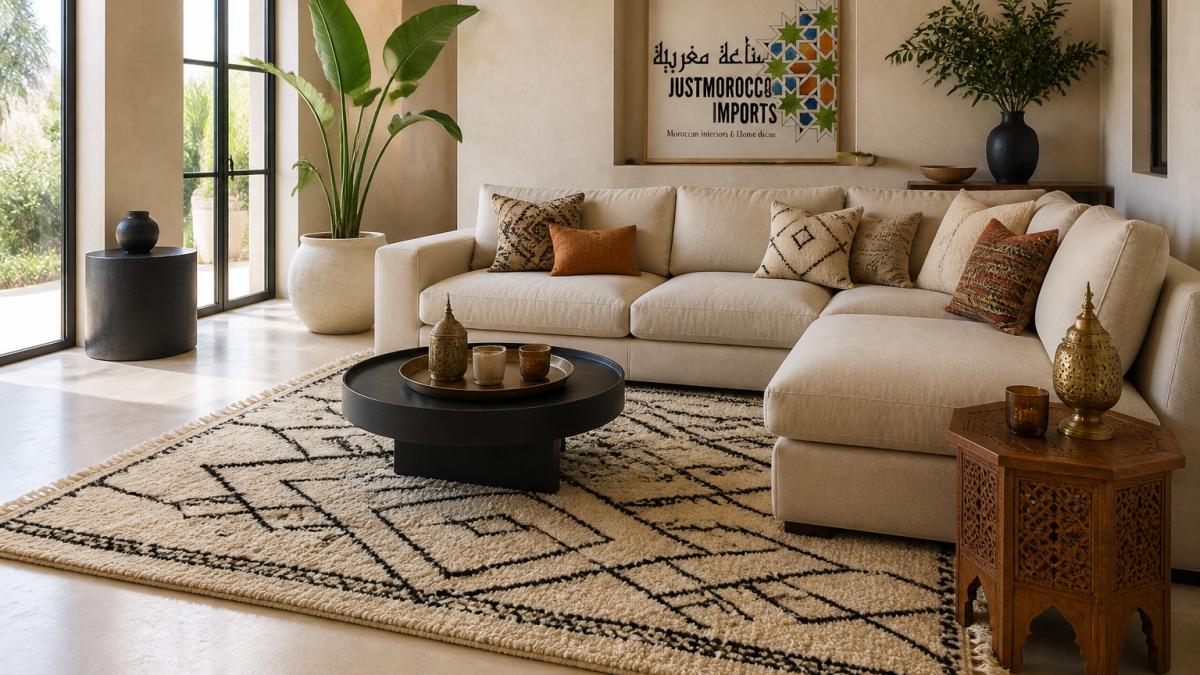
In living rooms, anchor your main seating group with the rug. Position it so the front legs of sofas and primary chairs rest on the rug. This creates a cohesive seating area and visually ties furniture together. Leave that 18-24 inch visible floor border on all sides.
In bedrooms, place the rug at the foot of the bed or on both sides, extending outward. This creates a soft landing when you step out of bed and visually expands the sleeping area. A rug that's too small under the bed looks awkward; a properly sized one becomes a design anchor.
For dining areas, the rug should accommodate the table and allow chairs to sit on it even when pulled out. This prevents the rug from shifting and keeps the dining area visually unified.
Creating Visual Balance and Focal Points
A Moroccan rug naturally becomes a focal point because of its pattern and craftsmanship. Use this to your advantage. Position it where it draws the eye when you enter the room.
If your rug is patterned or richly colored, keep surrounding furniture relatively simple. If your rug is neutral, you have more freedom to introduce pattern in pillows, textiles, or wall art.
Layering rugs works in luxury spaces. A large neutral rug can anchor a room, with a smaller patterned Moroccan rug layered on top to add texture and visual interest. This technique works especially well in living rooms with seating areas.
Step 7: Evaluate Pile Height, Texture, and Durability
Pile height and texture affect both how a rug feels and how it performs in your space.
Plush pile rugs like Beni Ourain pieces have deeper, softer piles. They feel luxurious underfoot and work beautifully in bedrooms and formal living areas. Plush piles require more maintenance because they show footprints and dust more easily.
Shaggy texture rugs have even deeper piles. These are stunning focal points but demand regular vacuuming and aren't ideal for high-traffic areas.
Flat-weave rugs like Kilims have no pile at all. They're easier to clean, more durable in high-traffic areas, and work well in entryways or dining rooms. Flat weaves show less wear over time.
Durability depends on fiber quality and construction. Handwoven wool from reputable sources lasts decades. The natural lanolin in wool resists staining and wear. Synthetic fibers may feel similar initially but degrade faster and don't develop the patina that makes vintage rugs beautiful.
Consider your lifestyle. If you have pets or children, a flat-weave rug in a durable fiber makes sense. If you're creating a formal sitting room with light use, a plush Moroccan rug becomes an investment piece.
Step 8: Plan for Long-Term Care and Investment Value
A luxury Moroccan rug is an investment. Proper care extends its life and preserves its value.
Regular maintenance keeps rugs looking fresh. Vacuum weekly in low-traffic areas, twice weekly in high-traffic zones. Use a vacuum without a beater bar for delicate pieces, or sweep with a soft broom.
Professional cleaning should happen every 2-3 years depending on use. Professional cleaners understand how to care for natural fibers and traditional dyes without damage.
Stain treatment matters. Blot spills immediately with a clean cloth. Avoid rubbing, which pushes stains deeper. For set-in stains, consult a professional rather than attempting home remedies that might damage fibers or dyes.
Storage for seasonal rugs requires a cool, dry place. Roll rugs rather than folding them to prevent creasing. Store in breathable materials, not plastic, to prevent moisture buildup.
Investment value in authentic handwoven Moroccan rugs tends to hold steady or appreciate, especially for well-documented pieces from respected artisans. This differs sharply from mass-produced rugs, which depreciate immediately.
The Taznakht vintage area rug at $1,230 represents the kind of piece that maintains value because of its documented provenance and handwoven construction. Vintage rugs often appreciate as they become rarer.
Choosing the right moroccan rug for a luxury space requires understanding your room's scale, your design goals, and what authenticity actually means. The process takes time, but investing in a genuine handwoven piece transforms your space in ways mass-produced alternatives cannot match.
At Justmorocco, we specialize in sourcing authentic Moroccan rugs and custom furniture imports that bring genuine craftsmanship to luxury interiors. Whether you're selecting a statement rug or designing an entire room around handwoven textiles and complementary pieces, our team works with you to ensure every element fits your vision and your space. Explore our collection of handwoven rugs and discover how authentic Moroccan design elevates your home.
Frequently Asked Questions
What size Moroccan rug should I choose for a luxury living room?
Size depends on your room dimensions and furniture layout. For a luxury living room, measure the space where the rug will sit. Typically, a rug should extend at least 18 inches beyond your seating arrangement on all sides, or position the front legs of sofas and chairs on the rug to define the seating area. For a standard 12-by-15-foot living room, an 8-by-10-foot or 9-by-12-foot Moroccan rug works well. Larger luxury spaces may accommodate 10-by-14-foot rugs. Always leave a visible floor border, this creates visual balance and prevents the room from feeling cramped.
How can I tell whether a Moroccan rug is authentic and well made?
Authentic Moroccan rugs are handwoven or hand-knotted using wool dyed with traditional methods. Check the back of the rug, handmade pieces show irregular knots and natural variations, while mass-produced rugs have uniform, perfect patterns. Ask for provenance documentation: reputable sellers like Justmorocco provide information about the weaver, region, and materials. Examine the fringe and borders for craftsmanship quality. Feel the wool, it should be soft and resilient. Authentic rugs may show slight color variations, which indicates natural dyes rather than synthetic coloring. Request photos of the piece before purchase and ask about the weaver's background.
What are the main types of Moroccan rugs, and which works best in a modern luxury interior?
The main types are Beni Ourain (plush, neutral tones), Azilal (geometric patterns, varied colors), Kilim (flat-weave, bold designs), and Berber tribal rugs (handwoven, traditional motifs). For modern luxury interiors, Beni Ourain and Azilal rugs are most popular because their geometric patterns and neutral or jewel-toned bases complement contemporary furnishings while maintaining authentic craftsmanship. Kilim rugs work well in eclectic luxury spaces. Choose based on your room's color palette and existing decor style, neutral rugs ground bold furniture, while patterned rugs become focal points in minimalist spaces.
How should a Moroccan rug be positioned under furniture in a luxury bedroom or living room?
In a living room, position the rug so that the front legs of sofas and accent chairs rest on it, creating a unified seating zone. Ensure at least 18 inches of visible floor border on all sides for visual balance. In a bedroom, center the rug at the foot of the bed or position it to extend 2-3 feet on either side for comfort and symmetry. Avoid placing the rug entirely under furniture, this diminishes its visual impact and craftsmanship. The goal is to let the rug define the space while allowing its borders and design to frame your luxury furnishings.