

Last Updated: November 5, 2026
Quick Summary
Choosing authentic moroccan bathroom hardware finishes follows a fixed sequence: lock tile and color palette first, match finish tone to the room's light second, and decide how much patina you want third. Brass suits frequently used faucets, while copper brings warmth to low-touch accents.
- Pick tile and wall color before looking at a single faucet.
- North-facing bathrooms read cool, so unlacquered brass warms the space.
- Lacquered brass keeps its bright gold look for years with no patina.
- A magnet will not stick to solid brass or copper, but jumps to plated steel.
- Pick a dominant finish for at least two-thirds of visible hardware.
Table of Contents
- Start With a Finish-Selection Framework, Not a Mood Board
- Brass vs. Copper Bathroom Fixtures: What Actually Differs
- Reading Authenticity: Handcrafted Hardware vs. Mass-Produced Look-Alikes
- Aged Brass and Patina: The Living Finish Explained
- Mixing Metal Finishes in a Bathroom Without Creating Clutter
- Coordinating Hardware With Zellige, Encaustic, and Mosaic Tile
- Unlacquered Brass Bathroom Care: Maintenance, Durability, and Repairability
- Fixture Selection for Showers, Baths, and Vanities
- Order Finish Samples and Plan Your Custom Vanity
- Frequently Asked Questions
Start With a Finish-Selection Framework, Not a Mood Board
Choosing authentic Moroccan bathroom hardware finishes starts with a sequence, not a shopping spree. The order is: tile and color first, light second, patina level third. Get that order right and every later decision gets easier. Rooms that look effortless are usually planned in that exact order, while spaces that stall tend to be assembled piece by piece.
Mood boards gather beautiful images. A framework decides what you actually buy.
Here is a three-step sequence to follow.
Step 1: Lock the Tile and Color Palette First
Tile sets the temperature of the room. Hardware either echoes it or fights it.
Pick the tile and the wall color before you look at a single faucet. Moroccan tile tends to run warm: terracotta, sand, olive, deep blue, emerald green. Those tones pull brass and copper forward and make silver look cold.
Write down three words for the palette. "Warm, earthy, matte." "Cool, glossy, calm." Every finish you shortlist has to match those words.
Step 2: Match Finish Tone to the Room's Light
North-facing bathrooms read cool. South-facing rooms run warm and bright.
In a cool, dim room, unlacquered brass warms the space without paint. In a bright room, aged brass and darker copper hold their own instead of washing out.
Watch out: a finish that looks rich in a showroom under warm spotlights can look flat in a small windowless bath. Judge tone in the actual room, at the actual time of day you use it most.
Step 3: Decide How Much Patina You Want
Patina is the darkening and mellowing that happens to raw brass and copper over time. It is a choice, not an accident.
- None: lacquered brass keeps its bright gold look for years.
- Some: unlacquered brass darkens gradually in high-touch spots.
- A lot: raw copper goes deep brown and can develop a green cast in wet areas.
Decide now, because it changes your cleaning routine and your expectations.
| Step | Decision | Why It Comes Here |
|---|---|---|
| 1 | Tile and palette | Sets warm or cool direction |
| 2 | Room light | Decides how bright a finish can go |
| 3 | Patina level | Sets maintenance and look over time |
Brass vs. Copper Bathroom Fixtures: What Actually Differs
Brass and copper look related but behave differently in a wet room. Brass is an alloy of copper and zinc, harder and more uniform in color. Copper is softer, redder, and patinas faster. Both are traditional materials for Moroccan bath fittings, and both can age into a living finish rather than a fixed coat.
The practical differences come down to color, hardness, and how quickly they change.
- Color: brass leans gold; copper leans red-orange.
- Hardness: brass holds shape better on handles and hinges; copper dents more easily.
- Patina speed: copper darkens faster, especially near water.
- Repair: both can be re-polished by hand; deep scratches are harder to hide on copper.
For a frequently used faucet, brass is often a practical choice. For a decorative tray, a sink vessel, or a low-touch accent, copper brings warmth nothing else matches.
If you want a metal that stays close to its original color, ask for lacquered brass. If you want the piece to tell time, choose unlacquered.
Reading Authenticity: Handcrafted Hardware vs. Mass-Produced Look-Alikes
Authentic handcrafted hardware shows the hand that made it, but "you know it when you see it" is not a buying standard. Use a verifiable checklist that separates artisan work from mass-produced look-alikes before money changes hands.
Start with material composition, not appearance. Ask the seller to state the base metal and its grade in writing. Solid brass is an alloy of copper and zinc, and a reputable maker can name the alloy or confirm solid cast or wrought brass rather than a zinc die-casting. Copper should be specified as solid copper, not copper-plated steel or zinc. A magnet is a crude field test: it will not stick to solid brass or copper, but it will jump to steel-core pieces with a plated skin.
Next, read the construction. Hand-finished pieces usually show evidence of assembly and finishing that molds cannot fake:
- Hammer marks: small, uneven dimples from hand-hammering, with variable depth and spacing, not a uniform stamped or cast texture.
- Solder or braze lines: visible joints where a craftsman fitted components, especially at spouts, escutcheons, and handle connections.
- Weight and wall thickness: solid cast or hammered metal feels heavier and rings differently than a thin stamped shell; thin edges and hollow-feeling bodies are a warning sign.
- Asymmetry: slight differences in pattern, proportion, or motif spacing that signal handwork rather than a mold.
- Finish variation: small shifts in tone across one piece, not a flawless sprayed coat that hides the metal.
Mass-produced look-alikes usually show the opposite: perfect repetition, thin edges, a uniform coating, and seams that look machined. A flawless mirror finish on a piece priced like handwork is a contradiction worth questioning.
Provenance is the third leg. Verifiable indicators include a named workshop or artisan, a consistent address or region of production, and documentation such as a certificate of origin or a maker's mark. Vague claims like "Moroccan style" or "artisan-inspired" are marketing language, not provenance. Ask how the piece was finished, who finished it, and whether the same workshop can supply replacement parts later; sellers of genuine artisan work answer those questions easily and consistently.
Watch out: photos alone cannot prove handwork. Request close-ups of joints, edges, and the underside, and ask for a short video of the piece in raking light so hammer marks and finish variation are visible. For a broader look at verifying sourcing, see our guide on how to verify fair trade Moroccan home goods.
Aged Brass and Patina: The Living Finish Explained
A living finish is a metal surface left raw so it keeps changing with use. Aged brass and raw copper are living finishes. The metal reacts with air, water, and the oils on your hands, darkening where it is touched most.
That is the point. A living finish records use. Handles darken first, edges mellow, and the piece gains depth that a factory coating can never copy.
What to expect:
Andalusian silver cabinet vanity →
- First weeks: a slight darkening on high-touch spots.
- First year: visible tone shift, especially near the sink and shower.
- Long term: a deep, even patina with lighter highlights where hands polish it.
You can slow patina with a thin coat of wax, or speed it by leaving the metal bare and wet. Neither is wrong. The choice is yours to make on purpose.
Mixing Metal Finishes in a Bathroom Without Creating Clutter
Mixing metals works when one finish leads and the others follow. The rule we use: pick a dominant finish for at least two-thirds of the visible hardware, then add one secondary metal in small doses. A third metal is usually one too many in a small bath.
A simple pairing plan:
- Lead metal: brass on the faucet, shower trim, and cabinet pulls.
- Secondary: matte black on towel bars and robe hooks.
- Accent: a single copper tray or mirror frame.
Keep the secondary metal in one zone, not scattered. Repetition makes a mix look intentional; scattering makes it look accidental.
Watch out: mixing shiny chrome with warm brass in the same sightline splits the room. If you must include a cool metal, keep it matte and small.
Coordinating Hardware With Zellige, Encaustic, and Mosaic Tile
Tile texture decides how much shine your hardware can carry. Glossy zellige throws light and color; matte cement tile absorbs it; mosaic adds fine pattern. Match the hardware's surface to the tile's surface for a room that feels resolved.
- Glossy zellige: pair with hand-finished brass or copper so the shine feels continuous, not competing.
- Matte encaustic or cement tile: aged brass adds warmth without glare.
- Mosaic: keep hardware simple; the pattern is already busy.
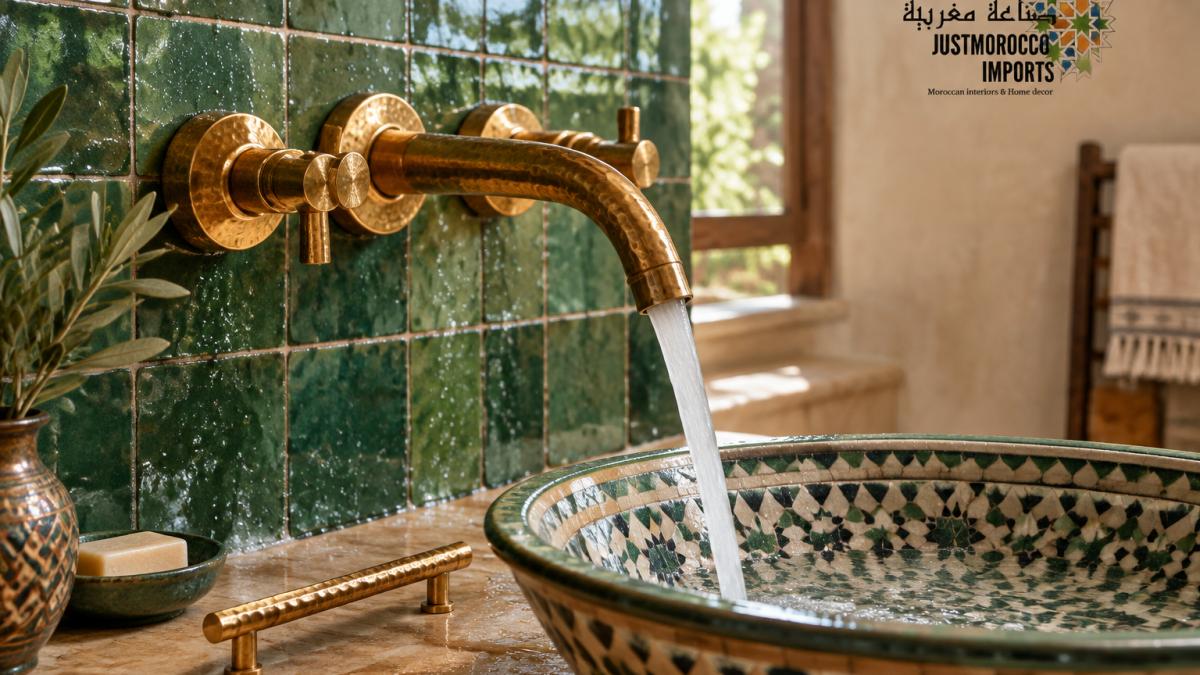
Color matters as much as texture. Green and blue tile loves brass. Terracotta and sand tones love copper. If you are still choosing tile, our guide on what zellige tile is used for walks through where each style belongs.
Unlacquered Brass Bathroom Care: Maintenance, Durability, and Repairability
Unlacquered brass generally responds best to gentle care rather than hard scrubbing. A soft damp cloth and mild soap, followed by drying, are a sensible approach, and abrasive pads and ammonia cleaners are best avoided.
Solid brass is generally durable in wet rooms, and its finish changes over time while the metal itself remains sound.
Repairability is where unlacquered brass wins. A scuffed spot can be re-polished by hand or left to blend into the patina. Lacquered brass is the opposite: once the coat chips, the bare metal underneath darkens in patches and the piece usually needs re-lacquering.
- Weekly: soft cloth wipe and dry.
- Monthly: mild soap on high-touch spots.
- Yearly: optional wax coat to even out tone.
Fixture Selection for Showers, Baths, and Vanities
Shower and bath fixtures take the most water, so choose the harder metal and the more durable finish there. Vanity hardware is touched daily but stays drier, which gives you more freedom on finish. The practical rule is to match finish durability to exposure, then match tone to the room.
For showers, solid brass trim and a brass showerhead are a common choice, and a finish you are willing to maintain is worth selecting. Raw copper in a constantly wet shower will patina fast and unevenly, especially around the valve trim and the spray face where water sits. If you want a warm look without daily patina management, lacquered brass or a quality plated finish holds its appearance longer in a wet zone. Check that the valve trim and showerhead are compatible with standard plumbing rough-in dimensions before ordering; a beautiful trim that does not fit the valve body is an expensive mistake.
For baths, a brass or copper tub filler becomes a focal point. Match its tone to the tub surround and confirm the filler's reach clears the tub rim. Floor-mounted fillers need a clear path in the subfloor and a supply line that can be routed without interfering with the tub drain; wall-mounted fillers need blocking in the wall at the right height. Decide the mounting type before the walls close up.
For vanities, this is where a piece like our two-sink pottery clay vessel vanity earns its place. The warm clay sinks pair naturally with brass or copper faucets and pulls. Vessel sinks raise the faucet height requirement, so confirm the spout reach and height clear the bowl rim; a standard lavatory faucet often sits too low for a tall vessel sink.
Finish durability deserves its own check. In a wet room, humidity, water spots, and cleaning products all attack the surface. Lacquered brass is protected until the coat chips, then the bare metal darkens in patches and usually needs re-lacquering. Unlacquered brass and raw copper are living finishes: they change with use, which is the point, but they ask for gentle care. Avoid abrasive pads and ammonia-based cleaners on any living finish, and dry high-touch spots after use to keep patina even.
Plan for long-term ownership before you buy. Ask whether replacement parts, such as cartridges, handles, and trim, will be available in the same finish years later. A finish that cannot be matched for a replacement handle turns a small repair into a full replacement. Also confirm the fixture is compatible with standard US plumbing connections and valve standards so a plumber can service it without custom adapters.
Watch out: do not choose a shower finish from a showroom display alone. A finish that looks rich under warm spotlights can look flat or too bright in a small windowless bath, so judge it in the actual room at the time of day you use it most.
Order Finish Samples and Plan Your Custom Vanity
Finish samples under your own bathroom light settle the decision faster than any photo. Order samples of your two top contenders, tape them beside the tile and the mirror, and check them in morning and evening light.
Then plan the vanity around the finish you chose. Our hand-carved Moroccan bathroom vanity pairs a dark mahogany-stained cedar body with two Fez pottery sinks, a natural match for warm brass or copper. If you want a metal-bodied piece, the Alhambra bathroom vanity gives you a hand-hammered silver cabinet to build a cooler palette around. And if neither off-the-shelf shape suits your room, custom furniture imports are available to discuss a piece around the finish and dimensions you have settled on.
Both routes start the same way: samples first, then the piece. That order saves returns and regret.
Frequently Asked Questions
What finishes are traditional for Moroccan bathroom hardware?
Hand-hammered brass and copper dominate, usually left unlacquered so they develop a living finish over time. Silver-toned metal appears too, often in hand-hammered sink cabinets and vessel sinks. Traditional pieces are finished by hand rather than plated, which is why tone varies slightly from piece to piece. If you want the classic look, plan for warm metal that darkens with use rather than a uniform factory sheen, and choose tile and cabinet colors that complement that warmth.
How do you tell whether Moroccan brass hardware is authentic?
Look for tool marks, slight asymmetries in hand-hammered patterns, and weight that feels solid rather than hollow. Mass-produced copies tend to be perfectly uniform and often use plating over a base metal. Ask the seller how the piece was made and whether it is one of a kind. A single available unit with hand-hammered texture, like a hand-hammered silver metal vanity, is a stronger authenticity signal than a listing with dozens of identical units in stock.
Can you mix brass and copper finishes in a bathroom?
Yes, provided you give one metal the lead role. Mixing metal finishes in a bathroom works when the secondary metal repeats at least twice, for example copper cabinet pulls paired with a copper tray, while brass handles the faucet and shower trim. Keep the finishes in the same temperature family, warm with warm, and repeat each metal at least twice so it reads as intentional. Avoid splitting a single fixture between two metals, which looks like a mistake rather than a choice.
How do you care for unlacquered brass bathroom fixtures?
Wipe unlacquered brass with a soft damp cloth and mild soap, then dry it immediately to avoid water spotting. Skip abrasive pads and ammonia-based cleaners, which strip the surface unevenly. If you want an even patina, leave the metal alone and let humidity do the work. If you prefer a brighter look, a brass polish restores shine but removes some patina, so apply it sparingly and only to the areas you want lighter.
Choosing authentic Moroccan bathroom hardware finishes comes down to sequence and patience: tile, light, patina, then the piece. Get the order right and the room holds together for decades. Justmorocco hand-selects and imports handcrafted Moroccan vanities and fixtures, with custom design support and direct shipping across the country. Start with finish samples, then let us help you plan the vanity that fits your palette.
