
Table of Contents
- What Is Zellige Tile and Where Does It Come From
- The History and Tradition Behind Zellige Craftsmanship
- Common Applications: What Zellige Tile Is Used For
- Zellige Tile Backsplash: Design and Installation
- Zellige Tile Bathroom Applications
- Zellige Tile Pros and Cons
- How to Clean Zellige Tile and Maintain Its Beauty
- Cost Considerations and Durability
- Frequently Asked Questions
Last Updated: October 6, 2026
What Is Zellige Tile and Where Does It Come From
Zellige tile is traditional handcrafted mosaic tilework from Morocco, characterized by intricate geometric patterns and glazed ceramic surfaces. At Justmorocco, we recognize zellige as one of the most distinctive expressions of Islamic and Moroccan architectural heritage.
These tiles are 100% handcrafted from organic clay found exclusively in Fez, hand-chiseled by master artisans in the medina's traditional souks. Raw clay is shaped, glazed individually, and fired to create the luminous, deeply colored surfaces that define authentic zellige. The imperfections, slight color variations, irregular edges, uneven surfaces, are signatures of genuine handcrafted work, the result of centuries-old techniques passed down through generations.
What makes zellige prized is the depth and visual richness it brings to any space. The glazed surfaces catch light differently depending on the time of day and angle of view, creating an ever-changing aesthetic. The geometric patterns, typically radiating from central stars with complex interlacing, follow Islamic design principles balancing mathematical precision with organic variation, what makes zellige fundamentally different from mass-produced ceramic tiles.
The History and Tradition Behind Zellige Craftsmanship
The zellige tradition stretches back centuries as a central element of Moroccan and broader Islamic architectural design. These tiles adorned riads (traditional Moroccan courtyards), palaces, and mosques, serving both functional and deeply spiritual purposes. Their geometric patterns reflect Islamic artistic principles, where abstract design and mathematical harmony were considered expressions of divine order.
What distinguishes zellige is the commitment to handcraftsmanship at every stage. Rather than molds or industrial processes, each tile is individually shaped, glazed, and fired, ensuring no two tiles are identical, a trait celebrated as authenticity rather than a manufacturing defect. Artisans undergo years of apprenticeship, learning to recognize clay quality, judge firing temperatures, and apply glazes with the precision complex geometric compositions require.
Traditional zellige's color palette draws from natural mineral pigments and glazes, producing the deep blues, rich terracottas, forest greens, and cream tones characteristic of authentic Moroccan design. These colors develop full luminosity only through firing, giving zellige distinctive visual depth compared to painted or glazed tiles. The tradition has remained largely unchanged for centuries, with contemporary artisans using methods identical to those of medieval Morocco.
Common Applications: What Zellige Tile Is Used For
Zellige tile serves multiple functional and aesthetic purposes in traditional Moroccan architecture and contemporary interior design. Understanding what zellige tile is used for means recognizing the contexts where its durability, water resistance, and visual impact provide genuine advantages.
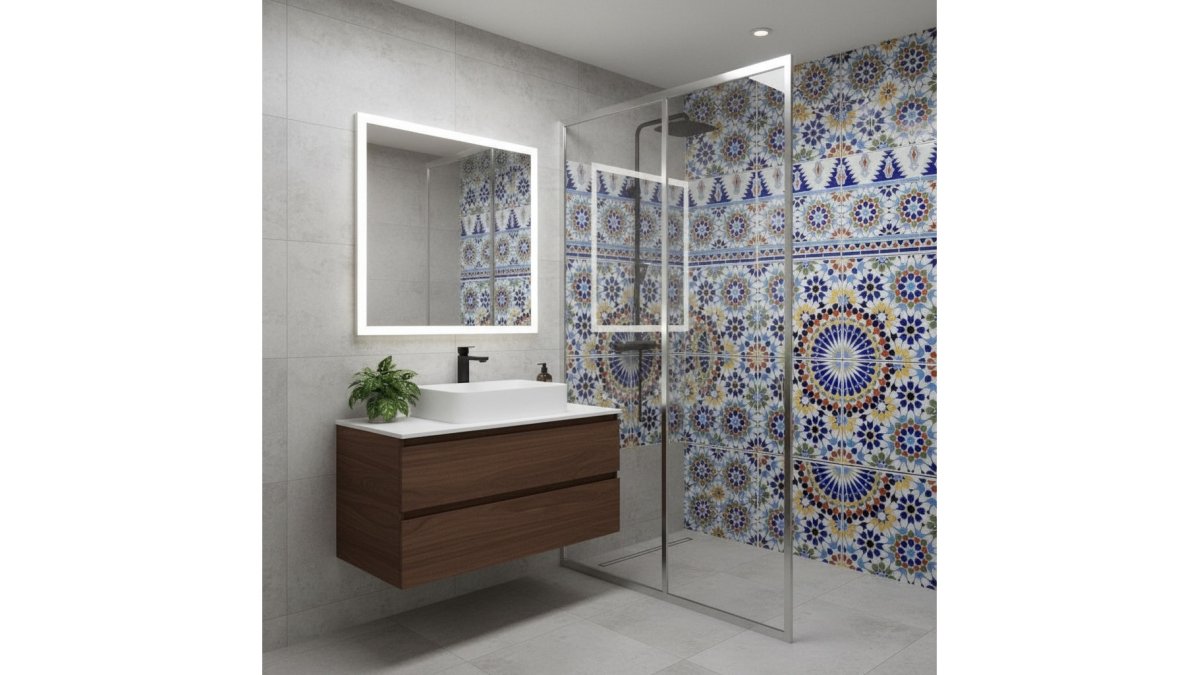
Zellige performs exceptionally well in wet areas, making it ideal for bathrooms and kitchen backsplashes. The glazed surface resists water penetration, and pre-mounted 12" by 12" sheets simplify waterproof installation. For kitchen backsplashes, zellige tile used for this application creates a dramatic visual anchor, adding architectural interest that standard subway or ceramic tiles cannot match.
Feature Walls and Accent Spaces
Feature walls are one of the most popular applications for zellige tile used for interior design statements. A single wall covered in zellige becomes a focal point that defines an entire room, its geometric patterns and color variations commanding attention without additional decorative elements. In living rooms, entryways, and dining areas, zellige feature walls establish luxury and cultural sophistication.
The key to a successful feature wall is understanding that zellige's visual richness means less is often more. A single wall in a room with neutral furnishings creates maximum impact, and the artisanal irregular edges and color variations become more celebrated as a cohesive composition. Many designers recommend limiting zellige to one accent wall to avoid overwhelming the space.
Fountains and Water Features
Zellige tile used for fountains and water features honors the tiles' historical use in Moroccan riads and palaces. Handcrafted zellige combined with flowing water creates a multisensory experience, pairing visual richness with the sound and movement of water. Justmorocco specializes in custom furniture imports that integrate zellige with traditional water features and architectural elements, bringing authentic Moroccan aesthetics into contemporary homes.
Water features benefit from zellige's durability and water resistance: the glazed surface withstands constant moisture, and the geometric patterns create visual movement complementing the water itself. Indoor fountains lined with zellige become sculptural elements adding ambient sound and visual interest to entryways, courtyards, or interior gardens.
Zellige Tile Backsplash: Design and Installation
A zellige tile backsplash is one of the most practical applications of what zellige tile is used for in contemporary kitchens. The backsplash zone sees constant moisture, heat, grease, and splashing, conditions where zellige's glazed, water-resistant surface performs well. The difference between a handcrafted-looking backsplash and a botched one comes down to three technical decisions most guides skip: substrate prep, adhesive selection, and grout strategy.
Designing the Pattern and Scale
Zellige comes in formats from simple 4" x 4" squares and 2" x 6" beveled rectangles to intricate 12" x 12" pre-mounted star-and-cross mosaic sheets. The choice depends on your kitchen's visual weight: with plain Shaker cabinetry and quartz counters, a busier star pattern carries the room; in kitchens rich with veining, brass, or patterned stone, a simple square or subway format prevents visual chaos. Running bond (brick offset) for rectangles and straight set for squares both hide natural size variation better than a stacked grid, which magnifies every irregular edge.
Substrate Requirements for Wet Areas
Zellige is unforgiving of an uneven wall: because each tile varies in thickness and edge profile, any substrate deviation is amplified. For a kitchen backsplash, the substrate must be flat within 1/8" over any 10-foot span, the same tolerance the Tile Council of North America (TCNA) specifies for large-format tile. Drywall is acceptable in dry zones, but behind a range or sink use cement backer board or a bonded waterproof membrane rated for wet areas. For shower surrounds, a waterproof membrane is required by code in most jurisdictions, and the substrate must be flat before the membrane goes down, you cannot flatten a wall with thin-set after waterproofing.
Adhesive Selection
Use a polymer-modified thin-set mortar (ANSI A118.4) or, for wet areas and exteriors, an improved modified mortar (ANSI A118.15). Pre-mixed mastics are not appropriate for wet areas or tiles larger than 6" x 6". For pre-mounted mosaic sheets, use a 3/16" x 5/32" V-notch trowel; for individual 4" x 4" tiles, a 1/4" x 1/4" square-notch trowel. Back-butter any tile thicker than 3/8", the TCNA recommends minimum 80% coverage in dry areas and 95% in wet areas and exteriors. Expect to spend 20-30% more time setting zellige than rectified ceramic.
Grouting Irregular Surfaces: The Step Most Guides Skip
Zellige's hand-chiseled edges mean grout joints are never uniform. Joint width should be at least 1/8" and can run to 3/16" to absorb size variation. Use unsanded grout for joints under 1/8" and sanded grout for wider joints; for wet areas, choose a cementitious grout meeting ANSI A118.7 or a single-component grout (ANSI A118.3).
A practical sequence that experienced setters use:
- Wait a minimum of 24 hours after setting before grouting (48 hours in cool or humid conditions).
- Pre-seal the tile face if the glaze is crackled or matte, this keeps grout haze from lodging in the crazing.
- Work grout diagonally across the joints with a hard rubber float, not a sponge, to force grout into the irregular gaps.
- Strike the joints with the float edge at a 45-degree angle to the tile face rather than a 90-degree angle, this prevents the float from catching on uneven edges and pulling grout out.
- Let the grout firm up 15-20 minutes, then wipe with a damp (not wet) sponge in a circular motion, rinsing frequently.
- Buff the haze with a dry microfiber cloth after 24 hours.
Sealing and Finishing
Glazed zellige does not require sealing on the tile face, but the grout does. Apply a penetrating grout sealer after curing (typically 72 hours) and reapply every 1-3 years depending on kitchen use. In a range backsplash exposed to grease, a solvent-based sealer holds up longer than a water-based one.
Zellige Tile Bathroom Applications
Bathrooms represent an ideal environment for zellige tile used for both practical and aesthetic purposes. The constant humidity, moisture exposure, and need for regular cleaning align perfectly with zellige's properties. A bathroom featuring zellige, whether as a full wall treatment, shower surround, or accent feature, becomes a luxurious retreat rather than a purely functional space.
Shower surrounds benefit particularly from zellige's water resistance and visual appeal, the handcrafted tiles and flowing water creating a spa-like atmosphere. The geometric patterns add visual interest to what might otherwise be a plain tiled enclosure. For bathroom vanity backsplashes, zellige provides the same visual impact as kitchen applications while withstanding sink-area moisture and splashing.
Bathroom floor applications require care. While zellige's glazed surface is water-resistant, irregular edges and uneven surfaces can create drainage challenges if not properly sloped, and natural tile-height variation complicates achieving that slope. Many designers therefore reserve zellige for vertical applications (walls, backsplashes, shower surrounds) rather than floors, where more uniform tiles perform better.
Zellige Tile Pros and Cons
A fair assessment of zellige tile used for any application has to separate aesthetic advantages from the practical trade-offs that show up after installation. This section defines what "low-traffic" actually means for floors and names the specific failure modes to plan around.
Advantages
- Authentic handcrafted aesthetic. No two tiles are identical; the color pooling and edge variation cannot be replicated by machine production.
- Exceptional visual depth. The traditional glaze and single-fire process produce a luminosity that shifts with the light through the day.
- Water-resistant glazed surface. The fired glaze resists water penetration and staining without a topical sealer.
- Versatile across applications. Suitable for interior walls, backsplashes, shower surrounds, feature walls, fireplace surrounds, and, with caveats, floors.
- Cultural and architectural authenticity. The geometric patterns carry genuine design lineage rather than a manufactured "Moroccan-style" look.
- Pre-mounted sheets. 12" x 12" mosaic sheets simplify alignment and reduce installation time versus setting individual chiseled pieces.
- Ages with character. The surface develops patina rather than degrading cosmetically the way some printed porcelain does.
Limitations and Challenges
- Batch-to-batch color variation. Matching tiles from a later production run is effectively impossible; order 10-15% overage for cuts and future repairs.
- Irregular edges and uneven faces. These require a flat substrate (within 1/8" over 10 feet) and a skilled setter.
- Higher cost than mass-produced ceramic. Handcrafted production and import logistics drive the price well above commodity tile.
- Minimum order and lead time. A 40 sq ft minimum and up to a 3-month lead time for special patterns make zellige a poor fit for fast-turnaround projects.
- Grouting is slower and less forgiving. See the grouting sequence above, irregular joints demand float application, not sponge application.
- Not a high-traffic floor tile. See the durability breakdown below.
| Aspect | Benefit | Challenge |
|---|---|---|
| Craftsmanship | Authentic, unique, handmade | Requires skilled installation |
| Aesthetics | Luminous, geometric depth | Color variation between batches |
| Durability | Water-resistant glazed surface | Irregular surfaces need a flat substrate |
| Applications | Versatile for walls, backsplashes, features | Not suitable for high-traffic floors |
| Cost | Investment in quality | Higher price than industrial tile |
| Availability | Custom patterns available | 40 sq ft minimum, up to 3-month lead time |
What "Low-Traffic" Actually Means for Floors
Most guides say zellige is "not ideal for high-traffic floors" without defining the term. Here is a working definition based on how the tile behaves in real installations:
- Low-traffic (zellige performs well): bathroom floors, powder rooms, closet and dressing areas, and decorative floor medallions in otherwise low-use rooms. These zones see foot traffic measured in a few passes per day, no rolling loads, and no grit tracked in from outdoors.
- Moderate-traffic (zellige works with caveats): a primary bathroom floor in a two-person household, a laundry room, or a mudroom entry that is used but not abused. Expect to reseal grout more often and to see some joint wear within 5-10 years.
- High-traffic (choose something else): kitchen floors, entryways, hallways, stair treads, and any commercial space. These zones see hundreds of passes per day, grit that acts as an abrasive, and occasional dropped objects. Zellige's uneven faces create high points that chip and joints that crack under repeated load.
If you want the zellige look on a high-traffic floor, the practical compromise is a porcelain tile printed to mimic zellige, you lose the tactile handcrafted surface but gain the wear layer. Reserve genuine zellige for the walls and feature zones in the same room.
How to Clean Zellige Tile and Maintain Its Beauty
Proper maintenance ensures zellige tile retains its luminous appearance and structural integrity for decades. Its handcrafted nature means slightly different care than mass-produced ceramics.
Regular cleaning means sweeping to remove dirt and abrasive particles, then washing gently with mild soap and water. The glazed surface is naturally sealed, so zellige needs no additional sealant, the firing process creates a durable surface that resists staining without treatment.
For stubborn stains or hard-water mineral deposits, a slightly stronger cleaner is fine, but avoid harsh chemicals or abrasive scrubbers that damage the glaze. Geometric patterns can trap dust in their recesses, so occasional deeper cleaning with a soft brush keeps them visually crisp. In bathrooms, regular cleaning prevents soap scum and mineral buildup that dull the tile's luminosity.
Grout joints need attention separate from the tile surface. Seal grout per manufacturer recommendations to prevent moisture penetration and staining; in wet areas like bathrooms and kitchens, this is essential to prevent water damage to the substrate. Resealing every 1-3 years, depending on usage and humidity, extends the installation's lifespan.
Cost Considerations and Durability
What zellige tile is used for ultimately connects to its cost structure and long-term durability. Understanding the investment helps determine whether zellige makes sense for your application.
Zellige pricing reflects the handcrafted nature and labor intensity of production. Justmorocco's Moroccan Zellij tile is priced at $65 per square foot, while the Moorish mosaic tile option is available at $72 per square foot, and the Cordobesa tile at $68 per square foot. These prices reflect the authentic artisanal production process and the direct import from master craftspeople in Fez. A minimum order of 40 square feet means initial zellige projects require substantial investment, typically $2,600 to $2,880 before shipping and installation.
Shipping costs vary by method and destination. Justmorocco offers air freight for faster delivery at higher cost, or sea freight taking approximately one month for containers reaching the east coast. Special orders may require up to 3 months depending on pattern complexity and quantity.
Durability makes zellige a sound long-term investment despite higher upfront costs. The glazed surface resists water penetration, staining, and moisture degradation, so zellige in bathrooms and kitchens outlasts less durable alternatives. The handcrafted clay and traditional firing create tiles that develop character with age rather than deteriorating; in low-traffic interior applications like backsplashes and feature walls, they maintain their appearance for decades with proper maintenance.
High-traffic floor applications present durability challenges. While the glaze is durable, irregular surfaces and uneven tiles create potential for grout cracking and water infiltration in heavily used areas. Zellige performs excellently in bathrooms and kitchens with moderate traffic; for entryways or kitchen islands receiving constant foot traffic, more uniform tile options may prove more practical despite lower aesthetic impact.
Zellige tile transforms ordinary spaces into expressions of authentic Moroccan craftsmanship and cultural heritage. Whether you're designing a kitchen backsplash, bathroom feature wall, or custom water fountain, what zellige tile is used for ultimately comes down to creating spaces that feel luxurious, distinctive, and deeply connected to traditional artistry. At Justmorocco, we specialize in sourcing authentic zellige directly from master artisans in Fez and integrating these handcrafted tiles into custom kitchen and bathroom remodeling projects. Our team works with your architect's plans to ensure these exquisite pieces fit your specific layout and vision, bringing the timeless beauty of Morocco directly into your living space.
Frequently Asked Questions
What is special about zellige tile compared to standard ceramic tiles?
Zellige tile is 100% handcrafted from organic clay and hand-chiseled by master artisans using techniques passed down for generations. Each tile features complex geometric patterns and abstract motifs that create luminous depth and variation impossible to replicate with mass production. The irregular edges and natural color palette are intentional characteristics of authentic zellige, not flaws, making every installation unique.
Can zellige tile be used in wet areas like showers and bathrooms?
Yes, zellige tile works well in bathrooms and wet areas when properly installed and maintained. The glazed surface provides water resistance, though grout joints should be sealed according to manufacturer recommendations. For shower installations, ensure adequate substrate preparation and proper grouting techniques for uneven surfaces, as zellige's artisanal nature means tiles may vary slightly in thickness.
How much does authentic zellige tile cost?
Authentic handcrafted zellige tile from Justmorocco starts at $65 per square foot for the Moroccan Zellij tile and $72 per square foot for Moorish mosaic tile options. Tiles come in 12-inch by 12-inch sheets and are pre-mounted for easier installation. Special orders with custom patterns, colors, and designs are available, with a minimum order of 40 square feet and delivery times up to 3 months depending on quantity and customization.
What makes zellige tile a good choice for kitchen backsplashes?
Zellige tile creates a striking visual focal point in kitchens with its geometric patterns and artisanal craftsmanship. The glazed surface resists moisture and staining, while the handcrafted aesthetic adds luxury and authenticity to any kitchen design. Its versatility allows it to complement both traditional Moroccan interiors and modern kitchens seeking an architectural detail that stands out from standard backsplash options.