
Last Updated: October 29, 2026
Quick Summary
To verify fair trade Moroccan home goods, ask the seller to name the certifying body and check that name in the Fairtrade Finder or FLOCERT database, searching the cooperative rather than the retailer. Then request process photos and shipment-level origin documentation tied to your specific piece.
- A legitimate certificate names the certifying body, product category, and date of the last audit.
- Search the cooperative's name in public databases, not the retailer's, since retailers resell.
- Flip the rug over: hand-knotted rugs show individual knots and irregular rows.
- Ask for the cooperative name, process photos, and shipment-level origin documents for the same piece.
- Under the U.S.-Morocco Free Trade Agreement, importers can produce digitized certifications of origin.
Table of Contents
- Why Fair Trade Verification Matters Before You Buy
- Fair Trade Artisan Certification Standards to Check
- How to Spot Fake Moroccan Rugs in Five Minutes
- Authentic Moroccan Furniture Identification Beyond the Rug
- Reading Supply Chain Transparency Markers
- The Visual Checklist for Digital Shoppers
- Seven Greenwashing Tactics That Fool Buyers
- Confirming Origin Under the U.S.-Morocco Free Trade Agreement
- Request Documentation From Justmorocco Before You Commit
- Frequently Asked Questions
Why Fair Trade Verification Matters Before You Buy
A rug labeled "fair trade" can still be woven by a child in an unregulated workshop. That gap between a label and the truth is exactly why verification matters. Buyers often pay premium prices for pieces they believe were ethically sourced, only to find the paperwork doesn't hold up.
The stakes are real. Fairtrade International's certification standards require third-party audits with physical inspections of workshops and records, not just a seller's word. Without verification, you're trusting a sticker.
Below, we'll show you exactly how to verify fair trade Moroccan home goods before money changes hands. Seven checks, in order, from the fastest to the most thorough.
Fair trade Moroccan sourcing starts with one principle: proof beats promises.
Fair Trade Artisan Certification Standards to Check
Fair trade artisan certification standards are third-party rules that confirm artisans are paid fairly and work in safe conditions. A legitimate certificate names the certifying body, the product category, and the date of the last audit.
Here's what a real standard covers:
- Fair wage documentation tied to a specific cooperative
- Safe working conditions confirmed by inspection
- No forced or child labor in the supply chain
- Regular audits of fields, plants, and offices
That last point separates real certification from marketing. Fairtrade International's verification procedure describes audits that include physical inspections, not paperwork alone.
Ask the seller which body certified them. If they can't name one, you have your answer.
Searching the Fairtrade Finder and FLOCERT Databases
Public databases let you confirm a supplier's status in minutes. the Fairtrade Finder database and the FLOCERT customer search both let you look up certified organizations by country and product.
Search the cooperative's name, not the retailer's. Retailers resell; the cooperative holds the certification. If the name doesn't appear, ask why.
How to Spot Fake Moroccan Rugs in Five Minutes
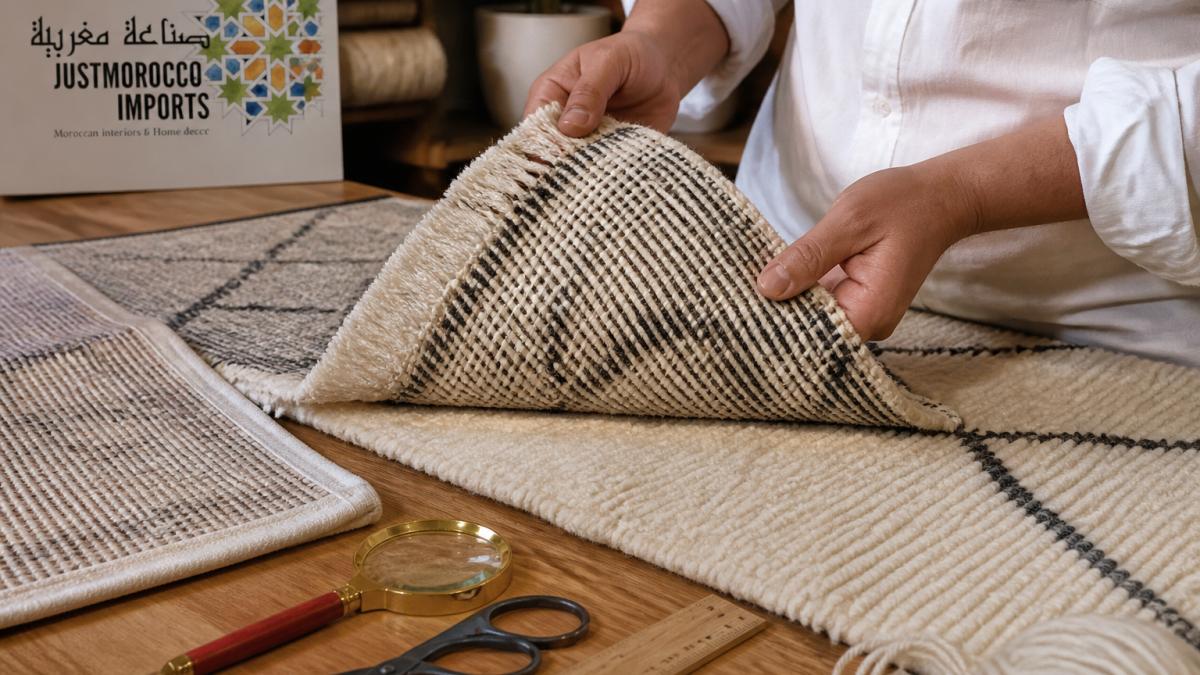
How to spot fake Moroccan rugs comes down to one habit: flip the rug over. The back tells the truth the front hides. A hand-knotted rug shows individual knots, slight irregularity, and wool fibers that vary in thickness. A machine-made rug shows a uniform grid and a glued backing.
Checking the Back for Knotting and Fringe
Hand-knotted rugs have knots tied by hand, so no two rows match perfectly. Machine-made rugs repeat with mechanical precision. Check the fringe too: hand-finished fringe is knotted into the weave, while machine fringe is often sewn on as a strip.
Look for natural dyes as well. Real wool often shows a soft sheen and slight color variation. Synthetic dyes look flat and uniform.
Authentic Moroccan Furniture Identification Beyond the Rug
Authentic Moroccan furniture identification relies on joinery, inlay, and finish. Hand-carved wood shows tool marks and slight asymmetry. Mother-of-pearl inlay sits flush and varies in tone, because each shell piece is cut by hand.
Mass-produced pieces fail these tests. Veneer peels at the edges. Inlay is printed or plastic. Carving is stamped, not cut. To see a real example of this craftsmanship, browse this hand painted Moroccan cabinet Moorish style TV stand.
Reading Supply Chain Transparency Markers
Supply chain transparency markers are the paper trail that connects a finished piece to a named workshop. Ask for three things:
- The cooperative or workshop name
- The region where the piece was made
- Photos of the creation process
That last marker is gaining ground. A seller with nothing to show is a seller with something to hide. You can browse a hand carved solid wood Moroccan cabinet that reflects these transparency claims.
The Visual Checklist for Digital Shoppers
Online buyers can't flip a rug. So we built a checklist that works from photos alone. Run every listing through it before you commit. For styling guidance, see how to pair Moroccan mother of pearl furniture with modern rugs.
| Check | What to Look For | Red Flag |
|---|---|---|
| Rug back photo | Visible individual knots | No back photo at all |
| Fringe | Knotted into the weave | Sewn-on strip |
| Color | Slight variation, soft sheen | Flat, uniform tone |
| Wood grain | Continuous, visible grain | Printed veneer pattern |
| Inlay | Flush, varied shell tone | Plastic or printed inlay |
| Process photos | Workshop and artisan shots | Only studio product shots |
| Certification | Named body and audit date | "Ethically made" with no source |
Seven Greenwashing Tactics That Fool Buyers
Labels are not the only indicator of ethical trade. That point comes from Terra Thread's analysis of fair trade practice, and it's the most useful thing a buyer can learn. Here are the seven tricks we see most.
- The vague badge. A logo with no certifying body named.
- The borrowed certification. A retailer displays a certificate held by a supplier they don't actually use.
- The "handmade" claim with no process photos.
- The fair-wage promise with no cooperative named.
- The expired certificate. Check the audit date, not just the logo.
- The country-of-origin swap. "Moroccan style" is not Moroccan made.
- The premium markup with no paper trail. High price does not equal fair trade.
Watch out: the most common one is the borrowed certification. Ask for the certificate number and match it to the cooperative name in the database.
Confirming Origin Under the U.S.-Morocco Free Trade Agreement
Origin claims are checkable, and the mechanism is more concrete than most buyers realize. Under the U.S.-Morocco Free Trade Agreement, U.S. Customs and Border Protection accepts digitized certifications of origin for qualifying goods. That means a legitimate importer can produce a documented origin trail, and a reseller marking up imports often cannot.
What the Origin Documentation Actually Is
It is not a marketing certificate and it is not the same as a fair trade certification. It answers a narrower question: was this good made in the qualifying territory under the rules the agreement sets? Ask your seller for the origin documentation tied to your specific piece, not a generic company certificate.
Reading the Document: Four Fields to Check
- Producer or exporter name, should match the workshop or cooperative, not just the retail brand.
- Good description, should describe the actual product category (hand-knotted wool rug, ceramic tagine, leather pouf), not a vague "home goods" line.
- Origin criterion, the rule the good qualifies under. If the seller can't explain which criterion applies, the document may be boilerplate.
- Date and shipment reference, origin documentation is tied to a shipment, not to a brand forever. An old document doesn't cover a new order.
Why This Matters Most for Non-Rug Goods
Most buying guides stop at rugs. But the origin question is sharpest for ceramics, leather, and metalwork, where "Moroccan style" is routinely applied to goods made elsewhere and finished to look the part. A ceramic tagine, a leather pouf, or a brass lantern can carry a Moroccan aesthetic without a Moroccan origin. For rugs, the back-of-rug inspection in the section above does much of this work visually; for ceramics, leather, and metalwork, the paper trail is often the only reliable signal.
The Middleman Test
Ask for the cooperative name, process photos, and shipment-level origin documents together for the same piece, and see which ones arrive. Ask for all three for the same piece, and see which ones arrive.
Request Documentation From Justmorocco Before You Commit
Before you buy, request the cooperative name, the process photos, and the origin documentation for the specific piece. For the full artisan Moroccan furniture buying guide, read on before you commit.
For custom work, our custom furniture imports service can help you source custom furniture.
Best for: buyers who want documented provenance before spending. Skip if: you're comfortable with an unverified "ethically made" sticker.
Frequently Asked Questions
What does fair trade certification mean for Moroccan home goods?
It generally means a third-party body has verified that artisans were paid fairly and worked in safe conditions. Certification typically involves audits, not a self-declared claim. For buyers, the practical test is whether the seller can name the certifying body and the cooperative behind the piece. A label alone proves little if nobody can trace it to a specific workshop.
How can I tell if a Moroccan rug is authentic and ethically sourced?
Start with the back of the rug: hand-knotted pieces show individual knots, slight irregularity, and a fringe that is part of the weave rather than sewn on. Then ask for provenance. Fair trade Moroccan rugs should ideally come with a named cooperative, a certification you can check against public certification databases, and photos of the weaving process.
Are there specific organizations that certify Moroccan fair trade artisans?
Fair trade certification is typically handled by recognized third-party certifying bodies, which often maintain public databases you can search. For Moroccan goods, also ask whether the supplier works through a registered cooperative, since collectives are the usual structure for artisan production. Cross-check any name a retailer gives you against those databases before you treat a certification claim as confirmed.
What are the signs of mass-produced versus handcrafted Moroccan decor?
Handcrafted pieces carry small irregularities: uneven dye lots, slightly asymmetric motifs, tool marks in tilework, and variation between two items of the same design. Machine-made goods are identical, with perfectly uniform pattern repeats and a flat, even sheen. Ask for photos of the creation process as proof of handmade origin, and compare the sheen and texture against the natural dyes and wool you would expect.
The real test of a fair trade claim is whether the seller can prove it. Ask for the certificate, the cooperative name, and the origin paperwork, then check each one. Justmorocco ships authentic, handcrafted Moroccan furniture across the United States, with mother-of-pearl inlay, custom cabinetry, and direct-from-source documentation on request. Get started with Justmorocco and buy your next piece with the paper trail to match.
