
Table of Contents
- What Makes Moroccan Furniture Truly Artisan-Made
- Quick Comparison: Artisan Moroccan Furniture Pieces and Prices
- Carved Wood Tables, Chests, and Armoires
- Camel Bone Inlay Chairs and Living Room Sets
- Leather Poufs, Benches, and Ottomans
- How to Maintain Moroccan Wood Furniture in US Climates
- Custom Moroccan Cabinetry Design for Kitchens and Bathrooms
- Shopping an Authentic Moroccan Home Decor Online Store
- Conclusion
- Frequently Asked Questions
Last Updated: September 12, 2026
What Makes Moroccan Furniture Truly Artisan-Made
Artisan Moroccan furniture for sale is furniture shaped, carved, and finished by hand in a traditional workshop rather than cut on a factory line, and the difference shows up in irregular tool marks, one-of-a-kind proportions, and joinery built to be repaired instead of replaced. At Justmorocco, we import pieces directly from master craftsmen, which means every table, chest, and chair carries the small variations only a human hand produces. This guide covers what to look for, what each piece costs, and how to keep it beautiful in an American home.
The word "authentic" gets stretched thin online. A machine-stamped panel can be photographed to look hand-carved, and a resin cast can pass for bone inlay in a listing thumbnail. So the question worth asking is not whether a piece looks Moroccan, but whether a person actually made it.
Here is the practical test. Run your fingertips across a carved surface. Hand-carving leaves subtle depth changes and slightly uneven edges, because the artisan follows the grain and corrects as they go. A pressed or routed pattern feels uniform and glassy, with identical repetition across every motif.
Reading the Signs of Hand-Carving and Bone Inlay
Camel bone inlay is the clearest authenticity marker in this category. Each piece of bone is cut, dyed, and set individually into a recess carved to receive it, so no two inlaid panels match exactly. Look for tiny gaps and slight height differences between inlay segments. Perfectly flush, perfectly identical inlay is usually resin.
Wood species tell you a lot too. Cedar, walnut, and other solid woods are the backbone of traditional Moroccan casegoods. If a listing says "wood veneer" without naming the species, treat that as a mass-market signal.
Quick Comparison: Artisan Moroccan Furniture Pieces and Prices
Prices below reflect current Justmorocco inventory. Because each piece is handmade and most are one-of-a-kind, stock moves quickly and special orders are common.
| Piece | Price | Material | Best For |
|---|---|---|---|
| Touareg carved chair | $1,250 | Hand-carved solid wood | Bedroom or reading corner |
| Moroccan leather bench | $1,600 | Leather, camel bone, silver | Entryway or foot of bed |
| Sahara bench | $1,800 | Solid wood, sabra fabric | Living room, 63" long |
| Mazagan bench | $1,800 | Hand-carved wood | Living room or hallway |
| Mosharabiya armoire | $1,900 | Carved wood, stain options | Bedroom storage |
| Marrakech living set | $2,550 | Wood, quality fabric, silver | Full seating arrangement |
| Moroccan carved chest | $2,600 | Cedar | Storage and statement decor |
| Moroccan Armoire | $2,600 | Hand-painted wood | Bedroom, 70" tall |
| Mazagan set | $4,200 | Silver sheet, camel bone, leather | Formal living room |
| Alhambra palace chairs | $9,500 | Camel bone, leather | Collector or formal room |
A note on why the range is wide: a single carved chair and a full bone-inlaid living set are different categories of object. The chair is furniture. The Alhambra pair is closer to a commissioned work of art.
Carved Wood Tables, Chests, and Armoires
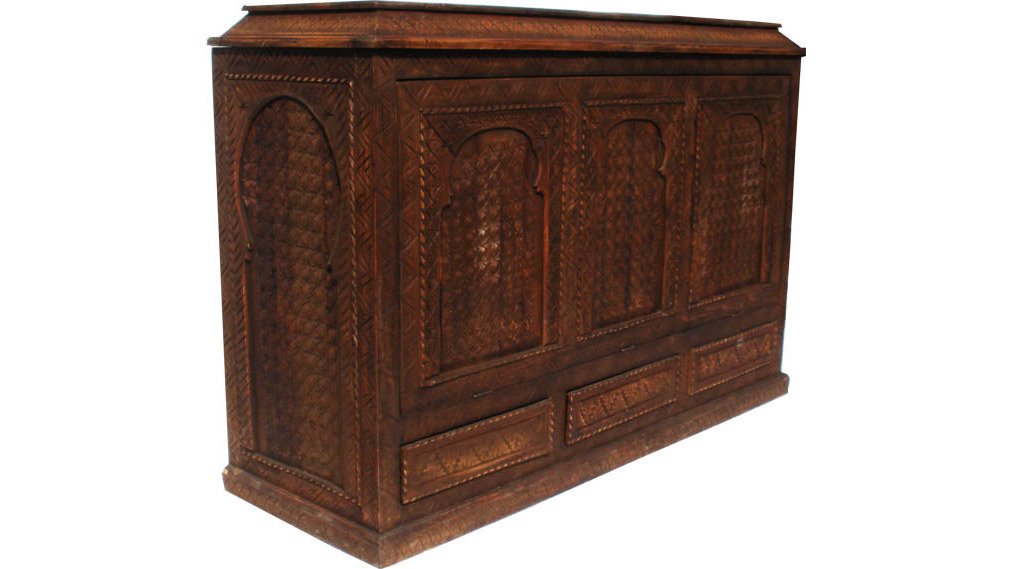
Start with the piece that does the most work in a room. The Moroccan carved chest at $2,600 is cedar, carved by hand, and sized to sit at the foot of a bed or against a hallway wall. Cedar resists moisture and insects, which matters in humid parts of the country.
Storage buyers should look at the Mosharabiya armoire at $1,900, which measures 64" x 43" x 15" and comes with an optional stain.
Cedar, Sabra Fabric, and Solid Wood Construction
Cedar is the traditional choice for Moroccan casegoods because it holds fine carving detail without splitting. Sabra fabric, woven from cactus fiber by women artisans in the Atlas Mountains, covers the Sahara bench at $1,800. It measures 63" long, 33" high, with an 18" seat height, and the weave has a subtle sheen that reads closer to silk than cotton.
Camel Bone Inlay Chairs and Living Room Sets
Bone inlay is where Moroccan seating separates itself from everything else on the market. The Mazagan set at $4,200 combines hand-tooled silver sheets, leather, and hand-carved camel bone into a full living room arrangement, and it is genuinely sturdy rather than decorative-only.
At the top of the range sit the Alhambra palace chairs at $9,500. These are full-size replicas of Andalusian throne chairs, bone-inlaid in the palette of the Alhambra, and each chair takes six weeks to complete. Only one pair is in stock.
Leather Poufs, Benches, and Ottomans
Leather seating is the most flexible category in this list, and the easiest place to start if you're testing whether Moroccan design fits your home. The Moroccan leather bench at $1,600 is embellished with camel bone and silver accents and works at the foot of a bed, in an entryway, or under a window.
For a carved alternative, the Mazagan bench at $1,800 measures roughly 65" long by 28" deep and carries the same Berber carving you'd see on much larger casegoods. Both are single-piece inventory, so check availability before you plan a room around one.
What Separates Artisan Leather From Factory Leather
Stitching, Fill, and Frame Construction
Three construction details matter more than the finish:
- Stitching. Hand-stitched seams use a saddle stitch, where two needles pass through the same hole from opposite sides. If one stitch breaks, the rest hold. Machine stitching uses a lock stitch, which can unravel in a run. Look at the underside of a seam, a saddle stitch is visibly irregular; a lock stitch is a perfect row.
- Fill. Poufs and ottomans are typically filled with cotton batting, shredded foam, or, in traditional pieces, straw or wool. Cotton batting holds shape longest and is the standard for a piece meant to be sat on daily. Shredded foam is cheaper and compresses within a year or two.
- Frame. A bench with a solid wood frame will hold its shape for decades. A bench built on a plywood or MDF frame may look identical in a photo but will flex and eventually delaminate at the joints.
Sizing and Placement in an American Home
Standard Moroccan poufs run 20" to 24" in diameter and 12" to 16" tall, which puts them at a comfortable height for a coffee-table footrest or a low extra seat. Benches are a different scale, the Mazagan bench at 65" long is sized for the foot of a queen or king bed, or as a hallway piece against a 6-foot wall. Measure the wall before you buy. A 65" bench in a 5-foot hallway will not fit, and freight returns on a 60-pound piece are expensive.
A Note on Sourcing
Most artisan leather in this category comes from small workshops where tanning, cutting, and stitching are separate trades handled by different people. That division of labor is why a single bench can take two to three weeks to complete and why the price sits where it does.
How to Maintain Moroccan Wood Furniture in US Climates
Humidity is the real threat to hand-carved wood, and it varies enormously by region. Coastal Florida air and dry Southwest winters pull wood in opposite directions, and both cause cracking if you ignore them. Keep indoor humidity between 35% and 55% year-round, and use a humidifier in winter if you live somewhere with forced-air heat.
Direct sun is the second problem. UV light fades hand-painted finishes and dries out leather. Position pieces away from south-facing windows, or use a sheer curtain as a buffer.
- Dust carved surfaces weekly with a soft, dry brush rather than a cloth, which snags on deep relief
- Apply a beeswax-based wood conditioner twice a year, working it into the grain with a lint-free cloth
- Wipe leather with a dry cloth only; avoid commercial leather cleaners on dyed or tooled surfaces
- Keep bone inlay away from standing water, which can lift the setting compound over time
- Re-tighten any visible hardware annually, since wood expands and contracts with the seasons
Custom Moroccan Cabinetry Design for Kitchens and Bathrooms
A bespoke approach lets you match door profiles, carved panels, and hardware to the rest of your home.
The process typically runs in four stages: measurements and drawings, material and finish selection, workshop production, and freight delivery. Hand-carved components add lead time, so plan backward from your installation date rather than forward from your order date. If you're coordinating with an architect, share their drawings early. Adjusting a carving pattern on paper costs nothing. Adjusting it after the panels are cut does not.
Why Kitchens and Bathrooms Are the Hardest Rooms for Carved Wood
A kitchen or bathroom introduces two problems: sustained humidity and airborne grease.
- Humidity.
- Grease.
Finish Choices That Survive Real Use
- Cedar and walnut hold up better than softer woods in a kitchen because they are denser and move less with humidity swings.
- Hand-painted finishes are beautiful but show water rings. In a bathroom, a hand-rubbed oil or a hardwax oil finish is more forgiving and can be spot-repaired without refinishing the whole door.
- Bone inlay should not be used on cabinet doors in a bathroom or directly above a sink. Standing water can lift the setting compound over time, and the repair is a workshop job, not a homeowner job.
- Metal hardware, brass, iron, or silver-toned pulls, should be solid, not plated. Plated hardware in a humid room will pit within a few years.
What a Realistic Timeline Looks Like
A custom cabinetry run with hand-carved components typically takes longer than a stock or semi-custom order. A common pattern is:
- Design and drawings, one to three weeks, depending on how many revisions you request.
- Finish sample approval, one to two weeks. Do not skip this. Cedar and hand-painted finishes read very differently under warm interior lighting than they do in a product photo.
- Workshop production, four to eight weeks for a typical kitchen or bathroom run, longer if the design includes extensive bone inlay or a large carved panel.
- Freight and installation, one to two weeks for crating and transit, plus a day or two on site.
Plan backward from your installation date. If you are remodeling a kitchen and the cabinets need to be in before the countertop template, the carving lead time is the constraint that drives the whole schedule.
A Unique Angle: Designing for Repair, Not Replacement
Moroccan cabinetry, done properly, is assembled so that a single damaged door or drawer front can be removed and replaced without tearing out the surrounding run. Ask your maker to pin or screw door fronts rather than glue them permanently, and to keep the carving pattern on file. A decade from now, when a door takes a hit, a replacement can be carved to match.
Shopping an Authentic Moroccan Home Decor Online Store
Buying from an authentic Moroccan home decor online store comes down to three verifiable things: named materials, real dimensions, and a seller who will talk to you about shipping. If a listing is missing all three, that is your answer.
Ask these questions before you buy:
- What species of wood is this, and is any part of it veneered?
- What are the exact dimensions, including depth?
- Is this in stock, or made to order, and what is the lead time?
- How is the piece crated, and who handles freight?
- Can you send a photo of this specific piece, not a catalog image?
Large pieces ship by freight with crating, and shipping is quoted by ZIP code. That is normal for this category. A seller who cannot explain their crating process is a seller who has not shipped much furniture.
Conclusion
The hard part of buying artisan Moroccan furniture is not finding something beautiful. It is confirming that what arrives matches what you paid for. Those are solvable problems, but only with a seller who names their materials, quotes real dimensions, and crates properly for freight.
Justmorocco imports hand-carved cedar chests, bone-inlaid seating, leather benches, and custom cabinetry directly from master artisans, with special orders available in any size and freight shipping to homes across the country. If you have a piece in mind that isn't in the current collection, custom furniture imports let you commission it to your own dimensions and finish. Get started with Justmorocco and furnish your space with pieces made to outlast the trend that brought you to them.
Frequently Asked Questions
What defines authentic artisan Moroccan furniture?
Authentic artisan Moroccan furniture is handmade by master craftsmen using traditional techniques passed down through generations. Look for hand-carved solid wood like cedar, camel bone inlay, hand-tooled silver and leather, and hand-woven sabra fabric. Each piece carries subtle irregularities that machine-made reproductions cannot replicate. At Justmorocco, every piece is crafted in artisan workshops, and the Alhambra palace chairs, for example, require a full six weeks to complete, reflecting the labor-intensive process behind genuine Moroccan furniture.
How can I tell if Moroccan furniture is handmade?
Examine the carving depth and pattern consistency. Hand-carved pieces show slight variations in cut depth and motif spacing that indicate individual artisan work. Bone inlay should have natural color variation rather than uniform synthetic appearance. Check joinery: handmade pieces often use traditional mortise-and-tenon joints rather than staples or screws. Justmorocco provides details on the artisan workshop and crafting time for each piece, giving buyers verifiable proof of handmade construction.
Is Moroccan furniture durable for daily use?
Yes, when properly constructed. Solid cedar and other hardwoods used in authentic Moroccan furniture are dense and long-lasting. The Sahara bench, for example, is built from strong solid wood and covered with hand-woven sabra fabric, designed to hold up to regular use. Camel bone inlay is set into wood with adhesive and protected by finish, making it suitable for daily wear. In humid climates like coastal Florida, maintain consistent indoor humidity to prevent wood movement.
How do I incorporate Moroccan decor into a modern home?
Use one or two statement pieces as focal points rather than filling a room with Moroccan furniture. A hand-carved armoire or a pair of bone-inlay chairs can anchor a contemporary living room without overwhelming it. Pair ornate pieces with clean-lined sofas and neutral walls. Moroccan lighting, such as a hand-hammered metal lantern, adds warmth to a minimalist space. The key is contrast: let the intricate carvings and geometric patterns stand out against simpler surroundings.
What materials are typically used in artisan Moroccan furniture?
Artisan Moroccan furniture uses solid cedar and other hardwoods, camel bone for inlay, hand-tooled silver and brass, genuine leather, and hand-woven sabra fabric made from agave plant fibers. Cedar is preferred for chests and armoires because it resists insects and holds intricate carvings well. Bone inlay provides the distinctive white geometric patterns seen on chairs and benches. Leather is used for seating surfaces and poufs. These natural materials age gracefully and develop character over time.