

Last Updated: November 16, 2026
Quick Summary
Complex patterns need more tile overage than a straight layout's 10%, with published guidance ranging from 15% for intricate perimeters up to 25-30% for several complex patterns. Choose your percentage by pattern, then adjust within the band for perimeter length, corner count, tile format, and installer skill.
- Herringbone and chevron patterns typically require 20-25% overage because cuts repeat along the whole run.
- Add roughly 1% to overage for every two corners beyond the first four in a patterned layout.
- Round up to full cartons, since the gap between square footage and carton coverage is free overage.
- Add a separate 2-3% damage buffer for factory-packaged ceramic and 3-5% for handmade or natural stone.
- Zellij tile comes in 12-inch by 12-inch pre-mounted sheets with a 40-square-foot minimum order.
Table of Contents
- Why Complex Patterns Need More Tile Overage
- Measure Room Dimensions and Square Footage First
- The Floor Tiles Calculation Formula Behind Every Estimate
- How to Choose a Tile Overage Percentage by Pattern
- Herringbone Tile Layout Waste and Chevron Adjustments
- Diagonal, Basketweave, and Brick Pattern Waste Factors
- Tile Orientation, Starting Point, and Cut Planning
- Breakage, Batch Matching, and Leftover Tile Storage
- Ordering Zellij and Mosaic Tile for Your Pattern Project
- Frequently Asked Questions
Why Complex Patterns Need More Tile Overage
Most tile projects fail on the order form, not on the floor. You calculate tile overage for complex patterns differently than for a straight lay, and getting it wrong means a second order, a batch mismatch, or a stalled install. The questions we hear most often start with "how much extra should I buy?"
Here is the short answer: a straight layout needs about 10% extra. Complex patterns need more, and the amount depends on the pattern itself. Published guidance ranges from 15% for intricate perimeters up to 25-30% for several complex patterns, according to Artistic Tile's installation guidance. There is no single number that fits every job.
Below, we walk through the full method: measuring, calculating square footage, picking a percentage by pattern, and planning cuts before you order.
Measure Room Dimensions and Square Footage First
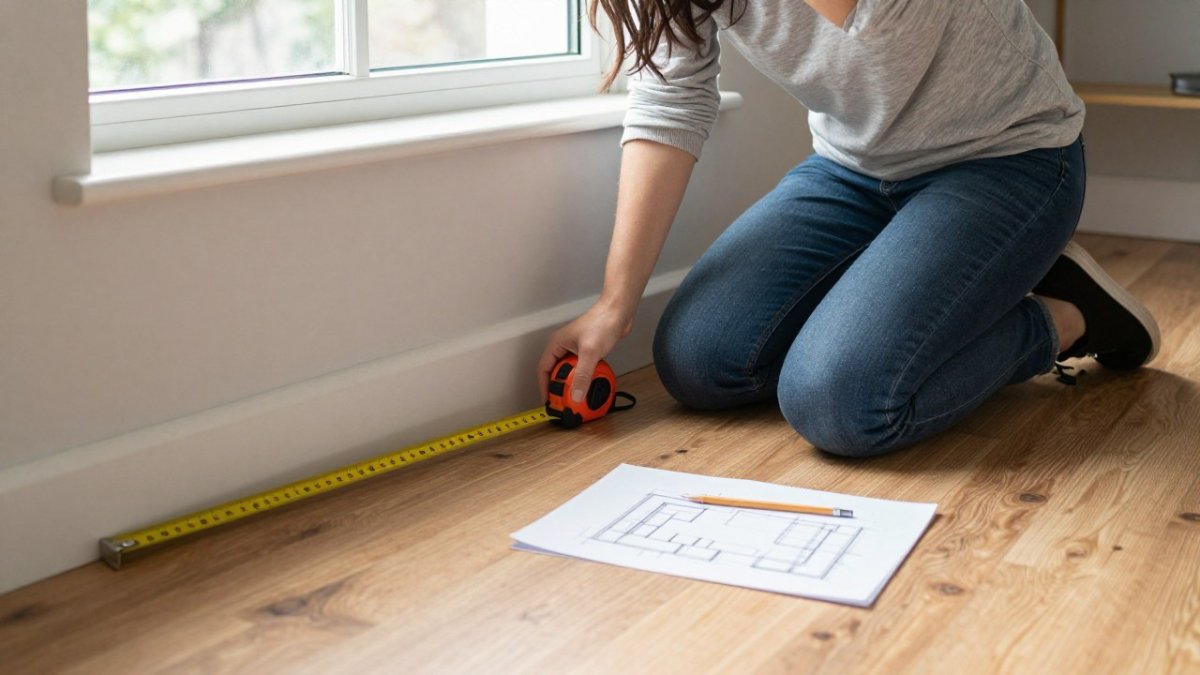
Start with a tape measure and a notepad, not a calculator app. Measure the length and width of the floor or wall at its widest points, in feet and inches. Write both numbers down before you do any math.
Then multiply length by width to get your floor area in square feet. A 12-foot by 10-foot room gives you 120 square feet. That is your base number, and every overage figure builds on it.
Three habits keep this step accurate:
- Measure twice, at different points, because older rooms are rarely square
- Round each measurement up to the next inch
- Note every doorway, closet, and alcove on a simple sketch
Handling Non-Standard Room Shapes and Intricate Perimeters
L-shaped rooms, angled walls, and curved thresholds break the simple length-times-width formula. Split the space into rectangles, calculate each one, and add the results together. A bay window or a curved shower curb gets measured as its own small section.
Intricate perimeters are where overage quietly disappears. Every corner, jog, and pipe cut creates edge cuts and waste pieces. More perimeter means more cuts, and more cuts mean more tile overage. If your sketch shows six or more corners, plan for the higher end of your pattern's range.
The woman is American.
The Floor Tiles Calculation Formula Behind Every Estimate
The floor tiles calculation formula is simple: area times the overage multiplier, then round up to whole boxes or sheets. That is the whole method. Everything else is choosing the right multiplier.
Here it is written out:
Here it is written out:
Total tile needed = room square footage × (1 + overage percentage)
For a 120-square-foot floor with 15% overage: 120 × 1.15 = 138 square feet.
Then divide by the coverage on the box or sheet. If your tile covers 1 square foot per sheet, you need 138 sheets. Round up to the next full unit, always.
How to Choose a Tile Overage Percentage by Pattern
Your tile overage percentage should track pattern complexity, not habit. Pick your pattern first, then assign a number from the range below. Do not default to 10% just because that is what the box says.
The logic is straightforward. Straight and stacked layouts waste little because almost every piece is a full tile. Diagonal and patterned layouts cut more pieces at the edges, and every cut leaves a usable-but-unused remainder. Herringbone and chevron multiply that effect because cuts repeat along the whole run.
If you are comparing patterned options while you decide, our Berber Zawaka tile shows how a real geometric pattern looks before you commit to a waste factor.
A Pattern-by-Pattern Overage Reference Table
| Pattern | Suggested Overage | Why |
|---|---|---|
| Straight or stacked | 10% | Few cuts, minimal waste |
| Brick or running bond | 10-15% | Offset cuts at each row end |
| Diagonal layout | 15-20% | Angled cuts along every wall |
| Intricate perimeter | 15% | Many corners and jogs |
| Basketweave | 15-20% | Small units, frequent cuts |
| Herringbone | 20-25% | Repeated angled cuts throughout |
| Chevron | 20-25% | Mirrored cuts on both sides |
| Versailles and mixed modular | 25-30% | Multiple sizes, heavy cutting |
Suggested Overage
These ranges come from published installer guidance, and they overlap on purpose. Your room decides where in the range you land.
How to Pick a Number Inside the Range
The table gives you a band. The band is not the answer. Four variables move you up or down inside it, and you can score them before you order.
1. Perimeter length relative to floor area. A 120-square-foot room that is 12 by 10 has 44 linear feet of perimeter. The same 120 square feet in a 20-by-6 galley has 52 linear feet. More perimeter means more edge cuts, and edge cuts are where patterned waste concentrates. If your perimeter-to-area ratio is high, take the top of the band.
2. Number of inside and outside corners. Each corner forces a cut on both sides of the angle. Count every jog, column, doorway return, and niche. A common rule of thumb among installers is to add roughly 1% to the overage for every two corners beyond the first four in a patterned layout. A rectangular room has four corners; a room with a fireplace bump-out, two doorways, and a closet return can easily reach ten.
3. Tile format and sheet construction. Large-format tile cut on a diagonal wastes more per cut than small mosaic, because the offcut is too big to reuse and too small to return. Conversely, pre-mounted mosaic sheets in a complex pattern can waste less than loose tile because the sheet edges align to the pattern grid. If your tile arrives in fixed sheets, ask the supplier whether the pattern repeats on the sheet boundary; if it does not, add 2-3% for pattern matching at every sheet seam.
4. Installer skill and cut method. A wet saw with a fresh blade produces clean cuts that can be reused on the opposite wall. A snap cutter on a diagonal pattern produces more breakage. Most practitioners find that a first-time DIY installer on a herringbone floor should budget at the top of the range, while an experienced setter on the same job can work at the bottom.
Worked Examples: Same Pattern, Different Answers
These three examples use the same 20-25% herringbone band and land in three different places.
Example A: 10-by-12 powder room, 120 square feet, four corners, one doorway. Perimeter is 44 feet, corners are minimal, and the tile is 12-by-12 mosaic sheets. Score: low perimeter complexity, low corner count, sheet construction. Land at 20%. Order quantity: 120 x 1.20 = 144 square feet.
Example B: 14-by-16 kitchen, 224 square feet, six corners, an island, and a pantry return. Perimeter is 60 feet plus the island, which adds roughly 12 linear feet of edge. Corner count is high. Score: high perimeter, high corners. Land at 24%. Order quantity: 224 x 1.24 = 277.8, round to 278 square feet.
Example C: 8-by-20 hallway with a diagonal entry and two closets, 160 square feet. The diagonal entry forces angled cuts at the most visible point, and the closets add returns. Score: high corner count, diagonal transition. Land at 25%. Order quantity: 160 x 1.25 = 200 square feet.
Same pattern, same band, three different order quantities. That is why a single number per pattern is not enough.
Watch out: if your installer plans to start from a centered layout rather than a wall, the perimeter cuts get smaller and more numerous, which pushes you toward the top of the band even in a simple room.
When to Break the Table
The table assumes a rectangular room, a single tile size, and an installer who plans cuts. Break it in three situations:
- Mixed modular patterns such as Versailles or ashlar that combine three or more tile sizes. These are not one pattern; they are a family of patterns, and the cut count depends on how the modules land at the walls. Budget 25-30% and dry-lay a full module before ordering.
- Rooms with curved walls or circular features. A curved shower curb or a round column forces every adjacent tile to be cut on a curve. Add 5% over the pattern band.
- Tile with a directional pattern or a strong shade variation. Matching the pattern across a cut piece can require sacrificing an extra tile per cut. Add 3-5% if the tile is sold as a shade-varied or "caliber" product.
If you are ordering handmade tile, ask the supplier whether the pattern is printed, glazed, or hand-set. Hand-set patterns have more variation at the sheet edge, which affects how much you lose to pattern matching.
Herringbone Tile Layout Waste and Chevron Adjustments
Herringbone tile layout waste runs higher than most homeowners expect, typically 20-25%. The pattern turns every tile 45 degrees, so cuts happen along all four walls and at every transition. Each cut piece leaves a triangular offcut that rarely fits anywhere else.
Chevron behaves the same way, with one extra wrinkle. The tiles are cut at an angle to form a true point, so the pattern itself consumes material before installation even starts. Budget at the top of the range if your supplier pre-cuts the chevron ends.
Two adjustments push you higher:
Two adjustments push you higher:
The woman is American.
Diagonal, Basketweave, and Brick Pattern Waste Factors
- Rooms with more than four walls or a diagonal entry
- Tile that arrives in fixed sheets rather than loose pieces
Basketweave sits in the same band. The pattern uses small rectangular units grouped in squares, so it generates many short cuts. Small-format tile also means more grout lines and more chances for a chipped piece.
Brick and running bond patterns are the mildest of the group at 10-15%. The offset is only half a tile, so end cuts stay large and reusable.
Tile Orientation, Starting Point, and Cut Planning
Where you start the layout decides how much tile you throw away. Set the starting point so full tiles land on the most visible wall, and let the cuts fall in corners, under appliances, or behind fixtures. This single decision can pull a job from the top of its overage range down to the bottom.
Plan cuts before you open a single box:
- Snap a chalk line for your first course and check it against both walls
- Dry-lay one full pattern repeat to confirm the count
- Mark every cut piece on your sketch
- Keep offcuts sorted by size for the edges that need them
For a tabletop or a feature surface, our guide to custom Moroccan mosaic dining table designs covers orientation and starting points before you commit to cuts.
Breakage, Batch Matching, and Leftover Tile Storage
Breakage is the quiet overage killer. Handmade tile, especially hand-chiseled mosaic, can chip in transit or crack under a trowel. Keep a buffer beyond your pattern percentage for damage, and open every box before the installer starts.
Batch matching matters just as much. Dye lots can shift between production runs, so a second order months later may not match the first.
Round to Full Cartons, Not Just Full Square Feet
Your square-footage math gives you a number. Your supplier sells in cartons, boxes, or sheets. The gap between the two is where most ordering errors happen.
Suppose your calculation says 144 square feet and the tile comes in cartons that cover 10 square feet each. That is 14.4 cartons. You cannot buy 0.4 of a carton, so you round up to 15 cartons, or 150 square feet. You have just added 6 square feet of buffer without changing your percentage.
That rounding is not waste. It is free overage. Count it before you decide to bump your percentage. If rounding up a carton already gives you 4-5% extra, you may not need to move from 20% to 25% on the pattern band.
Breakage Rates by Material and Handling
Breakage is not uniform across tile types. The buffer you add for damage should track the material.
- Glazed ceramic and porcelain. Factory packaging is robust, and breakage in transit is usually under 1-2% when pallets are not double-stacked. The bigger risk is cutting breakage on a snap cutter, especially on diagonal cuts.
- Handmade zellij and hand-chiseled mosaic. Edges are irregular by design, and thin chiseled points chip more easily. A common pattern is to lose 2-4% to chipping and transit damage, and more if the tile is shipped loose rather than pre-mounted on sheets.
- Natural stone. Stone can arrive with fissures that only show when wetted. Open and wet a sample from each crate before installation; a hidden fissure can turn one tile into three unusable pieces.
- Large-format tile. Anything over 15 inches on a side is more likely to crack at the corners during handling. The breakage rate is lower in the box but higher on the job site.
A practical buffer for damage on top of your pattern percentage is 2-3% for factory-packaged ceramic and 3-5% for handmade or natural stone. That buffer is separate from the pattern overage, and it is the number most homeowners forget.
Dye Lots, Caliber, and Shade Variation
Dye lot is the production run. Caliber is the size tolerance. Both can change between orders, and both matter more in a complex pattern than in a straight lay.
In a herringbone or chevron pattern, every tile touches several others at an angle. A caliber shift of a sixteenth of an inch is invisible in a straight lay but shows up as a widening grout line at every pattern junction. A dye-lot shift is worse: a second order that is one shade off will read as a patch in the middle of a patterned floor.
Three habits protect you:
Three habits protect you:
If you must split an order, ask the supplier to hold the balance from the same lot rather than shipping from stock. Most suppliers will do this for a deposit, and it is cheaper than a second freight charge.
Return Policies and the Cost of Over-Ordering
Overage is insurance, and like any insurance it has a cost. The cost is the price of the tile you do not install, minus whatever you can return.
Return policies vary widely. Some suppliers accept returns on full, unopened cartons within a set window, often 30 to 90 days, and charge a restocking fee. Others do not accept returns on special-order or handmade tile at all. Before you round up to the next carton, ask three questions:
- Is the tile returnable, and within what window?
- Is there a restocking fee, and does it apply to full cartons only?
- Does the return require the original packaging and lot number?
If the tile is non-returnable, your overage is a sunk cost, and you should size it carefully rather than generously. If it is returnable, you can round up with less worry, because the extra carton is a temporary loan rather than a purchase.
How to Store Leftover Tile for Future Repairs
The leftover tile is not trash. It is the only matching material you will ever have for a repair, and in a patterned floor a single broken tile can require a piece from the same lot.
Store it properly:
Store it properly:
Once your spare tile is set aside, choosing grout that suits handmade tile is the next decision, and our guide to how to choose grout colors for handmade tiles walks through it.
Ordering Zellij and Mosaic Tile for Your Pattern Project
Ordering is where the math becomes a purchase, and a few supplier rules change your quantity. Our zellij tile comes in 12-inch by 12-inch pre-mounted sheets, sold per square foot, with a 40-square-foot minimum. That minimum matters on small projects: a powder room that needs 30 square feet still requires 40.
Special orders can take up to three months depending on quantity and pattern, so lock your overage figure early. Sea freight takes about a month to reach the East Coast, while air freight is faster and costs more.
When you are ready, you can view the Moroccan zellij tile and confirm sheet coverage before you finalize your square footage. If you want a smaller quantity to test a pattern, an Alhambra tile pack lets you buy the exact patterned tile you have just calculated overage for. And if your project extends beyond tile to statement pieces, our custom furniture imports can be coordinated alongside your tile order so finishes and lead times line up.
The hardest part of a patterned tile project is not the install. It is trusting your overage number enough to order once and order right. Measure carefully, pick your percentage from the pattern rather than habit, and add a buffer for breakage and batch matching. Justmorocco can help you get there with handcrafted zellij and mosaic tile sold by the square foot, pre-mounted sheets for easier installation, and custom pattern and color requests on special order. Get started with Justmorocco and order your patterned tile with a quantity you can trust.
Frequently Asked Questions
How much tile overage should I order for a complex pattern?
Published guidance puts complex patterns well above the 10% used for straight layouts. Sources give 15% for intricate perimeters, 15-20% for diagonal layouts, 20-25% for herringbone and chevron, and 25-30% for several complex patterns. Your number depends on the pattern, room geometry, and how many edge cuts you expect. Order the higher end of the range when the room has many corners or the layout starts off-center.
What percentage of extra tile should I buy for a herringbone layout?
Plan on roughly 20-25% extra for herringbone. Herringbone waste is high because every perimeter cut produces an angled offcut that rarely fits elsewhere, and the pattern must stay aligned from the starting point outward. Rooms with multiple doorways, islands, or angled walls push you toward the 25% end. Keep the offcuts, since small angled pieces often work at the next wall.
How do I calculate the square footage of tile I need?
Multiply the length by the width of each rectangular area to get floor area, then add the areas together. For a tile calculator square feet estimate, divide that total by the coverage of one tile, round up, then apply your overage percentage. A 12-inch by 12-inch sheet covers 1 square foot, so a 120 square foot floor needs 120 sheets before overage. Add 20% for a complex pattern and you order 144.
Should I include extra tile for breakage and future repairs?
Yes, and keep it separate from pattern waste in your head. Pattern overage covers cuts and layout loss during installation; a few spare sheets cover breakage in transit and future repairs. Zellij and mosaic tile are hand-chiseled from clay, so a small buffer protects you if a sheet arrives damaged. Store spares flat in a dry space with the batch information, since matching a dye lot later is difficult.
