

Last Updated: November 14, 2026
Quick Summary
Choosing grout colors for handmade tiles starts with reading the tile's undertones and glaze variation, then deciding whether the grout should match, blend, or contrast. Most handmade tile works well with a joint of 1/8 inch or slightly wider, and testing your top grout choices on a cured sample board under real room lighting is the only reliable way to confirm the final color.
- Matching grout hides irregular handmade edges and makes small rooms feel larger and calmer.
- Blending grout sits one or two shades off the tile and keeps some definition without shouting.
- Save bold contrasting grout for tiles with calmer surfaces, not heavy glaze variation.
- Cementitious grout is forgiving and suits wider joints, while epoxy resists water and stains without sealing.
- Light grout needs gentler, more frequent cleaning, while dark grout hides dirt but shows haze and efflorescence.
Table of Contents
- Why Handmade Tile Changes the Grout Decision
- Step 1: Read the Tile's Undertones and Glaze Variation
- Step 2: Decide Between Matching, Blending, and Contrasting Grout
- Step 3: Set Grout Joint Width Around Irregular Edges
- Proven Tile and Grout Color Combinations for Artisan Tile
- How to Read a Tile Grout Color Chart
- Choosing Grout Colors for Handmade Tiles in Shower Installations
- Choosing Grout Colors for Handmade Tiles in Kitchen Spaces
- Step 4: Test Grout Colors on a Sample Board Under Real Lighting
- Step 5: Plan for Grout Type, Sealing, and Long-Term Cleaning
- Frequently Asked Questions
Why Handmade Tile Changes the Grout Decision
Grout color does more than fill the gaps between tiles. On a handmade tile, it becomes part of the design. Choosing grout colors for handmade tiles is harder than it is for factory tile because no two pieces are identical. Each tile carries its own glaze shift, its own slight curve, its own edge.
Machine-made tile is uniform. Grout lines read as clean geometry. Handmade tile is different. The surface ripples. The corners soften. Glaze pools thicker in some spots and thins in others.
That variation is the whole point of artisan tile. But it means your grout has to work with a moving target, not a fixed one.
Here is the core tension: a grout that looks perfect against one tile may fight the tile three rows over. Below, we walk through the steps to consider when pairing grout with zellij and other hand-chiseled tile.
The good news is that handmade tile is forgiving. Small grout mistakes disappear into the natural rhythm of the surface.
Step 1: Read the Tile's Undertones and Glaze Variation
Start by identifying whether your tile leans warm or cool. Grout that shares the tile's undertone blends quietly. Grout with an opposite undertone creates contrast you may not want.
Warm undertones show up as cream, honey, terracotta, or gold. Cool undertones read as gray, blue, green, or stark white. Hold a tile against a plain white sheet of paper in daylight. The true cast becomes obvious fast.
Glaze variation matters just as much. A handmade tile with heavy variation needs a grout that can absorb that busyness. A tile with even glaze can handle a bolder grout choice.
For a deeper look at reading undertones and building a neutral palette, see our guide on how to choose neutral color palettes for Moroccan fusion interiors.
Step 2: Decide Between Matching, Blending, and Contrasting Grout
There are three paths, and each one changes the look of the finished wall. Matching grout disappears into the tile. Blending grout sits one shade off. Contrasting grout makes the tile shape the star.
Matching and Blending: Pros and Cons
Matching grout creates a seamless surface. The eye reads the pattern, not the grid.
Pros:
- Hides slight irregularity in handmade edges
- Makes small rooms feel larger and calmer
- Forgives installation imperfections
Cons:
- Can make intricate patterns look flat
- Shows dirt and staining sooner on light grout
- Loses the handcrafted texture that makes the tile special
Blending is the safer middle ground. A grout one or two shades off the tile keeps some definition without shouting.
Contrasting: Pros and Cons
Contrasting grout outlines every tile. It turns the layout itself into the design.
Pros:
- Emphasizes tile shape and pattern
- Makes geometric layouts pop
- Adds a graphic, modern edge to traditional tile
Cons:
- Highlights irregular handmade edges and uneven joints
- Demands cleaner, more precise installation
- Can overwhelm a busy glaze
A common mistake is choosing high contrast on a tile with heavy glaze variation. The result is visual noise. Save bold contrast for tiles with calmer surfaces.
Step 3: Set Grout Joint Width Around Irregular Edges
Handmade tile is not perfectly square. Edges vary, corners round slightly, and thickness shifts. That irregularity dictates your grout joint width.
A joint that is too tight leaves no room for variation. Tiles chip or sit proud of one another. A joint that is too wide swallows the shape of small tiles.
For most handmade tile, a joint of 1/8 inch or slightly wider works well. Tile manufacturers commonly recommend a minimum 1/8-inch grout joint and sanded grout at that width for floor tile.
Shaped tile like fish scale needs extra care at the curves. Wider joints follow the irregular edge more cleanly. If you are working with a shaped tile, browse our fish scale tile to see how the edges behave before you set joint width.
Proven Tile and Grout Color Combinations for Artisan Tile
Some pairings simply work. These combinations hold up across handmade tile styles and room types.
| Tile Style | Grout Choice | Effect |
|---|---|---|
| Green or blue zellij | Warm off-white | Softens pattern, keeps color forward |
| Terracotta and cream tile | Sand or taupe | Blends warm undertones |
| White handmade tile | Light gray | Subtle definition, hides dirt |
| Bold geometric zellij | Charcoal or black | Sharp outline, graphic impact |
| Neutral beige tile | Cream or ivory | Seamless, calm surface |
Our Moroccan zellij tile is a good example of a tile where a warm off-white grout lets the geometric interlacing lead. The grout steps back, and the pattern speaks.
How to Read a Tile Grout Color Chart
A tile grout color chart is a starting point, not an answer. The chips are small, they are printed or dyed inconsistently, and they are viewed under whatever lighting the showroom happens to have. On handmade tile, the chart misleads more than it does on factory tile because the tile itself varies from piece to piece.
Read the chart with the tile in hand, not from memory. Hold the tile next to each chip in daylight, then again under the room's actual artificial light. Ignore names like "almond" or "linen" and trust your eyes on the actual color. A chip labeled warm white can read pink against a cool gray tile and yellow against a cream one.
Why the chart and the finished joint disagree
Three things separate a chart chip from a cured grout joint:
- Batch differences. Cementitious grout is a mined and manufactured product. Color can drift slightly between batches, and a chart printed years ago may not match the bag on the shelf today. Buy all the grout for a project in one batch when color consistency matters.
- Water ratio and mixing. Too much water lightens cured grout and can cause efflorescence. Mix to the manufacturer's ratio, and mix the whole bag the same way every time.
- Curing shift. Wet grout looks darker and richer than cured grout. Cementitious grout often dries lighter than it appears when wet. The only color that counts is the fully cured color.
A repeatable chart-to-sample workflow
- Shortlist two or three chart colors against the actual tile in daylight.
- Buy a small bag of each shortlisted grout.
- Build a test board with the real tile at the real joint width (see the sample-board step below).
- Grout each section in a different color, cure fully, and evaluate in the room's morning, afternoon, and evening light.
- Compare the cured board to the chart chip. Expect a shift, and choose based on the cured result.
Watch out: evaluating chips under showroom fluorescent lighting can push warm grouts green and cool grouts blue, so confirm every shortlist against the real tile in the real room before you commit.
Choosing Grout Colors for Handmade Tiles in Shower Installations
Showers change the rules. Water, steam, body oils, and constant cleaning put grout under pressure, and handmade tile adds irregular edges, varied thickness, and glaze variation that factory tile does not. Choosing grout colors for handmade tiles in shower installations means balancing looks with upkeep and with how the grout performs in a wet, frequently cleaned environment.
Color and maintenance in a wet area
Light grout shows soap scum, hard-water film, and mildew fast. Dark grout hides stains but can look heavy in a small shower and can show haze and efflorescence as white film. A mid-tone grout is often the practical pick because it hides water marks without closing in the space. On handmade tile, a mid-tone also softens the visual effect of uneven joints, which read more strongly in a shower where the tile is seen up close.
Joint width and irregular edges
Handmade tile is not perfectly square, and shower walls amplify that. A joint that is too tight leaves no room for edge variation and can chip or sit proud. For many handmade tiles, a joint of 1/8 inch or slightly wider is a common starting point, and sanded grout is typically used at that width. Shaped tile like fish scale needs extra care at the curves, where a slightly wider joint follows the irregular edge more cleanly.
Grout type: cementitious vs epoxy
- Cementitious grout is the common choice for handmade tile. It is forgiving to work with, accommodates slight movement, and suits wider joints. It must be sealed and resealed on the manufacturer's schedule, and sooner in a shower.
- Epoxy grout resists water, stains, and mildew without sealing, which suits shower floors and wet walls. It is less forgiving to install, sets fast, and can be harder to clean off textured handmade surfaces. Color shift between wet and cured epoxy is smaller than with cementitious grout, but it is not zero.
Cementitious grout with a proper sealer is often used as a practical default for shower walls, while epoxy grout is sometimes chosen for shower floors and high-use bathrooms.
Sealing and cleaning
Seal every grout joint, even on tile that needs no sealing. Sealer slows staining and makes cleaning easier. Reseal on the manufacturer's schedule, and sooner in wet areas. Plan your cleaning routine around your grout color: light grout needs gentler, more frequent cleaning, while dark grout hides dirt but shows haze and efflorescence. Our Hamam tile suits bath and shower settings, and it pairs well with a mid-tone grout that hides water marks.
Watch out: a very light grout can look clean in a showroom but show soap scum sooner in use, so test the shortlisted color on a cured sample board and weigh the cleaning routine you will actually keep up with.
Choosing Grout Colors for Handmade Tiles in Kitchen Spaces
Kitchens bring grease, food splatter, and heavy traffic. Choosing grout colors for handmade tiles in kitchen spaces comes down to how much cleaning you want to do.
Backsplashes see less abuse than floors. You can go lighter and bolder there. Floor tile near the stove and sink needs a grout that hides traffic soil.
For a kitchen backsplash, our Alhambra kitchen backsplash tile works with a light gray or warm white grout that keeps the pattern clean without showing every splash. Save the dark, high-contrast grout for walls away from the cooking zone.
Step 4: Test Grout Colors on a Sample Board Under Real Lighting
Never choose grout from a chart alone. Build a sample board with your actual tile and your top three grout choices.
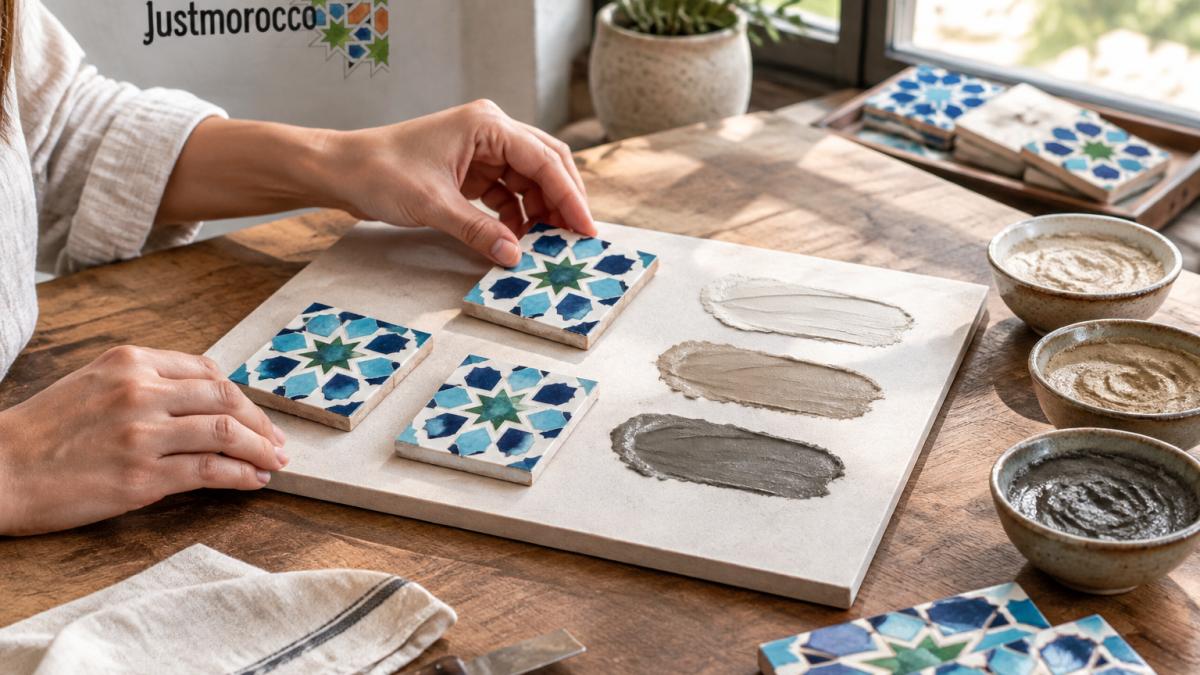
Glue a few tiles to a board and grout each section in a different color. Let it cure fully. Grout dries lighter or darker than it looks wet, and cured color is the only color that counts.
Then move the board around the room. Check it in morning daylight, afternoon light, and evening artificial light. A grout that looks right at noon can turn dull under warm bulbs.
Step 5: Plan for Grout Type, Sealing, and Long-Term Cleaning
Grout type affects both look and lifespan. Sanded grout suits wider joints and grips handmade edges well. Unsanded grout works for tight joints but can shrink and crack.
Seal every grout joint, even on tile that needs no sealing. Sealer slows staining and makes cleaning easier. Reseal on the manufacturer's schedule, and sooner in wet areas.
Plan your cleaning routine around your grout color. Light grout needs gentler, more frequent cleaning. Dark grout hides dirt but shows haze and efflorescence. Match the color to the maintenance you will actually keep up with.
Grout is the detail that decides whether handmade tile looks intentional or unfinished. Getting it right takes a sample board, honest lighting, and a clear read on your tile's undertones. That is the kind of judgment we bring to every project at Justmorocco, where our custom furniture imports and custom design work pair authentic handcrafted tile with the installation details that make it last. Browse our handmade tile collections, order samples, and let our team help you match grout to the tile you love. Get started with Justmorocco and choose grout with confidence.
Frequently Asked Questions
Should grout be lighter or darker than handmade tile?
There is no fixed rule, but the choice changes the look. A grout slightly lighter or darker than the tile in the same undertone family blends the layout into a calm surface. A grout several shades away creates contrast that outlines each tile shape. For handmade tile with irregular edges and glaze variation, a mid-tone grout that sits between the lightest and darkest glaze tones often reads as the most forgiving option, because it echoes the natural variation instead of fighting it.
How do I test grout colors before installation?
Build a sample board using actual tiles from your order, not paper swatches. Set three or four candidate grout colors in joints of the same width you plan to use, let them cure fully, then view the board in daylight, in evening artificial light, and at the angle you will actually see it from. Grout darkens as it cures and looks different wet, so judge only the dry, cured result. Keep the board for a week before deciding.
What grout colors work well with handmade tile in a shower?
Mid-tone grouts in warm gray, sand, or greige tend to hold up best in showers because they hide soap scum and water spotting better than white or very dark grout. Match the grout undertone to the tile glaze so the walls read as one surface. Whatever color you pick, seal the grout joints according to the manufacturer's recommendations and use sanded grout for joints 1/8 inch or wider, which is common with handmade tile.
Does grout color change the appearance of handmade tile?
It changes it significantly. Contrasting grout emphasizes tile shape, pattern, and layout, which suits geometric Moroccan tile where the design is the point. Blending grout softens the grid and lets glaze variation and texture carry the visual interest. On a busy pattern, a loud contrasting grout can compete with the design, while on a simple field tile it can add the definition the layout otherwise lacks. Test both directions on a sample board before committing.
