

Table of Contents
- Why Moroccan Wall Mirrors Belong in Small Apartments
- How to Make a Small Room Look Bigger with Mirrors
- Where to Place a Mirror to Reflect Light
- Moroccan Mirror Decor Ideas for Every Room
- Choosing the Right Moroccan Mirror Style
- Apartment-Safe Hanging and Wall Protection
- Budget and Buying Guidance for Authentic Pieces
- Care, Cleaning, and Material Considerations
- Frequently Asked Questions
Last Updated: October 21, 2026
Why Moroccan Wall Mirrors Belong in Small Apartments
Moroccan wall mirrors do two jobs at once in a small apartment: they bounce daylight into dark corners, and they give a plain wall a piece of real character. At Justmorocco, we import hand-carved bone inlay and arched mirrors for compact US homes.
Small apartments rarely have room for extra furniture. A mirror takes up no floor space at all.
The handmade frames matter too. A machine-cut frame looks flat from across the room. A hand-carved one catches the light and adds texture.
Here is what we cover: sizing, placement, glare, hanging in a rental, and how to spot real craftsmanship. Get those right and a single mirror can change how a whole room feels.
How to Make a Small Room Look Bigger with Mirrors
To make a small room look bigger with mirrors, place one large mirror where it reflects a window or a bright wall. The reflected view adds visual depth, so the eye reads the room as deeper than it is.
Size beats quantity here. Several small mirrors fragment the view. One tall mirror doubles the space.
An arched or tall rectangular shape also draws the eye upward. That makes ceilings feel higher.
Sizing and Placement Measurements That Work
Measure before you buy anything. These starting points work in most compact rooms:
- Width: the mirror should span about half to two-thirds of the wall or furniture below it
- Hang height: center the mirror at eye level, roughly 60 inches from the floor
- Above a console: leave 6 to 8 inches of gap between the tabletop and the bottom of the frame
- Above a sofa: keep the bottom edge 8 to 10 inches above the backrest
- Clearance: keep at least 12 inches from a doorway so the frame does not clip the swing
In a tight bedroom, a mirror over a dresser works well. In a living room, try a tall mirror beside the window wall.
Where to Place a Mirror to Reflect Light
The best spot for a mirror is directly opposite a window, or on a wall perpendicular to it. Opposite placement sends daylight deep into the room. Perpendicular placement spreads soft light across the wall.
Avoid facing a mirror at a lamp or a screen. You will get glare, not brightness.
Glare, Privacy, and Lighting Trade-Offs
Bright reflections come with trade-offs. Plan for them:
- Glare: a mirror facing a bright window can wash out a TV screen nearby. Angle it slightly or move the screen
- Privacy: a mirror facing a window can reflect your room toward neighbors at night. Close blinds after dark
- Evening light: mirrors amplify lamps too, so use warm bulbs to avoid harsh reflections
- Heat: keep frames away from direct sun on hot afternoons to protect inlay and finish
A mirror is a light tool, not a lamp. It reflects what is already there.
Moroccan Mirror Decor Ideas for Every Room
Moroccan mirror decor ideas work best when the mirror anchors one wall and the rest of the room stays calm. Let the frame be the statement, then add a few warm accents around it.
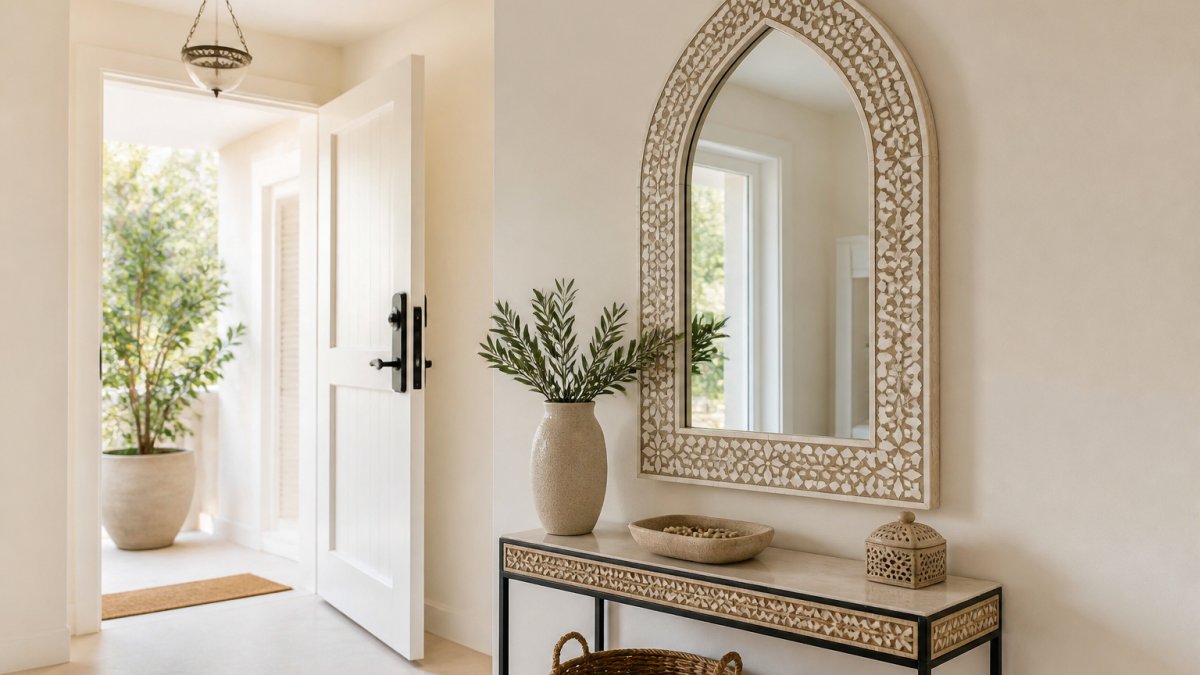
Entryway, Bedroom, and Living Room Layouts
Each room has its own best layout:
- Entryway: an arched mirror above a slim console, with a bowl for keys and one hanging lantern nearby
- Bedroom: a tall mirror beside the closet door, or a round bone inlay mirror above a low dresser
- Living room: a large rectangular mirror on the mantel wall or opposite the main window, framed by two small wall pieces
Keep the surrounding decor simple. A busy wall fights the intricate patterns in the frame.
Choosing the Right Moroccan Mirror Style
Start with shape, then frame, then material. Arched mirrors suit narrow walls and doorways. Round mirrors soften boxy rooms. Rectangular pieces fit above consoles and mantels.
Handmade Moorish Arch Mirror, Camel Bone Inlay, Moroccan Decor →
Frame style sets the mood:
- Bone inlay: white inlay set into dark wood, with fine geometric or floral patterns
- Carved wood: deep relief carving that reads well from a distance
- Plaster and brass: softer, warmer tones with metal detail
- Mosaic: small tile pieces for a bolder, more colorful look
Check the back of the frame and the joints. Handmade pieces show slight variation, and that is a good sign, not a flaw.
Our Handmade Moorish Arch Mirror with camel bone inlay measures 40 by 24 inches, a good scale for a bedroom or bathroom wall. For a round option, the 29-inch Moroccan bone inlay mirror suits a tighter wall.
Apartment-Safe Hanging and Wall Protection
Renters need two things from a mirror install: a hold that will not fail, and a wall you can leave clean at move-out. Most of the risk comes down to matching the hardware to the wall, and most of the damage comes from skipping that step.
Match the Anchor to the Wall
Start by identifying what is behind the drywall. A stud finder that also flags metal and live wiring is worth the $20 to $40; the magnetic and electronic models sold at hardware stores are accurate enough for this job. Then choose hardware by wall type:
- Wood stud: a lag screw or a heavy-duty wood screw driven at least 1 inch into the stud. This is the strongest option and the one to use whenever a stud is available.
- Hollow drywall (no stud): a toggle bolt or a self-drilling drywall anchor. Toggle bolts spread the load behind the drywall and are the standard choice for anything heavier than a small frame. Match the anchor's published weight rating to at least twice the mirror's shipping weight, because a slammed door or a leaning child adds dynamic load the static rating does not capture.
- Plaster over lath: plaster is brittle and crumbles around a hole. Use a toggle bolt with a wide washer, drill slowly with a masonry bit, and avoid self-drilling anchors, which crack plaster.
- Brick or concrete: a sleeve anchor or a masonry screw. These are common in older apartment buildings and need a hammer drill.
- Metal studs: a self-drilling screw plus a toggle bolt through the stud, or a strap toggle. Do not rely on a screw alone in thin-gauge metal.
For wide or heavy frames, a French cleat is the best load spreader. A cleat screwed into two studs distributes the weight across the wall and lets you lift the mirror onto the cleat rather than holding it while you drive screws. Have a second person steady the frame during the lift.
Protect the Wall and the Deposit
- Put felt pads or small rubber bumpers on the back corners so the frame does not scuff paint when the building shifts or a door slams.
- Use two hooks rather than one for any frame wider than about 24 inches, so the mirror cannot swing and crack.
- Keep mirrors off exterior walls that collect condensation, especially in humid climates; moisture behind the frame damages wood and inlay and stains paint.
- Photograph the wall before you drill and keep the anchor packaging. If a landlord questions a hole, a toggle bolt hole is easier to explain than a torn-out screw.
- At move-out, patch holes with lightweight spackle, sand smooth, and touch up with the paint color the building uses. Most leases require the wall to look as it did at move-in, and small patched holes usually pass.
Budget and Buying Guidance for Authentic Pieces
Handmade Moroccan mirrors cost more than mass-produced ones, and the price difference is mostly explainable. Understanding what drives the number lets you decide where to spend and where to save.
What Drives the Price
- Size and glass: a larger mirror needs thicker glass and a stronger frame, and both cost more. Glass is priced by area, so a 40-by-24-inch piece uses roughly twice the glass of a 24-by-20-inch piece.
- Frame material: solid wood costs more than MDF or plywood, and carved or inlaid wood costs more again because of labor hours. Bone inlay is the most labor-intensive common finish; each piece of bone is cut and set by hand.
- Handwork: hand-carved relief, hand-set inlay, and hand-cut mosaic all add hours. A machine-cut frame can look similar in a photo but reads flat in person.
- Finish and hardware: brass, copper, and plaster details add material cost and require more careful packing.
- Shipping and packing: glass and inlay need crating, and that cost is built into the delivered price. A seller who quotes a low price but charges high freight is not actually cheaper.
Handmade vs. Mass-Produced
A mass-produced mirror is consistent and inexpensive, and it is a reasonable choice for a hallway or a rental you plan to leave. A handmade piece varies slightly from one to the next, and that variation is the sign of handwork. Check the back of the frame and the joints: a solid wood back, tight joinery, and slight differences in the inlay pattern are good signs. A printed imitation of bone inlay will look uniform and flat up close.
A Realistic Budget Framework
Set your budget around size and material first, then let the frame style follow. As a working guide, small accent mirrors sit at the low end, mid-size arched and round pieces sit in the middle, and large inlaid or carved statement mirrors sit at the top. At Justmorocco, our mirrors range from the round 29-inch bone inlay piece at $570 to a large geometric striped mirror at $3,200, and each listing states the exact size and materials so you can match a piece to your wall before you commit. A smaller authentic piece often outlasts a larger imitation, so if the budget is tight, buy the best small piece rather than the biggest cheap one.
Questions to Ask Before You Buy
- Who made it, and where?
- Is the inlay real bone or a printed imitation?
- What is the return policy if the glass arrives damaged?
- Is the hanging hardware included, and what weight is it rated for?
- What are the exact dimensions, including the frame?
Care, Cleaning, and Material Considerations
Dust the frame weekly with a soft dry cloth. Clean the glass with a non-ammonia spray and a microfiber cloth, and spray the cloth, not the frame.
Keep these points in mind:
- Bone and wood dislike standing moisture, so wipe up splashes right away
- Avoid harsh cleaners on inlay and metal detail
- Keep mirrors out of direct afternoon sun to slow fading
- In humid coastal rooms, run a dehumidifier and check the back of the frame twice a year
Handle the frame, never the glass, when you move a piece. Small chips in bone inlay can be stabilized by a furniture restorer.
Frequently Asked Questions
What size Moroccan wall mirror works best in a small apartment?
Aim for a mirror that covers roughly 60 to 75 percent of the wall width above the piece of furniture it sits over. In compact rooms, a 24-inch to 40-inch wide arched mirror is usually enough to add depth without overwhelming the space. If you want the mirror to draw the eye upward and suggest higher ceilings, hang it vertically so the top edge sits a few inches above eye level. Measure the wall first and mark the footprint with painter's tape before buying.
Where should you place a mirror to reflect the most natural light?
Place the mirror on a wall perpendicular to your main window, or directly opposite it if the view outside is worth reflecting. A mirror opposite a window bounces daylight deep into the room, which is why it works so well in narrow apartments with one light source. Avoid facing a mirror straight at a screen or a bright lamp, since that creates glare. In a small bedroom, a mirror on the wall beside the window reflects light across the bed without shining directly into your eyes.
How do you hang a heavy Moroccan mirror safely in a rental?
Use two wall anchors rated for at least twice the mirror's weight, and drive them into studs wherever possible. For plaster or drywall, toggle bolts hold far better than plastic plugs. Add felt pads or rubber bumpers to the back corners so the frame does not scuff the paint, and keep the bottom edge at least 8 inches above a console or dresser.
How do you style a Moroccan mirror without making a small room feel cluttered?
Let the mirror be the statement and keep everything around it quiet. Pair one arched or geometric bone inlay mirror with a plain wall, a single hanging lantern, and one textured element such as a wool rug or a woven basket. Skip gallery walls of small frames nearby, since busy patterns compete with the intricate inlay. Stick to two or three colors in the surrounding decor, and keep the floor space under the mirror clear so the reflected light reaches the room.
Small apartments ask a lot of every wall, and a single handcrafted mirror can answer most of it: more light, more depth, and a real focal point. Justmorocco imports authentic Moroccan wall mirrors and custom pieces, with direct shipping to California, Texas, New York, and Florida. Browse our collection and match a hand-carved frame to your space, or talk to us about a custom size for a difficult wall.