
Table of Contents
- Moroccan vs Modern Minimalist: Core Design Philosophies
- Color Palette: Rich Warmth vs Neutral Restraint
- Pattern and Texture: Intricate Details vs Clean Lines
- Moroccan Style Lamp Choices and Lighting Design
- Furniture Selection: Ornate Craftsmanship vs Functional Minimalism
- Creating Modern Moroccan Interior Design Through Fusion
- Budget-Friendly Hybridization and Sustainable Sourcing
- Avoiding Common Mistakes When Blending Both Styles
- Conclusion
Last Updated: August 26, 2026
Moroccan vs Modern Minimalist: Core Design Philosophies
The tension between moroccan vs modern minimalist design represents one of the most compelling debates in contemporary interior styling. On one side sits a design language rooted in centuries of cultural richness, intricate craftsmanship, and sensory abundance. On the other sits a philosophy built on restraint, clarity, and the principle that less genuinely creates more. Yet here's what most design guides get wrong: these two approaches aren't opposites. They're complementary forces that, when balanced thoughtfully, create spaces with both soul and serenity.
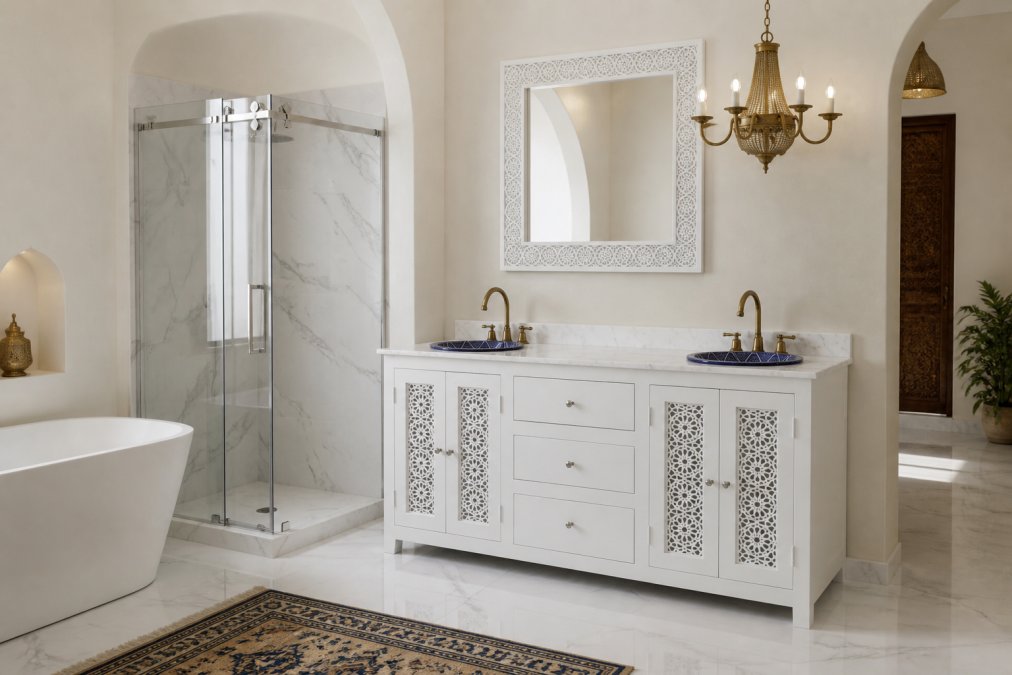
At Justmorocco, we've spent years working with architects and homeowners who wrestle with this exact question. The answer isn't choosing one or the other, it's understanding what each brings to a room, then deciding how much of each your space needs.
What Defines Moroccan Interior Design
Moroccan design is fundamentally about creating an immersive sensory experience. This style draws from centuries of Islamic, Berber, and Mediterranean influences woven into a cohesive aesthetic that prioritizes warmth, layering, and human connection.
The core DNA of Moroccan interiors centers on several non-negotiable elements. Ornate tilework, known as zellige, features geometric patterns in jewel tones, deep blues, terracottas, rich reds, and warm golds. Hand-carved wood appears throughout: in doors, screens (mashrabiya), ceiling panels, and furniture. Lighting is sculptural, not merely functional. Brass and copper lanterns cast intricate shadow patterns that transform a room's atmosphere as daylight shifts. Textiles, layered rugs, embroidered cushions, woven throws, create visual and tactile richness. The overall effect is convivial and inviting, designed for gathering, conversation, and a slower pace of life.
What makes Moroccan design distinctly different from other ornate styles is its intentional balance. Yes, there's visual complexity, but it's organized through color harmony and spatial rhythm. A room doesn't feel chaotic; it feels purposefully layered.
Principles of Modern Minimalism
Modern minimalism operates from an entirely different philosophy: the belief that every object must earn its place. This style emerged from Scandinavian design principles and Japanese aesthetics, both rooted in the idea that clarity creates calm.
Minimalist interiors prioritize function, clean lines, and negative space. Furniture is stripped to its essential form, no ornament, no excess. Color palettes are intentionally muted: whites, grays, blacks, soft beiges, and perhaps one accent color used sparingly. Materials are chosen for their inherent beauty: raw wood, concrete, steel, linen. The aesthetic is clutter-free by design, with storage integrated into the architecture itself so nothing sits exposed.
The philosophy behind minimalism isn't coldness; it's intentionality. Every piece of furniture, every color choice, every object on display has been deliberately selected. This creates a sense of visual rest and mental clarity that many find deeply calming.
Color Palette: Rich Warmth vs Neutral Restraint
Here's where the philosophical divide becomes visually obvious. Moroccan color palettes are bold, warm, and saturated. Think terracotta walls, jewel-toned cushions in sapphire and emerald, burnt orange accents, and deep burgundy textiles. These colors aren't random, they're drawn from the natural landscape of Morocco: the red earth, the blue Mediterranean sky, the golden desert light. The palette creates an immediate sense of warmth and luxury.
Modern minimalist color palettes are the inverse. Neutral base tones, white, light gray, soft taupe, dominate walls and large furniture pieces. Accent colors, when used, appear in single, restrained doses. A single navy chair. One piece of art. A charcoal throw. The restraint is the point. These muted tones create visual calm and make spaces feel larger and more serene.
The practical difference matters for your home. Moroccan color palettes energize and envelop; they make spaces feel intimate and lived-in. Minimalist palettes create breathing room; they feel sophisticated and uncluttered. Neither is objectively better, they serve different emotional needs.
When blending these approaches, the color question becomes crucial. Many hybrid spaces fail because they try to use both palettes equally, creating visual noise instead of harmony. The successful approach: choose one as your base and use the other as accent. A predominantly neutral room with one jewel-toned accent wall. Or a warm-toned room with clean-lined, minimal furniture that prevents it from feeling heavy.
Pattern and Texture: Intricate Details vs Clean Lines
Moroccan design embraces pattern and texture as essential elements. Geometric patterns appear in tilework, textiles, carved screens, and painted surfaces. These patterns aren't decorative afterthoughts, they're the primary visual language. Texture is equally important: rough woven rugs, smooth glazed tiles, carved wood, soft leather, embroidered cushions. Running your hand across a Moroccan room should be an experience. Layering is intentional, multiple patterns, textures, and materials coexist without feeling chaotic because they're unified through color and cultural coherence.
Modern minimalism treats pattern and texture differently. Pattern is minimal or absent entirely. Solid colors dominate. Texture exists but is subtle and organic: the grain of natural wood, the weave of linen, the matte finish of concrete. When pattern does appear in minimalist design, it's restrained, perhaps a single geometric rug or a subtle wallpaper. The goal is visual clarity, not visual richness.
This is the section where many hybrid designs derail. A room filled with both intricate Moroccan patterns and minimalist clean lines often feels incoherent, like two different design languages fighting for attention. The solution: use pattern strategically. A single statement wall with zellige tilework or geometric wallpaper works beautifully in an otherwise minimal space. A textured Moroccan rug grounds a room of clean-lined furniture. The key is restraint, let one element carry the pattern load while other surfaces remain calm.
Moroccan Style Lamp Choices and Lighting Design
Lighting is the most underutilized tool for bridging Moroccan and minimalist design. Most articles treat it as decoration; the reality is that lighting architecture determines whether a hybrid space feels cohesive or confused.
Color Temperature and Warmth as Design Language
Authentic Moroccan interiors rely on warm light, typically 2700K (warm white), which mimics the golden hour and creates the amber, intimate glow that defines the aesthetic (abwab shop). This isn't arbitrary. At 2700K, jewel tones read as rich and inviting; neutral walls feel warm rather than sterile. Minimalist spaces, by contrast, often default to 3500K-4000K (cool white or neutral white) to support visual clarity and make spaces feel larger.
The hybrid approach requires intentional color temperature layering. Your base ambient lighting should be 2700K to establish warmth throughout the space. This is non-negotiable. If you use 4000K overhead lighting, no amount of Moroccan accents will feel authentic; the space will read as cold and contemporary, not warm and layered.
For recessed ceiling lights (common in minimalist spaces), choose 2700K dimmable LED bulbs rated for at least 800 lumens per fixture in living areas, 400-600 lumens in bedrooms (abwab shop). This provides adequate illumination without harsh glare. Dimmers are essential; they allow you to adjust warmth and intensity based on time of day and mood, a principle both Moroccan and minimalist design respect (one for ambiance, one for functional clarity).
Layered Lighting Strategy: Ambient, Task, and Accent
Successful hybrid spaces use three lighting layers:
Ambient lighting provides overall illumination. In a minimalist-dominant room, this might be recessed ceiling lights or a simple track system in matte black or brushed steel, all set to 2700K. In a Moroccan-dominant room, ambient light comes from multiple sources: wall sconces, pendant lights, or lanterns distributed around the space rather than a single overhead fixture. The key difference: minimalist ambient lighting is even and unobtrusive; Moroccan ambient lighting is sculptural and creates shadow patterns.
Task lighting supports specific activities: reading, cooking, grooming. A minimalist space uses clean-lined desk lamps or under-cabinet lighting. A Moroccan space might use brass or copper sconces flanking a mirror or a carved wooden pendant above a work surface. In hybrid design, task lighting should reflect your dominant aesthetic. If minimalist is dominant, keep task fixtures simple; if Moroccan is dominant, allow them to be ornate. Task lighting is typically 3000K-4000K because clarity matters more than ambiance in functional zones.
Accent lighting highlights focal points: artwork, architectural details, statement furniture. A carved Moroccan credenza benefits from a brass picture light or a directional pendant above it. A minimalist gallery wall might use track lighting with adjustable heads. Accent lighting is often 2700K to maintain warmth and draw the eye without creating visual harshness.
In a 16x18 living room with minimalist bones and Moroccan accents, a practical layering might look like: recessed 2700K ceiling lights (dimmable, 800 lumens each, spaced 6 feet apart) as ambient base, a pair of brass Moroccan wall sconces (2700K, 400 lumens each) flanking a console as secondary ambient, and a single statement brass lantern (2700K, 300-500 lumens) positioned to cast shadow patterns as accent lighting. Total installed wattage: approximately 120-150 watts, sufficient for the space without overwhelming it.
Fixture Selection and Visual Weight
The fixture itself carries visual weight. An ornate brass Moroccan lantern with perforated metalwork is a statement piece; it demands attention and works best as a single focal point in an otherwise minimal space. Pairing two identical ornate lanterns creates symmetry and visual heaviness; they work in larger rooms (20+ feet) or in Moroccan-dominant spaces where pattern and ornamentation are expected.
Minimalist fixtures, recessed lights, track systems, simple pendant lights in matte finishes, are visually quiet. They support the space without competing for attention. In hybrid design, use minimalist fixtures as your structural backbone and Moroccan fixtures as accents. A room with five recessed lights and one statement brass lantern reads as intentional. A room with three recessed lights and three ornate lanterns reads as confused.
When selecting Moroccan lighting, consider the perforations and metalwork. Tight geometric patterns (small holes, dense designs) cast intricate shadows that create visual richness. Looser patterns (larger holes, sparse designs) cast softer shadows and feel less ornate. For small spaces or minimalist-dominant rooms, looser patterns work better; they add warmth without visual noise.
Practical Placement and Dimming
Placement determines impact. A Moroccan lantern hung at eye level in a corner casts shadows across two walls, maximizing visual effect. The same lantern hung in the center of a room creates a single overhead glow with less shadow play. For hybrid spaces, position statement lighting where it will be seen but not dominate: above a console, flanking a doorway, or in a corner where it frames the space without overwhelming it.
Dimmers are non-negotiable in hybrid design. They allow you to shift the mood from energetic (brighter, more minimalist) to intimate (dimmed, more Moroccan). Most 2700K LED bulbs are dimmable; confirm before purchasing. Install dimmer switches (not just plug-in dimmers) for reliability and aesthetics. A minimalist dimmer in brushed nickel or matte black blends into the wall; an ornate brass dimmer plate can become a decorative element.
Avoiding Common Lighting Mistakes
The most common error is mixing color temperatures. Using 2700K ambient lighting with 5000K task lighting creates visual discord and makes the space feel disjointed. Choose one dominant temperature (2700K for hybrid spaces) and stay consistent across all fixtures.
A second mistake is underestimating lumens. Many people install decorative Moroccan lanterns expecting them to provide primary illumination; they don't. A single ornate lantern typically produces 200-400 lumens, sufficient for accent lighting but not for reading or general navigation (abwab shop). Pair decorative fixtures with functional ambient lighting.
Third, avoid excessive ornamentation in lighting. A room with ornate lanterns, carved sconces, and patterned pendant lights feels cluttered, not layered. Limit ornate fixtures to one or two per room; let everything else be minimal.
Finally, don't ignore the finish. Brass and copper Moroccan fixtures develop patina over time, which adds character but requires occasional maintenance. Brushed or matte finishes hide fingerprints better than polished finishes. If you're investing in statement lighting, choose finishes that will age gracefully in your space.
Furniture Selection: Ornate Craftsmanship vs Functional Minimalism
Moroccan furniture is a statement. Pieces are typically low-profile, designed for floor seating and relaxation rather than formal dining. Wood is heavily carved with geometric or arabesque patterns. Inlay work features mother-of-pearl, bone, or colored resin creating intricate visual patterns. Upholstery uses rich leather, embroidered fabrics, and ornate nailhead trim. A single credenza or cabinet becomes a focal point, a piece of functional art that commands attention.
Minimalist furniture strips away all ornament. Pieces are defined by their essential form and material honesty. A table is a slab of wood on simple legs. A chair has clean lines and minimal padding. Storage is built-in or features flat surfaces without visible hardware. Materials are chosen for their inherent beauty, natural wood, steel, concrete, not for applied decoration.
The furniture you choose determines whether a space feels balanced or conflicted. A Moroccan room filled with carved wooden pieces and ornate details needs open floor space and minimal accessories to breathe. A minimalist room with clean-lined furniture can accommodate one or two statement pieces, like a carved Moroccan console or textile, without feeling cluttered. The scale matters: a small minimalist room benefits more from a single ornate piece than from many. A larger space can layer multiple styles without visual chaos.
Creating Modern Moroccan Interior Design Through Fusion
The real opportunity lies in the fusion. Modern Moroccan interior design takes the warmth and craftsmanship of traditional Moroccan aesthetics and filters it through a minimalist lens. The result is spaces that feel sophisticated, intentional, and deeply livable.
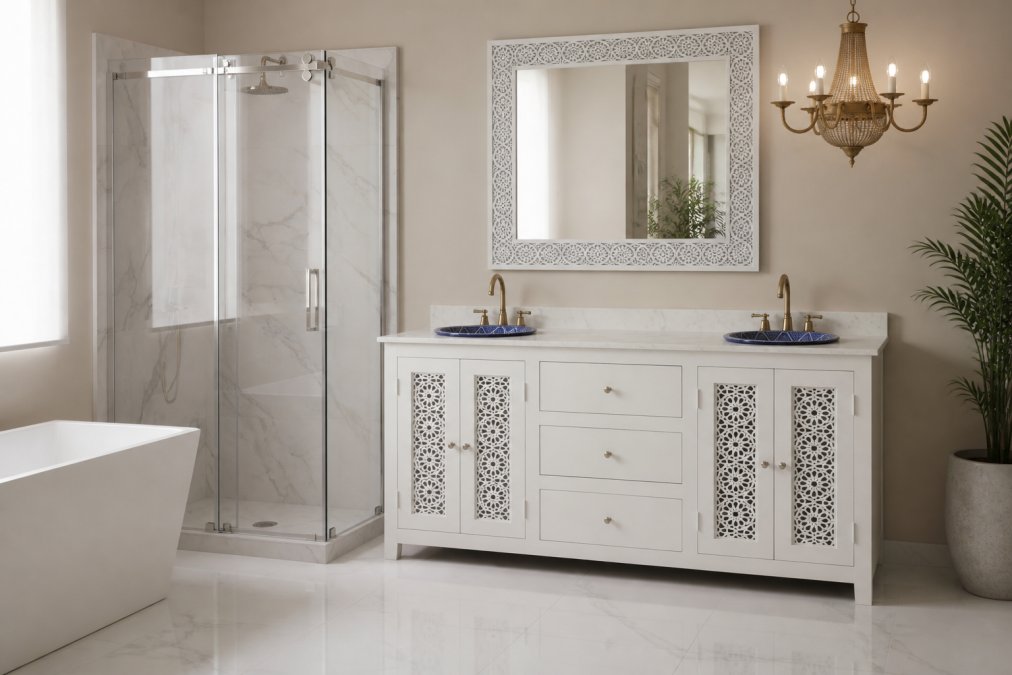
This approach respects both design languages. You're not diluting Moroccan authenticity with minimalism, nor are you compromising minimalist clarity with Moroccan abundance. Instead, you're selecting the best elements of each and combining them intentionally.
Balancing Texture and Simplicity in Hybrid Spaces
The most successful hybrid spaces use texture as their bridge between styles. A room with predominantly neutral walls, clean-lined furniture, and minimal ornamentation becomes warm and inviting through carefully selected textiles. A hand-knotted Moroccan rug in muted jewel tones grounds the space. Layered cushions in complementary colors add softness without clutter. A single woven throw across a minimalist sofa introduces warmth.
The principle: let texture carry what pattern cannot. A textured rug is more restrained than patterned tilework. Woven textiles are more subtle than carved wood. Leather adds richness without visual noise. This allows you to honor Moroccan design's sensory richness while maintaining minimalist clarity.
Spatial balance is equally crucial. A room that feels balanced has visual weight distributed intentionally. A large carved credenza on one wall needs empty space elsewhere, perhaps a blank wall, open floor, or minimal furnishings on the opposite side. This prevents the room from feeling top-heavy or cluttered. Many people instinctively fill empty space, which destroys the balance. Resist that impulse. Empty space is functional, not wasteful.
Textiles and Rugs: The Bridge Between Styles
Textiles are where Moroccan and minimalist design intersect most naturally. A Moroccan rug with geometric patterns in muted tones works beautifully in a minimalist room because rugs are expected to have pattern and texture. They're the designated place for visual richness. Similarly, a single Moroccan textile, a throw, a cushion cover, a wall hanging, becomes an accent piece in a predominantly minimal space rather than visual clutter.
When selecting rugs, consider both authenticity and restraint. Hand-woven Moroccan rugs feature traditional patterns: geometric shapes, diamond motifs, tribal designs. But the color palette matters enormously. A rug in deep navy, charcoal, and cream reads as sophisticated minimalism. The same rug in bright red, gold, and turquoise reads as traditional Moroccan. Both are authentic; the difference is how they interact with your overall design scheme.
Layering textiles is a Moroccan design principle that works beautifully in hybrid spaces. A larger neutral rug as your base, topped with a smaller patterned rug, creates visual interest without chaos. Cushions in complementary colors, perhaps three in solid neutrals, one in a jewel tone, add depth. The key is intentionality. Every textile should be chosen deliberately, not accumulated randomly.
Small Space Optimization with Dual Aesthetics
Small spaces demand ruthless editing. Attempting to blend Moroccan and minimalist design in a compact room will fail if you try to include too many elements from each style.
The successful approach: choose minimalism as your structural foundation and Moroccan elements as accents. Keep walls, large furniture, and flooring simple and neutral. This creates visual calm and makes the space feel larger. Then introduce Moroccan warmth through carefully selected pieces: a single brass lantern, a hand-woven rug, one piece of carved wood furniture, layered textiles.
This strategy works because it respects spatial hierarchy. The dominant visual impression is calm and clear (minimalist), while the room retains warmth and character (Moroccan). In a 12x14 bedroom, this might mean: white walls, a simple platform bed with clean lines, one carved Moroccan nightstand, a hand-knotted rug in muted tones, brass sconces on either side of the bed, and layered bedding in warm neutrals with one jewel-toned accent pillow.
For larger spaces, you have more flexibility. A 20x20 living room can accommodate more Moroccan elements, perhaps a carved console, multiple textiles, a statement lighting fixture, while still maintaining minimalist clarity through strategic empty space and a neutral base.
Budget-Friendly Hybridization and Sustainable Sourcing
Creating a modern Moroccan interior doesn't require unlimited resources. The key is prioritizing investment pieces and being strategic about what you source.
Authentic handcrafted Moroccan pieces represent genuine value. A hand-carved wood cabinet or a hand-knotted rug will outlast mass-produced alternatives by decades. These are pieces you live with, not replace seasonally. When sourcing these items, consider working with importers who specialize in custom furniture imports, ensuring you receive authentic pieces directly from artisans rather than mass-produced imitations.
Budget-friendly hybridization means investing in one or two authentic Moroccan pieces and filling the rest with quality minimalist furniture. A single carved credenza or console becomes the room's anchor. Everything else, seating, storage, lighting, can be contemporary and minimal, sourced at various price points. This creates visual impact without requiring a six-figure budget.
Sustainable sourcing matters increasingly. Authentic Moroccan pieces are inherently sustainable, they're handcrafted by artisans using traditional methods, often from reclaimed or sustainably harvested wood. When you purchase from importers that work directly with craftspeople, you're supporting traditional skills and small-scale production. This contrasts sharply with mass-produced "Moroccan-style" items that replicate the aesthetic without the authenticity or durability.
Ask questions about sourcing. Where is the wood from? Are artisans paid fairly? How is the piece finished, with natural stains or toxic chemicals? Authentic pieces come with provenance; sellers can tell you about the craftspeople who made them.
Avoiding Common Mistakes When Blending Both Styles
The most common error is visual overload. Homeowners excited about Moroccan design fill every surface with pattern, color, and texture, then add minimalist furniture, creating a space that feels confused. The room lacks a clear visual hierarchy or dominant aesthetic.
The solution is simple: choose one style as dominant and the other as accent. If Moroccan is dominant, minimalism provides breathing room. If minimalist is dominant, Moroccan elements add warmth. This isn't compromise; it's intentional design.
A second mistake is mixing authentic with inauthentic. A hand-carved Moroccan credenza next to a mass-produced "Moroccan-style" side table creates visual discord. The authentic piece stands out as real; the imitation reads as cheap. If budget is a constraint, better to have one authentic Moroccan piece and minimalist furnishings than several mediocre imitations.
Third, many people underestimate the importance of empty space. Moroccan design can feel cluttered if you don't balance visual richness with strategic emptiness. Leave walls bare. Keep floors mostly clear. Let your statement pieces breathe. This is where minimalist principles strengthen Moroccan design.
Fourth, lighting choices often undermine the fusion. Harsh overhead lighting or cool-toned bulbs (5000K+) destroy the warmth Moroccan design creates. Warm lighting (2700K) is non-negotiable. Similarly, overly ornate lighting in a minimalist space creates visual chaos. Choose lighting that complements your dominant aesthetic.
Finally, avoid the mistake of treating this as a temporary trend. Hybrid Moroccan-minimalist design works because it's rooted in genuine design principles, not Instagram aesthetics. If you're drawn to this fusion, commit to it. Invest in pieces you'll live with for years, not seasonal décor you'll tire of quickly.
The choice between Moroccan and modern minimalist design doesn't have to be binary. The most sophisticated interiors recognize that these two philosophies address different human needs, one for warmth and connection, the other for clarity and calm. By understanding the core principles of each and blending them intentionally, you create spaces that feel both luxurious and livable.
At Justmorocco, we specialize in helping clients achieve this balance through authentic, handcrafted pieces that anchor hybrid spaces. Whether you're investing in a statement piece for a bathroom renovation or selecting textiles and accessories to complement minimalist furnishings, our team understands how to bridge these aesthetic worlds. Start with one authentic Moroccan piece, something you genuinely love, and build your hybrid aesthetic around it. The result will be a home that reflects both sophistication and soul.
| Design Element | Moroccan Approach | Minimalist Approach | Hybrid Strategy |
|---|---|---|---|
| Color Palette | Warm, saturated jewel tones | Neutral, muted base | Neutral foundation + one warm accent |
| Pattern & Texture | Layered, intricate, abundant | Minimal, subtle, organic | Pattern in textiles; clean lines elsewhere |
| Furniture | Ornate, carved, low-profile | Clean lines, functional, minimal | One statement Moroccan piece + minimal furnishings |
| Lighting | Sculptural brass, warm glow | Simple fixtures, even illumination | Statement Moroccan lamp in minimal space |
| Textiles | Multiple patterns, rich colors | Solid colors, natural fibers | Hand-woven rug + layered neutral cushions |
| Space Usage | Layered, full surfaces | Open, negative space | Strategic emptiness with intentional richness |
Frequently Asked Questions
What are the key differences between Moroccan and minimalist design?
Moroccan design emphasizes vibrant colors, intricate geometric patterns, ornate details, and hand-crafted textures that create warmth and visual richness. Modern minimalism prioritizes clean lines, neutral palettes, uncluttered spaces, and functional simplicity. Moroccan spaces invite sensory engagement; minimalist spaces encourage calm through restraint. The two can coexist by using Moroccan textiles and accents as focal points within a minimalist neutral base.
How do you mix Moroccan decor with minimalist furniture?
Start with a neutral base of clean-lined furniture and muted wall colors. Layer in Moroccan elements through textiles, a geometric patterned rug, embroidered cushions, or a woven throw. Add a single statement piece like a carved wooden credenza or a moroccan style lamp with perforated metalwork. The key is restraint: choose one or two high-impact Moroccan accents rather than filling the space. This prevents visual chaos while honoring both aesthetics.
Can you combine maximalist Moroccan patterns with a minimalist color palette?
Yes, this is one of the strongest fusion strategies. Use muted tones like dusty rose, soft terracotta, or mauve for Moroccan geometric patterns and tilework. Pair these with white, cream, or soft gray walls and furnishings. The intricate patterns remain visually interesting, but the restrained color palette keeps the space feeling calm and organized rather than overwhelming. This approach brings sophistication without sacrificing the minimalist sense of order.
Is minimalism still popular in 2026?
Minimalism remains influential, but it has evolved beyond stark emptiness. Contemporary minimalism embraces warmth, natural materials, and thoughtful texture, which makes it ideal for blending with Moroccan design. The fusion of minimalist spatial principles with artisanal Moroccan craftsmanship reflects current design trends that value both simplicity and authentic, handmade character.