

Last Updated: November 17, 2026
Quick Summary
To mix global patterns in a contemporary bathroom, give one pattern the lead and let calm surfaces support it. Keep a 3:1 ratio of quiet surface to patterned surface, with one clear focal point per sightline. Limit any pattern to two repeats and vary the scale between them.
- Use one bold pattern per sightline and two neutral surfaces for every patterned one.
- Big patterns belong on big planes, small patterns on small ones.
- Tape out the pattern's repeat and check it from the doorway before committing.
- In small bathrooms, use one patterned surface and keep vanity, mirror and fixtures plain.
- Name each pattern's tradition and keep sacred motifs out of bathrooms and floors.
Table of Contents
- Start with a Dominant Pattern and a Quiet Counterpart
- Bathroom Design Styles That Support Global Pattern Mixing
- Pattern Scale, Repetition, and Visual Hierarchy
- How to Mix Global Patterns in a Contemporary Bathroom Design with Shower
- Small Bathroom Styles: Editing Patterns for Tight Spaces
- Transitional Bathroom Design: The Bridge Between Global and Modern
- Material Suitability for Wet and Humid Bathrooms
- Cultural Context and Respectful Use of Motifs
- Plan Your Global Pattern Bathroom with Justmorocco
- Frequently Asked Questions
Start with a Dominant Pattern and a Quiet Counterpart
The fastest way to mix global patterns in a contemporary bathroom is to give one pattern the lead and let a calm surface do the supporting work. This rule solves most of the anxiety around pattern mixing.
Pick a single hero: a zellij tile floor, a carved vanity, or a patterned shower wall. Then choose a quiet counterpart, such as plain marble, matte white ceramic, or warm plaster. The eye needs somewhere to rest.
A 2026 Houzz report, covered by Martha Stewart's coverage of the Houzz bathroom trends report, found that 40% of homeowners reworked the bathroom layout and 38% modified the walls during their projects. In other words, most people are already rebuilding the room.
Three habits keep the balance:
- One bold pattern per sightline
- Two neutral surfaces for every patterned one
- Repeat the hero pattern once, never three times
Get this wrong and the room feels busy. Get it right and the pattern reads as art.
Bathroom Design Styles That Support Global Pattern Mixing
Not every bathroom design style welcomes a bold cultural motif. The ones that do share a common trait: clean lines that let pattern stand out.
Soft minimalism and biophilic design are shaping contemporary bathrooms in 2026, according to Modern Bathroom's 2026 style trends series. Both rely on natural materials and light, which makes them ideal backdrops for a patterned floor or wall.
Porcelanosa's 2026 bathroom trends guide points to Mediterranean influence and Japandi aesthetics, a blend of Japanese and Scandinavian design. Both styles favor restraint, so global patterns fit without fighting the room.
The styles that work best:
- Contemporary: flat fronts, large tile, one patterned accent
- Transitional: classic shapes softened with modern fixtures
- Japandi: low clutter, natural wood, one strong motif
- Soft minimal: warm neutrals with a single patterned surface
What ties these together is simplicity. A global pattern needs breathing room to look intentional.
Pattern Scale, Repetition, and Visual Hierarchy
Pattern scale decides whether a room feels calm or chaotic. The practical rule most designers use is a 3:1 ratio of quiet surface to patterned surface, with one clear focal point per sightline. Big patterns belong on big planes, small patterns on small ones, and the eye should land somewhere first.
Here is how pattern weight typically ranks in a bathroom:
| Surface | Pattern Scale | Role |
|---|---|---|
| Floor tile | Large or medium | Anchor |
| Shower wall | Medium | Focal point |
| Vanity or mirror | Small, detailed | Accent |
| Ceiling and trim | None | Rest |
Scale is relative to viewing distance. A 12-inch zellij sheet reads as medium on a shower wall but as large on a 30-inch vanity backsplash. Before you commit, tape out the pattern's repeat on the wall and step back to the doorway, the distance you will actually view it from. If the motif repeats more than three times in that sightline, it is probably too small for the surface.
Repetition is the second lever. A motif repeated across a floor creates rhythm. The same motif on the floor, wall, and vanity creates noise. Limit yourself to two repeats of any pattern, and vary the scale between them, a large floor motif paired with a small band of the same motif behind the mirror reads as intentional, while two identical scales compete.
Visual hierarchy means the eye lands somewhere first. Give the floor or shower wall that job, then let smaller accents support it. A simple test: squint at the room from the doorway. Whatever pattern still reads clearly is your focal point. If two patterns read equally strong, one needs to shrink or go solid.
Negative space is part of the hierarchy. Leave at least one full wall or a wide band of plain surface between patterned zones so the eye can reset. In a typical 5-by-8-foot bathroom, that often means one patterned floor and one patterned accent wall, with the remaining walls in a solid, warm neutral.
One practical note: complex layouts waste tile. Before you order, work out your overage carefully with our guide on how much tile overage to add for complex patterns. Running short mid-install on a special-order pattern can stall a project for weeks.
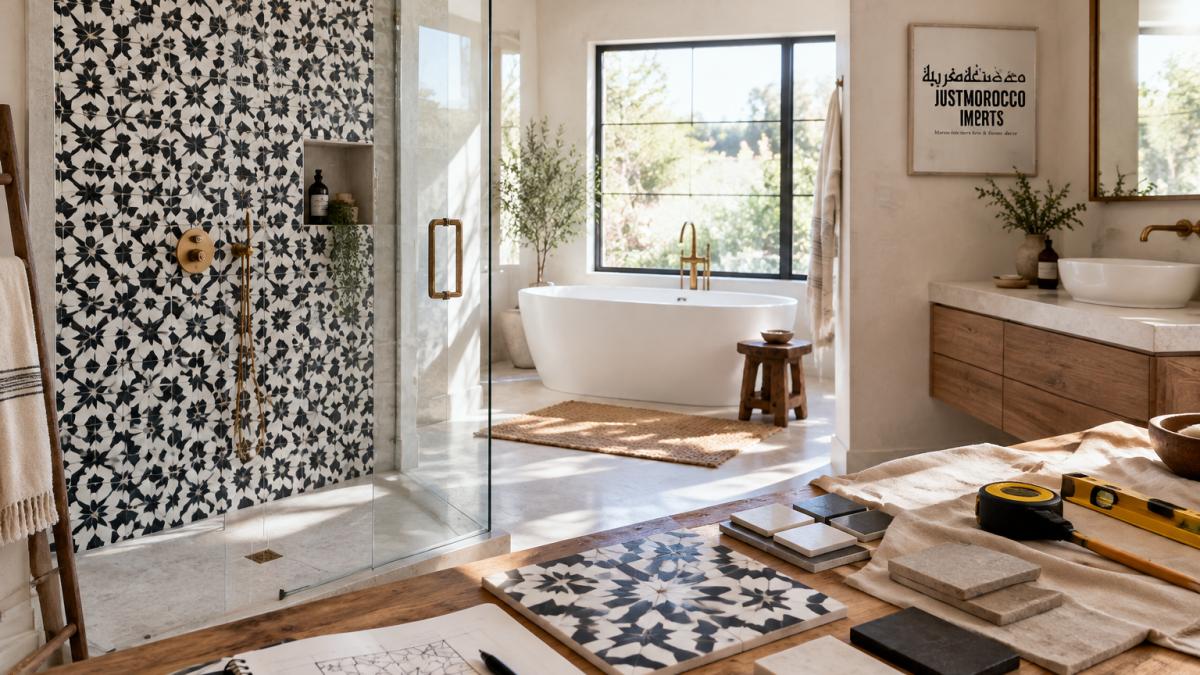
How to Mix Global Patterns in a Contemporary Bathroom Design with Shower
A shower is the best place to start mixing global patterns in a contemporary bathroom design because glass panels frame the tile like a display case. The pattern becomes the artwork, and the rest of the room stays quiet.
Here is the method we recommend, step by step:
- Choose one patterned tile for the shower's feature wall
- Keep the other shower walls solid or large-format
- Match the floor to the wall's quietest color
- Use brass or warm metal fixtures to tie the scheme together
- Repeat the pattern once outside the shower, such as a small band behind the mirror
A geometric tile with strong black and white contrast, like the kind HGTV highlights in its bathroom design trends coverage, works well here. The glass keeps the pattern contained, so it never overwhelms the room.
Watch out: patterned shower walls show grout lines and water spots more than plain tile. Seal the surface properly and choose a mid-tone grout that hides marks.
For the hero pattern itself, our Moroccan Zellij tile is hand-cut from clay and pre-mounted in 12-inch sheets, which makes a feature wall far easier to install than loose mosaic.
Small Bathroom Styles: Editing Patterns for Tight Spaces
Small bathrooms need fewer patterns, not more. One motif, scaled down, beats three patterns fighting for attention.
In a tight room, put the pattern where it will be seen least often up close, such as the floor or a single wall. Keep the vanity, mirror frame, and fixtures plain so the eye has a break.
A short list for small spaces:
- One patterned surface only
- Light grout to keep the floor feeling open
- Vertical patterns to draw the eye upward
- Plain, light-colored walls
- A single accent, like one vintage mirror
Scale matters more here than anywhere else. A large geometric pattern in a small room can feel cramped. A medium or small motif reads better.
If you are working with a compact layout, keep the pattern low and let the upper walls stay calm. The room will feel taller and brighter without losing character.
Transitional Bathroom Design: The Bridge Between Global and Modern
Transitional bathroom design is the safest route for anyone nervous about mixing cultures and eras. It blends traditional shapes with modern finishes, so a global motif feels collected rather than themed.
The formula is simple: classic pattern, modern fixture. A hand-painted vessel sink sits on a clean-lined counter. A carved mirror hangs above a flat-front vanity. Old and new share the room.
Ragno USA's bathroom style guide makes a useful point here: mixing styles works when it is done consciously and coherently. Transitional design is that coherence made visible.
What to pair:
- A traditional patterned tile with a modern walk-in shower
- A vintage mirror with contemporary brass hardware
- A handcrafted sink with a minimalist countertop
The result feels timeless rather than trendy. That matters if resale value is on your mind. A coherent transitional room appeals to more buyers than a fully themed one.
Material Suitability for Wet and Humid Bathrooms
Humidity is the silent killer of a beautiful bathroom. Before you commit to a pattern scheme, check that every material can handle steam, splashes, and warm air.
Glazed ceramic and stone tile hold up well in wet zones. Porous stone, untreated wood, and some metals do not. In coastal homes with salt air, the stakes are higher.
Our guide to materials that work for Moroccan bathroom fixtures breaks down which finishes survive a wet room and which ones fail. Read it before you order anything porous.
A quick checklist for wet areas:
- Glazed or sealed tile on shower walls and floors
- Marine-grade or sealed brass for fixtures
- Sealed stone counters, never raw
- Proper ventilation to control moisture
Watch out: an unsealed porous tile in a shower will stain and degrade faster than you expect. Seal it or choose glazed.
Pattern choice and material choice should happen together. A stunning motif in the wrong material becomes a maintenance problem within a year.
Cultural Context and Respectful Use of Motifs
Using a global pattern well means knowing where it comes from. Zellij, the geometric tilework of Morocco, is built from interlacing lines that radiate from a central star. Each motif carries history, and treating it as decoration alone misses the point.
Respectful use starts with attribution. Name the tradition in your design notes and when you talk about the room. Choose authentic pieces where you can, and ask makers how the pattern is traditionally used. Avoid mixing sacred symbols into casual decor, prayer motifs, calligraphy, and religious iconography do not belong on bathroom floors or shower walls.
A practical method for respectful mixing:
- Identify the origin and traditional setting of each pattern you want to use.
- Decide whether the pattern is decorative or symbolic. Decorative motifs travel well; symbolic ones need care.
- Choose one culture's pattern as the lead and let others play supporting roles, so no tradition is reduced to a token accent.
- Credit the source in how you describe the room, "Moroccan zellij floor" rather than "ethnic tile."
- Buy from makers who credit their craft, and ask whether the pattern is produced traditionally or as a reproduction.
Our article on Moroccan tile patterns and their meaning explains what common motifs represent, so you can choose with knowledge rather than guesswork.
Three habits for respectful mixing:
- Learn the origin of each pattern you use
- Buy from makers who credit their craft
- Keep sacred motifs out of bathrooms and floors
Mixing cultures in one room can be beautiful. It works best when each element is chosen with care and named honestly.
Plan Your Global Pattern Bathroom with Justmorocco
A global pattern bathroom comes together when the pattern, the material, and the fixture all agree. That is where we can help.
At Justmorocco, we import handcrafted Moroccan furniture and tile, and we take on custom bathroom remodeling projects. Our pieces are handcrafted, and we serve clients across the United States. If you have a specific piece in mind that you cannot find in our collection, our custom furniture imports service lets you commission it directly.
Start with a hero piece. Our Marrakesh palace vanity sink cabinet is a Moroccan-inspired vanity sink cabinet that anchors a global scheme without shouting. Add a brass lantern or a carved mirror and the room finds its balance.
When you are ready to finish the design, browse our Moroccan bathroom vanities to see the full range.
Mixing global patterns is not about collecting motifs. It is about choosing one with care, giving it room, and letting the rest of the room stay quiet. That is the difference between a bathroom that looks designed and one that looks decorated.
If you want help sourcing authentic pieces or planning a custom remodel, we are here. Get started with Justmorocco and build a bathroom that feels collected, coherent, and unmistakably yours.
Frequently Asked Questions
How many global patterns should I use in a bathroom?
Stick to two or three patterns per bathroom. A large-scale geometric floor tile, a smaller motif on a shower wall, and a solid or subtly textured surface everywhere else gives the eye enough variety without visual noise. If your room is under 40 square feet, limit yourself to one patterned surface and let fixtures, lighting, and hardware carry the global influence.
Can I mix Moroccan tile with contemporary bathroom fixtures?
Yes, and the contrast is what makes the room work. Pair intricate zellij or fish-scale tile with clean-lined vanities, frameless glass showers, and matte white tubs. Keep the fixture shapes simple and let the tile supply the detail. Warm brass or gold hardware ties the two languages together. Justmorocco's Marrakesh Palace vanity sink cabinet shows this balance: carved wood and a Moroccan mirror set against a sleek tub and minimalist shower glass.
What colors work well with patterned bathroom tile?
Soft neutrals, warm whites, and muted earth tones keep patterned tile from overwhelming a room. Black and white geometric patterns pair well with brass, warm wood, and matte black fixtures. If your tile includes color accents like dusty rose or terracotta, repeat that hue once elsewhere, such as a towel, a lantern, or a painted stool, so the palette feels intentional rather than accidental.
How do I make a patterned bathroom feel cohesive?
Repeat one element at least three times: a metal finish, a color, or a shape. Use a consistent grout color across different tile patterns. Keep the pattern density lower on larger surfaces and higher on smaller ones. And leave breathing room, solid walls, plain countertops, and uncluttered shelving, so the patterns read as deliberate focal points instead of competing for attention.
