

Table of Contents
- Why Homeowners Choose Alternatives to Standard Bathroom Wall Tiles
- Acrylic Wall Panels: Seamless Surfaces with Quick Installation
- Waterproof Bathroom Wall Panels: Durability and Design Flexibility
- Natural Stone Veneers and Slabs: Authentic Texture and Elegance
- Microcement and Seamless Renders: Grout-Free Wet Zone Solutions
- Waterproof Wallpaper: Aesthetic Versatility for Moisture-Resistant Walls
- Resin-Based Surfaces: High-Gloss Finishes and Impact Resistance
- Exposed Concrete Finishes: Industrial Aesthetics with Waterproof Membranes
- Moisture-Resistant Wood and Timber: Substrate Preparation and Longevity
- Bathroom Wall Cladding Pros and Cons: Installation Speed vs. Long-Term Maintenance
- Installing Bathroom Wall Panels vs. Tiles: Cost, Substrate Requirements, and Repairability
- Moroccan Zellij Tile: A Handcrafted Alternative to Standard Ceramic
- Conclusion
Last Updated: August 28, 2026
Why Homeowners Choose Alternatives to Standard Bathroom Wall Tiles
Standard ceramic tiles have dominated bathroom design for decades, but homeowners increasingly seek alternatives offering faster installation, seamless finishes, or authentic aesthetic appeal. Grout lines require maintenance, tile installation takes time, and many homeowners want surfaces that feel custom rather than mass-produced. Some prefer visual continuity without grout, while others seek authentic cultural elements like handcrafted Moroccan tilework that standard tiles cannot deliver.
At Justmorocco, we recognize that bathroom wall alternatives extend far beyond acrylic panels and microcement to include natural stone veneers, waterproof wallpaper, resin-based surfaces, and authentic handcrafted options like Moroccan zellij tile. Each addresses specific priorities: installation speed, durability in wet zones, aesthetic versatility, or long-term environmental impact.
Below, we'll explore the most viable bathroom wall alternatives, comparing installation requirements, maintenance demands, repairability, and cost considerations.
Acrylic Wall Panels: Seamless Surfaces with Quick Installation
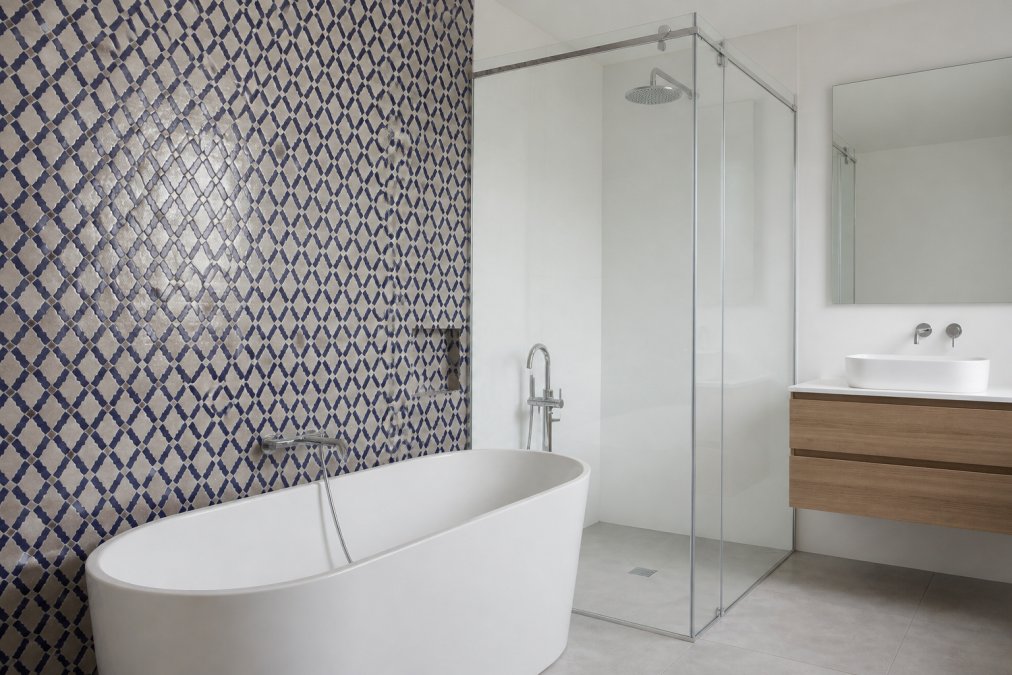
Acrylic wall panels deliver the fastest installation of any bathroom wall alternative. A typical shower enclosure installs in one to two days, compared to five to seven days for tile work. Pre-formed and pre-finished panels require only adhesive application and basic substrate preparation.
These panels create genuinely seamless surfaces with no grout joints, eliminating mold growth, grout staining, and maintenance. The high-gloss finish reflects light, making bathrooms feel larger and more contemporary. However, acrylic shows water spots and fingerprints visibly, has moderate impact resistance, and may yellow over 10-15 years in high-humidity bathrooms. Substrate requirements are strict: walls must be flat, smooth, and properly sealed, as any irregularity will show through or cause adhesive failure.
Acrylic panels typically cost $400-$1,200 for a standard shower surround. Small cracks are repairable by professionals, but large cracks often require full panel replacement.
Waterproof Bathroom Wall Panels: Durability and Design Flexibility
Waterproof bathroom wall panels include PVC, composite materials, and fiberglass-reinforced options, each offering distinct advantages. PVC is more impact-resistant than acrylic and tolerates temperature swings better. Composite panels often mimic natural materials, stone, or wood grain without the maintenance burden of the real thing.
These panels offer hundreds of aesthetic options, from embedded textures to metallic accents, opening design possibilities that standard tiles cannot match. Installation remains fast at two to three days, including substrate preparation. The non-porous surface resists mold and simplifies cleaning. High-quality composite panels last 20+ years in typical bathroom conditions.
Cost ranges from $800 to $2,500 for a complete shower enclosure. Repairs are possible but often require professional installation, and replacing a single damaged panel can be challenging if the manufacturer discontinues that style.
Natural Stone Veneers and Slabs: Authentic Texture and Elegance
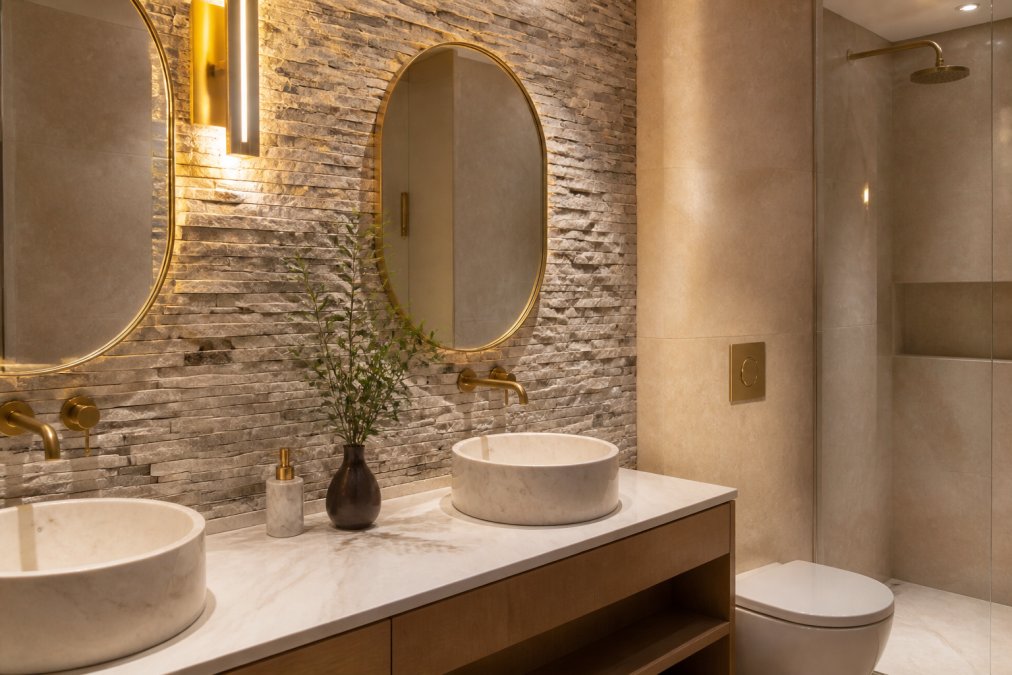
Natural stone veneers and slabs bring authentic texture and visual depth that no manufactured alternative can replicate. Slate, marble, granite, travertine, and limestone each have distinct character, color variation, and natural veining that make bathrooms feel genuinely luxurious.
Installation is more complex than panels, requiring waterproof membranes, mortar-based adhesive, and professional substrate preparation over five to seven days. The aesthetic payoff is substantial: stone conveys permanence and craftsmanship, aging gracefully rather than deteriorating. However, porous stones like marble and limestone require regular sealing every 6-12 months to resist water absorption and staining. Acidic substances etch certain stones, and grout joints still require maintenance. Deep cracks are permanent and impossible to repair invisibly.
Cost is substantial at $1,500-$4,000+ for a full bathroom wall, including installation. When properly maintained, stone lasts decades. Repairability depends on damage: minor chips can be professionally ground and polished, but major cracks or deep stains are often permanent.
Microcement and Seamless Renders: Grout-Free Wet Zone Solutions
Microcement creates genuinely seamless surfaces in wet zones through thin, cement-based coatings that bond directly to existing walls, producing monolithic finishes with no joints or visible seams. Installation requires skilled application over four to six days, including substrate work, primer, base coats, topcoat, and sealing. This is not a DIY project; poor application leads to cracking, adhesion failure, and moisture penetration.
The aesthetic advantages are real: seamless surfaces feel contemporary and sophisticated, can be tinted any color, and finished with matte, satin, or high-gloss topcoats. However, the surface is softer than tile or stone and susceptible to impact damage. Repairs are visible because new microcement rarely matches aged patina. Water sealing is critical; if the topcoat fails, moisture penetrates the porous microcement beneath, causing difficult-to-remediate damage.
Cost ranges from $1,200 to $3,000 for a complete bathroom, with labor as the major expense. Repairability is challenging and often shows.
Waterproof Wallpaper: Aesthetic Versatility for Moisture-Resistant Walls
Waterproof wallpaper offers unprecedented aesthetic versatility for bathroom walls, but the term "waterproof" is misleading. Modern waterproof wallpaper is water-resistant, not waterproof. Water-resistant wallpaper tolerates high humidity, occasional splashing, and condensation without deteriorating. The vinyl layer resists water penetration and prevents mold growth on the surface, but the adhesive and substrate behind it do not.
Where Waterproof Wallpaper Works
Waterproof wallpaper is suitable for bathroom walls that do not receive direct water spray: walls opposite the shower or tub, walls around the vanity area away from direct splash, accent walls, and powder rooms with minimal moisture exposure. It is NOT suitable for shower surrounds, areas receiving direct water spray, bathrooms without exhaust ventilation, or bathrooms with chronic moisture problems.
Installation and Substrate Preparation
Walls must be smooth, clean, and properly primed with moisture-resistant primer formulated for high-humidity areas. Standard drywall primer is insufficient. If drywall is damaged, soft, or shows previous water damage, it must be replaced before wallpaper installation. Use vinyl-specific or acrylic-based adhesive rated for high-humidity applications, applied evenly and completely. Seams must be sealed with waterproof seam sealer after hanging and drying. Installation typically takes 1-2 days, with 24-48 hours drying time before normal bathroom use.
Aesthetic Advantages
Wallpaper patterns create visual interest that standard tiles cannot match. Geometric designs, botanical prints, textures, metallics, or solid colors in unexpected shades transform bathrooms from functional spaces into designed environments. Color selection is virtually unlimited, allowing bathrooms to reflect personal style rather than defaulting to neutral tile colors. Embossed wallpaper, grasscloth, or textured vinyl creates visual depth and intentional design.
Durability and Maintenance
Premium waterproof wallpapers last 7-10 years in typical bathroom conditions. Maintenance is straightforward: regular cleaning with a damp cloth handles most dirt and dust. For mold or mildew on the wallpaper surface, use one part white vinegar to three parts water with minimal moisture. Monitor seams; if they lift or curl, re-seal immediately to prevent moisture infiltration.
Health and VOC Considerations
Vinyl wallpaper can off-gas volatile organic compounds (VOCs) in the weeks after installation. In small, poorly ventilated bathrooms, VOC accumulation can be noticeable. To minimize exposure: ensure exhaust fans run continuously for 24-48 hours after installation, open windows if weather permits, choose low-VOC or zero-VOC products if available, allow wallpaper to cure fully before heavy bathroom use, and consider acrylic-coated paper wallpaper instead of vinyl, which typically off-gases less.
Cost and Repairability
Wallpaper cost ranges from $300 to $1,200 for a typical bathroom, including installation. Small damage can be patched, though seams will be visible. If wallpaper fails due to moisture, remediation requires removing the wallpaper, treating any mold on the substrate, replacing damaged drywall if necessary, and rehanging new wallpaper, typically costing $800-$1,500.
Resin-Based Surfaces: High-Gloss Finishes and Impact Resistance
Resin-based surfaces combine resin binders with aggregates, creating non-porous, highly durable surfaces available in virtually any color with decorative elements like crushed glass, stone chips, or metallic flakes embedded in the matrix. High-gloss finishes reflect light dramatically, creating contemporary, jewel-like appearances. The non-porous surface is genuinely hygienic; bacteria and mold cannot penetrate the material. Cleaning is simple with a damp cloth.
Installation varies by product type, ranging from two days for panel systems to five days for custom poured applications. Impact resistance is superior to acrylic or microcement, tolerating dropped objects and general bathroom wear without cracking or chipping. Thermal stability is excellent, with minimal expansion and contraction. modern bathroom design trends.
The main limitation is cost at $2,000-$5,000 for a complete bathroom installation. Repairability depends on the product; some can be patched while others require full replacement of damaged sections. Color matching for repairs can be challenging if the resin was custom-mixed.
Exposed Concrete Finishes: Industrial Aesthetics with Waterproof Membranes
Exposed concrete finishes bring industrial aesthetics to bathrooms, appealing to design-forward homeowners. Polished concrete can be tinted any color and finished to a high sheen, creating simultaneously modern and earthy surfaces. Stained concrete adds color depth without masking the material's inherent character.
Installation requires waterproof membrane application beneath the concrete, proper substrate preparation, and finishing work over five to seven days. This is specialized work; finding experienced contractors is more challenging than finding tile installers. Durability is excellent when properly sealed, with concrete resisting moisture, impact, and thermal stress. The material only improves with age, developing patina many homeowners find appealing.
The practical limitation is moisture management. Concrete is porous; without proper membrane installation and ongoing sealing, water penetrates and causes damage. Hairline cracks are common and don't necessarily indicate failure, but they can become water pathways if sealing is neglected. Repairs are visible; patching concrete never completely hides the repair.
Cost ranges from $1,500 to $3,500 for a complete bathroom. Repairability is moderate; small cracks and chips can be sealed or patched, but major damage often requires professional intervention.
Moisture-Resistant Wood and Timber: Substrate Preparation and Longevity
Moisture-resistant wood and timber alternatives offer warm, organic aesthetics that conventional bathroom materials cannot match. These products use engineered lumber, pressure-treated wood, or tropical hardwoods selected for moisture tolerance. Wood brings warmth and natural character, creating spaces that feel like sanctuaries rather than functional rooms.
Installation depends on the product, ranging from two to four days. Durability requires meticulous substrate preparation, waterproof membranes, proper ventilation, and ongoing maintenance. Sealing must be renewed periodically, typically every 1-2 years. In high-humidity bathrooms or without proper ventilation, wood can swell, warp, or develop mold despite moisture-resistant treatment.
Repairability is moderate. Wood can be sanded, refinished, or patched, but repairs are visible. Severe water damage requires replacement of affected sections. Cost ranges from $1,200 to $3,500 for a complete bathroom, with long-term ownership including periodic sealing and potential repairs from moisture exposure.
Bathroom Wall Cladding Pros and Cons: Installation Speed vs. Long-Term Maintenance
The choice between bathroom wall alternatives ultimately hinges on balancing installation speed against long-term maintenance demands. Fast-install alternatives like acrylic panels, waterproof panels, and waterproof wallpaper prioritize speed and ease at one to three days, with moderate substrate requirements. The trade-off is that these materials often require more frequent maintenance or have shorter lifespans than natural materials.
Slow-install alternatives like natural stone, microcement, exposed concrete, and wood finishes demand more installation time but often deliver superior longevity and aesthetic depth. A natural stone bathroom installed correctly lasts 30+ years. Microcement, concrete, and wood require ongoing maintenance but age gracefully rather than deteriorating.
Installation speed matters less than most homeowners assume. Whether your bathroom takes three days or seven days to complete is insignificant compared to living with the results for 10, 20, or 30 years. The real question is whether you'll maintain the surface and whether it will perform in your specific climate and humidity conditions.
| Alternative | Installation Time | Maintenance Frequency | Lifespan | Repair Difficulty |
|---|---|---|---|---|
| Acrylic Panels | 1-2 days | Monthly cleaning | 10-15 years | Moderate |
| Waterproof Panels | 2-3 days | Monthly cleaning | 15-20 years | High |
| Natural Stone | 5-7 days | Every 6-12 months | 25+ years | Moderate |
| Microcement | 4-6 days | Monthly cleaning, annual sealing | 15-20 years | High |
| Waterproof Wallpaper | 1-2 days | Monthly cleaning | 7-10 years | Low |
| Resin Surfaces | 2-5 days | Monthly cleaning | 20+ years | High |
| Exposed Concrete | 5-7 days | Every 2-3 years | 25+ years | Moderate |
| Wood/Timber | 2-4 days | Every 1-2 years | 15-20 years | Moderate |
Installing Bathroom Wall Panels vs. Tiles: Cost, Substrate Requirements, and Repairability
The comparison between panels and standard tiles reveals why many homeowners now choose alternatives. Tiles have dominated bathrooms for practical reasons, but substrate preparation and repair reality differ significantly.
Substrate Requirements
Ceramic tile installation requires walls flat within 1/8 inch over 10 feet. Any deviation causes lippage, cracked grout, or loose tiles within months. Achieving this flatness often requires skim-coating with joint compound or installing cement board. Waterproof membranes must be installed before tile in wet zones. If substrate is damaged, soft, or shows previous water damage, it must be replaced entirely. Substrate work typically adds 2-3 days and $400-$800.
Acrylic and composite panels are more forgiving on flatness but demand different preparation. Walls must be clean, dry, and free of loose paint or wallpaper. Minor irregularities up to 1/4 inch are acceptable. However, panels are unforgiving about moisture; if substrate moisture exceeds 12-15%, panel adhesive fails to cure properly (zellij tile). Pre-installation moisture testing is critical for panels but rarely required for tile. Substrate preparation typically takes 1-2 days and costs $200-$400.
Repairability
A single cracked ceramic moroccan tile straightforward to replace using a grout saw and oscillating tool, with labor costs of $50-$150. However, matching grout color is often challenging, and visible seams in the repair area are common.
Acrylic panel repair depends on damage severity. Small cracks under 2 inches can be filled with acrylic repair putty, sanded smooth, and polished to blend invisibly at $100-$300. Large cracks typically require full panel replacement at $400-$800 labor cost. If the panel is discontinued, you may need to replace multiple panels to maintain color uniformity.
Composite and PVC panels are more durable but harder to repair. Impact damage often cracks the material in ways that cannot be invisibly patched. Replacement of a damaged section is typical, with cost depending on whether the panel system allows partial replacement or requires replacing the entire surround.
Microcement repair is visible and challenging. Small chips can be sealed with topcoat, but cracks require professional intervention at $300-$800 depending on damage extent. For large damage, replacing the entire microcement finish is often more cost-effective.
Natural stone repair depends on stone type and damage. Marble and limestone are soft and prone to etching and staining; these cannot be invisibly repaired. Granite and slate are harder; small chips can be ground and polished, but repairs are still visible. Large cracks in stone slabs are permanent and cannot be repaired without replacement. Stone repair labor costs $200-$500 for minor work, but major damage often requires full slab replacement at $1,000+.
Cost Comparison Over 20 Years
Ceramic tile: Initial cost $800-$2,500. Grout maintenance and occasional resealing add $100-$300 annually. A single tile replacement every 5-10 years costs $100-$200. Total 20-year cost: $2,500-$4,500.
Acrylic panels: Initial cost $400-$1,200. Minimal maintenance. Panel replacement at year 12 costs $400-$800. Total 20-year cost: $1,200-$2,500.
Composite panels: Initial cost $800-$2,500. Minimal maintenance. Panel replacement at year 15 costs $600-$1,200. Total 20-year cost: $1,800-$3,500.
Microcement: Initial cost $1,200-$3,000. Annual sealing costs $100-$200. Repair work every 5-7 years costs $300-$800. Total 20-year cost: $2,500-$4,500.
Natural stone: Initial cost $1,500-$4,000. Sealing every 6-12 months costs $150-$400 annually. Repairs are rare if properly maintained. Total 20-year cost: $3,500-$6,000.
The lowest long-term cost is acrylic panels, but this assumes no major damage. The highest is natural stone, but stone also lasts longest and ages most gracefully. The real decision is whether you prioritize lowest cost, fastest installation, seamless aesthetics, or authentic material character.
Moroccan Zellij Tile: A Handcrafted Alternative to Standard Ceramic
Moroccan zellij tile represents an entirely different category: not faster or easier than standard tiles, but profoundly different in character and authenticity. Zellij is handcrafted tile work where individual pieces are hand-cut and hand-placed to create intricate geometric patterns. Each tile is unique; no two pieces are identical.
The aesthetic impact is transformative. Zellij brings authentic Moroccan artistry directly into your bathroom. The geometric patterns, color combinations, and visible handcraftsmanship create spaces that feel genuinely luxurious and culturally rich.
At Justmorocco, we offer authentic zellij tile. The Moroccan Zellij tile is 100% handcrafted from organic clay, hand-chiseled by artisans. Each piece arrives pre-mounted on 12-inch sheets for easier installation, though the work still demands precision and skill.
Installation is more complex than standard tile because tiles vary slightly in thickness and dimension, part of their authenticity. Installation takes longer because each piece must be individually assessed and placed. Cost reflects the handcrafted nature, starting at $65.00 per square foot, with a typical bathroom accent wall running $1,500-$3,500 depending on size and pattern complexity.
Durability is excellent. Handcrafted clay tile is inherently durable and improves with age. The geometric patterns hide grout lines visually, making maintenance less obvious. Zellij works beautifully as an accent wall, establishing the bathroom's aesthetic character.
Justmorocco also offers distinctive handcrafted options including the Tangier tile, the Riad tile, and the Alhambra bathroom tile pack. Each brings authentic Moroccan character and artisanal quality to bathroom spaces. For homeowners interested in exploring how authentic Moroccan design can transform their bathrooms, our custom furniture imports service can help source and integrate these handcrafted pieces into your renovation.
The decision to choose zellij is not about speed or convenience. It's about prioritizing authenticity, craftsmanship, and aesthetic depth. If your bathroom renovation is an opportunity to bring genuine cultural artistry into your home, zellij tile delivers that in a way no standard alternative can match.
The bathroom wall alternatives landscape has expanded dramatically beyond standard ceramic tiles. Whether you prioritize seamless surfaces and fast installation, authentic natural materials, or handcrafted artistry, options exist that align with your values and renovation timeline. The key is matching the alternative to your specific situation, wall condition, climate, maintenance tolerance, and design priorities.
At Justmorocco, we believe bathrooms deserve the same design consideration as living rooms or bedrooms. If you're drawn to authentic Moroccan aesthetics and handcrafted quality, our zellij tile and other Moroccan collections bring genuine artistry to your renovation. Explore our offerings to see how authentic Moroccan design can transform your space into a sanctuary that reflects your personal style and appreciation for traditional craftsmanship.
Frequently Asked Questions
Q: What can I use on my bathroom walls instead of tiles?
A: Several alternatives work well for bathroom walls: acrylic panels offer seamless, moisture-resistant surfaces; natural stone veneers provide authentic texture; microcement creates grout-free finishes; waterproof wallpaper adds pattern and color; resin-based surfaces deliver high-gloss durability; exposed concrete with waterproof membranes suits industrial designs; moisture-resistant wood adds warmth. Each option requires proper substrate preparation and waterproofing to handle wet zone conditions effectively. Moroccan Zellij tiles, handcrafted from organic clay, blend artisanal aesthetics with ceramic durability at $65.00 per square foot.
Q: Are waterproof bathroom wall panels better than tiles?
A: Waterproof bathroom wall panels offer distinct advantages: faster installation (no grout joints), seamless surfaces that resist mold, easier maintenance, and design flexibility. Tiles provide superior impact resistance, individual repairability, and proven longevity in high-moisture areas. Panels suit renovations where speed matters; tiles suit homes prioritizing durability and traditional aesthetics. The choice depends on your timeline, budget, and whether you value installation speed or long-term repairability. Both require proper substrate preparation and adhesive application for lasting performance.
Q: What are the most durable waterproof alternatives to bathroom tiles?
A: Acrylic panels, natural stone veneers, and resin-based surfaces rank among the most durable options. Acrylic panels resist thermal expansion and offer non-porous, mold-resistant surfaces. Stone veneers provide exceptional longevity when sealed properly. Resin surfaces deliver high impact resistance and hygienic finishes. Microcement creates seamless, waterproof layers that resist cracking if substrate preparation is thorough. All require waterproof membranes or adhesives designed for wet zones. Moroccan handcrafted tiles combine ceramic durability with artistic design.
Q: How long does it take to install bathroom wall panels versus tiles?
A: Wall panels typically install in one-third the time of tiles. Panels require substrate preparation, adhesive application, and sealing, usually 1-2 days for a standard bathroom. Tiles demand substrate prep, layout planning, adhesive application, grouting, and grout sealing, typically 3-5 days. Panel installation speed reduces labor costs significantly. However, tile installation allows for individual piece replacement if damage occurs. Both methods depend on substrate condition; poor preparation extends timelines. Moroccan Zellij tiles come pre-mounted on 12-inch sheets, accelerating installation compared to individual ceramic tiles while maintaining artisanal authenticity.
Q: What are the environmental and health considerations for bathroom wall alternatives?
A: Acrylic and resin surfaces may off-gas VOCs (volatile organic compounds) initially; ensure adequate ventilation during and after installation. Natural stone requires minimal processing and is non-toxic. Microcement and concrete finishes are low-VOC when using quality adhesives and membranes. Waterproof wallpaper varies by composition; choose low-VOC formulations. Handcrafted Moroccan tiles use organic clay and traditional methods, minimizing synthetic chemicals. Long-term durability reduces replacement frequency, lowering environmental impact. Substrate preparation materials and adhesives also contribute to indoor air quality, select products meeting low-VOC standards for healthier bathrooms.