

Last Updated: November 21, 2026
Quick Summary
Aromatherapy at home means using essential oils through scent, baths, or massage to create a calm, spa-like feeling in your own space. Build a ritual around what you have, keep dilutions low, and diffuse in ventilated rooms for 20 to 30 minutes at a time.
- Grand View Research put the global aromatherapy market at USD 9.9 billion in 2025.
- Patch test a diluted blend on your inner forearm and wait 24 hours.
- Diffuse 3 to 5 drops for 20 to 30 minutes, then open a window.
- For a shower routine, add 2 to 3 drops to the shower floor away from the drain.
- Store oils in dark glass, tightly capped, away from heat and sunlight.
Table of Contents
- Why Aromatherapy Belongs in a Home Spa Ritual
- Essential Oil Safety and Dilution Before You Begin
- How to Use Essential Oils in a Diffuser
- Building an Aromatherapy Shower Routine
- Aromatic Baths, Bath Salts, and Carrier Oils
- Pairing Scents With Cleansing, Exfoliation, and Skincare
- Designing a Spa Day at Home Routine That Fits Your Space
- Personalizing Scent, Ventilation, and Storage
- Choosing the Vessel: Scent, Storage, and Moroccan Accents
- Frequently Asked Questions
Why Aromatherapy Belongs in a Home Spa Ritual
Aromatherapy at home is the practice of using essential oils through scent, baths, or massage to create a calm, spa-like feeling in your own space. It works because scent and touch reach the brain fast, and small rituals give your body a clear signal to slow down. This guide from Justmorocco shows you how to build one safely.
The market reflects that interest. Grand View Research put the global aromatherapy market at USD 9.9 billion in 2025, with a projected USD 10.7 billion in 2026 (Grand View Research aromatherapy market estimate). In the United States alone, IMARC Group reports USD 3.2 billion in 2025 and projects USD 6.1 billion by 2034.
But here is what most guides get wrong. They jump straight to recipes and skip the two things that decide whether a ritual feels good or backfires: dose and safety. Below, we cover both, plus a full spa day at home routine you can adapt to your time, budget, and equipment.
What the Evidence Actually Supports
A 2025 review of aromatic plant practices, including inhalation and massage, examined how these methods are used in wellness settings (review of aromatherapy practices). Earlier work on clinical aromatherapy reached similar ground (clinical aromatherapy article).
Neither source gives us a hard number on stress relief, so we will not invent one. Treat scent as a comfort tool, not a treatment. If you want it to help you unwind, pair it with things that reliably work: deep breaths, dim light, warm water, and a quiet room.
Essential Oil Safety and Dilution Before You Begin
Safety is the part most home-spa guides skip, and it is the part that decides whether a ritual feels restorative or sends you to the sink to wash off a burning blend. Essential oils are concentrated plant extracts measured in drops, not spoonfuls. The FDA notes that the word "aromatherapy" on a label does not by itself establish a product's regulatory status (FDA notes on aromatherapy products), so read the ingredient list and buy from sellers who disclose both the botanical name and the carrier.
Dilution math you can actually use
Dilution is expressed as a percentage of essential oil in a carrier. Start with a low dilution and add drops gradually, you can always add a drop, and you cannot take one out.
Measure the carrier first, then add oil, then stir. A kitchen measuring spoon and a small glass bottle are enough; you do not need special equipment.
Patch testing and sensitive skin
Apply a small amount of the finished diluted blend to your inner forearm, cover it, and wait 24 hours. If you have eczema, rosacea, or broken skin, patch test every new oil and keep blends at 1% or below.
Who should skip or get professional guidance
- Pregnancy and breastfeeding: many oils are avoided or restricted; consult a clinician before any topical or inhaled use.
- Children: dilution ceilings are much lower and some oils (such as camphor- and menthol-rich types) are avoided; do not treat adult blends as child-safe.
- Pets: cats and dogs metabolize oils differently, and diffused oils can irritate respiratory tracts; ventilate and keep bottles sealed and out of reach.
- Asthma, migraines, and scent sensitivity: strong diffusing can trigger symptoms; start with the mildest option or skip scent entirely (see the fragrance-free notes below).
- Anyone on medication or with a chronic condition: ask a pharmacist or clinician about interactions before regular use.
Inhalation and diffuser cautions
Never swallow essential oils. Keep them out of eyes and away from mucous membranes. Diffuse in a ventilated room for 20 to 30 minutes at a time rather than all day, and take breaks. If a scent produces a headache, dizziness, or coughing, stop and air the room out.
Watch out: undiluted oil on skin, oil dripped straight into bathwater, and long unventilated diffuser sessions are the three most common home mistakes, each is easy to avoid with the steps above.
How to Use Essential Oils in a Diffuser
Using a diffuser is the easiest entry point. Fill the reservoir with water, add a few drops of oil, and run it for 20 to 30 minutes at a time. That is enough to change the mood of a room without overwhelming it.
A simple diffuser ritual:
- Clear the space and dim the lights.
- Add water and 3 to 5 drops of oil.
- Run for 20 to 30 minutes.
- Open a window or door afterward.
- Clean the reservoir weekly.
Rotate scents so your nose does not tune them out.
Building an Aromatherapy Shower Routine
An aromatherapy shower routine is the fastest option when you do not have time for a bath.
Try this three-step version:
- Add 2 to 3 drops of eucalyptus or lavender to a corner of the shower floor, away from the drain.
- Step in and take five slow, deep breaths.
- Finish with cooler water for 30 seconds to wake up.
Watch out: oils make shower floors slick. Rinse the floor after you finish.
Aromatic Baths, Bath Salts, and Carrier Oils
An aromatic bath combines warm water, bath salts, and a carrier oil to soften skin.
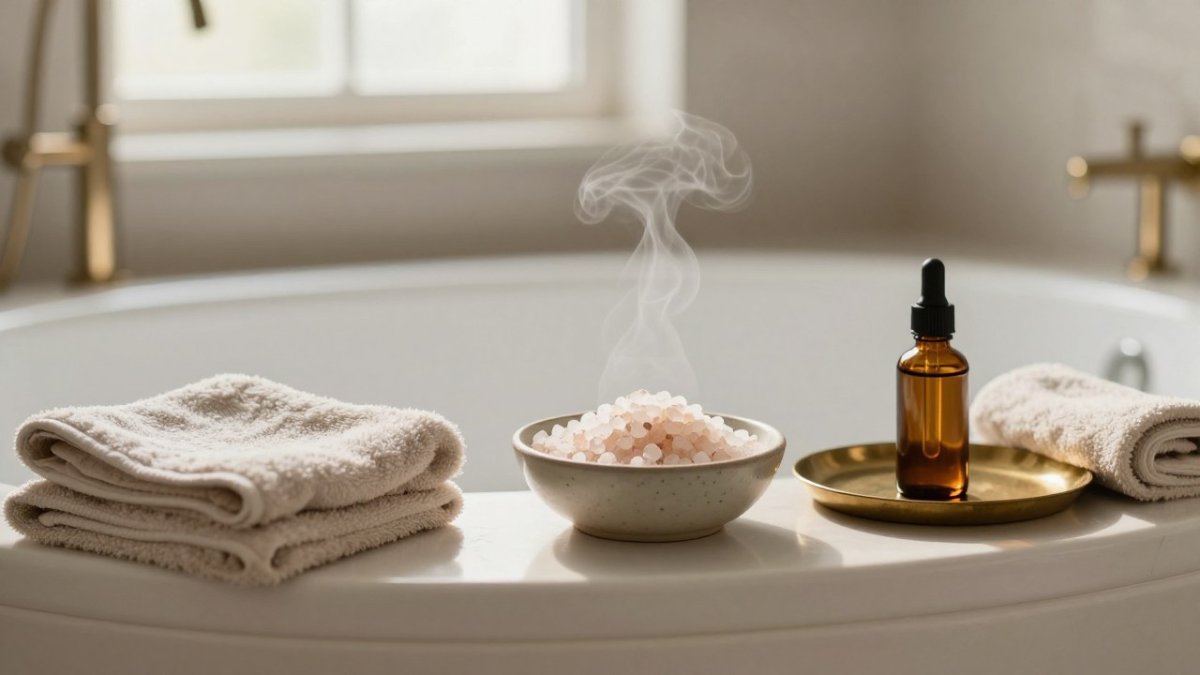
Never pour drops straight into the tub; oil and water do not mix, and undiluted oil can irritate skin.
Pairing Scents With Cleansing, Exfoliation, and Skincare
Build a simple sequence: cleanse, exfoliate, then moisturize, and let one scent carry through the whole thing.
- Cleansing: a lavender or chamomile-scented wash sets a calm tone.
- Exfoliation: a sugar or salt scrub with a drop of citrus wakes up dull skin.
- Facial steam: add 1 drop of eucalyptus to a bowl of hot water, cover your head with a towel, and breathe for 3 to 5 minutes.
- Skincare: use only pre-diluted facial oils; do not add drops to a finished product.
A common mistake is layering three or four strong scents at once.
Designing a Spa Day at Home Routine That Fits Your Space
A home spa ritual works best when it is built around what you actually have, a bathroom, a bedroom corner, a chair and a tray, and how much time you can give it. Below are three tiers: a 10-minute reset, a 30-minute evening ritual, and a 90-minute extended session. Each works without a bathtub or a diffuser, and each can be run on a small budget.
The 10-minute reset (no tub, no diffuser)
- Clear a small surface and dim the lights.
- Add 2 to 3 drops of lavender or eucalyptus to a corner of the shower floor, away from the drain, and take five slow breaths in the steam.
- Cleanse with an unscented wash so the oil note stays the lead.
- Finish with 30 seconds of cooler water.
- Pat dry and apply a pre-diluted body oil to damp skin.
Equipment: shower, one bottle of oil, one towel. This is the version to repeat on a weeknight.
The 30-minute evening ritual (diffuser optional)
- Set the scene: tidy the surface, lay out a towel, lower the lights.
- If you have a diffuser, run 3 to 5 drops for 20 minutes; if not, place a bowl of hot water with 1 drop of oil on a stable surface nearby and let the steam carry it.
- Cleanse, then exfoliate with a sugar or salt scrub.
- Take a warm shower or a short soak.
- Self-massage with a 1% to 2% diluted blend, working from feet upward.
- Sit with herbal tea and three minutes of quiet breathing.
Equipment: shower or tub, a bowl or diffuser, a carrier oil, a scrub. Budget-friendly and repeatable two or three times a week.
The 90-minute extended session (full spa day at home)
- Arrival (10 min): dim lights, set out towels, start a diffuser or a warm bowl, and put your phone away.
- Cleanse and steam (15 min): shower, then a facial steam with 1 drop of eucalyptus in a bowl of hot water, towel over your head, for 3 to 5 minutes.
- Exfoliate (10 min): sugar or salt scrub on damp skin, rinse.
- Soak or long shower (20 min): aromatic bath with 1 cup Epsom or sea salt, 1 tablespoon carrier oil, and 3 to 5 drops of oil, stirred in; or a long shower with a shower steamer placed out of the direct stream.
- Self-massage (15 min): diluted oil, slow strokes, focus on shoulders and feet.
- Wind-down (20 min): herbal tea, dim light, a few minutes of box breathing (inhale four counts, hold four, exhale four, hold four).
Equipment: tub or shower, diffuser or bowl, scrub, carrier oil, steamer or salts. This is the version to schedule when you have a free evening.
Adapting to your space and budget
A small bathroom works fine; so does a bedroom corner with a chair and a tray. If your bathroom is the anchor, a carved door or an arched mirror changes the whole feel of the room. You can browse a Hamam spa carved door to define the entry, and go deeper on mixing global patterns in bathrooms if you are styling the space around it. If you want pieces that are harder to find locally, custom furniture imports can source furnishings made to your space rather than off the shelf.
Fragrance-free and low-scent adaptations
If scent is a trigger, asthma, migraines, or plain sensitivity, run the same tiers with the scent step removed. Warm water, dim light, a scrub, and slow breathing do most of the work on their own.
Watch out: layering three or four strong scents in one session overwhelms the nose and makes the ritual feel busy rather than calm, pick one lead note and keep the rest neutral.
The article lays out three time-based tiers so you can pick the ritual that fits your evening.
| Tier | Time | Key steps | Equipment |
|---|---|---|---|
| 10-minute reset | 10 min | Shower floor drops, five slow breaths, cooler water finish | Shower, one bottle of oil, one towel |
| 30-minute evening ritual | 30 min | Diffuser or hot bowl, cleanse, exfoliate, self-massage | Shower or tub, bowl or diffuser, carrier oil, scrub |
| 90-minute extended session | 90 min | Arrival, cleanse and steam, exfoliate, soak, massage, wind-down | Tub or shower, diffuser or bowl, scrub, carrier oil, steamer or salts |
Time
Personalizing Scent, Ventilation, and Storage
Your nose is the best guide. Some people relax with lavender; others find it cloying. Test one oil at a time and note how you feel after 20 minutes. Build a small set of two or three favorites rather than a shelf of bottles.
Storage and airflow matter more than most guides admit:
- Keep oils in dark glass, tightly capped, away from heat and sunlight.
- Store them out of reach of children and pets.
- Air out the room after diffusing; scent fatigue is real.
- Clean diffusers weekly with water and a little white vinegar.
Choosing the Vessel: Scent, Storage, and Moroccan Accents
The container is part of the ritual. A small tray holds your oils, a covered jar keeps bath salts dry, and a hand-carved vase can display dried lavender stems between uses.
For display, a hand carved camel bone Moroccan vase or a handmade blue Moroccan vase brings texture to the shelf without competing with the calm you are building.
Keep the arrangement simple: one tray, two or three objects, and space between them. Clutter works against the mood you are trying to set.
Building an aromatherapy ritual at home is not about buying more. It is about a few safe habits, one scent you love, and a space that signals rest. At Justmorocco, we craft hand-carved doors, mother-of-pearl inlay, and custom cabinetry that turn an ordinary bathroom into a sanctuary, with direct shipping and custom design work for projects of any size. Get started with Justmorocco and build a spa space that feels like yours.
Frequently Asked Questions
How do I make my house smell like a spa with essential oils?
Start with a diffuser in the room you use most, and run it for 30 to 60 minutes rather than all day. Keep windows cracked for ventilation, and clean the diffuser between oils so old residue does not turn rancid. Aromatherapy at home works best when the scent is light enough that you notice it on entry and stop noticing it after a few minutes.
What is the 20/30/50 rule for essential oils?
It is a shorthand for dilution ratios. Start with a low dilution and patch test any new oil on your inner forearm before wider use.
Which essential oils should you not mix together?
There is no universal ban list, but some combinations are unpleasant or irritating rather than dangerous.
How do you use essential oils safely in a home spa?
Dilute before skin contact, never swallow essential oils, and keep them away from eyes and mucous membranes. Pregnant people, children, and anyone with asthma or a fragrance allergy should check with a clinician first. Store bottles tightly capped in a cool, dark place, since heat and light degrade oils. Ventilate any room where you diffuse, and stop using a scent if it triggers headaches or irritation. Read labels rather than assuming.
