
Quick Summary
Traditional moroccan weaving produces rugs that last longer and wear better because each piece is hand-knotted or woven from wool, dyed with long-established methods, and finished without mass-production shortcuts. These qualities show in the hand, the weight, and how the pattern holds up over years of use.
- Check the back: hand-knotted work shows individual knots, while machine tufting shows a uniform grid.
- Look for a tight, even pile, consistent edges, and a pattern that stays square when viewed from the side.
- Ask whether the knotting or weaving was done by hand, since a rug labeled handmade may be partly machine-finished.
- Ask the seller for the origin, tribe or region, materials, and whether the piece is vintage or newly made.
- Vacuum regularly without a beater bar, which can pull knots loose, and blot spills immediately.
Table of Contents
- What Makes a Moroccan Rug Worth Owning
- The Berber Knot and Why Its Structure Matters
- Types of Moroccan Rugs and Their Construction
- Wool Quality: What Lanolin, Fiber Length and Hand-Spinning Contribute
- Natural Dyes and Colorfastness Over Decades
- Vertical Looms, Tension Control and the Value of Imperfection
- How to Tell If a Moroccan Rug Is Authentic
- Hand-Woven Rug Maintenance and Restoring Traditional Knots
- Choosing a Traditional Rug for Your Home or Project
- Frequently Asked Questions
What Makes a Moroccan Rug Worth Owning
Last Updated: November 3, 2026
Traditional Moroccan weaving creates rugs that last longer and wear better than most machine-made alternatives, and the reasons come down to how each piece is built. A traditional rug is knotted or woven by hand from wool, dyed with methods that have been used for generations, and finished without the shortcuts of mass production. The differences show up in the hand, the weight, and the way the pattern holds over years of use.
The craft itself is old. Weaving techniques for traditional carpets date back to the 12th century, according to National Geographic's coverage of traditional weaving practices. That long history matters because the methods have been refined through repetition rather than invented for a catalog. Hand-woven rugs take considerable time to complete, which reflects the labor involved and explains why these pieces are not produced at factory speed.
Several qualities separate a worthwhile rug from a decorative floor covering. Look for a tight, even pile, consistent edges, and a pattern that stays square when you view it from the side. Check the back, too: hand-knotted work shows individual knots, while machine tufting shows a uniform grid. These are practical checks you can make in a showroom or on a photograph before you buy. If you are sourcing a piece for a specific space or project, custom furniture imports can help you line up the right rug alongside the rest of your furnishings.
Watch out: a rug labeled "handmade" can still be partly machine-finished. Ask whether the knotting or weaving was done by hand, not only the finishing.
The Berber Knot and Why Its Structure Matters
Knot density is the number that separates a durable rug from a decorative one.
Types of Moroccan Rugs and Their Construction
Moroccan rugs fall into a few broad construction families, and each one suits different rooms. Knotted pile rugs, such as the Beni Ourain style with its cream field and geometric marks, have a soft, dense surface. Flatweave kilims are thinner and reversible, woven rather than knotted.
Regional origin also shapes the pattern and structure. Taznakht rugs, for example, often feature bold geometric blocks in rich colors, while Azilal rugs are known for more free-form designs. Many modern pieces combine techniques, integrating flatweave, knotting, and embroidery into a single rug to add texture and visual depth, a trend noted by Rug Hub's 2024 industry trends.
Our current selection includes the Taznakht berber mekissa, a hand-knotted, double-sided wool carpet made by Berber women in the Atlas Mountains. You can view the Taznakht berber mekissa to see how its quilt-like column design is put together.
The main construction families differ in surface, weight and reversibility, as summarised below.
| Type | Construction | Key difference |
|---|---|---|
| Knotted pile rugs (e.g. Beni Ourain) | Knotted | Soft, dense surface |
| Flatweave kilims | Woven | Thinner and reversible |
| Taznakht rugs | Often geometric blocks | Bold geometric blocks in rich colors |
| Azilal rugs | Varied | Free-form designs |
Wool Quality: What Lanolin, Fiber Length and Hand-Spinning Contribute
Wool quality determines how a rug feels, how it resists soil, and how long it keeps its shape.
Lanolin is the waxy coating sheep produce naturally to protect their fleece. It is what makes wool water-resistant and soil-shedding.
Fiber length, or staple length, is the second variable.
Natural Dyes and Colorfastness Over Decades
The wool is dyed with a process traditionally employed by Moroccans, and when the carpet is cared for properly, the colors do not visibly fade.
Ask about the dyeing method when you buy, and keep the rug out of direct, prolonged sunlight to protect it over time.
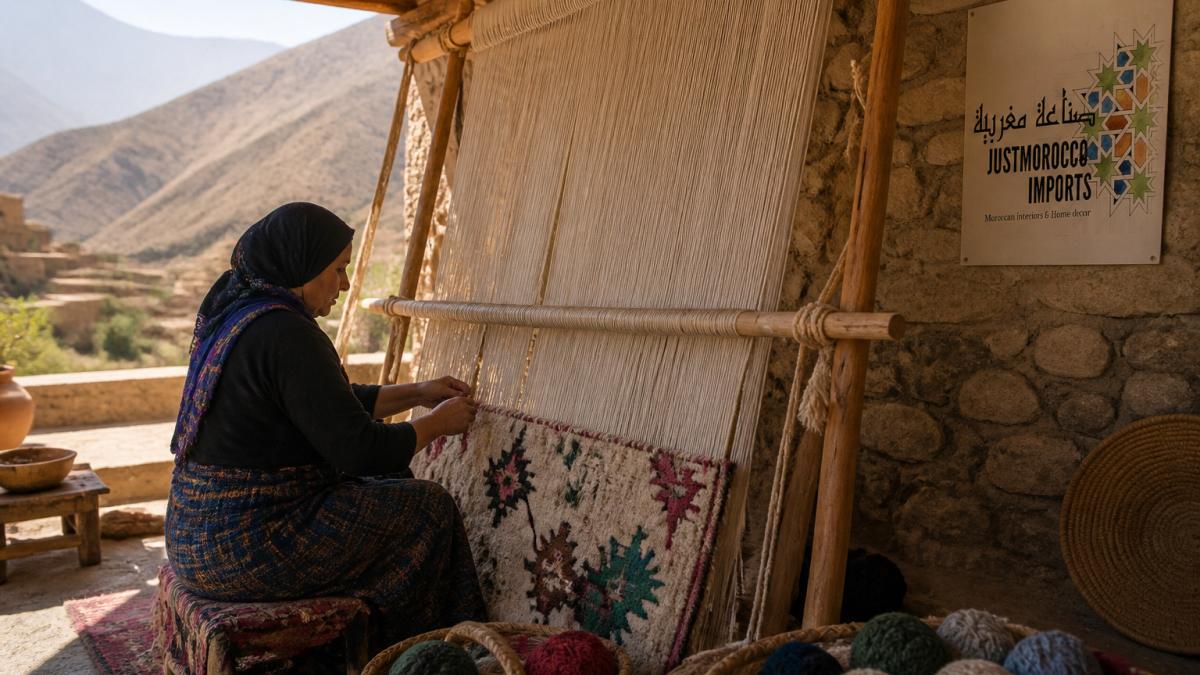
Vertical Looms, Tension Control and the Value of Imperfection
Treat irregularity as information, not as a defect automatically. Major distortions, loose knots, or fraying are real problems. Gentle variation in line and color is what handwork looks like.
How to Tell If a Moroccan Rug Is Authentic
Telling an authentic Moroccan rug from a reproduction takes a few concrete checks. Start with the back.
Finally, ask the seller for the origin, the tribe or region, the materials, and whether the piece is vintage or newly made. A reputable seller will answer these questions directly. Our listings state the construction, wool content, and origin for each rug so you can check them before buying. The Taznakht Atlas blue rug listing, for example, documents its all-wool, handwoven construction and its size.
Watch out: "antique" and "vintage" are often used loosely. Ask for specifics about age and condition instead of accepting the label alone.
Hand-Woven Rug Maintenance and Restoring Traditional Knots
Vacuum regularly without a beater bar, which can pull knots loose. Blot spills immediately rather than rubbing them in.
Choosing a Traditional Rug for Your Home or Project
Choose a rug based on how the room will be used, then on the look you want. A knotted pile rug suits a bedroom or lounge where softness matters. Size the rug so that the front legs of seating sit on it, which anchors the room.
Compare the construction and size details on each listing against your room measurements before you buy.
Our listings show each rug's price in USD.
Frequently Asked Questions
What is special about Moroccan rugs?
Moroccan rugs are known for their geometric designs, which vary by tribe and region. Buyers often value that the designs carry cultural meaning rather than following a catalog pattern.
How can I tell if a Moroccan rug is authentic?
Check the back of the rug first. Ask the seller about the tribe or region of origin and about the materials used.
How long do traditional hand-woven Moroccan rugs last?
Vacuum gently without a beater bar, and blot spills quickly rather than rubbing them in.
What is the best way to maintain a hand-woven Moroccan rug?
Vacuum regularly on a low setting without rotating brushes, and clean spills immediately by blotting rather than rubbing. If a knot pulls loose, avoid cutting or trimming the strand, which can unravel the surrounding structure.
Justmorocco brings authentic, hand-woven Moroccan rugs directly to homes across the United States, with direct shipping to California, Texas, New York, and Florida. If you are planning a room and want help choosing construction, size, and pattern, reach out and we will walk you through the options.
