
Last Updated: November 4, 2026
Quick Summary
Styling moroccan accent tables for luxury homes works best when the table is treated as a sculptural piece rather than an afterthought. Choose one statement table with visible craftsmanship, match its scale to the seating, and keep the rest of the room restrained so its inlay and carving can be seen.
- Start with material, since wood with metal or bone inlay suits daily use.
- Match table height to the arm of the chair it serves.
- Keep at least 18 inches of walking space around the table where possible.
- Limit patterned textiles and objects so one strong pattern is the focus.
- Place a warm, low lamp beside the table so inlay and carving catch light.
Table of Contents
Moroccan accent tables bring material honesty and handcrafted character into a luxury room. Across the market, there is a clear shift in 2026 toward furniture that shows its craftsmanship, lasts for daily use, and uses real materials such as brass, wood, bone and natural fibers. Styling moroccan accent tables for luxury homes works best when the table is treated as a sculptural piece rather than a decorative afterthought.
Moroccan Interior, a design publication, frames this as "material honesty," the idea that high-end decor should show its making and wear well over time Moroccan Interior 2026 trends in material selection for high-end home decor. You can see where these handcrafted pieces are sourced and made. That approach fits luxury buyers who want pieces that look better with age rather than less.
Designers are also moving away from heavily ethnic-styled rooms. Casa Amar reports that central tables and ottomans are increasingly placed inside modern, non-ethnic layouts to create a more global, sophisticated look Casa Amar 2026 guidance on contemporary Moroccan layouts. A single carved or inlaid table can anchor a neutral room without turning it into a themed space.
Metal accents are another reason these tables suit luxury interiors. Justmorocco's handmade silver and bone-inlay pieces, such as the Vintage Bone Inlay Moroccan Table, Handmade Silver Accent Decor, add richness that pairs well with leather, linen and stone.
Best for: homeowners and designers who want one statement piece with visible craftsmanship. Skip if: you want a purely minimalist room with no decorative accents.
Choosing the Right Moroccan Table: Material, Shape and Finish
Start with the material, because it determines how the table will age. Wood with metal or bone inlay suits rooms with daily use, while solid carved pieces tolerate handling well. Check whether a listing states its materials; Justmorocco lists wood and metal on its handmade tables.
Shape matters as much as material. Round and octagonal tops soften a room with angular furniture, while rectangular tables suit tight spaces. Leg style also changes the look: arched legs read as more ornate, while plain legs keep the piece quieter beside a sofa. Compare the height to your seating; a side table should sit just below the arm of the chair it serves.
Finish is the last decision. A hand-painted surface shows color and pattern, while an antique or natural finish suits a neutral palette. Mother-of-pearl and bone inlay add light reflection and should be placed where they catch daylight. The Handmade Moroccan Carved Wooden Coffee Table, Andalusian Art is a useful reference for how carved patterns read in a finished room.
Saediya Side Table shows how a finished side table in a neutral tone can carry the Moroccan detail without dominating the seating area.
Luxury Moroccan Interior Design Principles for Scale and Placement
Scale is the principle most often gotten wrong. A table that is too large crowds a seating group, while one that is too small looks like an afterthought. Measure the sofa arm height and the clearance around the seating before choosing a size, and keep at least 18 inches of walking space around the table where possible.
Treat the table as one layer in a composition rather than the whole composition. Pair it with a lamp, a stack of books or a ceramic vessel so the eye has a focal sequence. The aim is balance: one strong piece, supported by quieter surroundings.
Keep the palette restrained. Two or three colors drawn from the table's own pattern tie the room together more convincingly than adding new hues. Warm neutrals let the metal and wood details stand out.
Room-by-Room Placement in Living Rooms and Bedrooms
In a living room, place the table within easy reach of a seat, at roughly the same height as the arm of the chair. A round table works well at the corner of a sectional, while a larger carved piece can sit in front of a sofa as a coffee table.
In a bedroom, a Moroccan nightstand or small accent table beside the bed gives the room a focal point without visual weight. Keep it low enough that the bedside lamp sits comfortably on top.
Entryways and reading corners also suit a single accent table, especially where lighting can catch inlay or metalwork.
Vintage Bone Inlay Moroccan Table, Handmade Silver Accent Decor →
Styling Mosaic Side Tables Without Overwhelming the Room
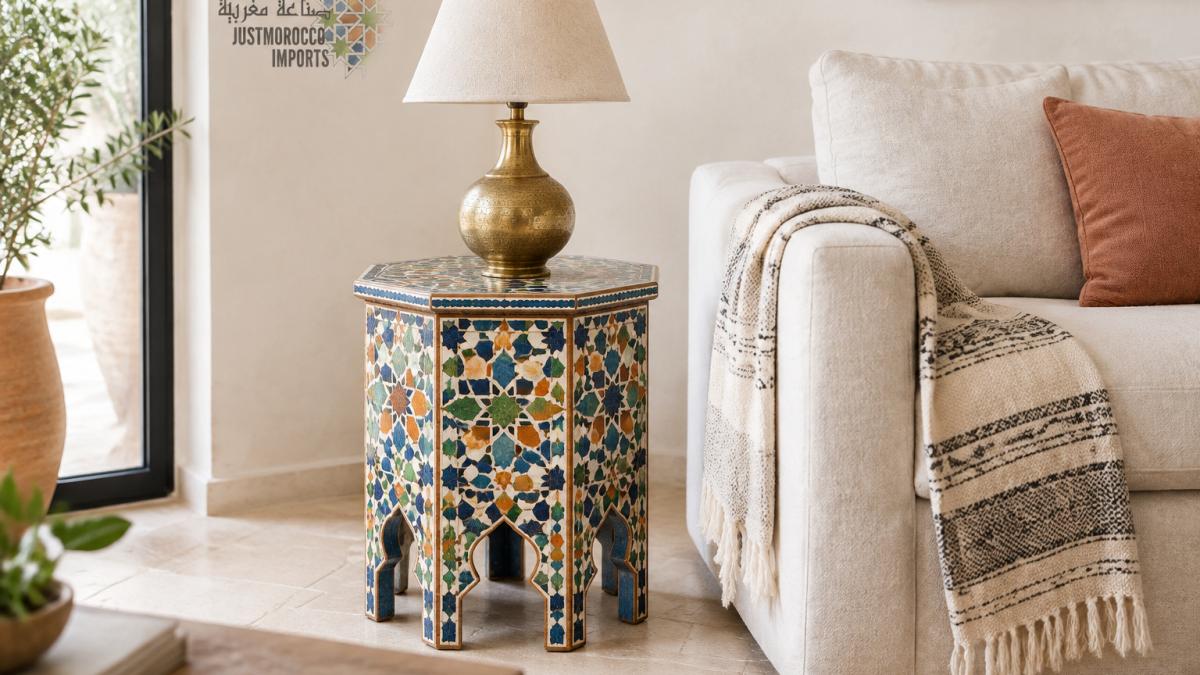
Mosaic side tables carry strong pattern, so limit the rest of the room to solid or low-pattern textiles. One patterned element per sightline keeps a space calm. Place the table where daylight or a lamp can reveal the tile geometry, and avoid stacking it with other patterned objects.
Mosaic Blue Tile Table is a practical example of a mosaic piece that can anchor a seating corner with a single accent color.
Pairing Moroccan Tables With Existing Furniture and Lighting
Pair a Moroccan table with furniture that has clean lines, such as a linear sofa or a plain wood dresser, so the pattern is not competing with other ornament. Match one metal finish from the table to a light fixture or hardware elsewhere in the room.
Lighting is essential. Warm, low-level light brings out inlay and carved detail, while harsh overhead light flattens it. Place a lamp next to the table so the surface is lit from the side.
Syrian Mother Of Pearl Nightstand shows how a mother-of-pearl bedside piece can sit alongside a wood bed frame and a warm lamp without clashing.
Layering Textiles, Ceramics and Accessories Around Your Table
Use textiles to soften the table's hard surface. A low-pile rug beneath a coffee table grounds it, while a folded throw on a nearby chair adds warmth. Choose textures that contrast with the table's finish, such as linen against carved wood.
Ceramics and small accessories complete the look. Place one or two vessels on the table and keep the surface otherwise open. Overcrowding a Moroccan table hides the craftsmanship it is meant to show.
Mother of Pearl Furniture Care by Material and Finish
Mother of pearl is delicate and needs gentle handling. Dust with a soft, dry cloth, avoid harsh cleaners, and keep the piece out of direct, prolonged sunlight, which can dry wood and loosen adhesives over time. Wood with metal or bone inlay should be cleaned with a barely damp cloth and dried immediately.
Humidity is the main risk. Keep indoor humidity steady and away from heating vents or radiators, since rapid swings can crack wood and lift inlay. These steps apply to most of the pieces in the Justmorocco range, but check each product listing for specific material notes.
Booking a Consultation to Find Your Statement Table
Choosing a statement table is easier with a specific room in mind. Contact Justmorocco through the website to talk through your room and the pieces that suit it.
Frequently Asked Questions
How do you incorporate Moroccan furniture into a modern luxury home?
Start with one Moroccan accent table as the focal point and keep the surrounding palette neutral, such as cream walls, natural wood and linen upholstery. Choose clean-lined sofas and streamlined lighting so the handcrafted piece reads as intentional rather than themed. Scale matters: a table sized to the seating it serves looks deliberate in a contemporary room. Limit the number of strong patterns to one or two per room, and let color coordination, rather than extra motifs, tie the table to the rest of the space.
What materials are typically used in authentic Moroccan accent tables?
Authentic Moroccan accent tables are commonly made from carved or painted wood, often paired with metal accents such as brass, copper or silver. Some pieces feature bone inlay or mother of pearl, and mosaic tops built from small tile pieces are also common. Justmorocco's current collection includes handmade tables in wood with silver metal inlay, bone inlay tables and hand-carved wooden tables, each made by artisans in Morocco. Reviewing a piece's listed materials before buying helps you match its finish to your existing hardware and furniture.
How can I style a mosaic tile table without overwhelming a room?
Let the mosaic table be the one patterned element in its zone and keep nearby textiles solid or subtly textured. Place it where it has breathing room, rather than squeezed between busy pieces. A single decorative object, such as a ceramic vessel or a small brass tray, is usually enough to complete the vignette. Warm, indirect lighting from a nearby lamp will bring out the tile colors without adding visual noise.
How do I maintain mother of pearl inlay furniture?
Dust mother of pearl and bone inlay regularly with a soft, dry cloth, and wipe spills promptly with a barely damp cloth, drying the surface immediately. Avoid harsh cleaners, abrasive pads and prolonged direct sunlight, which can dull the shell and dry the wood beneath it. Keep these tables away from heating vents and damp areas, where wood can shift and loosen inlay. Ask your supplier for care guidance specific to your piece's finish before you begin any restoration.
