

Table of Contents
- Why Shipping Delicate Moroccan Furniture Requires Special Care
- What You'll Need: Essential Materials and Tools
- Step-by-Step: How to Pack Fragile Furniture for Shipping
- Selecting International Furniture Shipping Companies
- Understanding Customs Duties on Moroccan Furniture USA Imports
- Shipping Insurance for Antiques and Luxury Moroccan Pieces
- Common Mistakes to Avoid When Shipping Delicate Moroccan Furniture
- Cost Estimation and Timeline Expectations
Last Updated: July 30, 2026
Shipping delicate moroccan furniture safely requires specialized knowledge and materials that go far beyond standard packaging practices. At Justmorocco, we understand the unique challenges of transporting handcrafted pieces across the country, from protecting intricate mother-of-pearl inlays to preserving delicate wood finishes during transit. This guide walks you through the complete process of shipping delicate moroccan furniture safely, covering everything from pre-shipment inspection to customs clearance.
Research from American Furniture Manufacturers Association shows that fragile items account for over 40% of shipping damage claims in the furniture industry. A single mishandled piece can result in thousands of dollars in damage.
Why Shipping Delicate Moroccan Furniture Requires Special Care
Moroccan furniture features bone-inlay details, carved wooden frames, hand-painted tiles, and finishes that took artisans weeks to complete. Traditional Moroccan wood, often cedar, walnut, or thuya, is denser and more brittle than many domestic hardwoods, making it vulnerable to splitting during transit if not properly supported.
Temperature fluctuations also pose a serious threat. When wood moves from a climate-controlled home to an unheated warehouse and back again, expansion and contraction can crack joints and warp surfaces. Professional shippers treat Moroccan furniture like fine art because, fundamentally, that's what it is.
What You'll Need: Essential Materials and Tools
Professional Packaging Materials for Fragile Items
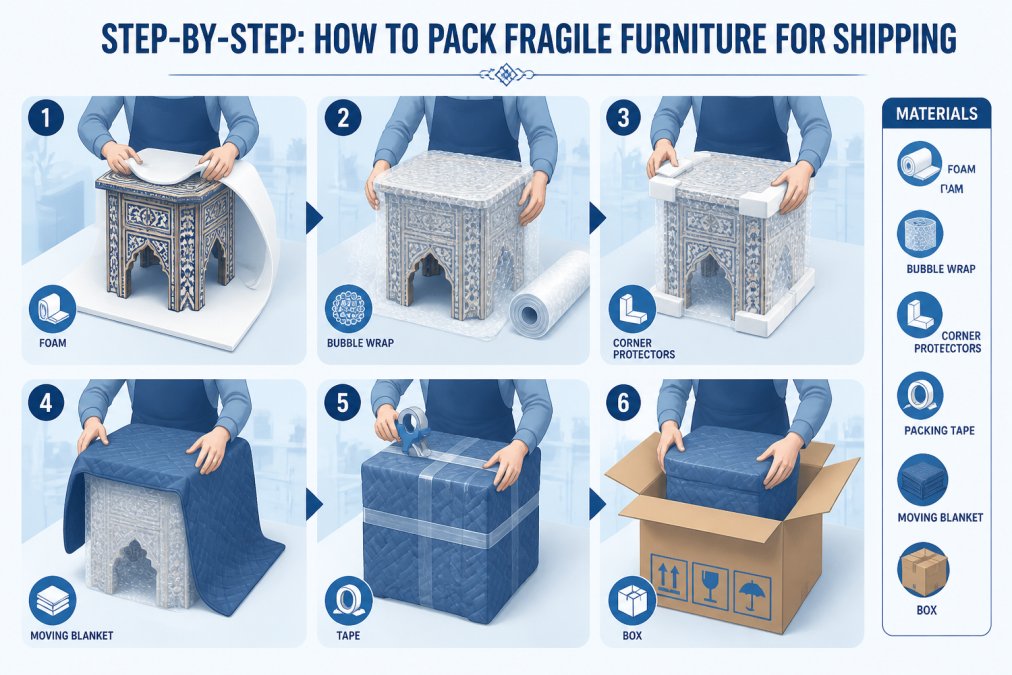
Bubble wrap (1/2-inch minimum, preferably 5/8-inch) should wrap all carved details, legs, and protruding elements in at least three layers. Secure with painter's tape, never duct tape.
Foam padding serves as your primary shock absorber. Closed-cell foam is superior to open-cell because it doesn't absorb moisture. Use 2-3 inches on all sides of the furniture piece. For delicate items like mosaic tile work, add a rigid foam frame inside the crate to distribute impact forces.
Kraft paper and moving blankets protect against dust and minor abrasions. Wrap these over the bubble wrap as your outermost layer before boxing or crating.
Crating materials include 3/4-inch plywood, 2x4 lumber, and L-brackets. Invest in quality materials; cheap plywood splinters and fails under stress.
Moroccan Wood Care During Transit
Place moisture-absorbing packets inside the crate, silica gel packs rated for furniture shipping. A typical crate should contain 2-4 pounds of silica gel, distributed throughout the box.
Consider adding a humidity indicator card inside the crate. These cards change color if humidity swings beyond safe ranges (typically 30-50% relative humidity for wood furniture), providing documentation for insurance claims if conditions fail.
For pieces with decorative finishes, hand-painted details, or varnished elements, add a layer of acid-free tissue paper between the foam padding and the wood to prevent adhesive residue from transferring to the finish.
Step-by-Step: How to Pack Fragile Furniture for Shipping
Pre-Shipping Inspection Checklist
Before packing, document the piece's condition. This is your insurance baseline; if damage occurs during shipping, you need proof of what the piece looked like before it left your home.
Photograph every angle: top, bottom, all four sides, close-ups of inlays, carvings, and finishes. Include a ruler or coin in some photos to establish scale.
Write a detailed condition report noting any existing scratches, loose joints, or areas of concern. Be specific: "hairline crack in left rear leg, approximately 2 inches from floor" rather than "some damage on leg."
Check for hidden damage by opening drawers and inspecting interior surfaces. Look for wood-boring insects by examining wood surfaces for small holes. Test all moving parts to ensure doors, drawers, and hinges operate smoothly.
| Step | Duration | What to Check |
|---|---|---|
| Photograph all angles | 15-20 minutes | Lighting, close-ups, scale reference |
| Document condition | 10 minutes | Existing damage, loose joints, wear patterns |
| Inspect interior surfaces | 10 minutes | Hidden damage, infestation signs, structural issues |
| Test moving parts | 5 minutes | Doors, drawers, hinges, latches |
| Measure and weigh | 10 minutes | Dimensions, weight, fragile areas |
DIY Crating Guide for Large Pieces
For large Moroccan furniture pieces, a custom crate is often the only safe shipping option. Professional crates cost $300-800 depending on size.
Step 1: Design the crate structure. Measure your furniture piece in three dimensions and add 4 inches to each dimension for padding space.
Step 2: Build the bottom frame. Cut 2x4 lumber to length and assemble a rectangular base using L-brackets and 3-inch wood screws. Ensure the frame is square by measuring diagonals; both should be equal length.
Step 3: Add interior supports. Install vertical 2x4 posts at each corner and midway along each long side. Brace them with diagonal cross-members to prevent racking.
Step 4: Create the padding cavity. Line the interior with 2-3 inches of closed-cell foam using construction adhesive.
Step 5: Position your furniture. Place the furniture piece carefully in the center of the crate, surrounded by at least 4 inches of padding on all sides.
Step 6: Add top bracing and seal. Install the top frame using bolts rather than nails, which allows inspection at customs. Cover the exterior with plywood sheets, secured with 2-inch screws every 6 inches. Reinforce all corners with metal corner braces.
Step 7: Add handling marks. Clearly mark the crate with "FRAGILE," "THIS SIDE UP," and "DO NOT STACK" labels on all sides in large, bold lettering.
The entire process takes 4-6 hours for a standard furniture piece.
Selecting International Furniture Shipping Companies
Not all shipping companies handle Moroccan furniture equally. Standard parcel carriers like UPS and FedEx have weight and size limits that exclude most furniture pieces.
Freight vs. Parcel Shipping: Which is Right for Your Piece
Parcel shipping (UPS, FedEx, DHL) works for small items under 150 pounds. It's faster (3-7 days) and simpler, but expensive per pound with limited protection for fragile items.
Freight shipping handles larger pieces and offers better protection. White-glove freight services include pickup from your home, professional packing, climate-controlled transport, and delivery into your room of choice. Shipments typically take 7-14 days.
For most Moroccan furniture, freight shipping is the right choice.
Choosing a Shipping Courier: Key Criteria
Insurance coverage. Ask what's included in standard coverage and what optional coverage costs. Full-value protection should cover the piece's replacement cost. Get this in writing.
Experience with fragile items. Ask how many furniture pieces they ship annually and specifically how many involve delicate inlays, carvings, or hand-painted finishes.
Climate-controlled transport. Confirm they offer climate-controlled trucks for long-distance shipments. This is non-negotiable for Moroccan wood.
Tracking capability. You should be able to track your shipment in real-time or receive updates every 24 hours.
Customs expertise. If shipping internationally, the shipper must have in-house customs brokers or partnerships with brokers.
References from similar shipments. Ask for contact information from customers who've shipped comparable pieces.
Get written quotes from at least three shippers. The lowest quote often reflects cutting corners on insurance or protection.
Understanding Customs Duties on Moroccan Furniture USA Imports
If you're receiving Moroccan furniture from overseas, customs duties apply. These can add 10-25% to the piece's cost, depending on the item's classification and material composition.
HS Code Classification for Moroccan Pieces
The Harmonized System (HS) code determines your duty rate:
HS 9403.30 covers wooden furniture (not upholstered). Most Moroccan tables, cabinets, and carved pieces fall here with typically 0% duty for wood furniture from Morocco under trade agreements.
HS 9404.90 covers cushions, pillows, and mattresses. Moroccan poufs and floor cushions may fall here.
HS 7323 covers articles of copper or copper alloy with duty rates around 2-6%.
HS 6909 covers ceramic articles with rates typically 3-8%.
Determining the correct HS code requires understanding what materials dominate the piece. A wooden table with tile inlay is classified by its primary material (wood), not the inlay.
Documentation and Customs Clearance Requirements
Your shipper should provide a commercial invoice listing each item, its description, material composition, country of origin, and declared value.
Include a bill of lading (BOL), which is the freight carrier's receipt and contract of carriage, and a packing list detailing exactly what's in each box or crate, including dimensions and weight.
For shipments valued over $2,000, customs may require additional documentation including proof of payment, photographs, certificates of authenticity, and appraisals for high-value pieces.
The declared value should match the actual purchase price or appraised value. Undervaluing to reduce duties is customs fraud and can result in seizure of the shipment and legal penalties.
Most professional shippers handle all customs paperwork, but you should review everything before shipment to ensure accuracy.
Shipping Insurance for Antiques and Luxury Moroccan Pieces
Basic carrier liability covers damage from the shipper's negligence. This is usually $0.50-$2.00 per pound of declared value, which is often inadequate for luxury items.
Full-value protection covers the piece's replacement cost regardless of cause. This costs 1-3% of the declared value and is essential for luxury items.
All-risk insurance extends beyond carrier liability to cover damage from environmental factors and theft. This is available through third-party insurers and typically costs 2-5% of the item's value.
For pieces valued over $10,000, consider purchasing separate fine art or antique insurance through a specialty insurer. American Fine Art and Antique Insurance Association can connect you with providers.
Document everything for insurance purposes: pre-shipment inspection photos, condition report, purchase receipt, and any appraisals. Keep copies of all insurance documents, including the policy number, coverage limits, and exclusions.
Common Mistakes to Avoid When Shipping Delicate Moroccan Furniture
Using undersized padding. One inch of bubble wrap is not enough. Two inches is minimum; three inches is better. This is the single most common cause of preventable shipping damage.
Mixing fragile and sturdy items in the same shipment. Heavy items can shift during transit and crush lighter, more delicate pieces.
Skipping the pre-shipment inspection. Without documented proof of the piece's condition before shipping, you have no basis for an insurance claim if damage occurs.
Choosing the cheapest quote without understanding what's included. A $400 quote that excludes insurance will cost far more if damage occurs than a $600 quote that includes full protection.
Not confirming humidity and temperature control. Ask your shipper directly: "Will this shipment travel in a climate-controlled vehicle?" If the answer is anything other than a clear yes, find a different shipper.
Undervaluing the piece for customs to reduce duties. This is fraud and means your insurance covers only the undervalued amount.
Assuming standard boxes are sufficient. For anything larger than a small side table, a custom crate is required.
Cost Estimation and Timeline Expectations
Shipping costs depend on distance, weight, size, and service level. A 200-pound table shipping within the continental United States typically costs $800-1,500 for freight shipping with full protection. International shipping from Morocco to the US runs $2,000-5,000 depending on the piece's size and service level.
Timeline expectations:
- Local/regional shipping (under 500 miles): 3-5 business days
- Cross-country shipping: 7-10 business days
- International from Morocco: 14-21 business days plus 3-7 days for customs clearance
- White-glove service (includes delivery to room): add 2-3 days for scheduling
Customs clearance adds unpredictability. Most shipments clear within 24-48 hours, but complex items or incomplete documentation can cause delays of a week or more.
With proper planning, the right materials, and a qualified shipper, your handcrafted Moroccan furniture will arrive safely and ready to enhance your home for decades. Justmorocco specializes in sourcing and delivering authentic pieces that require exactly this level of care, from custom kitchen cabinetry with hand-painted tile to vintage beds with mother-of-pearl accents. Let our team guide you through the entire process, from selection through delivery.
Frequently Asked Questions
What materials are best for packing delicate Moroccan furniture for shipping?
Use professional packaging materials including bubble wrap, foam padding, and kraft paper to protect fragile items. For mother-of-pearl inlays and intricate tilework, wrap each section individually before adding a protective outer layer. Avoid direct contact between the furniture and hard surfaces. For wood pieces, use acid-free tissue and moisture-resistant materials to prevent damage during transit. Consider custom crating for high-value items to ensure maximum protection during long-distance shipping.
How do I understand customs duties when shipping Moroccan furniture to the USA?
Customs duties depend on the HS code classification of your piece, the materials used, and current tariff rates. Most handcrafted Moroccan wooden furniture falls under specific HS codes that determine duty percentages. You'll need a commercial invoice, bill of lading, and detailed item description for customs clearance. A freight forwarder familiar with US import regulations can help ensure proper documentation and minimize delays. Contact US Customs and Border Protection for specific duty rates on your items.
Is shipping insurance necessary for delicate Moroccan furniture?
Yes, shipping insurance is essential for luxury Moroccan pieces, especially those with mother-of-pearl inlays, intricate tilework, or antique value. Standard courier coverage often doesn't fully protect high-value items. Comprehensive insurance coverage should account for the full replacement value of your piece. Document your furniture with photos and detailed descriptions before shipping. Insurance costs vary based on declared value and shipping method, but the protection is worth the investment for authentic, handcrafted pieces.
What's the difference between freight and parcel shipping for Moroccan furniture?
Parcel shipping through couriers like DHL Express and FedEx works for smaller, lighter pieces under 150 pounds and fits standard packaging dimensions. Freight shipping is better for large furniture pieces, crated items, and heavy goods that require palletizing and specialized handling. Freight typically offers door-to-door delivery and is more cost-effective for oversized items, while parcel services provide faster transit times for smaller packages. Your choice depends on piece size, weight, fragility, and delivery timeline requirements.