

Table of Contents
- What to Expect From Custom Mosaic Tile Installation Services
- The Real Cost of Mosaic Tile Installation
- Mosaic Tile Installation Best Practices That Protect Your Investment
- Hiring a Professional Tile Contractor: What to Verify
- DIY vs. Professional Installation: Where the Risks Lie
- Substrate Preparation and Grout Selection for Custom Mosaic Tile
- Mosaic Tile Maintenance Guide for Long-Term Durability
- Design Versatility, Property Value, and What Buyers Notice
- Frequently Asked Questions
Last Updated: September 14, 2026
What to Expect From Custom Mosaic Tile Installation Services
A review of custom mosaic tile installation services starts with one hard truth: the tile is rarely the problem. The installation is. Justmorocco has supplied handcrafted Moroccan mosaic tile to homeowners, designers, and contractors across the country, and the pattern is consistent. Clients who budget carefully for the material and treat installation as an afterthought are the ones who end up disappointed.
Custom mosaic tile installation is the process of setting mesh-mounted or hand-chiseled mosaic sheets onto a prepared substrate, then grouting, sealing, and finishing the surface so the pattern reads as one continuous design. It differs from standard tile work in three ways: the pieces are small, the layout is pattern-driven, and mistakes are visible from across the room.
Below, we break down what a real installation involves, what it costs, how to vet a contractor, and where DIY attempts tend to fail. The goal is simple: help you protect a purchase that, at the high end, can run into five figures before labor is even quoted.
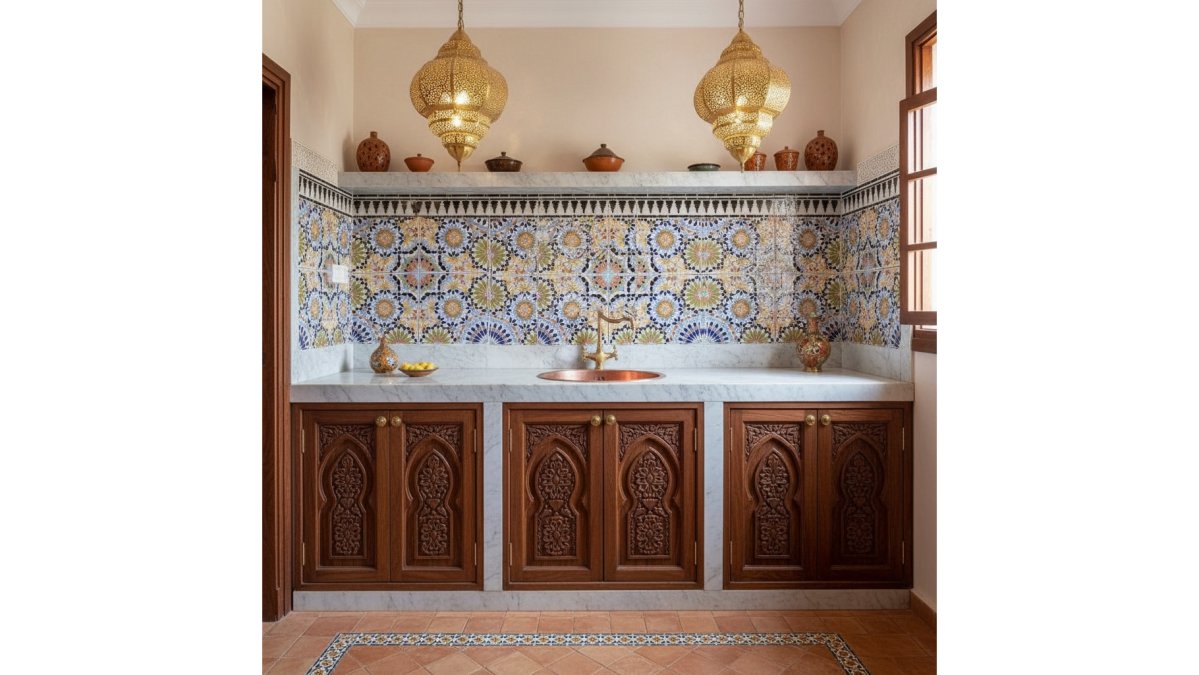
The Real Cost of Mosaic Tile Installation
The cost of mosaic tile installation is driven by labor intensity, not material volume. Small pieces mean more cuts, more alignment checks, and more time per square foot than large-format ceramic or porcelain. A backsplash that would take a day in subway tile can take three in mosaic.
Two cost buckets matter: what you pay for the tile itself, and what you pay a crew to set it. Most homeowners underestimate the second. The sections below break down both, plus the prep and grout line items that estimators often bury or omit.
Material Costs by Tile Type
Material pricing varies widely by tile type, finish, and whether the pattern is a stock design or a bespoke commission. Here is what a genuine zellij order looks like at the entry point:
| Tile Product | Price | Format | Best For |
|---|---|---|---|
| Moroccan Zellij tile | $65.00 | 12" x 12" pre-mounted sheet | Floors, walls, large areas |
| Riad mosaic tile | $62.00 | 12" x 12" pre-mounted sheet | Kitchen backsplash, feature walls |
| Alhambra Mosaic Tile | $68.00 | 12" x 12" pre-mounted sheet | Courtyard-style floors, patios |
| Moorish mosaic tile | $72.00 | 12" x 12" pre-mounted sheet | Bathroom walls, pool surrounds |
| Santa Barbara Tile | $92.00 | Custom pattern | Modern-minimalist focal walls |
| Alhambra Tile Pack | $160.00 | 16" x 10", 10 per pack | Kitchen and bathroom projects |
| Andalusia kitchen tile | $165.00 | 16" x 10", 10 per pack | Kitchen backsplash and counters |
| Marrakech riad tile | $165.00 | 16" x 10", 10 per pack | Full kitchen schemes |
| Taza Haut tile | $165.00 | 8" x 8", 12 per pack | Bathroom floors and walls |
| Moroccan tile | $175.00 | 16" x 10", 10 per pack | Backsplashes, floors, sinks |
Pricing is per square foot or per pack depending on the product. Shipping charges will apply, please call for a quote. Expect a lead time of up to three months for larger or more complex patterns, or roughly one month by sea freight.
What Labor Actually Costs Per Square Foot
Labor is where the budget surprises live. Mosaic is one of the most labor-intensive tile surfaces to set, and the premium over large-format work is real. As a planning range, most markets see mosaic installation labor priced meaningfully above standard ceramic or porcelain, and the spread widens with pattern complexity, ceiling-height walls, and the amount of cutting around fixtures.
A few variables move the labor number more than anything else:
- Pattern complexity. A running-bond field of one sheet type sets faster than an interlacing star pattern that has to resolve at every corner and edge.
- Surface orientation. Floors are faster than walls. Walls above shoulder height, ceilings, and niches slow a crew down because of staging and reach.
- Cut count. Every outlet, valve, drain, and corner adds cuts. Mosaic cuts are slower than large-format cuts because each piece is small and the pattern has to continue through the cut.
- Access and staging. Stairs, occupied homes, and tight bathrooms add time that never shows up on a square-foot quote.
- Substrate condition. A flat, sound wall sets fast. A wavy wall that needs leveling first can add a full prep day before a single sheet goes up.
A practical way to sanity-check a bid: ask the contractor to break labor into prep, setting, and grouting and finishing. If those three lines are not separated, you cannot tell whether the number is fair or whether prep has been quietly skipped.
Substrate Prep, Waterproofing, and Grout Line Items
These are the line items most likely to be missing from a low bid, and they are the ones that decide whether the installation lasts.
- Substrate repair and leveling. Patching cracks, replacing soft drywall or backer board, and flattening the surface to a mosaic-appropriate tolerance.
- Waterproofing. A membrane in showers, behind sinks, and anywhere moisture reaches the wall assembly. This is a separate material and a separate labor step.
- Backer board or substrate replacement. Sometimes the existing surface cannot be salvaged and has to come out.
- Thin-set and trowel work. The adhesive, the notched trowel, and the time to achieve full coverage behind every sheet.
- Grout and sealing. Grout material, application, cure time, and sealer.
- Demo and disposal. Removing the old surface and hauling it away.
A bid that lists only "install tile" is not a bid you can compare to a bid that itemizes these. The cheaper number usually means one or more of these steps was assumed away.
A Total Installed Cost Framework
Rather than quote a single number that will be wrong for your market, build the estimate in layers:
- Material. Tile plus shipping plus a waste allowance. Mosaic waste runs higher than large-format because of cuts and pattern matching, so plan for more overage than you would on a simple field tile.
- Prep and waterproofing. Priced per the actual condition of your substrate, not a flat guess.
- Setting labor. Priced by square foot with adjustments for pattern complexity, wall height, and cut count.
- Grout, sealing, and finishing. Material plus labor plus cure time.
- Contingency. Old walls and floors rarely present a flat, sound surface, and correcting that is billable work. A contingency line is not pessimism; it is how you avoid a mid-project change order.
Add those five lines and you have a defensible installed cost. Skip any of them and you have a number that will move once the crew opens up the wall.
Where the Money Goes Over Time
The cheapest bid is rarely the cheapest project. A low number that skips waterproofing or substrate leveling buys you a finished room and a future repair. A higher number that itemizes prep, membrane, and finishing buys you a surface that does not need to be touched again for decades. When you compare bids, compare the scope line by line, not the bottom line.
Mosaic Tile Installation Best Practices That Protect Your Investment
The best practices that protect a mosaic installation are unglamorous: flat substrate, correct thin-set, consistent trowel size, and patience with layout. Get those right and the tile performs for decades. Skip one and you will see it within a year.
A few principles separate a lasting install from a callback:
- Dry-lay the pattern first. Lay sheets out on the floor before any adhesive is mixed. This catches pattern mismatches and reveals where cuts will fall.
- Pull from multiple cartons. Shade varies slightly between batches. Mixing cartons across the field keeps the finished surface uniform.
- Use the right trowel size. A notched trowel matched to the tile thickness gives full coverage without squeeze-out.
- Maintain consistent grout lines. A spacer system keeps joints even and reduces lippage between sheets.
- Work in manageable sections. Thin-set skins over. Set only what you can adjust before it grabs.
What most guides miss is that mesh-mounted sheets are not perfectly square. They flex, and the mesh can stretch. A setter who trusts the sheet edge instead of snapping a chalk line will drift out of alignment by mid-wall.
Hiring a Professional Tile Contractor: What to Verify
Hiring a professional tile contractor comes down to verification, not vibes. The right questions filter out most problems before a contract is signed. The twist with mosaic is that general tile competence is not enough. A crew that sets large-format porcelain beautifully can still fail a mosaic job, because the skills and the failure modes are different.
Credentials and Coverage
Start with the basics, and get them in writing:
- License and insurance. Confirm the contractor holds a current license and carries liability and workers' compensation coverage. Ask for certificates, not verbal assurances.
- Written contract. Scope, price, payment schedule, and timeline in a signed document. Verbal agreements are how disputes start.
- Payment schedule. Never pay the full amount up front. A deposit plus progress payments tied to milestones is standard.
Mosaic-Specific Experience
This is where most homeowners stop asking questions too early. Large-format porcelain and mosaic are different skills. Ask to see completed mosaic work, not just tile work, and look for these specifics in the photos:
- Grout line consistency. Do the joints run even across the whole surface, or do they wander?
- Pattern alignment at corners. Does the pattern resolve cleanly where walls meet, or does it die into a mismatched edge?
- Lippage. Are any pieces sitting proud of their neighbors? On mosaic, even slight lippage is visible from across the room.
- Cuts around fixtures. Outlets, valves, and drains should be cut cleanly with the pattern continuing through, not patched with filler.
Ask the contractor directly: how do you handle mesh-mounted sheets that are not perfectly square? A good answer mentions snapping reference lines on the substrate and not trusting the sheet edge. A vague answer tells you they have not thought about it.
Questions That Separate Mosaic Specialists From Generalists
Bring this list to every interview:
- Which thin-set do you plan to use, and why? The answer should reference the substrate and the tile, not a default brand.
- How do you achieve full coverage behind mesh-mounted sheets? Look for a notched trowel matched to tile thickness, plus back-buttering where needed.
- How do you control lippage between sheets? Spacers, a leveling system, or careful bedding, depending on the tile.
- What is your substrate flatness tolerance? Mosaic telegraphs every dip and hump, so the tolerance should be tighter than for large-format work.
- How do you handle waterproofing in wet areas? A membrane, specified and installed to standard, not a paint-on shortcut.
- What grout do you recommend for these joints, and why? The answer should account for joint width and location.
- How do you protect the finished surface during the rest of the project? Mosaic scratches and chips; protection matters.
A contractor who can answer these without hesitation has done the work. One who cannot has not thought about your substrate, and that is where failures begin.
References, Portfolios, and Site Visits
Request two or three recent clients and actually call them. Ask about timelines, cleanup, and how the contractor handled problems, not just whether they were nice. Problems always come up on a renovation; how they were handled is the real signal.
If you can, visit a completed job in person. Photos hide lippage and grout-line drift. Standing in front of the work for two minutes tells you more than a portfolio page.
Red Flags in an Estimate or Interview
- A vague scope that does not list substrate prep, waterproofing, thin-set type, grout type, sealing, and cleanup as separate line items.
- No mention of substrate flatness or how it will be corrected.
- A price that is dramatically below every other bid, with no explanation of what was left out.
- Pressure to pay a large deposit up front or to sign before you have seen references.
- Reluctance to put the scope and schedule in writing.
A vague estimate is a red flag. If the contractor cannot tell you which thin-set and grout they plan to use, they have not thought about your substrate, and that is where failures begin.
DIY vs. Professional Installation: Where the Risks Lie
DIY mosaic installation is realistic for a small, flat, low-moisture backsplash. It is a bad idea for floors, showers, pools, and any surface where waterproofing or structural movement is involved.
The risks in DIY work are not about skill alone. They are about the invisible layers. Waterproofing membranes, substrate flatness, and thin-set coverage are all hidden once the tile goes down. If any of them is wrong, the failure shows up months later as cracked grout, loose tiles, or mold behind the wall.
Here is how the two paths compare on the factors that actually decide outcomes:
| Factor | DIY | Professional |
|---|---|---|
| Best suited to | Small flat backsplashes | Floors, showers, pools, large areas |
| Substrate prep | Often skipped or underbuilt | Assessed and corrected first |
| Waterproofing | Rarely done correctly | Specified and installed to standard |
| Pattern alignment | Drift and lippage common | Chalk lines and spacers used |
| Grout and sealing | Frequently rushed | Cured and sealed on schedule |
| Long-term risk | High on wet or load-bearing surfaces | Low when prep is done right |
For anything involving water, foot traffic, or a custom pattern you paid a premium for, the professional route is the cheaper decision over ten years.
Substrate Preparation and Grout Selection for Custom Mosaic Tile
Substrate preparation and grout selection decide whether a mosaic installation lasts or fails. Both are invisible in the finished room, and both are where most installations go wrong.
Why Substrate Prep Decides Long-Term Performance
Substrate preparation is the process of making the surface behind the tile flat, sound, clean, and correctly waterproofed before any adhesive is applied. A flat substrate lets the tile sit level; a sound substrate keeps it bonded; waterproofing keeps moisture out of the wall assembly.
The tolerance matters. Mosaic is unforgiving of an uneven substrate because the small pieces follow every dip and hump. A wall that is out of plane by a quarter inch will telegraph through the finished pattern as visible waviness.
Prep steps that matter most:
- Repair cracks, soft spots, and water damage before anything else.
- Level and flatten the surface to a mosaic-appropriate tolerance.
- Install a waterproofing membrane in wet areas such as showers and behind sinks.
- Prime the surface so thin-set bonds properly.
- Confirm the substrate is fully cured and dry before setting.
Skipping any of these is how a beautiful installation becomes a repair job.
Choosing the Right Grout for Grout Lines and Finish
Grout selection comes down to joint width and location. The general rule is straightforward: sanded grout for joints of 1/8" or larger, unsanded for narrower joints.
For mosaic, the joint width is usually set by the sheet spacing, which is often around 1/8". That puts most custom mosaic work in sanded grout territory. Sanded grout is stronger and less prone to shrinking in wider joints, which is why it is the default for floors and larger grout lines.
Finish matters too. A matte grout reads softer and more stone-like, which suits muted palettes. A glossier grout can make a busy pattern feel busier. Match the grout tone to the design intent: a grout close to the tile color softens the pattern, while a contrasting grout makes every geometric line pop.
Grout joints should be sealed according to the manufacturer's recommendations, and resealed periodically in wet areas.
Mosaic Tile Maintenance Guide for Long-Term Durability
Mosaic tile maintenance is simpler than most people expect. The material itself is durable; the grout is the part that needs attention.
A practical routine:
- Sweep or dust regularly. Grit and abrasive particles dull the surface over time. Keeping floors free of them extends the finish.
- Use a mild soap cleaner. Harsh acidic or abrasive cleaners can etch grout and dull glaze. Mild is enough for routine cleaning.
- Address spills quickly. Grout is porous, and colored liquids left standing can stain.
- Seal grout joints. Follow the manufacturer's schedule, and reseal more often in showers and other wet areas.
- Inspect periodically. Check for cracked grout, loose tiles, or soft spots. Small repairs caught early stay small.
The maintenance burden sits almost entirely in the grout lines.
Design Versatility, Property Value, and What Buyers Notice
Design versatility is where mosaic earns its keep. A single pattern can read traditional in a courtyard-style bathroom, minimalist in a neutral palette, or bold as a kitchen focal wall. The same material adapts to the scheme around it.
Custom design options include:
- Geometric star patterns built from interlacing lines radiating from a central point.
- Muted earth palettes that ground a space without dominating it.
- High-contrast schemes that turn a wall into the room's centerpiece.
- Bespoke commissions where pattern, color, and scale are set to your space.
On property value, the honest answer is that distinctive tilework is a differentiator, not a guaranteed return. A well-executed feature wall or bathroom floor reads as quality craftsmanship to buyers who value design. A poorly executed one reads as a problem. The variable is installation quality, not the tile itself.
What buyers notice first is whether the work looks intentional. Consistent grout lines, a pattern that lines up at corners, and a clean finish signal that the rest of the home was cared for too.
If you are sourcing the tile, Justmorocco's Moroccan mosaic tile collection covers the full range from $62 pre-mounted sheets to custom commissions, with direct shipping to major markets including California, Texas, New York, and Florida. For projects that extend beyond tile, their Custom furniture imports can round out a room with pieces that match the same handcrafted sensibility.
Custom mosaic tile is a long-term purchase, and the installation is what determines whether you enjoy it for decades or repair it within a year. The material is only half the equation. Substrate prep, grout selection, and a contractor who verifies their work are what protect the investment. If you are planning a kitchen, bathroom, or feature wall, Justmorocco supplies handcrafted Moroccan mosaic tile and handles custom design projects from pattern selection through delivery, with direct shipping across the country. Get started with Justmorocco and build a room that reads as intentional from the moment someone walks in.
Frequently Asked Questions
How much does it cost to install custom mosaic tile?
Cost depends on tile material, substrate condition, and room size. At Justmorocco, tiles range from $62 to $175 per pack or sheet depending on the pattern. Always request a written installation estimate that separates materials, labor, and prep work.
What are the common challenges when installing mosaic tile?
The biggest challenges are substrate flatness, lippage between small tiles, and grout haze on textured or matte finishes. Mesh-mounted sheets can shift during pressing, causing uneven grout lines. Thin-set mortar also skins over quickly, so tilers must work in small sections. Hiring a professional tile contractor who has handled zellij or glass mosaic before prevents most of these issues.
Are there specific maintenance requirements for custom mosaic installations?
Yes. Sweep or vacuum floors regularly to remove abrasive particles that dull the finish. Use a mild soap cleaner and avoid acidic or ammonia-based products on ceramic and stone mosaic. Seal grout joints every 12 to 18 months, especially in bathrooms and kitchens. Grout still needs protection to prevent staining and mold growth.
How long does a professional mosaic tile installation typically take?
A backsplash usually takes two to three days including prep and grouting. A full bathroom floor or shower can take one to two weeks. Custom zellij orders from Justmorocco may require up to three months for production and shipping before installation begins. Plan your project timeline around both the delivery window and the installer's schedule, particularly for spring deadlines.
Will custom mosaic tile hurt or help my property value?
High-quality mosaic installations in kitchens and bathrooms generally appeal to buyers looking for distinctive, handcrafted finishes. Neutral palettes and well-executed grout lines photograph better and read as luxury upgrades. Highly specific patterns can narrow buyer interest, so many homeowners balance a bold focal wall with simpler surrounding surfaces. A professional installation estimate helps you judge whether the investment fits your resale goals.