

Table of Contents
- Mosaic Tile vs Marble Fountains: Quick Comparison
- Design Aesthetics and Garden Style
- Material Durability and Weather Resistance
- Handcrafted vs Mass-Produced Features
- Maintenance Tips for Outdoor Mosaic Fountains
- How to Winterize Garden Fountains
- Installation and Structural Requirements
- Benefits of Zellige Tile Water Features
- Pricing and Long-Term Value
- Frequently Asked Questions
Last Updated: September 24, 2026
Mosaic Tile vs Marble Fountains: Quick Comparison
When choosing in the mosaic tile vs marble fountains decision for garden decor, the choice hinges on three core factors: durability in your climate, maintenance commitment, and the aesthetic you want to achieve. At Justmorocco, we've helped homeowners and designers select the right water feature for their outdoor spaces, and the choice isn't as straightforward as price alone.
Mosaic tile fountains deliver bold geometric patterns and authentic Moorish design with hand-cut zellige tilework that creates visual drama. Marble fountains offer timeless elegance and understated luxury, though they demand more careful maintenance. Both can last decades when properly installed and cared for, but they perform differently in freeze-thaw cycles, salt air, and direct sun exposure.
Here's what sets them apart and where each excels.
| Feature | Mosaic Tile Fountains | Marble Fountains |
|---|---|---|
| Starting Price | $2,970-$4,500 | $7,500 |
| Material Durability | Weather-resistant glazed ceramic | Porous natural stone |
| Maintenance Frequency | Quarterly grout cleaning | Monthly sealing required |
| Best Climate | Moderate to hot, dry regions | Temperate zones |
| Aesthetic | Bold geometric patterns, Andalusian style | Elegant, minimalist luxury |
| Installation Complexity | Moderate; requires proper drainage | High; needs structural foundation |
| Freeze-Thaw Tolerance | Excellent | Poor; prone to cracking |
Design Aesthetics and Garden Style
The visual impact of your fountain choice shapes the entire garden's character. Mosaic tile fountains bring authentic Moorish architecture directly into your outdoor space, with hand-cut geometric patterns that draw the eye and create conversation pieces. The zellige tilework, intricate ceramic mosaics with rich jewel tones and earth-toned hues, establishes a specific cultural aesthetic that works beautifully in Mediterranean, eclectic, or bohemian garden designs.
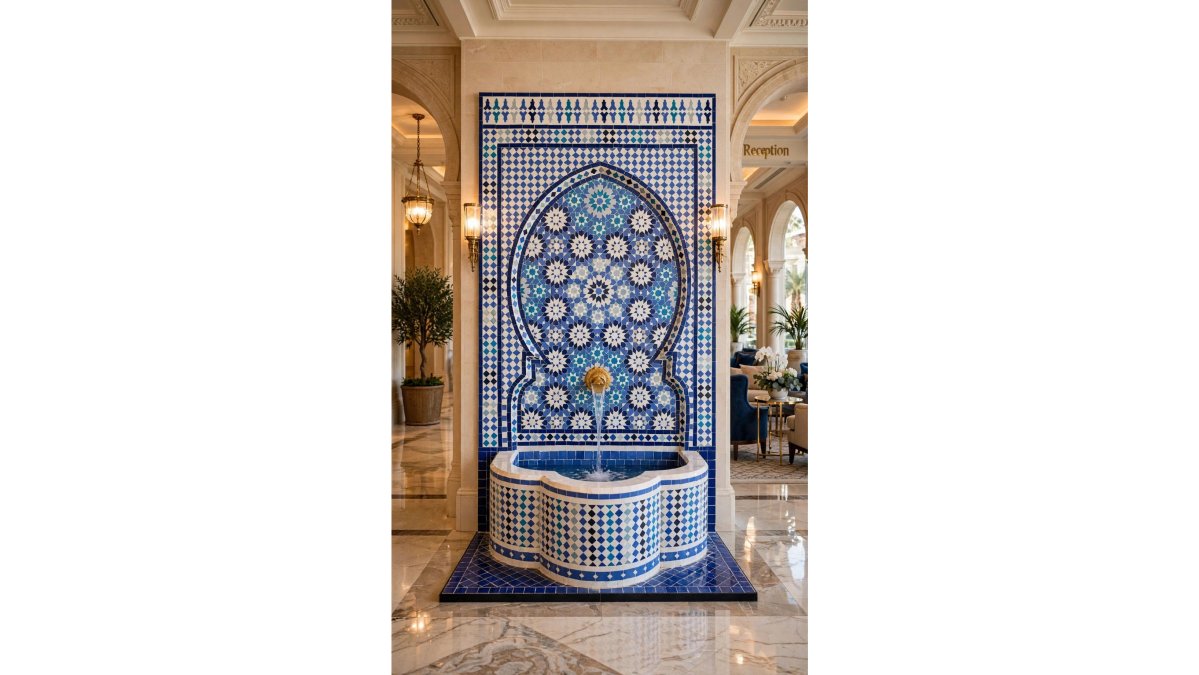
Marble fountains project understated elegance and timeless sophistication. They work in classical, contemporary, and formal garden settings. A marble water feature becomes a focal point through its material presence rather than pattern complexity. The natural veining in marble creates organic visual interest, and the stone's smooth finish reflects light in ways that ceramic tile cannot.
The choice depends on whether you want your fountain to be a bold design statement or a refined accent. Mosaic tile fountains command attention and anchor a garden's aesthetic direction. Marble fountains complement existing landscapes without overwhelming them. If your garden already features ornate plantings or architectural details, a quiet marble fountain balances the composition. If your space feels understated, mosaic tile's geometric patterns add visual richness.
Consider your home's exterior architecture too. Homes with Moroccan, Spanish Colonial, or Mediterranean influences pair naturally with mosaic fountains. Contemporary, traditional, or formal homes integrate marble features more seamlessly.
Material Durability and Weather Resistance
This is where climate becomes decisive, and the stakes are highest. Mosaic tile fountains use glazed ceramic, a fired, non-porous material that resists water absorption and weather damage. The glaze seals the tile surface, preventing moisture from penetrating the ceramic body. This makes them exceptionally durable in freeze-thaw cycles common in northern and mountain regions. When water freezes inside porous materials, it expands and cracks the stone. Glazed tile won't crack this way because water cannot enter the material.
Marble is porous natural stone. It absorbs water through microscopic capillaries in its crystalline structure. When that water freezes during winter months, it expands by approximately 9 percent, exerting outward pressure on the marble's internal structure. This pressure causes internal fracturing and surface spalling, the flaking and pitting visible on marble exposed to repeated freeze-thaw cycles. In regions with regular freeze-thaw cycles (most of the northern United States, including the Northeast, Midwest, and mountain states), marble fountains require protective measures or risk structural failure within 2-3 years.
Mosaic tile fountains, by contrast, can remain outdoors in moderate to hot, dry regions. Draining the fountain before winter is still recommended as a best practice to protect the pump and internal plumbing.
Handcrafted vs Mass-Produced Features
Authenticity matters to many homeowners seeking genuine Moroccan decor. Justmorocco's mosaic tile fountains are handmade in Morocco using the same techniques Moorish artisans employed in Andalusia centuries ago. Each tile is hand-cut, and patterns vary slightly from piece to piece. This variation, slight color shifts, minor sizing differences, proves authenticity. Mass-produced tiles are uniform and identical.
The Handmade Mosaic Tile Fountain, Moroccan Moorish Water Feature (48x30") exemplifies this craftsmanship. Every geometric pattern is individually hand-chiseled by skilled artisans. You're not buying a factory product; you're acquiring a piece of architectural history made using preserved traditional methods.
Marble fountains vary in origin and production method. Some are hand-carved by artisans; others are machine-cut from quarried blocks. Justmorocco's marble fountains are hand-picked and hand-crafted, ensuring each piece receives individual attention. The Granada marble wall fountain and standard marble wall fountain both offer this artisanal quality.
Mass-produced fountains, whether tile or marble, sacrifice this individuality. They prioritize consistency and cost reduction over craftsmanship. If authenticity and cultural heritage matter to your decision, handcrafted pieces justify their premium pricing.
Maintenance Tips for Outdoor Mosaic Fountains
Mosaic tile fountains require less maintenance than marble, but they're not maintenance-free. Supporting keyword: maintenance tips for outdoor mosaic fountains involves regular grout inspection and cleaning.
Drain the fountain before winter in cold climates. Standing water freezes and expands, potentially cracking the ceramic or the basin. Even though glazed tile resists freeze damage better than marble, draining is still the safest practice.
How to Winterize Garden Fountains
Supporting keyword: how to winterize garden fountains is essential for protecting your investment. The winterization process differs slightly between tile and marble, but both require drainage and protection.
For mosaic tile fountains:
- Turn off the pump and drain all water from the basin and tubing.
- Disconnect the pump and store it indoors in a dry location.
- Leave the fountain structure in place if it's permanently installed. The glazed tile resists cold damage.
- If the fountain is portable, consider moving it to a sheltered location or covering it with a breathable tarp.
- In spring, reconnect the pump, refill with fresh water, and test circulation before leaving it running continuously.
For marble fountains:
- Drain completely as with tile fountains.
- Remove the pump and store indoors.
- Inspect for cracks or damage when uncovering in spring.
The key principle: standing water is the enemy. Drain your fountain before the first freeze, regardless of material.
Installation and Structural Requirements
Both fountain types require proper installation to function correctly and safely. Mosaic tile fountains typically weigh 200-400 pounds depending on size. The Garden wall fountain at 64" x 35" demands a sturdy wall structure capable of supporting concentrated weight. Install it on a wall reinforced with proper backing, not on vinyl siding or drywall alone.
The installation and structural requirements differ. Mosaic fountains can be mounted on existing garden walls with appropriate anchors and brackets. Marble fountains, being heavier and more prone to cracking under stress, often require a dedicated structural foundation. The Granada marble wall fountain and Marble wall fountain both weigh significantly more and benefit from professional installation.
Professional installation is recommended for both types, particularly for marble. Justmorocco can advise on installation requirements based on your specific location and wall structure, and offers custom furniture imports to help you source authentic pieces tailored to your garden's unique needs.
Benefits of Zellige Tile Water Features
Supporting keyword: benefits of zellige tile water features centers on the unique properties of this traditional Moroccan material. Zellige, hand-cut, glazed ceramic tile, offers aesthetic and practical advantages that mass-produced alternatives cannot match.
Handmade Mosaic Tile Fountain, Moroccan →
Each tile is hand-cut by artisans, creating slight variations that add visual richness and authenticity.
The geometric patterns possible with zellige are unmatched by machine-cut alternatives. These patterns transform a functional water feature into an artistic focal point. The Handmade Mosaic Tile Fountain, Large Moorish Water Feature showcases this artistry at a larger scale.
Zellige's cultural authenticity matters to homeowners seeking genuine Moroccan design. These tiles carry centuries of architectural tradition. Installing zellige connects your garden to the palaces and riads of historic Morocco. The investment in authentic craftsmanship pays dividends in aesthetic satisfaction and long-term durability.
Maintenance of zellige is simpler than marble. Grout maintenance is the primary ongoing task. Over a 10-year period, a zellige fountain typically costs less to maintain than a marble alternative.
Pricing and Long-Term Value
Understanding the full cost picture, initial price plus maintenance, repairs, and replacement cycles, reveals the real value proposition of each option. A side-by-side comparison shows why the lower upfront cost of mosaic tile often translates to lower lifetime cost.
Initial Purchase Price
Mosaic tile fountains start at $2,970 for the 48" × 30" model and reach $5,720 for larger handcrafted pieces. The Garden wall fountain sits at $4,500. These are one-time purchases with minimal ongoing costs. Marble fountains start at $7,500 for either the Granada or standard Marble wall fountain. The higher initial cost reflects the hand-picked stone and artisanal craftsmanship.
Maintenance Costs and Frequency
The maintenance burden differs significantly. Mosaic tile fountains require:
- Grout inspection and cleaning: Quarterly (DIY, minimal cost) or annually professional ($150-$250)
- Pump replacement: Every 5-7 years ($150-$300 for the pump itself; $200-$400 if professional installation is required)
- Seasonal winterization: DIY (free) or professional drainage service ($100-$200 in cold climates)
- Annual water system flush: DIY with distilled water (minimal cost)
Marble fountains require:
- Stone sealing: Every 1-2 years ($200-$400 per application, professional recommended)
- Professional cleaning: Annually ($300-$500 to remove mineral deposits and algae without damaging the stone)
- Crack inspection and repair: As needed ($500-$1,500 per repair for professional stone restoration)
- Winterization: Professional protective covering and sealing in freeze-thaw climates ($300-$600 annually)
- Pump replacement: Every 5-7 years ($150-$300)
Total Cost of Ownership Over 10 Years
Assuming average maintenance (not accounting for major repairs):
Mosaic tile fountain scenario:
- Initial purchase: $4,000 (average mid-range model)
- Grout maintenance (10 years, quarterly DIY): Minimal cost
- Professional grout cleaning (annual, years 3, 6, 9): Estimated $450
- Pump replacement (once, year 6): $250
- Winterization (annual, 5 years in cold climate): Estimated $500
- Total: $5,200
Marble fountain scenario (mild climate, no freeze-thaw):
- Initial purchase: $7,500
- Stone sealing (every 18 months, 6 applications): Estimated $1,500
- Professional cleaning (annual, 10 years): $4,000
- Pump replacement (once, year 6): $250
- Crack repair (one minor repair, year 5): Estimated $750
- Total: $14,000
Marble fountain scenario (freeze-thaw climate):
- Initial purchase: $7,500
- Stone sealing (every 12 months, 10 applications): Estimated $2,500
- Professional cleaning (annual, 10 years): $4,000
- Winterization (annual, 10 years): Estimated $4,000
- Pump replacement (once, year 6): $250
- Crack repair (two repairs, years 3 and 7): Estimated $2,000
- Total: $20,250
Cost-Benefit Analysis
The financial advantage of mosaic tile becomes clear when you factor in long-term maintenance. Marble's premium aesthetic comes with a premium maintenance burden that many homeowners underestimate at purchase time.
Replacement and Resale Value
Frequently Asked Questions
What is the best material for outdoor fountains in varying climates?
Mosaic tile fountains excel in moderate climates with seasonal changes, while marble fountains suit stable, dry environments. Mosaic tile's glazed ceramic surface resists freeze-thaw cycles better than porous marble. In coastal areas with salt air or humid regions, mosaic tile's sealed surface prevents moisture penetration. Marble requires protective sealing and struggles in freeze-thaw zones where water expands in pores and cracks the stone. Choose based on your region's temperature swings and humidity levels.
How do mosaic tile fountains compare to solid marble in terms of maintenance?
Mosaic tile fountains require regular grout cleaning and occasional resealing of hand-cut joints, typically annually. Marble fountains demand frequent sealing to prevent staining and water absorption, plus careful monitoring for cracks in freeze-thaw climates. Tile's geometric patterns hide mineral deposits better than marble's smooth surface. Both need pump maintenance and water circulation checks. Tile maintenance focuses on grout; marble maintenance focuses on sealing and crack prevention. Tile generally demands less intensive care over 5-10 years.
Are mosaic tile fountains durable enough for year-round outdoor use?
Yes, when properly maintained. Handcrafted mosaic fountains using glazed ceramic tile withstand freeze-thaw cycles better than marble because glazed surfaces don't absorb water. Proper drainage and winter protection (draining water and covering) extend lifespan. Marble fountains face greater risk of cracking in freeze-thaw zones.
What are the aesthetic differences between Moroccan mosaic and traditional marble fountains?
Moroccan mosaic fountains feature hand-cut geometric patterns, intricate borders, and vibrant glazed colors that evoke 12th-century Andalusian architecture. Marble fountains offer smooth, uniform surfaces with subtle veining and a classical, minimalist aesthetic. Mosaic tiles create visual texture and cultural authenticity; marble conveys timeless elegance and simplicity. Mosaic designs incorporate zellige tile water features with ornate, patterned focal points. Marble suits modern and traditional gardens equally. Choose mosaic for bohemian, Mediterranean, or eclectic styles; marble for classical or contemporary landscapes.
Do decorative fountains require professional installation?
Yes, professional installation is recommended for both types. Marble fountains require structural foundation assessment due to their weight and need for proper water circulation setup. Mosaic tile fountains need secure wall mounting, grout application, and pump integration to function correctly. Improper installation causes water leaks, structural damage, and reduced fountain lifespan. Professional installers ensure proper drainage, electrical safety for pumps, and correct water flow acoustics. DIY installation risks voiding warranties and damaging handcrafted pieces during transit and setup.