

Table of Contents
- Understanding High-End Moroccan Furniture Shipping Costs
- Air Freight vs. Sea Freight for Handcrafted Pieces
- LCL vs. FCL Shipping for Furniture
- International Furniture Shipping Costs Breakdown
- US Customs Duty on Imported Furniture from Morocco
- Crating and Packaging Standards for Fragile Moroccan Pieces
- Transit Times and Delivery Options
- Working with Freight Forwarders and Customs Brokers
High-End Moroccan Furniture Shipping Costs: Complete 2026 Guide
Last Updated: August 3, 2026
Understanding High-End Moroccan Furniture Shipping Costs
Shipping authentic Moroccan handcrafted pieces across the Atlantic demands far more than standard logistics. High-end moroccan furniture shipping costs reflect the complexity of protecting delicate mother-of-pearl inlays, intricate tilework, and hand-carved wood elements through international transit. At Justmorocco, we've helped affluent homeowners and design professionals navigate these expenses, and costs vary dramatically based on method, route, and protection standards.
The real challenge isn't just the freight charge. It's the constellation of costs that appear after commitment: tariffs, customs clearance, specialized crating, terminal handling, and insurance. Many importers discover these expenses only at arrival. This guide breaks down every component so you can budget accurately and avoid surprises.
Why Moroccan Furniture Requires Specialized Shipping
Standard furniture logistics don't cut it for high-end Moroccan pieces. These items arrive with zero protection, no bubble wrap, no corner guards, no shock sensors. A single piece featuring bone-inlay work or zellige tile mosaic represents weeks of handcrafted labor. Damage in transit means irreplaceable loss of authentic artistry.
Wooden crates with proper cushioning, ISPM-15 certification, and climate control become non-negotiable. Fragile items demand air freight or premium sea freight with temperature and humidity monitoring. Justmorocco specializes in these pieces, and we've learned that cutting corners on protection costs far more than investing in proper crating upfront.
Cost Factors That Impact Your Final Bill
Piece weight and dimensions determine volumetric charges. Origin city in Morocco (Marrakech vs. Casablanca vs. Fes) affects pickup logistics. Destination in the US, whether a major port city or inland location, changes drayage costs significantly. Seasonality matters too, peak season (September through November) adds 15-25% premiums on freight rates. The type of wood, presence of delicate inlays, and tile mosaics all demand different protection strategies.
Air Freight vs. Sea Freight for Handcrafted Pieces
Choosing between air and sea freight is the biggest lever on your total shipping cost.
When Air Freight Makes Sense
Air freight from Morocco to the US typically takes 5-7 days door-to-door. For time-sensitive projects, a hotel renovation opening in eight weeks, a client event requiring specific pieces, speed justifies the premium. Air freight costs roughly 4-8 times more than sea freight per kilogram, but for smaller, high-value items, the math can work. A single ornate wooden bed frame might cost $3,000-$6,000 by air versus $800-$1,500 by sea. Air freight also reduces handling risk through fewer transfers and shorter transit time.
When Sea Freight Delivers Better Value
Sea freight from Morocco to US ports (typically New York, Los Angeles, or Houston) takes 15-25 days. For bulk orders or large custom kitchen cabinetry projects, sea freight is the only economically viable option. A full container of handcrafted pieces costs $2,500-$4,500 in freight versus $15,000+ by air. Less Than Container Load (LCL) shipping for partial container space still costs far less per kilogram than air. Most high-end Moroccan furniture imports use sea freight because pieces aren't time-sensitive once design is locked in.
LCL vs. FCL Shipping for Furniture
Understanding container loads determines whether you're paying for empty space or sharing costs with other shippers.
Less Than Container Load (LCL) Explained
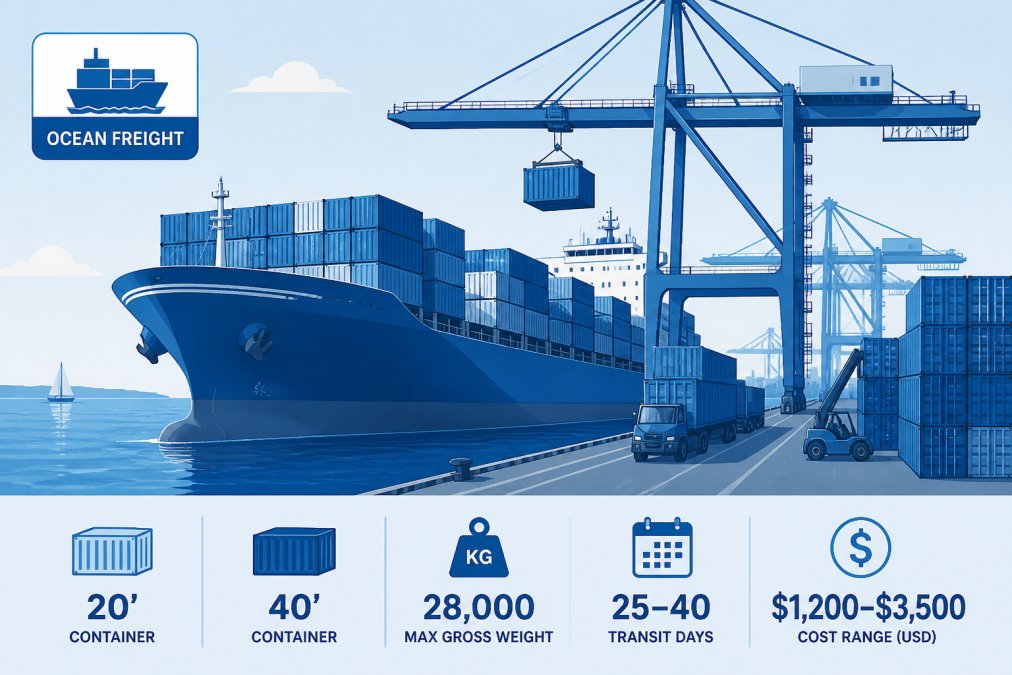
LCL shipping means your furniture shares a 20-foot or 40-foot container with shipments from other importers. You pay only for the cubic meters your items occupy. For a single ornate Moroccan bed, a mirror collection, or modest custom cabinetry order, LCL makes sense. LCL rates run roughly $80-$150 per cubic meter from Morocco to US ports, plus terminal handling charges ($200-$400 per shipment). A typical LCL shipment occupies 3-8 cubic meters, resulting in freight costs between $240-$1,200 before tariffs and fees. The tradeoff: LCL shipments take longer due to consolidation and involve more handling, increasing damage risk for fragile pieces.
Full Container Load (FCL) for Large Orders
FCL means you rent an entire 20-foot or 40-foot container exclusively for your shipment. A 20-foot container costs roughly $2,500-$4,000 from Morocco to major US ports; a 40-foot container runs $3,500-$5,500. Peak season adds 20-30%. FCL makes financial sense when your shipment exceeds roughly 10-12 cubic meters of volume. You also get faster port processing and fewer handling points, reducing damage risk.
| Shipping Method | Volume Range | Cost per CBM | Total Freight Cost | Transit Time | Best For |
|---|---|---|---|---|---|
| LCL | 1-8 CBM | $80-$150 | $240-$1,200 | 20-28 days | Single pieces, small collections |
| FCL 20ft | 10-25 CBM | $125-$225 | $2,500-$4,000 | 15-22 days | Medium orders, custom cabinetry |
| FCL 40ft | 25-65 CBM | $55-$85 | $3,500-$5,500 | 15-22 days | Large collections, hotel projects |
| Air Freight | 0.5-5 CBM | $4-$8 per kg | $2,000-$12,000 | 5-7 days | Urgent, high-value items |
International Furniture Shipping Costs Breakdown
Your total cost extends far beyond the freight charge itself.
Base Freight Charges
The base freight charge covers actual transportation. For sea freight LCL, this runs $240-$1,200 for typical high-end Moroccan furniture shipments. For FCL, expect $2,500-$5,500 depending on container size and season. Air freight ranges $2,000-$12,000 depending on weight and urgency. These rates fluctuate monthly based on fuel costs, port congestion, and seasonal demand. Peak season commands 20-30% premiums; off-season offers 10-15% discounts.
Hidden Costs: Terminal Fees, Drayage, and Handling
Terminal handling charges at the origin port typically run $150-$300. At the US destination port, expect $200-$500. Drayage, trucking from port to final destination, costs $0.50-$1.50 per mile. Port congestion fees, documentation fees, and customs broker charges add another $200-$400. Building a 15-20% contingency into your budget for miscellaneous fees prevents surprises.
Insurance and Damage Protection
International shipping insurance for high-end furniture typically costs 1-3% of declared value. A $20,000 shipment would carry insurance premiums of $200-$600. Insurance only covers what you declare, and it requires proper documentation. Justmorocco recommends declaring full replacement value and purchasing comprehensive coverage for pieces with mother-of-pearl inlays or intricate tilework.
US Customs Duty on Imported Furniture from Morocco
Tariffs add a significant layer to your final cost.
Tariff Rates and Classification
Moroccan furniture imported to the US falls under various tariff codes depending on material and construction. Wooden furniture typically classifies under HS code 9401-9406, with base tariff rates of 0-5% depending on specific construction. As of 2026, most handcrafted wooden furniture from Morocco faces 5% tariff duty on declared value. A $10,000 shipment incurs $500 in tariffs. Misclassifying furniture to avoid tariffs is illegal and results in penalties, delays, and potential confiscation.
Customs Clearance Documentation Requirements
Proper documentation is non-negotiable for smooth customs clearance. You'll need a commercial invoice detailing item descriptions, quantities, and declared values; a bill of lading from the freight forwarder; and a packing list showing exactly what's in each crate. For handcrafted furniture, a certificate of origin from Morocco strengthens your case for duty exemptions if applicable. Customs brokers typically handle this paperwork, charging $150-$300 per shipment.
Crating and Packaging Standards for Fragile Moroccan Pieces
Proper crating is the difference between a piece arriving pristine and arriving destroyed.
ISPM-15 Treatment for Wood Crates
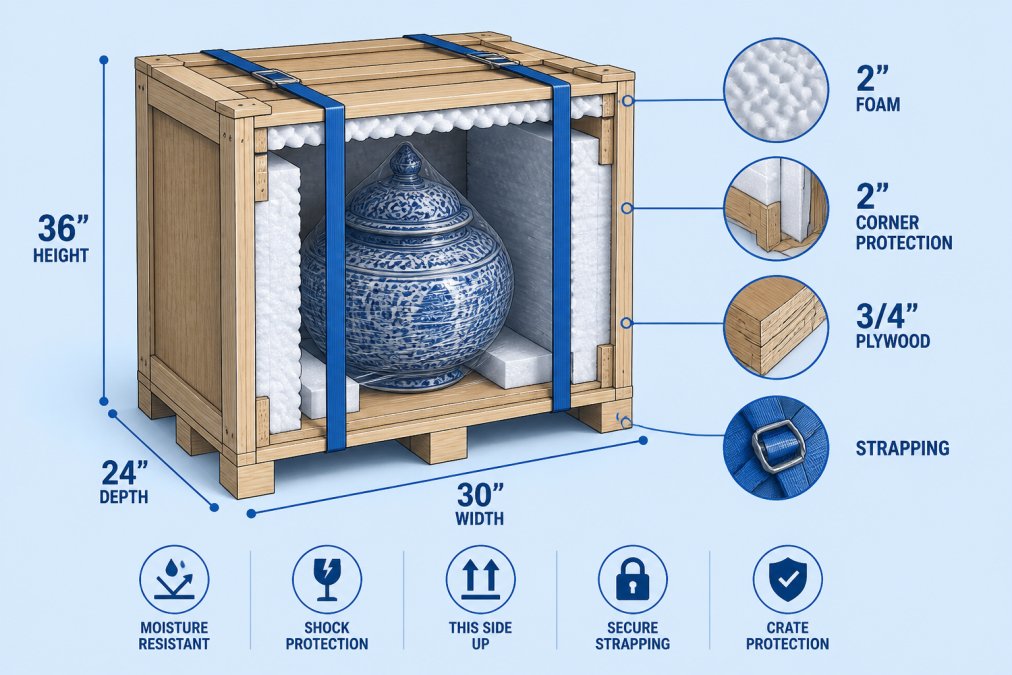
ISPM-15 (International Standards for Phytosanitary Measures) certification is mandatory for wooden crates crossing international borders. This treatment prevents the spread of pests and diseases. Crates must be heat-treated or fumigated and stamped with the ISPM-15 mark. A non-compliant crate can be rejected at US customs, delaying your shipment by weeks. Proper crating involves multiple layers: an outer wooden frame (ISPM-15 certified), interior cushioning with foam or bubble wrap, and protective corner guards. The crate itself might cost $200-$600 depending on item size and complexity.
Mother-of-Pearl and Mosaic Tile Protection
Mother-of-pearl inlays demand meticulous protection through individual wrapping in tissue paper, then bubble wrap, then foam padding to prevent scratching and cracking. Mosaic tile pieces require rigid support to prevent tiles from shifting during transit. Justmorocco works with specialized freight forwarders who understand these materials and provide custom crating solutions that protect your investment.
Transit Times and Delivery Options
Understanding how long your pieces take to arrive shapes project timelines and storage planning.
Door-to-Door vs. Port-to-Port Delivery
Door-to-door delivery includes pickup from the supplier in Morocco, international freight, customs clearance, and final delivery to your address. This takes 20-28 days for sea freight LCL and 15-22 days for FCL. The freight forwarder handles all logistics and documentation, simplifying the process but adding 10-15% to total cost. Port-to-port delivery means you arrange local pickup from the US port yourself, saving $300-$800 in drayage but requiring you to coordinate with a local carrier and manage customs clearance independently.
Estimated Transit Times from Morocco to Major US Cities
From Morocco's primary export ports (Casablanca, Tangier), sea freight to East Coast ports typically takes 15-20 days. To Gulf Coast ports, expect 18-23 days. To West Coast ports, plan for 20-25 days. Air freight from Morocco to major US hubs takes 5-7 days total. For luxury home renovation projects, Justmorocco recommends building in 4-6 weeks from order placement to delivery to account for production time, customs clearance, and unexpected delays.
Working with Freight Forwarders and Customs Brokers
Navigating international logistics alone invites costly mistakes. Professional intermediaries earn their fees through expertise.
What a Freight Forwarder Does for Your Shipment
A freight forwarder arranges transportation, consolidates shipments, manages documentation, and handles customs coordination. They negotiate rates with carriers, secure container space, and track your shipment in real time. They also arrange insurance, manage tariff classification, and troubleshoot delays. For high-end moroccan furniture shipping costs, a freight forwarder's knowledge prevents overpaying on tariffs and terminal fees. Freight forwarder fees typically run 5-10% of total freight cost, but they often save that amount through better rate negotiation.
How to Request and Compare Shipping Quotes
When requesting quotes, provide exact specifications: item descriptions, dimensions in centimeters, weight in kilograms, and declared value. Specify special handling requirements and desired delivery date. Ask quotes to itemize every cost: freight, terminal handling, drayage, customs brokerage, insurance, and miscellaneous fees. Request references from previous furniture importers and verify their experience with handcrafted pieces.
| Comparison Factor | What to Ask | Why It Matters |
|---|---|---|
| Experience | How many shipments of handcrafted furniture? | Fragile items need specialized handling |
| Transparency | Can you itemize every cost? | Hidden fees inflate final invoices |
| Insurance | What damage scenarios are covered? | Mother-of-pearl inlays need comprehensive coverage |
| Timeline | Can you meet my delivery deadline? | Peak season affects availability |
| References | Can you provide past client references? | Reputation reflects reliability |
| Tracking | Do you provide real-time shipment tracking? | Visibility reduces anxiety during transit |
Practical Cost Estimation Framework
Use this framework to estimate your total high-end moroccan furniture shipping costs before committing to a purchase.
Step 1: Calculate Item Weight & Volume Weigh each piece in kilograms. Measure dimensions in centimeters. Calculate cubic meters (length × width × height ÷ 1,000,000). Add 20% for crating and packaging materials.
Step 2: Choose Freight Method
- Single item or small collection: LCL sea freight
- Multiple pieces totaling 10+ CBM: FCL sea freight
- Urgent deadline or high per-unit value: Air freight
Step 3: Base Freight Cost
- LCL: Volume (CBM) × $80-$150 per CBM
- FCL 20ft: $2,500-$4,000 flat rate
- FCL 40ft: $3,500-$5,500 flat rate
- Air: Weight (kg) × $4-$8 per kg
Step 4: Add Terminal & Handling Fees
- Origin port: $150-$300
- Destination port: $200-$500
- Customs brokerage: $150-$300
- Subtotal: $500-$1,100
Step 5: Calculate Drayage
- Distance from port to final address (miles) × $0.50-$1.50 per mile
Step 6: Tariffs
- Declared item value × 5% (typical rate for wooden furniture)
Step 7: Insurance
- Declared item value × 1-3%
Step 8: Crating & Packaging
- Custom crating for fragile items: $200-$600 per crate
Total Cost = Base Freight + Terminal Fees + Drayage + Tariffs + Insurance + Crating
Example: A $15,000 collection of handcrafted Moroccan pieces (6 CBM) shipped LCL to Miami:
- Base freight: 6 × $115 = $690
- Terminal fees: $1,100
- Drayage (400 miles): 400 × $1.00 = $400
- Tariffs: $15,000 × 5% = $750
- Insurance: $15,000 × 2% = $300
- Crating: $400
- Total: $3,640 (24% of item value)
Key Takeaways
Understanding high-end moroccan furniture shipping costs requires accounting for freight method, container type, customs duties, terminal fees, and specialized crating. Sea freight LCL works for single pieces and small collections, while FCL becomes cost-effective for larger orders. Air freight justifies its premium only when timelines demand speed. Tariffs, terminal handling, and drayage often surprise importers who focus only on the freight charge itself.
Working with experienced freight forwarders and customs brokers prevents costly misclassifications and ensures proper documentation. Investing in professional crating protects mother-of-pearl inlays and mosaic tile work that cannot be easily replaced. Building a 4-6 week timeline from order to delivery accounts for production, customs clearance, and unexpected delays.
The most successful high-end furniture imports treat shipping as a strategic investment, not an afterthought. Justmorocco helps clients navigate these complexities by connecting them with vetted freight forwarders, ensuring proper crating standards, and providing transparent cost estimates upfront. When you invest $15,000 or more in handcrafted Moroccan pieces, spending an additional $3,000-$5,000 on professional shipping logistics protects your investment and ensures your artisan-crafted pieces arrive ready to transform your space.
Frequently Asked Questions
What is included in high-end Moroccan furniture shipping costs?
High-end Moroccan furniture shipping costs typically include base freight charges, crating and packaging, terminal handling fees, drayage (ground transport), customs duties, and optional shipping insurance. Additional charges may apply for specialized handling of fragile items like mother-of-pearl inlays or mosaic tilework. Request an itemized quote from your freight forwarder to see all components. Costs vary significantly based on shipment size, destination city, and whether you use LCL or FCL shipping methods.
How do US customs duty on imported furniture affect my total cost?
US customs duties on imported Moroccan furniture typically range from 5-20% depending on the item's classification and materials. A customs broker calculates duty based on the declared value of your shipment and applicable tariff codes. Duties are assessed at the port of entry before your shipment clears customs. Factor this into your budget when requesting quotes. The total landed cost includes the base freight, all handling charges, plus customs duties and any applicable taxes. Always declare items accurately to avoid delays or penalties.
What is the difference between LCL vs FCL shipping for furniture orders?
LCL (Less Than Container Load) ships partial containers, sharing space with other shipments, making it cost-effective for smaller orders but with higher per-unit costs and longer transit times due to consolidation. FCL (Full Container Load) dedicates an entire container to your shipment, offering lower per-unit costs for large orders and faster delivery, but requires minimum volume to be economical. Most custom kitchen and bathroom remodeling projects use LCL unless ordering multiple pieces or large quantities. Freight forwarders help determine which method saves money for your specific shipment size and timeline.
How long does it take to ship Moroccan furniture to the US?
Sea freight typically takes 3-6 weeks from Morocco to major US ports like Los Angeles, Houston, or New York, plus additional time for customs clearance and final delivery. Air freight is faster (7-10 days) but costs significantly more. Door-to-door delivery adds 1-2 weeks compared to port-to-port. Customs clearance can add 3-7 business days depending on documentation completeness and port congestion. Plan your timeline around these ranges and communicate with your freight forwarder about potential delays during peak shipping seasons.
What documentation do I need for importing Moroccan furniture to the US?
Required documents include a commercial invoice, bill of lading, packing list, and proof of origin. For handcrafted pieces, include certificates of authenticity or detailed descriptions. A customs broker typically handles documentation submission, but you must provide accurate item descriptions, materials, and declared values. Incomplete or inaccurate paperwork delays customs clearance and increases costs. Work with your freight forwarder to prepare all documents before shipment departs Morocco. Keep copies for your records and insurance claims.
Moroccan doors
Ready to import authentic Moroccan furniture without the logistics headaches? Justmorocco connects you with experienced freight forwarders specializing in handcrafted pieces, manages customs documentation, and ensures proper crating standards that protect mother-of-pearl inlays and intricate tilework. Work with Justmorocco to transform your space with genuine artisan-crafted pieces delivered safely