
Table of Contents
- What Makes Moroccan Carved Doors a Unique Investment
- Hand-Carved Door Cost: Pricing Across Styles and Sizes
- Custom Door Installation Cost: Hidden Expenses and Total Investment
- Durability and Expected Lifespan of Solid Wood Doors
- Annual Energy Cost Impact (Exterior Door Application):
- Carved Wood Door Maintenance: Protecting Your Investment Long-Term
- Moroccan Door Design Ideas: Interior vs. Exterior Applications
- Resale Value and Long-Term Home Appeal
- Comparison: Single vs. Double Doors and Material Selection
- Is a Moroccan Carved Door Right for Your Home?
- Frequently Asked Questions
Last Updated: October 10, 2026
What Makes Moroccan Carved Doors a Unique Investment
Installing moroccan carved doors transforms more than just your entryway. These hand-carved architectural pieces function as both functional portals and investment-grade art, blending authentic craftsmanship with measurable home value. The question isn't whether they're beautiful, it's whether the cost justifies the return.
At Justmorocco, we've learned that real value emerges from understanding the complete financial picture: purchase price, installation complexity, durability, and resale appeal. Most buyers focus only on sticker price and miss the strategic advantages that justify premium positioning.
Hand-carved solid wood doors often appreciate when properly maintained. Traditional craftsmanship, geometric patterns rooted in Islamic and Berber design, horseshoe arches, and relief carving create scarcity. A genuine moroccan carved door carved from cedar or brass commands premium pricing because it cannot be replicated by industrial production.
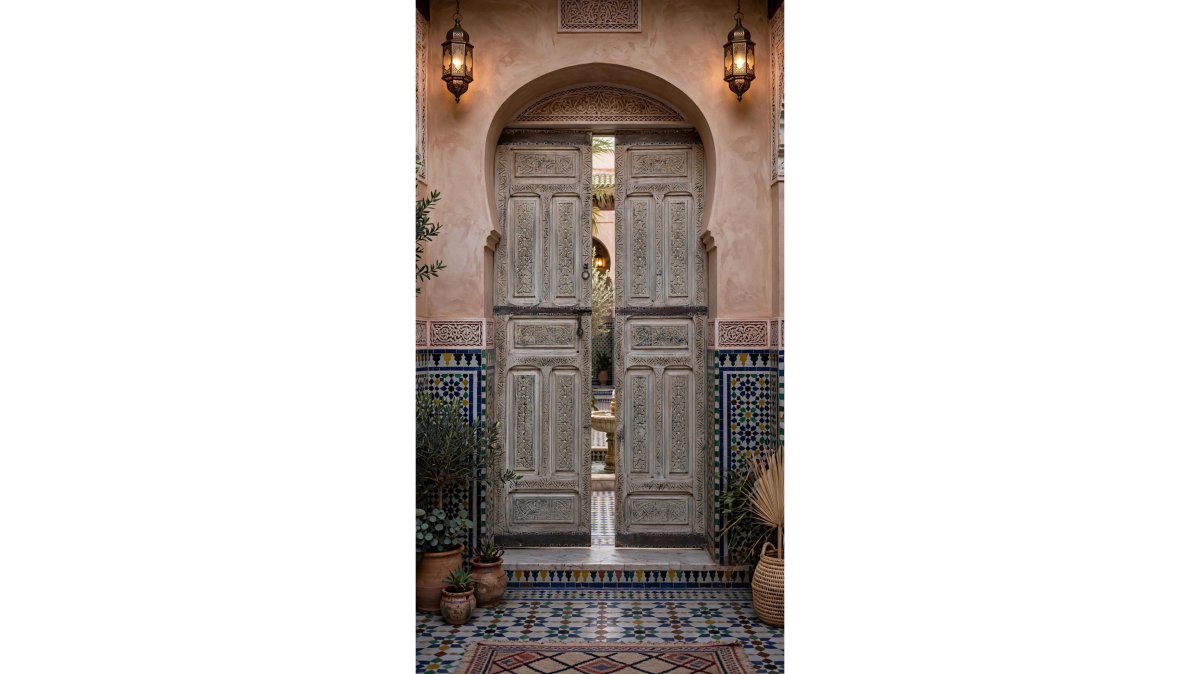
Cost-benefit analysis depends on use case. Exterior entryway doors justify higher investment than interior accent doors. Custom orders cost more upfront but eliminate frame modifications, transforming impulse purchases into strategic decisions.
Hand-Carved Door Cost: Pricing Across Styles and Sizes
Moroccan carved door pricing spans a wide range based on authenticity level, materials, and dimensions. Entry-level options start around $1,800, while architectural statement pieces exceed $42,000. The price reflects not just materials but labor hours.
Entry-Level Carved Doors
Entry-level moroccan carved doors range from $1,800 to $3,500 for interior accents or smaller entryways. The Handmade Vintage Moroccan Carved Double Door in white cedar (80.5" x 44.5") from Justmorocco at $1,800 features traditional geometric star-and-cross motifs with distressed whitewashed finish and dark metal hardware.
Expect solid wood construction with hand-carved details, though carving depth is less pronounced than premium options. These work best for interior applications or protected entryways. The whitewashed finish suits contemporary homes incorporating Moroccan design elements.
Mid-Range Handcrafted Options
Mid-range moroccan carved doors range from $4,000 to $15,000 and represent the most popular segment for home renovations. The Hand-Carved Moroccan Double Door in Andalusian Alhambra style (98" x 56") from Justmorocco costs $8,200, featuring deep relief carving with eight-pointed geometric stars, arabesque patterns, horseshoe arch motifs, and walnut-to-espresso staining.
The Custom Moroccan Arch Door Panel in Moorish design (87" x 37") at $2,800 offers symbolic Berber carving and traditional hardware. Mid-range doors balance authenticity with reasonable investment, featuring 1.5" to 2.5" carving depth and solid wood construction.
Premium Architectural Doors
Premium moroccan carved doors exceed $13,000 and serve as architectural focal points for luxury homes and commercial spaces. The Handmade Carved Brass Moroccan Royal Palace Double Door (98" x 56") from Justmorocco at $13,940 creates dramatic visual impact, though it requires specialized installation and maintenance.
The flagship Authentic Moroccan Hand-Carved Cedar Double Doors (95" W x 118" H) from Justmorocco, priced at $42,000, represents the premium tier. These massive architectural pieces feature built-in wicket doors (Bab Seghir), traditional forged iron sliding bolts, and hand-carved geometric stars with 3" to 4" relief depth. Premium doors justify their cost through unmatched authenticity, scale, and artistic value.
| Door Type | Price Range | Best For | Carving Depth |
|---|---|---|---|
| Entry-Level | $1,800-$3,500 | Interior accents, smaller openings | 0.75"-1.5" |
| Mid-Range | $4,000-$15,000 | Primary entryways, home renovations | 1.5"-2.5" |
| Premium | $13,000-$42,000 | Architectural statements, luxury homes | 2.5"-4" |
Custom Door Installation Cost: Hidden Expenses and Total Investment
Purchase price represents only 40-50% of the total investment in a moroccan carved door installation. Professional installation, shipping, customs fees, and frame modifications create substantial hidden costs that first-time buyers often overlook.
Professional Installation Labor
Professional installation labor ranges from $800 to $3,500 depending on complexity. Standard double-door installation in an existing frame costs $1,200 to $1,800, including hanging, alignment, testing, and sealing.
Frame modifications increase labor costs significantly. Adjusting existing frames costs $1,500 to $3,500. Custom frame construction for new openings can exceed $4,000. Structural modifications add $800 to $2,000.
Shipping, Customs, and Import Fees
Shipping typically costs $500 to $2,000 depending on size and destination. Mid-range doors (150-250 lbs) cost $1,000 to $1,500. Oversized doors exceeding 100" require specialized handling and cost $1,500 to $2,500.
Import duties and customs fees range from 5-15% of purchase price depending on material classification. A $10,000 door may incur $500 to $1,500 in customs duties.
Frame Modifications and Hardware Upgrades
Frame modifications are frequently underestimated. Adjusting frame width, height, or depth costs $400 to $1,200. Reinforcing frames adds $300 to $800.
Hardware upgrades include specialty hinges, mounting brackets, and locking mechanisms. Upgrading to heavy-duty pivot hinges costs $400 to $1,000. Custom locking mechanisms add $300 to $800. Weather sealing and insulation upgrades cost $200 to $600.
Total Installation Cost Breakdown (Mid-Range Door Example):
- Door purchase: $8,200
- Professional installation labor: $1,500
- Shipping and customs: $1,200
- Frame modifications: $800
- Hardware upgrades: $600
- Total investment: $12,300
Durability and Expected Lifespan of Solid Wood Doors
Moroccan carved doors constructed from solid cedar demonstrate exceptional durability when properly maintained, with lifespans of 30-50 years. However, durability alone does not justify premium cost; the complete value proposition must account for energy efficiency, security, and weather resistance.
Material Durability and Structural Longevity
Cedar naturally resists rot and insect damage. Hand-carved doors last 30-50 years because solid wood accommodates seasonal humidity changes gracefully, strengthening wood-to-wood joinery.
Climate significantly impacts durability. Interior doors last indefinitely if protected from water damage. Exterior doors in humid coastal climates require more frequent maintenance. Protected entryways function beautifully for 50+ years with minimal intervention; fully exposed locations require annual maintenance and last 25-35 years before refinishing.
Energy Efficiency and Air Leakage Performance
Hand-carved moroccan doors are typically solid wood with minimal insulation value.
Annual Energy Cost Impact (Exterior Door Application):
Air leakage around frames compounds the energy efficiency gap. Professional installation and weather sealing ($200-$600) reduce but do not eliminate this gap.
Security Performance and Lock Integration
Traditional moroccan doors feature decorative hardware designed for aesthetic impact rather than security robustness. Standard forged iron locks lack modern security features like deadbolts, reinforced strike plates, and tamper-resistant mechanisms.
Upgrading moroccan doors to modern security standards requires:
- Reinforced deadbolt installation: $300-$600
- Heavy-duty strike plate and frame reinforcement: $200-$400
- Security hinges (if exterior): $200-$400
- Total security upgrade cost: $700-$1,400
Moroccan doors require aftermarket security upgrades, adding to total installed cost and potentially compromising aesthetic authenticity.
Frame fit and structural integrity also affect security. Moroccan doors must be installed in properly reinforced frames with minimal gaps. A door installed in a weak or poorly fitted frame can be compromised regardless of lock quality. Professional installation that includes frame reinforcement (cost: $800-$2,000) is essential for security performance.
Weather Resistance and Exterior Performance
Exterior moroccan doors face weather challenges impacting durability and operating costs. Solid wood doors absorb moisture, requiring protective finishes and regular maintenance, while modern doors shed water and require minimal maintenance.
Weather Protection Requirements:
- Initial protective finish (stain/sealant): $400-$800
- Resealing every 2-3 years: $600-$1,200 per application
- 30-year lifecycle cost for weather protection: $6,000-$12,000
Water infiltration risk is higher with moroccan doors because carved details create recesses where water accumulates. Proper installation includes sloped sill ($200-$400), drip edge and flashing ($300-$600), and caulking ($200-$400), totaling $700-$1,400.
Failure to implement proper water protection can result in wood rot, structural damage, and replacement costs exceeding $5,000.
Lifecycle Cost Comparison: Moroccan Door vs. Modern Insulated Door
30-Year Lifecycle Cost (Exterior Application, Climate Zone 4):
Moroccan Carved Door:
- Purchase and installation: $12,300
- Energy penalty: $4,500-$7,500
- Weather maintenance and resealing: $6,000-$12,000
- Minor repairs and hardware replacement: $1,500-$3,000
- Total 30-year cost: $24,300-$34,800
This analysis reveals that moroccan doors carry substantial hidden costs beyond purchase price. The durability advantage (30-50 year lifespan) is offset by energy inefficiency, security limitations, and weather maintenance demands.
When Durability Justifies Premium Cost
Moroccan doors become cost-justified on durability grounds when:
- Installed in interior applications where energy efficiency and security are not factors
- Placed in protected locations (covered entryways, interior hallways) where weather maintenance is minimal
- Valued primarily for aesthetic and artistic merit rather than functional performance
- Integrated into homes where long-term character and craftsmanship are prioritized over operating cost efficiency
For exterior applications in harsh climates, the durability advantage is substantially eroded by energy costs, maintenance demands, and security limitations. A realistic cost-benefit analysis must account for these factors rather than relying on lifespan alone.
Carved Wood Door Maintenance: Protecting Your Investment Long-Term
Protecting a moroccan carved door investment requires understanding seasonal care priorities and realistic repair costs. Maintenance differs substantially between interior and exterior applications.
Seasonal Care and Climate Considerations
Interior moroccan carved doors require minimal seasonal maintenance. Annual inspection and occasional furniture polish preserve appearance. Maintaining indoor humidity between 40-50% prevents excessive wood movement and carving detail separation.
Exterior moroccan carved doors demand quarterly maintenance. Spring inspection identifies finish deterioration or water infiltration. Summer maintenance includes reapplying clear sealant every 2-3 years. Fall preparation checks weather seals and hardware. Winter monitoring prevents snow and ice accumulation in carved recesses.
Authentic Moroccan Hand-Carved Cedar Double Doors – 95" W x 118" H Entryway →
Coastal environments present unique challenges. Salt air accelerates finish degradation and corrodes iron hardware. Cedar doors in coastal locations require biennial resealing versus triennial resealing in inland locations.
Repair Costs and Restoration
Minor repairs (loose hardware, scratches, finish damage) cost $150 to $400. Replacing latches or adjusting hinges costs $200 to $500.
Significant repairs (replacing panels, structural damage, restoring finishes) cost $800 to $3,000. Refinishing typically costs $1,200 to $2,500 depending on door size and carving complexity.
Full restoration of damaged moroccan carved doors can exceed $5,000 but remains economically justified given the door's value. Professional restoration preserves authenticity and maintains resale appeal better than replacement.
Moroccan Door Design Ideas: Interior vs. Exterior Applications
Moroccan carved doors function beautifully in both interior and exterior contexts, but each application requires different considerations.
Grand Entryway Statements
Exterior moroccan carved doors create dramatic first impressions. A double door installation in a home's main entry establishes architectural character and signals quality craftsmanship. Grand entryway doors work best with supporting design elements like zellige tile work or traditional lighting.
The Authentic Moroccan Hand-Carved Cedar Double Doors (95" W x 118" H) from Justmorocco exemplify grand entryway applications. The built-in wicket doors allow daily entry without opening the full doors, adding authentic character.
Exterior entryway doors require strong weather protection. Covered porches or recessed entries reduce weather exposure and extend door lifespan. Direct sun exposure fades finishes faster, so strategic placement matters for long-term appearance preservation.
Interior Accent Doors and Bedroom Features
Interior moroccan carved doors function as sculptural art pieces that elevate room aesthetics. Bedroom entries, closet doors, or bathroom entrances benefit from hand-carved detail without exterior maintenance demands. Interior doors can feature lighter finishes that might not withstand exterior weather.
The Handmade Vintage Moroccan Carved Double Door in white cedar (80.5" x 44.5") from Justmorocco works well as an interior feature. Its distressed whitewashed finish complements contemporary interiors while maintaining authentic character, allowing homeowners to enjoy detailed carving without protective finishes.
Interior doors also serve as headboard alternatives, creating dramatic focal points while preserving the artwork.
Resale Value and Long-Term Home Appeal
Resale value for moroccan carved doors presents a high-variance outcome that depends on buyer demographics, regional design trends, and whether the door aligns with the home's overall architectural narrative. Unlike standard upgrades with predictable ROI, hand-carved doors create polarized buyer responses: strong premiums in design-forward markets, or reduced appeal in conservative regions.
Market Segments and Resale Outcomes
Design-forward urban markets show stronger resale appreciation for distinctive architectural elements. Homes featuring moroccan carved doors as part of a cohesive design strategy attract buyers willing to pay premiums. Comparable sales analysis suggests distinctive doors may recover 40-70% of installation cost through increased buyer interest, though this varies by property price point and neighborhood.
Conservative suburban markets show weaker resale outcomes. Buyers typically prefer neutral, replaceable doors. A $12,000-$15,000 moroccan door installation may reduce buyer pool, as some buyers deduct replacement costs from their offer.
Documentation and Narrative Value
Resale value depends heavily on positioning. Homes with professional documentation, sourcing certificates, installation records, and professional photography, command stronger premiums. Real estate listings that feature moroccan doors prominently attract design-conscious buyers.
Custom-commissioned doors create stronger resale positioning than pre-made options. A door specifically designed for a home's architecture becomes part of its unique character, working as an asset in design-forward markets but as a liability in conservative markets.
Risk-Adjusted Financial Modeling
A realistic cost-benefit model for resale value should account for:
Scenario 1: Design-Forward Market, 10-Year Hold
- Total installed cost: $12,300
- Estimated resale premium (40-60% recovery): $4,920-$7,380
- Annual cost of capital: ~$1,230 (opportunity cost of $12,300 invested elsewhere)
- Net financial outcome: Negative to break-even, but offset by 10 years of daily enjoyment and potential appreciation if home value increases
Scenario 2: Conservative Market, 5-Year Hold
- Total installed cost: $12,300
- Estimated resale impact: -$2,000 to -$5,000 (buyer deduction for replacement cost)
- Annual cost of capital: ~$2,460
- Net financial outcome: Significant loss; financial justification depends entirely on personal aesthetic value, not resale appreciation
Scenario 3: Design-Forward Market, 15-Year Hold with Maintenance
- Total installed cost: $12,300
- Maintenance and minor repairs (15 years): $2,000-$4,000
- Estimated resale premium (50-70% recovery): $6,150-$8,610
- Annual cost of capital: ~$820
- Net financial outcome: Break-even to modest positive, primarily justified by long-term enjoyment and home character rather than pure financial return
When Resale Value Justifies the Investment
Resale appreciation becomes a meaningful financial factor only when:
- You install the door in a market segment that values distinctive architectural elements
- You maintain comprehensive documentation and professional presentation
- You plan to hold the property 10+ years (allows time for market appreciation and amortizes annual carrying costs)
- The door integrates with broader home design direction (not an isolated aesthetic choice)
- You commit to regular maintenance that preserves the door's condition and appearance
For most homeowners, resale value should be treated as a secondary benefit, not the primary financial justification. The primary financial case for moroccan carved doors rests on durability (30-50 year lifespan versus 15-20 years for standard doors) and personal satisfaction, not resale appreciation.
Comparison: Single vs. Double Doors and Material Selection
Moroccan carved door installations require decisions about panel configuration and material composition. Each choice affects cost, aesthetic impact, and functional performance.
Cedar vs. Brass: Aesthetic and Performance Trade-offs
Cedar doors dominate the moroccan carved door market and offer excellent value. Cedar naturally resists rot and insect damage, provides warm aesthetic appeal, and costs significantly less than brass. Cedar doors from Justmorocco range from $1,800 to $42,000 depending on size and carving complexity.
Brass doors create dramatic visual impact. The Handmade Carved Brass Moroccan Royal Palace Double Door (98" x 56") costs $13,940 and develops natural patina over time. However, brass doors weigh substantially more, requiring reinforced frames and specialized installation, plus periodic polishing to prevent tarnishing.
Cedar doors suit most applications and budgets. Brass doors justify premium pricing for luxury installations, coastal properties, or commercial spaces where durability and visual drama justify additional investment.
Single Panel vs. Double Panel Configurations
Single-panel moroccan carved doors cost 30-40% less than double-panel configurations and work well for interior applications or narrower openings, suiting bedroom entries, closet doors, or accent installations.
Double-panel moroccan carved doors create more dramatic visual impact for primary entryways or grand openings, typically measuring 60-100 inches wide. The Authentic Moroccan Hand-Carved Cedar Double Doors from Justmorocco at 95 inches wide exemplify this architectural drama.
Double-panel doors cost more but allow furniture movement through wider openings and create balanced proportions in large entryways. Single doors suit smaller spaces and limited budgets.
Is a Moroccan Carved Door Right for Your Home?
Determining whether a moroccan carved door investment makes financial and aesthetic sense requires honest assessment of several factors.
Choose moroccan carved doors if:
- Your home design direction already incorporates global or bohemian aesthetics
- You're installing in a protected interior location or covered entryway
- Your regional market values distinctive architectural elements
- You plan to stay in your home 10+ years (allows investment to mature)
- Your budget accommodates $8,000-$15,000 total installation cost
- You appreciate handcrafted authenticity and can commit to maintenance
Consider alternatives if:
- Your home follows strictly traditional or contemporary design
- You're in a conservative market where distinctive doors limit buyer appeal
- You need a fully weatherproof exterior door in harsh climate
- Your budget is under $5,000 total
- You prefer minimal maintenance requirements
- You plan to sell within 5 years
The cost-benefit analysis ultimately depends on personal priorities. If you value authentic craftsmanship, unique design, and long-term durability, a moroccan carved door delivers measurable returns through daily enjoyment and potential resale appreciation. If you prioritize budget efficiency and low maintenance, standard doors serve functional needs adequately.
Moroccan carved doors represent a distinctive investment category that blends artistic value with functional architecture. The complete cost, including installation, shipping, and maintenance, typically ranges from $10,000 to $50,000 for quality installations. When properly selected and installed, these hand-carved doors appreciate in design-forward markets, and create lasting home character.
At Justmorocco, we specialize in sourcing and installing authentic moroccan carved doors that transform spaces into luxurious sanctuaries. Our collection ranges from accessible entry-level options like the Handmade Vintage Moroccan Carved Double Door ($1,800) to architectural masterpieces like the Authentic Moroccan Hand-Carved Cedar Double Doors ($42,000). We provide custom furniture imports and professional guidance to ensure your moroccan door investment delivers both aesthetic and financial returns. Explore our collection and discover how authentic craftsmanship elevates your home's character and value.
Frequently Asked Questions
How much does a Moroccan carved door cost?
Moroccan carved doors range from $1,800 for vintage antique options to $42,000 for grand architectural double doors with intricate hand-carved details. Mid-range handcrafted doors typically cost $2,800 to $13,940, depending on size, wood species, carving complexity, and whether they feature traditional cedar, brass elements, or custom designs. Pricing reflects the labor-intensive hand-carving process and authentic craftsmanship.
What affects the price of a custom carved door?
Door pricing depends on dimensions (larger doors cost more), material selection (cedar versus brass), carving intricacy (geometric patterns and relief depth), finish options (stained, whitewashed, or natural), and customization features like built-in wicket doors or specialized hardware. Import duties, shipping costs to your location, and professional installation labor also significantly impact the total investment beyond the door's purchase price.
Are hand-carved wooden doors worth the investment?
Hand-carved doors offer long-term value through durability (solid wood doors last 20-50+ years with proper maintenance), aesthetic impact as a focal point that elevates home design, and potential resale appeal for buyers seeking authentic architectural details. However, the investment requires commitment to regular maintenance, climate protection, and realistic expectations about resale demographics, not all buyers value niche design elements equally.
How do you maintain a carved wooden door?
Carved wooden doors require seasonal conditioning with appropriate wood sealants or oils to prevent moisture damage, especially in humid or coastal climates. Inspect hardware annually for rust or loosening, clean carved details gently to avoid trapping moisture, and reapply finish every 2-3 years depending on exposure. Protect exterior doors with awnings or overhangs, and address any cracks or warping promptly to prevent structural compromise.
Can a Moroccan carved door be used as an exterior door?
Yes, solid wood Moroccan doors can serve as exterior doors if properly finished and protected. However, exterior installation requires weather-resistant finishes, adequate overhang protection, and regular maintenance to withstand rain, humidity, and temperature fluctuations. Interior applications are often more practical for preserving intricate carvings and avoiding climate-related deterioration, though some homeowners successfully use them as covered entryway doors with proper sealing and care.