
Table of Contents
- What Defines Moorish Architectural Design
- Key Moorish Architectural Design Characteristics
- Regional Variations: Al-Andalus vs. Maghreb Styles
- Handcrafted vs. Mass-Produced: Construction Methods Compared
- Modern Moroccan Interior Design: Blending Heritage with Contemporary Spaces
- Hiring a Moorish Architectural Designer: What to Expect
- Maintenance and Preservation of Moorish Elements
- Cost-Benefit Analysis: Custom Moorish Pieces vs. Mass-Market Alternatives
- Why Moorish Design Stands Apart in Modern Interiors
- Conclusion
Last Updated: August 14, 2026
What Defines Moorish Architectural Design
Moorish architectural design represents one of history's most sophisticated aesthetic traditions, blending Islamic geometric principles with regional craftsmanship to create spaces of extraordinary visual complexity and harmony. At Justmorocco, we recognize that understanding these foundational elements is essential for anyone considering authentic Moorish pieces for their home or commercial space.
Historical Origins and Islamic Influence
The roots of Moorish architectural design trace back to the Islamic expansion into the Iberian Peninsula beginning in the 8th century. This architectural tradition emerged from the convergence of Islamic principles, Byzantine influences, and local European materials and techniques. The style evolved distinctly across two primary regions: Al-Andalus (Islamic Spain and Portugal) and the Maghreb (North Africa), each developing unique characteristics while maintaining core Islamic design philosophy.
Islamic architecture fundamentally shaped Moorish design through its prohibition against figurative representation. Rather than depicting living creatures, artisans channeled their creativity into geometric patterns, calligraphy, and intricate ornamentation. This constraint became the greatest strength of the tradition, producing mathematical precision and visual sophistication that still captivates observers nearly 1,400 years later.
The architectural vocabulary of Moorish design draws heavily from Islamic principles emphasizing order, symmetry, and the infinite. Water features, courtyards, and carefully orchestrated spatial sequences reflect Islamic concepts of paradise and the relationship between the physical and spiritual worlds. These weren't merely decorative choices, they represented a comprehensive worldview expressed through built form.
Geometric Patterns and Symmetry
Geometric patterns form the visual and conceptual backbone of Moorish architectural design. These aren't random decorative flourishes; they're expressions of mathematical principles rooted in Islamic theology. The patterns typically feature repeating units based on squares, triangles, and hexagons, arranged in ways that suggest infinite continuation beyond visible boundaries.
Symmetry operates at multiple scales within Moorish design. Bilateral symmetry creates immediate visual balance in individual tiles, doorways, and wall compositions. Rotational symmetry, where a pattern looks identical when rotated around a central point, adds complexity and visual interest. The interplay between these symmetries creates compositions that feel both restful and intellectually engaging.
The mathematical sophistication underlying these patterns wasn't accidental. Medieval Islamic scholars understood complex geometric principles, and architects applied this knowledge to create designs of remarkable precision. A single zellige tile pattern might contain multiple overlapping geometric systems, each contributing to the overall visual harmony. This layering of mathematical relationships creates visual depth that rewards sustained observation.
Key Moorish Architectural Design Characteristics
Moorish architectural design distinguishes itself through several defining elements that work together to create immersive, sensory-rich environments. These characteristics aren't isolated features but integrated components of a comprehensive design philosophy.
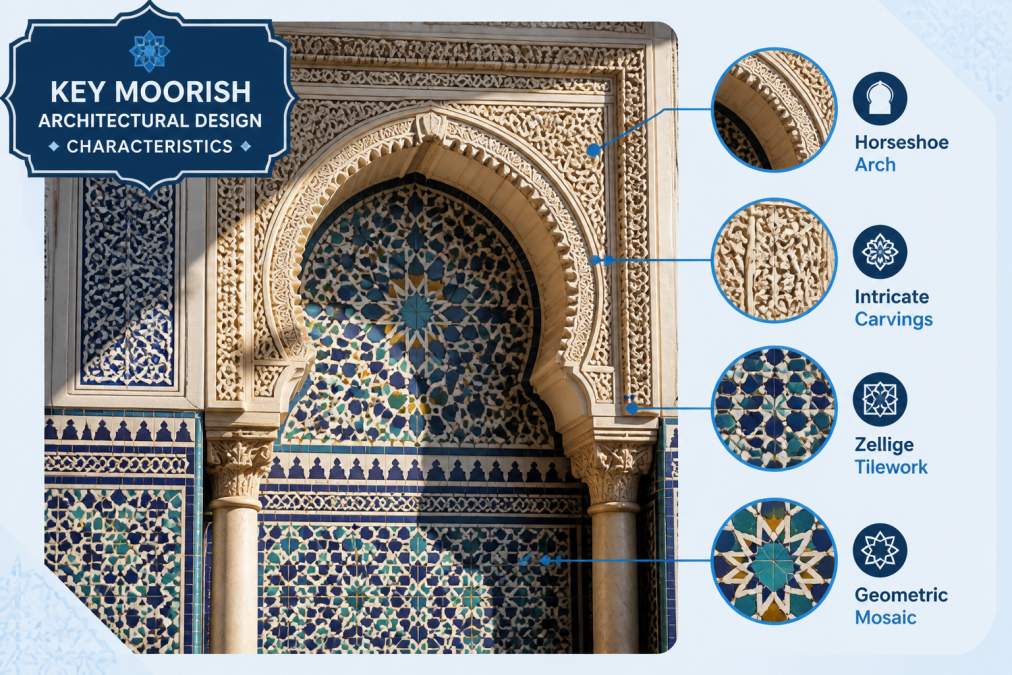
Horseshoe Arches and Decorative Elements
The horseshoe arch, wider at its widest point than at its base, stands as one of the most recognizable signatures of Moorish architectural design. Unlike Roman or Gothic arches, horseshoe arches create a distinctive visual profile that immediately signals Islamic influence. The arch's proportions and curvature create optical effects that make spaces feel simultaneously intimate and expansive.
Beyond their structural function, horseshoe arches serve as canvases for elaborate ornamentation. Stucco work, calligraphic inscriptions, and geometric patterns flow across arch surfaces, transforming them into focal points of visual drama. The interplay between the arch's structural geometry and its decorative surface creates a dialogue between form and ornament characteristic of Moorish design.
Decorative elements surrounding arches extend the visual experience. Spandrels, the spaces between arches, receive dense ornamentation featuring arabesques, geometric patterns, and carved details. These surfaces demonstrate the Moorish commitment to eliminating visual emptiness; every available surface becomes an opportunity for artistic expression. The cumulative effect creates environments where the eye never rests but continuously discovers new details.
Zellige Tilework and Mosaic Techniques
Zellige represents the pinnacle of Moorish tilework craftsmanship. Unlike mass-produced ceramic tiles, zellige involves hand-cutting individual pieces from glazed clay, then fitting them together in intricate geometric patterns. Each tile is unique, varying slightly in thickness and dimension, requiring extraordinary skill from artisans to create seamless compositions.
The zellige process begins with firing glazed clay in kilns, then hand-cutting pieces using traditional tools. Artisans work from patterns, but their hands guide each cut, meaning no two zellige installations are identical. This handcrafted quality gives authentic zellige an irreplaceable character that mass-produced alternatives cannot replicate.
Color in zellige tilework follows Islamic design traditions emphasizing jewel tones, deep blues, rich greens, warm terracottas, and brilliant turquoises. These colors weren't chosen arbitrarily; they reference natural pigments available in the Islamic world and carry symbolic associations. The interplay of colored tiles creates optical effects where patterns seem to shift and reconfigure as viewers move through spaces.
Jali Screens and Lattice Work
Jali screens, geometric lattice work carved from wood, stone, or plaster, serve both practical and symbolic functions in Moorish architectural design. These screens filter light, creating patterns of shadow and illumination that shift throughout the day. This dynamic quality transforms spaces, making them feel alive and responsive to natural cycles.
Jali screens also provide privacy while maintaining visual and spatial connection. In traditional Moorish homes, screens allowed inhabitants to observe activities in shared spaces while remaining unseen. This balance between transparency and concealment reflects Islamic principles regarding domestic privacy and social interaction.
The geometric patterns in jali work demonstrate extraordinary mathematical sophistication. Craftsmen carved intricate patterns from solid material, removing negative space to reveal the underlying geometry. The complexity of these patterns, often featuring dozens of interlocking geometric shapes, required precise planning and exceptional technical skill. Contemporary artisans still create jali screens using traditional hand-carving methods, with pieces taking weeks or months to complete.
Regional Variations: Al-Andalus vs. Maghreb Styles
While Moorish architectural design shares fundamental principles across regions, distinct regional variations emerged based on local materials, climate, and cultural influences. Understanding these variations helps contemporary designers appreciate the diversity within the Moorish tradition.
Al-Andalus style, developed in Islamic Spain and Portugal, incorporated European Gothic influences alongside Islamic principles. This cross-cultural synthesis produced distinctive characteristics: pointed arches sometimes appear alongside horseshoe arches, and Christian iconographic elements occasionally surface in secular contexts. The Alhambra in Granada represents the apex of Al-Andalus Moorish architectural design, demonstrating how regional variation created unique aesthetic expressions.
Maghreb style, dominant in North African regions, maintained closer adherence to Islamic design principles with less European influence. Moroccan Moorish architectural design emphasizes geometric patterns, zellige tilework, and carved stucco with particular intensity. The climate of the Maghreb, hotter and drier than Al-Andalus, influenced design choices; courtyards became more central to domestic life, and water features gained heightened importance.
Contemporary Moorish architectural design often draws inspiration from both traditions. Designers might combine the geometric rigor of Maghreb style with the arched sophistication of Al-Andalus, creating hybrid approaches that honor both regional traditions while serving modern functional requirements.
Handcrafted vs. Mass-Produced: Construction Methods Compared
The distinction between handcrafted and mass-produced Moorish pieces fundamentally affects authenticity, durability, longevity, and visual impact. Understanding these differences helps clients make informed decisions about their investment in Moorish design.
Traditional Artisanal Fabrication
Handcrafted Moorish architectural design relies on techniques refined over centuries. Master artisans spend years, often decades, developing the skills required to produce authentic pieces. This apprenticeship model ensures knowledge transmission and maintains traditional methods that industrial production cannot replicate.
Zellige tilework exemplifies artisanal methodology. Craftspeople hand-cut each tile, hand-paint glazes, and hand-fit pieces into compositions. This labor-intensive process means each installation is unique. The slight variations in tile thickness, color saturation, and pattern execution that result from handwork create visual richness that perfectly uniform mass-produced tiles cannot achieve.
Wood carving for doors, screens, and ceiling panels follows similar artisanal principles. Master carvers work from traditional patterns but adapt them based on wood grain, material characteristics, and their own artistic vision. A handcrafted Moorish door requires weeks of work, with artisans making thousands of individual cuts to reveal intricate geometric patterns.
The investment in handcrafted pieces reflects genuine material and labor costs. A master artisan's time commands premium compensation because their skills took decades to develop. Justmorocco's Marrakech palace door, for example, represents the work of a master artisan in traditional cedar carving, commanding $15,200 because it embodies extraordinary craftsmanship and authentic materials.
Modern Manufacturing Alternatives
Mass-produced Moorish-inspired pieces use industrial processes to create products at lower costs. Digital cutting equipment, standardized molds, and assembly-line manufacturing replace handwork. These processes produce consistent results, every piece matches specifications exactly, but sacrifice the uniqueness of handcrafted work.
Industrial zellige production involves machine-cutting tiles to precise dimensions, then applying consistent glazes. While visually similar to traditional zellige, mass-produced tiles lack the subtle variations that characterize authentic work. The uniformity, while efficient, creates a flatter visual experience.
Cost savings from industrial production are substantial. Mass-produced Moorish-inspired tiles, doors, and screens typically cost 40-60% less than handcrafted equivalents. For budget-conscious projects, these alternatives provide aesthetic appeal without the premium investment. However, industrial pieces often show wear more quickly, as consistent material thickness and standardized construction methods don't account for the durability advantages of traditional techniques.
The choice between handcrafted and mass-produced reflects different priorities. Handcrafted pieces offer authenticity, uniqueness, and longevity but require significant investment. Mass-produced alternatives provide accessibility and consistency at lower cost. Neither approach is inherently superior; the right choice depends on project goals, budget, timeline, and the client's commitment to authentic Moorish aesthetic principles.
Modern Moroccan Interior Design: Blending Heritage with Contemporary Spaces
Contemporary interior designers increasingly recognize Moorish architectural design as a sophisticated approach to creating distinctive, memorable spaces. The challenge lies in integrating traditional elements into modern functional contexts without creating pastiche or historical recreation.
Successful modern Moroccan interior design treats Moorish elements as design vocabulary rather than historical reenactment. A contemporary living room might feature a handcrafted Moroccan sofa, such as Justmorocco's Medina sofa with its andalusian wooden moorish carving, positioned alongside minimalist modern furniture. This juxtaposition creates visual interest and cultural richness without sacrificing contemporary functionality.
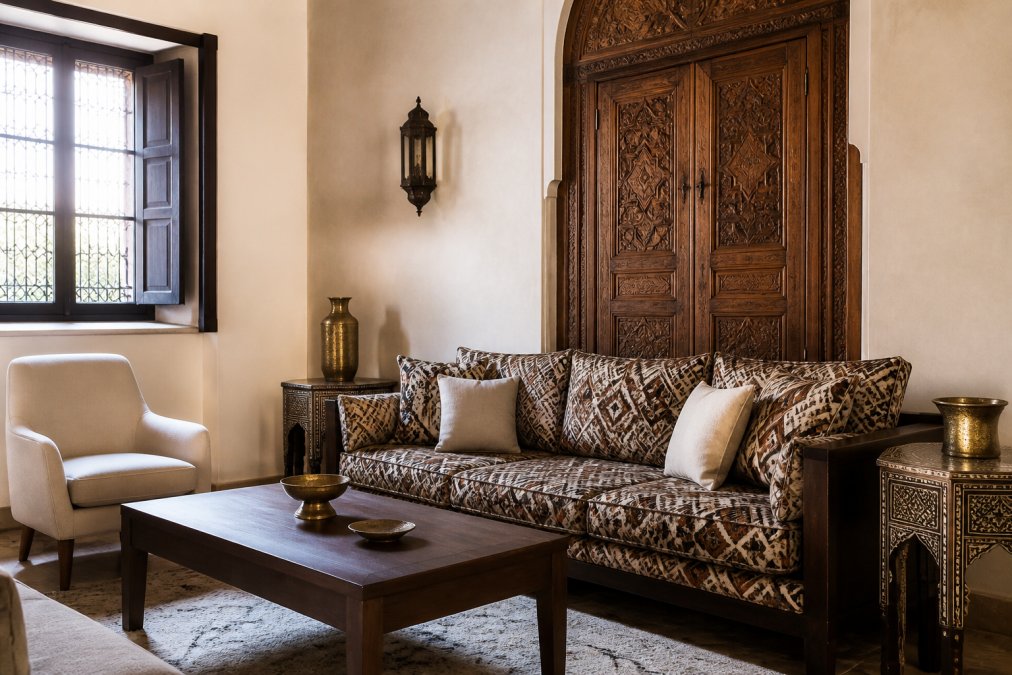
Lighting design becomes critical in modern Moorish interiors. Traditional luxury lighting, often featuring brass or copper with geometric perforations, creates the characteristic shadow patterns associated with Moorish spaces. Contemporary designers use these lighting pieces as sculptural elements, positioning them to create visual drama while providing functional illumination.
Color palettes in modern Moroccan interior design often shift from traditional jewel tones toward more restrained compositions. Deep blues and teals might appear as accent colors rather than dominant hues, paired with neutral walls and natural wood tones. This approach maintains Moorish visual richness while creating spaces that feel contemporary rather than historicized.
Material authenticity matters in modern contexts. Genuine zellige tilework, handcrafted wooden screens, and carved stucco elements carry weight and presence that mass-produced alternatives lack. Even when used sparingly, perhaps a zellige accent wall or a single jali screen, authentic pieces anchor the design with cultural credibility and visual sophistication.
Hiring a Moorish Architectural Designer: What to Expect
For significant projects, kitchen remodels, bathroom renovations, or comprehensive interior redesigns, engaging a designer experienced in Moorish architectural design ensures authentic results aligned with both aesthetic and functional objectives.
Design Process and Timeline
Professional Moorish architectural design begins with comprehensive consultation. Designers assess your space, understand your functional requirements, and discuss your aesthetic preferences. This initial phase typically requires 2-4 weeks and involves site visits, measurements, and preliminary concept development.
Concept development follows, where designers present visual references, material samples, and preliminary layouts. This phase allows clients to refine direction before committing to detailed specifications. Expect 3-6 weeks for concept refinement, with multiple rounds of revision ensuring alignment between designer vision and client expectations.
Detailed design and specification development constitutes the longest phase. For custom projects involving handcrafted elements, designers must coordinate with artisans, specify materials and dimensions, and develop construction documents. This phase typically requires 6-12 weeks, depending on project complexity. Custom kitchen and bathroom remodeling projects from Justmorocco involve this comprehensive specification process, ensuring every element, from zellige tilework to custom cabinetry, aligns with the overall design vision.
Customization and Budget Considerations
Moorish architectural design customization ranges from selecting pre-existing handcrafted pieces to commissioning entirely custom fabrication. Pre-existing inventory offers faster timelines and known costs; Justmorocco maintains a curated collection including sofas such as the Baraka sofa ($2,500) and the Meridien sofa ($2,500) that provide immediate availability.
Custom fabrication allows unlimited aesthetic possibilities but requires extended timelines and premium investment. A custom Moorish door, for instance, might take 8-12 weeks to complete, with costs reflecting master artisan labor and material quality. The Moorish large painted door from Justmorocco exemplifies custom work, handpainted in traditional style with authentic materials and functional hardware.
Budget planning for Moorish architectural design projects should account for several cost categories: design services, materials, fabrication labor, installation, and contingency reserves. For comprehensive projects, material and labor costs typically dominate. A high-end kitchen remodel incorporating custom zellige tilework, handcrafted cabinetry, and custom lighting might range from $75,000 to $250,000+, depending on scope and customization level.
Experienced designers help clients prioritize investments. Rather than spreading budget thinly across many elements, strategic concentration on key focal points, perhaps a dramatic zellige feature wall or custom entry door, creates maximum visual impact while managing costs effectively.
Maintenance and Preservation of Moorish Elements
Authentic Moorish architectural design elements require thoughtful maintenance to preserve their beauty and functionality across decades. Understanding proper care prevents deterioration and extends the lifespan of handcrafted pieces.
Zellige tilework demands minimal maintenance if properly installed. Regular dusting removes surface debris; mild soap and water clean soiled surfaces. Avoid acidic cleaners that can damage glazes. Grout between tiles may require periodic resealing to prevent moisture infiltration, particularly in wet environments like bathrooms and kitchens.
Handcrafted wooden elements, doors, screens, ceiling panels, require climate control and periodic conditioning. Wood responds to humidity fluctuations; maintaining consistent indoor humidity (ideally 45-55%) prevents cracking and warping. Annual application of quality wood conditioner protects finishes and maintains visual richness.
Mother-of-pearl inlays and bone inlay work require gentle care. Avoid excessive moisture exposure, which can cause separation between materials. Dust with soft cloths; use minimal water during cleaning. Professional restoration by craftspeople experienced in traditional techniques may be necessary if damage occurs.
Carved stucco elements benefit from dust removal and occasional gentle cleaning with soft brushes. Avoid harsh chemicals that can damage finishes or underlying materials. Cracks in stucco should be addressed promptly to prevent water infiltration and further deterioration.
Climate considerations become critical in certain regions. High humidity environments, particularly coastal areas with salt air, accelerate deterioration of wood and organic materials. Proper ventilation, dehumidification, and protective finishes help preserve pieces in challenging climates. Justmorocco's experience serving clients across coastal regions including Florida demonstrates that authentic Moorish pieces can thrive with appropriate maintenance protocols adapted to local environmental conditions.
Cost-Benefit Analysis: Custom Moorish Pieces vs. Mass-Market Alternatives
The decision between investing in custom handcrafted Moorish pieces versus mass-produced alternatives ultimately rests on long-term value assessment, aesthetic priorities, and functional requirements.
Long-Term Value and Durability
Handcrafted Moorish pieces typically outlast mass-produced alternatives by decades. Traditional construction methods, hand-cut zellige tiles fitted without adhesive using lime mortar, wood carving from solid timber, hand-forged hardware, create durability through material quality and construction integrity. A properly maintained handcrafted zellige installation can remain visually and functionally intact for 50+ years.
Mass-produced Moorish-inspired pieces, while initially cheaper, often show deterioration within 10-15 years. Machine-cut tiles may crack more easily; standardized adhesives can fail; industrial finishes deteriorate under UV exposure. The lower upfront cost disappears when replacement becomes necessary.
From a cost-per-year perspective, handcrafted pieces often prove economical. A $15,000 custom door lasting 60 years costs approximately $250 annually; a $6,000 mass-produced alternative lasting 12 years costs $500 annually. This analysis becomes more favorable as project longevity extends.
Authenticity and Craftsmanship Premium
The premium for handcrafted Moorish architectural design reflects genuine value beyond aesthetics. Master artisan time, material quality, and cultural authenticity command higher prices because they're irreplaceable. A handcrafted piece carries the maker's skill, knowledge, and artistic vision, elements that cannot be industrially replicated.
Authenticity matters particularly for designers and architects seeking to honor Moorish cultural heritage. Mass-produced approximations, while visually similar at first glance, lack the depth and integrity of authentic work. Discerning clients and design professionals recognize these differences and value the authenticity that justifies premium pricing.
The resale value of handcrafted Moorish pieces often exceeds initial investment for high-quality items. Collectors and design enthusiasts actively seek authentic pieces, recognizing their cultural significance and artistic merit. Mass-produced items, by contrast, depreciate like most manufactured goods.
| Comparison Dimension | Handcrafted Moorish Pieces | Mass-Produced Alternatives |
|---|---|---|
| Initial Cost | $2,500-$25,000+ per piece | $800-$5,000 per piece |
| Expected Lifespan | 40-60+ years | 10-15 years |
| Cost Per Year | $40-$250 | $50-$500 |
| Visual Uniqueness | Completely unique | Identical reproductions |
| Authenticity | Genuine cultural expression | Aesthetic approximation |
| Maintenance Requirements | Moderate, specialized knowledge | Minimal, standard methods |
| Resale Value | Often appreciates | Depreciates significantly |
| Repair/Restoration | Possible through skilled artisans | Limited options, often replacement |
Why Moorish Design Stands Apart in Modern Interiors
In an era of mass-produced standardization, Moorish architectural design offers something increasingly rare: spaces that feel genuinely distinctive, culturally rich, and individually expressive. This distinction stems from fundamental characteristics that differentiate Moorish design from contemporary alternatives.
The geometric sophistication of Moorish architectural design engages the mind as well as the eye. Viewers find themselves drawn into patterns, discovering new relationships and symmetries with sustained observation. This intellectual engagement creates a quality of presence that superficial decoration cannot match.
The handcrafted nature of authentic Moorish pieces carries inherent meaning. Each mark, variation, and imperfection represents human skill and intentional choice. This tangible connection to maker and tradition resonates with contemporary desires for authenticity in an increasingly digital world.
The cultural heritage embedded in Moorish design provides narrative richness. A zellige-tiled bathroom or carved wooden door carries centuries of artistic tradition, connecting inhabitants to a vast cultural legacy. This historical resonance creates spaces that feel grounded and meaningful rather than merely fashionable.
For designers and architects, Moorish architectural design offers sophisticated solutions to contemporary challenges. The emphasis on spatial sequence, sensory richness, and visual complexity creates environments that engage inhabitants fully. These aren't neutral backdrops but active participants in daily experience.
Moorish architectural design transforms spaces through principles refined across fourteen centuries, principles that remain remarkably relevant to contemporary design challenges. Whether through a handcrafted Marrakech palace door commanding attention in an entryway or zellige tilework creating visual drama in a kitchen, authentic Moorish elements elevate interiors with unmatched sophistication.
Justmorocco specializes in bringing this design tradition to life through custom kitchen and bathroom remodeling projects, handcrafted furniture pieces, and architectural elements that honor cultural authenticity while serving modern functional requirements. Our collection of handmade sofas, custom doors, and artisanal pieces, from the Medina sofa's andalusian carving to the Marrakech palace door's master craftsmanship, demonstrates how genuine Moorish design creates spaces of lasting beauty and cultural significance. Learn more about authentic Moroccan craftsmanship and design principles to discover how these timeless elements can transform your home into a luxurious sanctuary that reflects both sophisticated taste and genuine cultural appreciation.
Frequently Asked Questions
What are the key characteristics of Moorish architectural design?
Moorish architectural design centers on geometric patterns, horseshoe arches, intricate tilework (zellige), lattice screens (Jali), and elaborate stucco ornamentation. Symmetry and mathematical precision define the spatial planning, while arabesque motifs and hand-carved details showcase artisanal craftsmanship. Islamic artistic principles influence every decorative element, creating visually complex yet harmonious spaces that blend function with ornamental beauty.
How does hiring a Moorish architectural designer differ from standard interior design services?
Hiring a Moorish architectural designer requires expertise in Islamic geometric principles, traditional material sourcing, and regional stylistic variations between Al-Andalus and Maghreb traditions. These specialists understand custom fabrication timelines, authentic artisan networks, and how to integrate handcrafted elements like mother-of-pearl inlays and zellige tilework into modern layouts. They typically work directly with your architect and builder to ensure pieces fit exact dimensions and climate conditions.
Is modern Moroccan interior design just traditional style, or does it incorporate contemporary elements?
Modern Moroccan interior design blends traditional Moorish aesthetics with contemporary functionality and minimalist spatial planning. It preserves handcrafted details like geometric patterns and carved wooden doors while using modern materials, lighting, and furniture proportions suited to current living spaces. This hybrid approach allows homeowners to honor cultural heritage without creating a museum-like environment, making Moorish elements work in 21st-century homes.
Why is handcrafted Moorish design more expensive than mass-produced alternatives?
Handcrafted Moorish pieces require master artisans to hand-carve, hand-paint, and assemble each element using traditional techniques passed down through generations. Materials like dry cedar, mother-of-pearl inlays, and authentic zellige tiles are sourced directly from artisan communities. Custom sizing, shipping protection, and the time investment in creating intricate motifs and symmetrical patterns justify the premium. Mass-produced alternatives use machine cutting and synthetic materials, eliminating the labor-intensive artisanal process.
Will Moorish architectural elements hold up in humid climates?
Authentic handcrafted Moorish pieces made from quality materials like dry cedar and properly sealed tilework are designed to withstand various climates when maintained correctly. However, high humidity and salt air exposure require regular maintenance: sealing wood finishes annually, protecting mother-of-pearl inlays from moisture, and ensuring proper ventilation around zellige tilework. Working with a designer familiar with your specific climate conditions ensures pieces are treated and installed appropriately for long-term durability.
This article was written using GrandRanker