
Quick Summary
To import handmade Moroccan goods legally into the US, first identify your product category and its HTS code, then gather a commercial invoice, packing list and proof of origin. Check whether cultural-property restrictions apply, especially for older or antique items, before you buy.
- Name your product clearly by material, construction and use before contacting suppliers.
- Gather commercial invoice, packing list, proof of origin, bill of lading and customs entry documents.
- Request provenance records for any older or antique piece to rule out cultural-property restrictions.
- Build a landed-cost worksheet including freight, insurance, duty, MPF, HMF and brokerage fees.
- Confirm duty rates and fees with a customs broker or CBP, since they change.
Table of Contents
- Start With Your Product: What Category Are You Importing?
- Documents Needed to Import Handicrafts into the US
- Restricted Cultural Property: Archaeological and Antique Items
- U.S. Customs Duties on Moroccan Goods
- Import Fees From Morocco to the USA: Calculating Your Landed Cost
- How to Verify Authentic Moroccan Handmade Goods Before You Ship
- Clearing Customs and Working With a Customs Broker
- Your Next Step: Confirm Requirements Before You Place the Order
- Frequently Asked Questions
Start With Your Product: What Category Are You Importing?
Last Updated: November 2, 2026
Importing handmade Moroccan goods into the United States starts with one question: what exactly are you bringing in? A hand-woven rug, a carved wooden table, a mosaic tile fountain and a ceramic bowl each follow different rules, and the category you choose decides which duties apply, which documents you need and whether any restrictions reach your shipment when you import handmade Moroccan goods.
Most importers skip this step and regret it later. Take five minutes to name your product clearly before you contact a supplier or book freight.
Common Moroccan handmade categories to identify:
- Furniture, such as carved wood tables, chests and beds
- Home decor, such as lanterns, mirrors and wall pieces
- Textiles, such as rugs, pillows and woven throws
- Ceramics and tilework, such as bowls, tiles and mosaic panels
- Metalwork, such as brass trays, lamps and inlaid boxes
- Antiques and older objects, which need extra review
Each category carries its own tariff line. Describe the item by material, construction and use. "Hand-carved cedar side table" tells customs far more than "Moroccan decor."
Checking HS Codes and Tariff Classification
The Harmonized Tariff Schedule (HTS) assigns every imported good a code that determines its duty rate. Customs uses the HTS to classify your item, so a vague description can lead to a wrong code and a costly delay.
Start by searching the HTS online for your product's material and function. Compare the codes you find against your product description. Keep notes on why you chose each code.
Watch out: an item's classification can change with its materials. A wood-framed piece with fabric upholstery may fall under a different heading than solid wood. Confirm the details before you commit.
If the classification is unclear, a customs broker or a binding ruling from U.S. Customs and Border Protection can settle it. Ask before the shipment arrives, not after.
Documents Needed to Import Handicrafts into the US
Customs needs paperwork that matches your shipment exactly. Missing or mismatched documents are one of the most common reasons goods are held at the border.
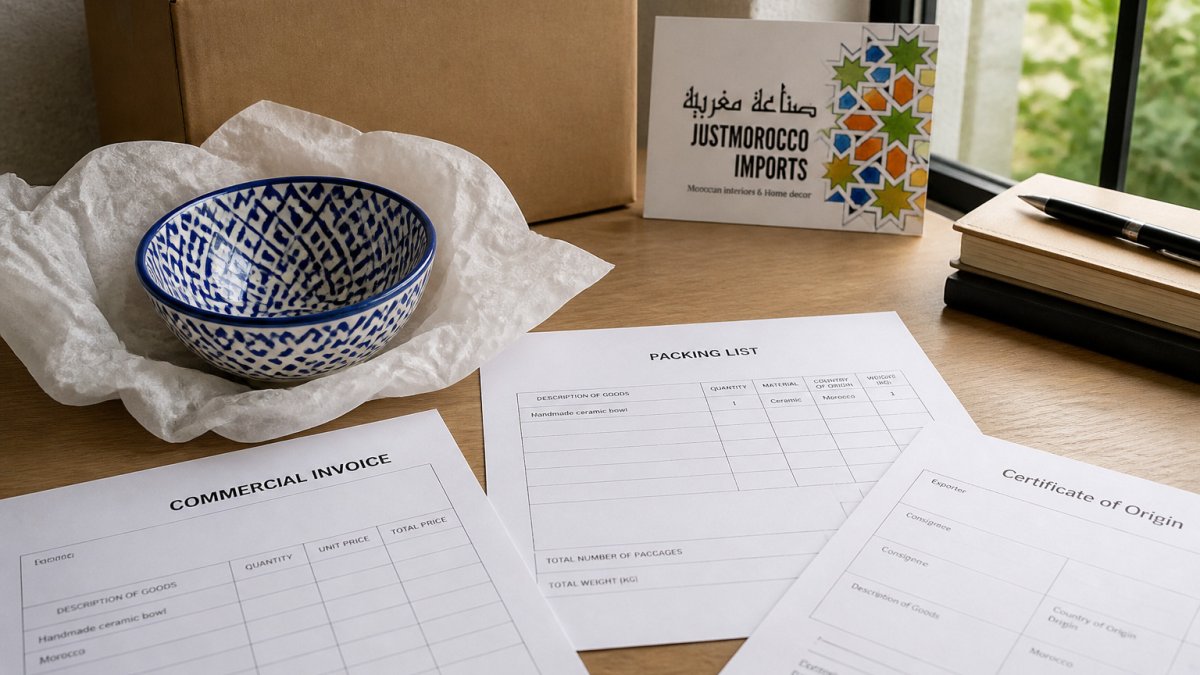
Gather these documents for every shipment:
- Commercial invoice showing price, quantity and description
- Packing list showing package count, weights and dimensions
- Proof of origin showing the goods were made in Morocco
- Bill of lading or air waybill from your carrier
- Customs entry documents filed through a broker or your own account
Each document should tell the same story. If the invoice says "decorative bowls" and the packing list says "ceramic items," expect questions.
Commercial Invoice, Packing List and Proof of Origin
The commercial invoice is the core document. It should list the seller and buyer, the product description, the quantity, the unit price and the currency. Use U.S. dollars where possible, and state the terms of sale.
The packing list breaks down the shipment by carton. Include the weight and dimensions of each box so the carrier and customs can match what arrived with what was declared.
Proof of origin confirms that the goods were made in Morocco. Many suppliers provide a certificate of origin issued by a Moroccan chamber of commerce or a similar body. Request it before shipping. Without it, you may pay a higher duty rate or face delays while customs verifies the origin.
Keep copies of all documents for at least five years. Good records protect you if customs asks questions after the goods clear.
The core paperwork for every shipment comes down to five documents that must describe the same goods consistently.
| Document | What it shows | Key check |
|---|---|---|
| Commercial invoice | Price, quantity, description, currency | Use U.S. dollars where possible |
| Packing list | Package count, weights, dimensions | Matches each carton that arrived |
| Proof of origin | Goods were made in Morocco | Request before shipping |
| Bill of lading or air waybill | Carrier documentation | Issued by your carrier |
| Customs entry documents | Filed entry for the shipment | Filed via broker or your account |
Restricted Cultural Property: Archaeological and Antique Items
This is the section where a routine decor import can become a legal problem. The United States restricts import of certain archaeological and ethnological material from countries with which it has entered a bilateral agreement or taken emergency action under the Cultural Property Implementation Act (CPIA), the U.S. law that implements the 1970 UNESCO Convention. Morocco is among the countries covered by such restrictions, and the covered categories are defined in the Federal Register notice and the CBP document that accompanies the agreement (Federal Register notice on import restrictions for Moroccan archaeological and ethnological material).
What the restriction actually does. It is not a ban on all Moroccan goods. It restricts import of material that falls within the defined categories and predates a stated cutoff, unless the importer can document that the material left Morocco legally, typically through an export certificate issued by the Moroccan government, or through evidence that the object was outside Morocco before the restriction took effect. The burden of proof sits with the importer, and CBP can detain or seize material that arrives without it.
Categories that commonly matter for handmade goods. The covered list is specific, and the practical risk areas for this trade generally include:
- Archaeological material such as ancient pottery, tile fragments and architectural elements.
- Ethnological material such as traditional textiles, rugs, jewelry, metalwork and wooden objects above a stated age threshold.
- Architectural and decorative elements removed from historic structures.
A newly made rug, a contemporary brass tray or a recently carved table generally falls outside the restriction. The line is drawn by the object's age and category, not by how it looks. A piece marketed as "vintage," "antique" or "old" is exactly where the question arises, and a seller's casual description is not documentation.
The documentation to request before you buy:
- A written statement from the supplier describing the item's age, materials and origin, and how the supplier acquired it.
- Any Moroccan export certificate or permit that accompanied the item when it left the country.
- Provenance records, prior sales receipts, auction records, gallery invoices or exhibition history, showing the object was outside Morocco before the restriction date.
- Photographs of the object and any maker's or workshop marks.
Keep these with your entry records. If CBP detains a shipment, the importer who can produce a clean provenance file resolves the hold far faster than one who cannot.
How to handle an uncertain piece. If you cannot establish the age or provenance of an older object, do not import it on the assumption that it will pass. Ask a customs broker experienced in cultural property, or request a binding ruling from CBP before shipping. The cost of a ruling is trivial next to a seizure.
Watch out: a supplier who cannot or will not document an older piece's history is a signal to walk away, because the legal exposure lands on the importer of record, not the seller.
Newly made goods in traditional styles. The safest path for a handmade-goods business is to source contemporary production and document it as such. Ask the supplier for a dated statement that the piece was made to order, keep the order and payment records, and describe the item accurately on the commercial invoice. Accurate description is your first line of defense if a shipment is ever questioned.
U.S. Customs Duties on Moroccan Goods
Duty is the tax customs charges on imported goods, calculated from the HTS code, the declared value and the country of origin. If you import handmade Moroccan goods, the origin you document matters, because Moroccan goods may qualify for preferential treatment under trade agreements.
Duty rates change. Trade policy can shift quickly, so check the current rate for your specific HTS code before you price your shipment. Check with a customs broker or U.S. Customs and Border Protection for any additional duties currently in effect on Moroccan goods before you rely on a rate.
Plan for duty as a real cost. Build it into your pricing from the start, rather than treating it as a surprise at the port.
Import Fees From Morocco to the USA: Calculating Your Landed Cost
Landed cost is the total you pay to get goods from your supplier's workshop to your warehouse door. It is the number you must use for pricing, not the supplier's unit price. Most new importers price off the product cost alone and discover their margin disappeared once freight, duty and brokerage were added. The fix is to build a landed-cost worksheet before you place the order, then update it with actual invoices after the shipment clears.
The cost stack, in the order it accrues:
- Product cost. The FOB (free on board) price your supplier quotes, meaning the goods are loaded on the carrier at the Moroccan port or airport and everything after that is your cost.
- International freight. Ocean LCL or FCL, or air. This is the line item that varies most by volume, route and season.
- Cargo insurance. Typically a small percentage of the insured value; ask your freight forwarder whether the quote already includes it.
- Duty. Calculated on the customs value at the HTS rate for your product and origin.
- Merchandise Processing Fee (MPF). A CBP fee assessed on most formal entries, subject to statutory minimum and maximum amounts that CBP adjusts periodically, confirm the current figures on the CBP website before you finalize your worksheet.
- Harbor Maintenance Fee (HMF). Assessed on ocean cargo; confirm the current rate and applicability with your broker.
- Customs brokerage and entry fees. Your broker's fee plus any disbursements.
- Inland transport. Port or airport to your warehouse, including any drayage at the port.
- Contingency. A reserve for inspections, demurrage or storage if a shipment is held.
How customs value is built. CBP generally assesses duty on the transaction value, the price actually paid or payable for the goods, adjusted for certain additions such as the cost of packing and any selling commission. International freight and insurance are generally not part of the dutiable value for U.S. entries, but the rules on what is and is not included are technical. Ask your broker to confirm the value declaration on your first few entries rather than assuming.
A worked example. Suppose you buy 40 hand-carved cedar side tables at a FOB price per unit that your supplier quotes. Add the freight, insurance, duty, fees and inland delivery quoted for your shipment. The total is your landed cost, and that is the number your wholesale and retail pricing must clear. Run the arithmetic with your own quotes from suppliers and forwarders.
Where the estimate usually goes wrong. Freight quotes are the biggest source of error. Ask every carrier whether the quote covers pickup in Morocco and delivery in the United States, or only one leg. A quote that looks cheap often excludes the origin haul, the destination drayage or the documentation fee. Request at least two quotes and compare them line by line, not on the headline number.
Watch out: a landed-cost worksheet built on an unconfirmed duty rate or an incomplete freight quote can understate your true cost by a wide margin, so treat every figure as provisional until you have the broker's entry summary in hand.
After the shipment clears. Reconcile the worksheet against the actual commercial invoice, freight invoice, broker invoice and CBP entry summary. The gap between estimate and actual tells you which line item to sharpen next time. Keep the reconciled worksheet with your entry records, it is also the basis for the cost figures you will need at tax time.
How to Verify Authentic Moroccan Handmade Goods Before You Ship
Verification protects your business and your customers. Buyers increasingly want proof that a piece is genuinely handmade and fairly produced, and a bad supplier can damage your reputation fast.
Use these checks before you place an order:
- Ask the supplier how each item is made and by whom
- Request photos of the workshop and the artisans at work
- Look for tool marks, hand-finished joints and natural variation in the work
- Ask about the artisan's compensation and working conditions
- Request references from other buyers who have imported from that supplier
Ask for a small sample order before a large purchase. Inspect the sample for workmanship, finish and accuracy against your description.
Authentic handmade goods usually show irregularity. A mass-produced piece looks identical every time. If every item in a supplier's catalog matches perfectly, ask why.
Clearing Customs and Working With a Customs Broker
A customs broker is a licensed professional who files your entry with U.S. Customs and Border Protection on your behalf. For first-time importers, a broker is usually worth the fee. They catch classification errors and document gaps before they cause delays.
When you hire a broker, provide:
- The commercial invoice and packing list
- The proof of origin and any cultural-property documentation
- The HTS codes you have identified
- The carrier's bill of lading or air waybill
Ask the broker about bond requirements, which may be needed for your entry. Also ask how they handle inspections, because some shipments are selected for review.
Expect some shipments to be held for inspection. Keep your documents ready and respond quickly to any requests from customs. Quick responses shorten the hold.
Your Next Step: Confirm Requirements Before You Place the Order
Importing handmade Moroccan goods legally comes down to three things: classify your product correctly, keep accurate documents and check for restrictions before you buy. Each step is manageable when you handle it early.
Start by naming your product category and checking its HTS code. Then confirm whether any cultural-property restrictions apply, and request proof of origin from your supplier. For specific questions about your shipment, contact Justmorocco to ask about your product and planned order. Pricing depends on quantity, dates and delivery, so request a quote for current figures.
Frequently Asked Questions
Are there tariffs on goods imported from Morocco?
Yes. Goods entering the United States are subject to duties set by their Harmonized Tariff Schedule classification, and the rate depends on the product and its origin. Some Moroccan goods may qualify for preferential treatment under a trade agreement if they meet origin rules. Confirm the duties currently in effect with U.S. Customs and Border Protection or a licensed customs broker before you price your shipment.
What documents do I need to import Moroccan goods?
At minimum you need a commercial invoice showing the seller, buyer, description, quantity and value in U.S. dollars, a packing list, and proof of country of origin. Your customs broker or the importer of record will file the entry, . Keep these records for as long as customs requires after clearance.
Are there restrictions on importing Moroccan rugs, furniture, or home decor?
Most handmade furniture and home decor is not restricted, but certain Moroccan archaeological and ethnological material is. U.S. import restrictions cover specified categories of this material, and covered items require documentation certifying they left Morocco. Antique or older pieces with possible archaeological origin should be checked against the restricted categories published by U.S. Customs and Border Protection before you buy or import them.
How do I verify that handmade Moroccan goods are authentic and legally sourced?
Ask the supplier for artisan or workshop names, production location, materials and the export documentation for each item. Request photographs of the making process and a written description of any inlay or tile work. For antiques, ask for provenance records. Authenticity claims are not verifiable from the research alone, so treat them as supplier statements and confirm them through documents before you commit.
