
Table of Contents
- Understanding the Moroccan Tea Service as a Ritual of Hospitality
- Essential Components of a Traditional Moroccan Tea Set
- Choosing the Right Moroccan Tea Glasses and Teapot
- Setting Up Your Moroccan Tea Tray with Authenticity
- Preparing Moroccan Mint Tea for Your Ceremony
- Creating the Perfect Atmosphere with Decor and Seating
- The Art of Pouring Tea from a Height
- Display Layout Variations for Different Spaces
- Budget-Friendly Alternatives and Substitutions
- Conclusion
- Frequently Asked Questions
Last Updated: October 20, 2026
Understanding the Moroccan Tea Service as a Ritual of Hospitality
A Moroccan tea service display is far more than a beverage presentation. It's a cornerstone of hospitality that transforms a simple gathering into a meaningful cultural experience. At Justmorocco, we recognize that creating an authentic moroccan tea service display requires understanding the tradition's deeper significance. In Moroccan homes, offering tea signals respect, warmth, and connection.
Tea isn't rushed; it's savored. The ceremony, from preparation to pouring to serving, communicates care and intention.
Essential Components of a Traditional Moroccan Tea Set
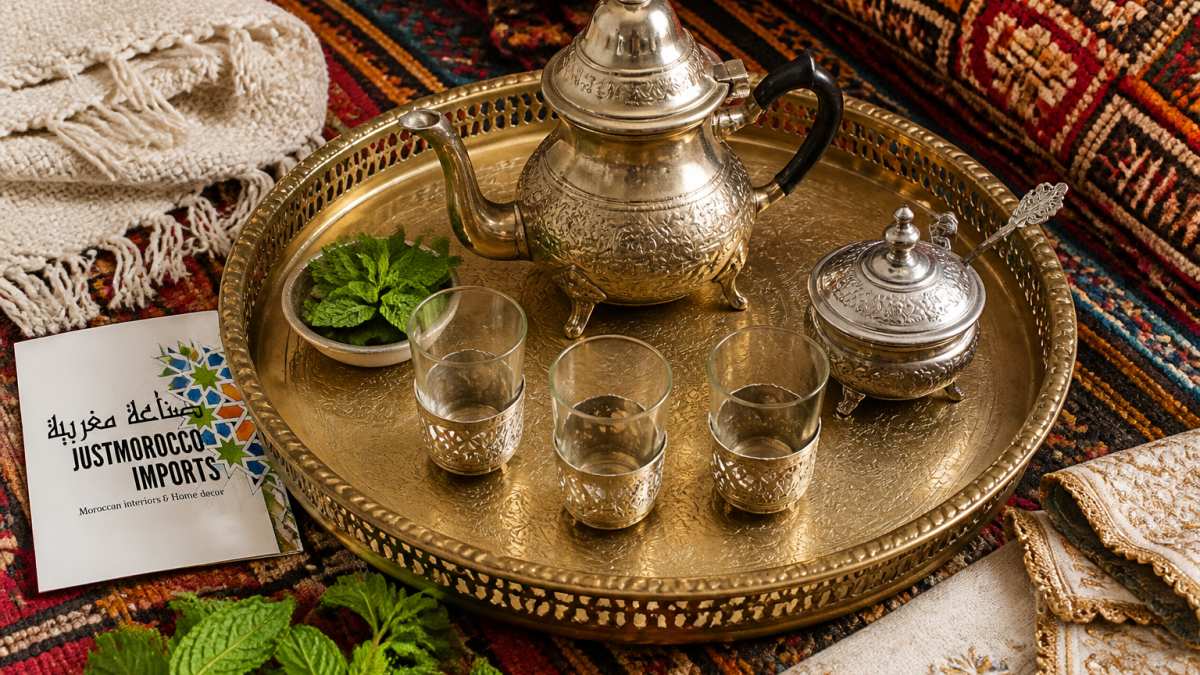
A traditional Moroccan tea set contains specific pieces that work together: a teapot, tea glasses, a serving tray, and the right ingredients.
The teapot is the centerpiece. Its wide body distributes heat evenly, and its long spout allows for the high pour.
Tea glasses are small and decorative, standing 3 inches tall, often with a silver or brass base. The small size encourages sipping and multiple rounds.
The serving tray is your display foundation. Look for decorative trays large enough to hold the teapot, glasses, and sugar, ideally with geometric or arabesque designs.
Beyond the core pieces, you'll want:
- Fresh mint (the signature herb)
- Green tea (typically gunpowder green tea)
- Sugar (lots of it, Moroccan tea is sweet)
- Small spoons
- A small bowl for sugar
- Cloth napkins or small towels
Justmorocco offers handcrafted teapots and tea glass sets that bring authentic Moroccan craftsmanship into your home. The Silver tea glasses set includes a hand-carved teapot and three silver-bottom glasses for $65.00. Each piece is handmade and unique, with the teapot measuring 7" x 8" and glasses measuring 3" H x 2.5" wide.
Authentic Moroccan teapots are hand-washed only. Never put them in the dishwasher. The handmade nature means each piece varies slightly, that's part of their charm and value.
Choosing the Right Moroccan Tea Glasses and Teapot
Authentic Moroccan tea glasses and teapots aren't mass-produced; they're handcrafted by skilled artisans, which affects both appearance and function.
For teapots, look for a comfortable handle, a spout long enough for pouring from height, and enough weight to signal durability.
Justmorocco carries two primary teapot options. The Moroccan teapot is an old-style Andalusian design, handmade by master craftspeople in Fez. It measures 10" x 10" and costs $75.00. The Hyatt teapot follows the same traditional style at $85.00. Both are semi-antique, hand-washed only, and built to last generations.
For tea glasses, choose ones with a silver or brass base, which protects your hands from heat and adds visual elegance. Clear glass shows the tea's color, and smaller glasses (around 3 inches tall) encourage the multi-round ceremony.
The Silver tea glasses set includes three handmade glasses with silver bases. Each glass is unique due to the handmade nature. This set pairs perfectly with either teapot option for a complete, coordinated display.
Setting Up Your Moroccan Tea Tray with Authenticity
The tray setup is where your moroccan tea service display comes to life. Here is a repeatable setup you can follow in about ten minutes.
Step 1: Choose and stabilize the surface.
Start with a tray that leaves a 1- to 2-inch border of empty metal around the grouped pieces. Set it on a non-slip mat or dampened cloth, since brass or copper on bare wood slides easily. Test stability by pressing one corner; if it rocks, place a thin cork pad under the low corner.
Step 2: Place the teapot first, slightly back and off-center.
Put the teapot down first, toward the back of the tray and offset from dead center. This keeps the spout from hovering over glasses and creates visual depth. Leave at least 3 inches of clear space in front of the spout, angled toward the open side of the tray, not a guest's seat.
Step 3: Set the sugar bowl opposite the spout.
Moroccan tea is traditionally very sweet, and sugar goes in the pot, not the cup. Place the sugar bowl opposite the spout so reaching for sugar never crosses the pour path. A small bowl with a spoon resting handle-out keeps the display tidy.
Step 4: Arrange glasses in a shallow arc, not a straight line.
Space glasses 1 to 1.5 inches apart in a gentle semicircle along the front edge of the tray. An arc lets each guest reach a glass without brushing a neighbor. Keep rims clear of the pour zone, and for more than six guests, stage a second tray.
Step 5: Add spoons, napkins, and mint last.
Small spoons go beside the sugar bowl, handles aligned. Folded cloth napkins sit at the tray's edge. Fresh mint sprigs go in a small glass or dish near the teapot, not loose where they can wilt against hot metal.
Step 6: Do a reach test before guests arrive.
Sit where a guest will sit and reach for a glass, the sugar bowl, and a napkin. If you have to lean across the teapot or stretch past a candle, rearrange. The display should be reachable from at least two sides for groups of four or more.
Safety and handling details most guides omit:
- Never fill the teapot more than two-thirds full before a high pour; a full pot is heavy and the stream is harder to control.
- Keep the tray at least 6 inches from table edges so a sleeve or elbow cannot catch it.
- Place candles and lanterns off the tray, never among the glasses.
- Warm glasses with a splash of hot water before pouring; sudden heat on cool glass is a common cause of cracking.
- Set hot teapots on a small trivet or folded cloth, not directly on a delicate tray finish.
Quick setup checklist:
- Non-slip base under tray
- Teapot back and off-center, spout clear
- Sugar bowl opposite spout, spoon handle-out
- Glasses in a shallow arc, 1 to 1.5 inches apart
- Spoons aligned, napkins folded, mint in a small dish
- Reach test from two seating positions
- Candles and lanterns off the tray
Preparing Moroccan Mint Tea for Your Ceremony
Moroccan mint tea follows a specific formula for its distinctive flavor.
Basic Moroccan mint tea formula:
- 1 teapot of green tea (gunpowder green tea is traditional)
- Handful of fresh mint leaves
- 3-4 tablespoons of sugar (adjust to taste)
- Hot water
Start by warming your teapot: pour in hot water, let it sit a moment, then empty it, so the tea steeps at the right temperature.
Add green tea to the warm teapot, about one teaspoon per cup of water, plus a generous handful of fresh, fragrant mint (not dried).
Pour hot water over the tea and mint and steep for 3-5 minutes. Moroccan tea is typically strong, so don't rush this step.
Add sugar directly to the teapot, not individual cups, and stir well to dissolve. Taste and adjust sweetness if needed.
Let the tea rest for another minute. This allows flavors to meld and any loose leaves to settle.
Serving sequence:
Pour the first glass as a test. If it's too strong, add hot water; if too weak, steep longer next time.
Pour glasses in sequence so each guest receives tea at the same temperature and strength, rather than filling one completely before moving to the next.
The first pot of tea is often poured back into the teapot to strengthen flavor. This "first pour" technique ensures consistency across all glasses.
Creating the Perfect Atmosphere with Decor and Seating
Decor and seating work together to create an authentic Moroccan atmosphere.
Color palette: Moroccan design embraces vibrant, warm tones. Incorporate them through textiles, cushions, and decorative pieces for visual warmth and energy.
Lighting: Warm, soft lighting is essential. Harsh overhead lights break the intimate mood. Use table lamps, candles, or string lights. Moroccan lanterns with colored glass cast beautiful, patterned shadows that add authenticity and romance.
Textiles: Layer rugs, cushions, and throws. Moroccan rugs typically feature geometric patterns or tribal designs in multiple colors; wool is traditional and durable. Layer a smaller decorative rug over a larger base rug for visual interest.
Seating arrangement: Low tables and floor seating are traditional. If you have a low coffee table, that's perfect. Arrange cushions and poufs around it. Guests sit on cushions rather than chairs. This creates an intimate, grounded feeling that encourages conversation.
Poufs are essential: low, cushioned, easy to move, and able to accommodate various group sizes.
Wall decor: Moroccan geometric patterns, arabesque designs, or traditional artwork on walls reinforce the aesthetic. Brass or copper wall hangings add metallic warmth.
The Art of Pouring Tea from a Height
The high pour is the signature technique of Moroccan tea service, both functional and theatrical: it aerates the tea, cools it slightly, and creates visual drama.
Why pour from height?
Pouring from 12-18 inches above the glass cools hot tea as it falls through the air. It also aerates the tea, enhancing flavor and creating a slight foam on top, a sign of proper technique.
How to pour properly:
Hold the teapot with a firm but relaxed grip: handle resting in your palm, fingers lightly supporting the spout.
Extend your arm so the spout is 12-18 inches above the glass. Start slow to establish the stream, then pour with confidence once it's steady.
Pour in a smooth, continuous motion. Don't jerk or hesitate. The stream should be consistent and controlled.
Fill the glass about three-quarters full. Stop before it overflows. This leaves room for the foam and prevents spills.
Common mistakes to avoid:
- Pouring too quickly (tea splashes)
- Holding the teapot too low (no cooling effect)
- Shaking or jerking the teapot (unsteady stream)
- Overfilling the glass (spillage and mess)
Practice with water first if you're nervous; after a few pours, you'll develop the muscle memory and confidence.
Display Layout Variations for Different Spaces
Not every home has a traditional low table and floor seating. Adapt the moroccan tea service display to your space while maintaining authenticity. The key is matching the layout to the height guests sit at, the number of people, and how the tea will be poured. Below are four reproducible plans with the dimensions and trade-offs that matter.
Plan A: Low table with floor seating (traditional).
A low table 12 to 18 inches high, with cushions and poufs arranged on three sides, is the classic setup. The tray sits at the table's center, and the host sits on the open fourth side so the pour faces the guests. Keep the tray within 18 inches of each guest's seated reach. This layout is the most intimate and the most authentic, but it is hard on guests with limited mobility, so offer at least one chair-height seat at the edge of the group.
Plan B: Coffee table with regular seating.
Use your existing coffee table, but raise the display's visual weight: place the tray on a stack of two large books or a low wooden riser so the teapot sits closer to seated eye level. Keep the tray at least 6 inches from the table edge. This layout suits four to six guests and is the easiest to host in a typical living room. The trade-off is that a high pour over a coffee table has less clearance, so pour from 10 to 12 inches rather than the full 12 to 18.
Plan C: Side table or console (buffet style).
For larger groups or formal settings, set the tray on a side table or console against a wall and let guests approach rather than sit around it. Stage clean glasses in two rows and keep a small stack of napkins at the end. This works well for eight or more guests because it removes the reach problem entirely. The trade-off is that the host pours standing, so keep the surface at counter height, about 36 inches, to avoid bending.
Plan D: Outdoor patio or picnic setup.
Outdoors, stability matters more than style. Use a sturdy table or a large tray set on a blanket over level ground. Avoid uneven grass under a brass tray; a slight slope is enough to send a teapot sliding. Weight the tray's corners with small stones or use a non-slip mat. Battery-powered lanterns are safer than open flames in a breeze. This layout suits large, relaxed gatherings but requires a second trip for refills, so keep a spare pot and water nearby.
Plan E: Dining table integration.
For a dinner party, place the display at one end of the dining table and pour from there. Guests stay seated, which keeps the ceremony contained. Keep the tray at least 12 inches from the nearest place setting so plates and glasses do not crowd the tea service.
| Layout | Best for | Key dimension | Main trade-off |
|---|---|---|---|
| Low table + floor seating | Intimate gatherings of 4-6 | Table 12-18 in. high | Less accessible for some guests |
| Coffee table + seating | Casual groups of 4-6 | Tray 6 in. from edge | Lower pour clearance |
| Side table / console | 8+ guests, formal | Surface about 36 in. high | Host pours standing |
| Outdoor patio | Large relaxed groups | Level, weighted surface | Refill trips |
| Dining table end | Dinner parties | 12 in. from place settings | Limited reach for far guests |
Sightline and accessibility checks:
- Sit at the lowest seat in the room and confirm you can see the teapot and reach a glass without standing.
- Keep the pour path clear of candles, phones, and centerpieces.
- For mixed-age groups, set a small tray at chair height as a secondary station so older guests are not reaching to the floor.
- In every layout, leave one open side of the tray for the host's pouring arm.
Budget-Friendly Alternatives and Substitutions
Authentic Moroccan pieces are investments. If budget is a concern, alternatives exist that maintain the spirit of the tradition without breaking the bank.
Teapot alternatives:
If you can't invest in a traditional Moroccan teapot, look for any teapot with a long spout. The shape matters more than the exact origin. Even a simple stainless steel teapot with a decorative covering (wrapped in copper wire or fabric) can work in a pinch.
Tea glass substitutions:
Traditional Moroccan tea glasses are special, but any small, heat-safe glasses work. Clear glasses with a decorative holder or coaster substitute for silver-based glasses. You can even use small ceramic or porcelain cups if that's what you have.
Tray alternatives:
A wooden cutting board, a decorative platter, or even a woven basket can serve as a tray. The key is having a defined surface that groups the pieces together.
Textiles on a budget:
Thrift stores and online marketplaces offer affordable Moroccan-inspired rugs, cushions, and throws. You don't need expensive pieces, layered, colorful textiles create the atmosphere regardless of price point.
DIY decor:
Candles in glass holders, string lights, and printed Moroccan patterns on cardstock create ambiance cheaply. These investments cost little but transform the space.
What not to compromise on:
Quality tea matters. Invest in good gunpowder green tea and fresh mint. These are inexpensive but make a huge difference in taste. Fresh mint especially, dried mint tastes stale and disappointing.
Conclusion
Creating an authentic moroccan tea service display transforms hospitality into ritual. You're not just serving tea, you're inviting guests into a tradition that spans centuries. The display itself, from the teapot to the glasses to the arrangement, communicates care and intentionality.
Start with quality pieces if you can. Justmorocco's custom furniture imports and handcrafted teapots and tea glass sets bring genuine Moroccan artistry into your home. The Moroccan teapot ($75.00) and Silver tea glasses set ($65.00) are built to last and improve with use. These pieces become family heirlooms.
But remember: the ritual itself matters more than perfection. Your effort, your warmth, and your intention to create connection are what guests will remember. Whether you're pouring from an antique Moroccan teapot or a simple brass vessel, the act of slowing down, gathering together, and sharing tea creates meaning.
Frequently Asked Questions
What items are needed for a traditional Moroccan tea service?
A traditional Moroccan tea service includes a teapot, small glasses, a decorative serving tray, fresh mint, green tea, sugar, and a low table or coffee table. This setup creates the foundation for an authentic hospitality ritual that welcomes guests.
How do you arrange a Moroccan tea tray setup properly?
Start by placing the teapot in the center of your decorative tray. Position the small glasses in a circle around the teapot, leaving space for a small dish of sugar and fresh mint sprigs. Ensure the glasses are easily accessible without reaching across the tray. Leave room for additional items like dates or small pastries if serving them. The arrangement should feel balanced and inviting, with the teapot as the focal point. This Moroccan tea tray setup emphasizes functionality while maintaining visual appeal and honoring the ceremonial nature of the service.
What makes Moroccan mint tea ceremony different from other tea traditions?
The Moroccan mint tea ceremony is a formal ritual centered on hospitality and connection. Unlike casual tea drinking, this ceremony involves precise preparation, high pouring from a height to aerate the tea, and specific serving etiquette. The tea is traditionally served three times, with each round representing different meanings: the first glass is gentle like life, the second is strong like love, and the third is bitter like death. Guests are expected to accept at least one glass as a sign of respect. This Moroccan mint tea ceremony transforms tea service into a meaningful cultural exchange between host and guest.
Can you create an authentic Moroccan tea display in a small space?
Yes, authenticity doesn't require a large room. Use a small low table or even a sturdy ottoman as your tea surface. Choose a compact teapot and arrange just two or three glasses instead of a full set. Place one cushion or pouf nearby for seating. Add a potted plant or small lantern to enhance the atmosphere without taking up floor space. The key is maintaining the ritual's essence and respectful presentation rather than the room's size.
Transform your home into a sanctuary of Moroccan hospitality. Get started with Justmorocco's authentic handcrafted teapots and tea sets, and bring the timeless tradition of Moroccan tea service to your gatherings.