
Table of Contents
- Understanding Moroccan Kitchen Cabinet Color Foundations
- Step 1: Assess Your Kitchen's Light and Room Orientation
- Step 2: Select Your Primary Color from Moroccan Kitchen Color Schemes
- Step 3: Apply the 60-30-10 Color Rule for Kitchen Design
- Step 4: Choose Kitchen Cabinet Color Combinations That Work Together
- Step 5: Coordinate Cabinet Colors with Moroccan Tile Backsplash Colors
- Selecting Cabinet Finishes and Wood Tones for Durability
- Cabinet Hardware and Accent Colors That Complete the Look
- Common Mistakes to Avoid When Choosing Moroccan Cabinet Colors
- Frequently Asked Questions
Last Updated: October 6, 2026
Understanding Moroccan Kitchen Cabinet Color Foundations
Choosing moroccan kitchen cabinet colors means balancing authentic design traditions with your home's unique light and space. At Justmorocco, we help homeowners and designers across the United States create kitchens that feel luxurious and livable.
Moroccan design draws from centuries of cultural influences, and deep jewel tones and warm earth tones create its visual richness. The best moroccan kitchen cabinet colors work with your space's natural light, a showroom color often looks completely different at home.
The color palette for moroccan kitchen cabinet colors typically includes:
- Deep blues and indigos
- Sage green and muted greens
- Terracotta and rust red tones
- Cream and sand neutrals
- Rich burgundy and wine shades
- Warm mustard yellows
Each color family carries different emotional weight and practical considerations, so understand how your kitchen's light, orientation, and existing materials will influence the result.
Step 1: Assess Your Kitchen's Light and Room Orientation
The single biggest factor in how your cabinet color will look is natural light. A deep indigo that glows in a south-facing kitchen with large windows can look almost black in a north-facing space with limited light.
Observe your kitchen at different times of day and note whether it gets warm, golden morning light or cool, blue-tinted afternoon light. This matters enormously for moroccan kitchen cabinet colors because undertones shift with light temperature.
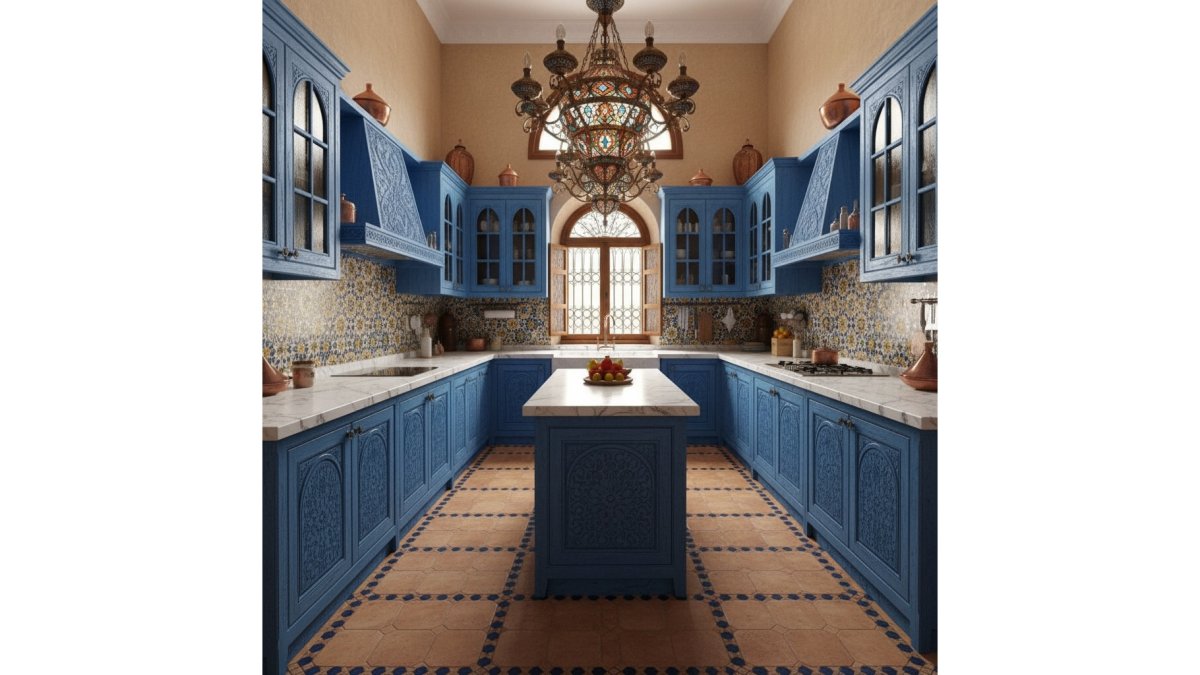
Consider these lighting factors:
- North-facing kitchens: Receive cool, consistent light. Warmer cabinet colors (terracotta, warm cream, mustard) work better here than cool blues.
- South-facing kitchens: Get warm, intense light. Deep blues, sage greens, and cool neutrals balance this warmth.
- East-facing kitchens: Bright morning light, softer afternoon. Jewel tones show their richness here.
- West-facing kitchens: Intense afternoon heat and light. Lighter earth tones prevent the space from feeling dark.
Paint undertones matter more than you'd think: a "white" cabinet can look cream in another kitchen, and a "blue" can read as purple, gray, or true blue. Get large swatches and observe them in your actual kitchen for at least three days.
Step 2: Select Your Primary Color from Moroccan Kitchen Color Schemes
Your primary cabinet color sets the mood for the entire space and typically covers your base cabinets or the majority of your cabinetry. Moroccan kitchen color schemes traditionally feature one dominant color supported by accents and neutrals. Here's a repeatable method and concrete specifications you can hand to a painter or cabinet maker.
A four-step method for choosing your primary color
- Lock your fixed finishes first. List everything you cannot easily change: floor tile, countertop, appliances, and any permanent backsplash. Note each one's dominant color and undertone (warm, cool, or neutral). Your cabinet color has to live with these, not fight them.
- Choose your mood, then your color family. Decide whether you want the kitchen to read coastal and airy, earthy and grounded, jewel-toned and dramatic, or contemporary and restrained. Each mood maps to a different color family (below).
- Pick one primary and one secondary, no more. Two colors plus a neutral is the ceiling for most kitchens. Three saturated colors competing at equal weight is the single most common regret.
- Test before you commit. Order large peel-and-stick samples (8 in. x 8 in. or larger) and tape them to the actual cabinet doors. Live with them for at least three days, checking morning, midday, and evening.
Color families matched to Moroccan design influences
Moroccan style is not one look. Treating it as a single palette is why so many "Moroccan" kitchens feel generic. Match the family to the influence you actually want:
- Coastal Moroccan (think Essaouira): Chalky whites, soft blues, and sea-glass greens. Primary cabinet color: a muted blue-green or warm white. Secondary: sand or pale gray. Accent: brass or weathered wood.
- Earthy Moroccan (think Atlas foothills and rural riads): Terracotta, clay, ochre, olive, and warm cream. Primary cabinet color: terracotta or olive. Secondary: cream or raw plaster white. Accent: blackened iron or copper.
- Jewel-toned Moroccan (think Marrakech riads and zellige courtyards): Deep indigo, emerald, sapphire, and burgundy. Primary cabinet color: one saturated jewel tone. Secondary: cream or warm white. Accent: brass, gold, or mother-of-pearl.
- Contemporary Moroccan: A neutral base (warm white, greige, or soft sand) with one bold accent, often a single island or a run of lower cabinets in indigo or emerald. This is the safest entry point if you're unsure.
Concrete color specifications to start from
These widely used reference points read as Moroccan when paired correctly, treat them as starting samples and always test in your own light.
- Deep indigo / navy: Benjamin Moore Hale Navy (HC-154) or Sherwin-Williams Naval (SW 6244).
- Emerald / jewel green: Benjamin Moore Peppermint Leaf is too light for cabinets; look instead at Amazon Green (2145-30) or Sherwin-Williams Evergreens (SW 6447).
- Sage / muted green: Benjamin Moore Pale Avocado (2146-40) or Sherwin-Williams Sage Green Light (SW 2860).
- Terracotta / rust: Benjamin Moore Terra Mauve (1200) or Sherwin-Williams Red Barn (SW 7591) for a deeper rust.
- Warm cream / sand: Benjamin Moore White Dove (OC-17) or Sherwin-Williams Alabaster (SW 7008).
- Burgundy / wine: Benjamin Moore Burgundy (CC-64) or Sherwin-Williams Fine Wine (SW 6307).
Paint names and numbers are the fastest way to get a painter and designer on the same page.
How to decide between two finalists
If you're torn between two colors:
- Which one appears in your fixed finishes? If your countertop has a warm undertone and one candidate color is cool, the warm one usually wins.
- Which one survives a cloudy day? Look at both samples on an overcast afternoon. The one that still looks intentional is the safer long-term choice.
- Which one do you want to see every morning? Cabinets are the largest painted surface in the room. If a color feels like a costume rather than a choice, it will wear on you.
Step 3: Apply the 60-30-10 Color Rule for Kitchen Design
The 60-30-10 color rule for kitchen design prevents color chaos: 60 percent dominant color, 30 percent secondary, and 10 percent accent. This ratio creates visual balance without monotony.
For moroccan kitchen cabinet colors, apply this rule strategically:
- 60 percent (dominant): Your primary cabinet color plus walls and large surfaces
- 30 percent (secondary): A complementary color like your backsplash, island, or accent wall
- 10 percent (accent): Hardware, small decorative elements, or accent tile details
In practice: if sage green is your primary cabinet color for 60 percent of the space, use cream or soft sand for 30 percent (upper cabinets, walls, or open shelving) and a jewel-tone blue or terracotta for 10 percent (backsplash section, island base, or hardware).
This ratio allows the rich color layering moroccan design celebrates; without it, multiple bold colors clash rather than harmonize.
Step 4: Choose Kitchen Cabinet Color Combinations That Work Together
Knowing which kitchen cabinet color combinations complement each other prevents expensive mistakes.
Blue and White Combinations: Classic moroccan pairing. Deep indigo or sapphire blue cabinets with white or cream walls and countertops create crisp, sophisticated contrast. Add terracotta or brass accents for warmth.
Sage Green and Cream Combinations: A softer, more contemporary moroccan look. Sage green cabinets paired with cream walls and light wood tones feel organic and calming.
Terracotta and Rust Tones: Warm earth tones that feel grounded and inviting. Pair terracotta cabinets with cream, soft yellow, or pale blue accents. These colors work beautifully in kitchens with south or west-facing light.
Burgundy and Gold: A luxurious, jewel-box approach. Deep burgundy or wine-colored cabinets paired with gold hardware, cream walls, and warm wood tones create richness and depth.
Test your chosen kitchen cabinet color combinations by placing large paint samples side by side in your actual kitchen for several days, noting how they interact under different lighting.
| Color Combination | Best Light Condition | Mood | Accent Color |
|---|---|---|---|
| Blue and White | South or East-facing | Crisp, Sophisticated | Terracotta or Brass |
| Sage Green and Cream | Any, prefers warm light | Organic, Calming | Soft Blue or Wood Tone |
| Terracotta and Rust | South or West-facing | Warm, Inviting | Cream or Pale Yellow |
| Burgundy and Gold | East or South-facing | Luxurious, Rich | Cream or Soft Wood |
Step 5: Coordinate Cabinet Colors with Moroccan Tile Backsplash Colors
Your backsplash color dramatically influences how your cabinet color reads. A moroccan tile backsplash often features multiple colors and patterns, so your cabinet color must complement or intentionally contrast with it.
If your backsplash features patterned tile with multiple colors, choose a cabinet color that appears within that tile pattern. This creates visual connection rather than competition, if the tile includes blues, creams, and terracotta, blue or cream cabinets tie the design together.
Moroccan tile backsplash colors typically include:
- Deep blues and indigos
- Cream and ivory
- Terracotta and rust red
- Sage green and muted greens
- Burgundy and wine tones
- Warm yellows and golds
Solid-colored backsplash tile gives you more flexibility: cream works with nearly any cabinet color, solid blue pairs with cream, white, or sage green cabinets, and solid terracotta complements blue, cream, or burgundy cabinets.
Marrakech riad kitchen cabinets →
Your backsplash and cabinet colors should feel intentional together, they're the two largest visual elements in your kitchen after walls and flooring.
Selecting Cabinet Finishes and Wood Tones for Durability
Your cabinet color choice is only half the equation. Finish and wood tone affect both durability and how the color appears, and a showroom-beautiful finish can fail in a working kitchen within a year.
How finish sheen changes the color you chose
Sheen changes how much light bounces off the cabinet face, which changes how saturated and how light the color reads.
- Matte / flat (roughly 5-10 percent sheen): Shows the truest, deepest version of the color. Excellent for jewel tones and dark indigos, which can look flat or chalky in higher sheens. Downside: shows fingerprints, water spots, and grease splatter more readily, and is harder to wipe clean without leaving streaks.
- Satin (roughly 25-35 percent sheen): The most common kitchen cabinet finish. Balances color accuracy with practical durability. Hides fingerprints better than matte and cleans easily with a damp cloth. Works with nearly every Moroccan palette.
- Semi-gloss (roughly 35-55 percent sheen): Reflects more light, which can make a color read one shade lighter than the chip. Easiest to clean. Best for busy kitchens and for lighter colors where you want the room to feel brighter. Downside: highlights imperfections in the cabinet surface and can look dated if overused.
- High-gloss / lacquer (60 percent sheen and up): Maximum reflectivity. Dramatic with deep jewel tones. Requires the most careful surface prep and shows every flaw. Best reserved for accent cabinets or islands rather than an entire kitchen.
A practical rule: the darker and more saturated the color, the lower the sheen you can get away with. The lighter the color, the more sheen helps it read as intentional rather than washed out.
Painted vs. stained vs. lacquered, durability compared
Finish type matters as much as sheen. The three main options:
- Painted (waterborne or oil-based paint over a primed wood or MDF door): The most common choice for Moroccan cabinet colors because it allows any color. Durability depends heavily on prep and topcoat. A quality waterborne cabinet paint with a hard topcoat holds up well in a busy kitchen before touch-ups. Touch-ups are easy because you can match the original paint.
- Stained (transparent or semi-transparent over solid wood): Shows the wood grain, which suits earthy Moroccan palettes. More forgiving of scratches because the color goes into the wood rather than sitting on top. Limited to wood tones, you cannot get a true indigo or emerald from stain alone. Refinishing later is more involved.
- Lacquered (sprayed, catalyzed lacquer): The most durable. Produces the deepest, most uniform color and the highest sheen. Downside: repairs are difficult, a scratched lacquer door usually needs to be resprayed professionally, not touched up with a brush.
Wood tones and how they interact with Moroccan colors
Wood tone is a color in the room, not just a background. Match it deliberately:
- Dark woods (walnut, mahogany, wenge): Add depth and contrast. Pair with cream, sand, or pale sage cabinets. Avoid pairing with very dark cabinet colors, which can make the room feel heavy.
- Medium woods (cherry, oak, teak): The most versatile. Work with terracotta, olive, and muted blues. Teak in particular reads as authentically Moroccan and pairs well with brass hardware.
- Light woods (pine, ash, maple, bleached oak): Best with jewel tones and saturated colors, where they act as a neutral counterweight. Also excellent for open shelving against a bold cabinet run.
- Painted wood (color-matched to cabinets or a contrasting neutral): The most flexible option. Eliminates the wood-tone variable entirely, which is why it's common in contemporary Moroccan kitchens.
Matching finish to the color family you chose
If you chose a palette in Step 2, here's how to finish it:
- Coastal Moroccan (whites, soft blues, sea-glass greens): Satin or semi-gloss. Lighter colors benefit from sheen to read as crisp rather than dingy. Easy to clean in a kitchen that sees daily use.
- Earthy Moroccan (terracotta, clay, ochre, olive): Matte or satin. Earth tones look best with a slightly chalky, plaster-like finish that echoes Moroccan tadelakt walls. Accept that matte requires more wiping.
- Jewel-toned Moroccan (indigo, emerald, sapphire, burgundy): Satin for most cabinets, semi-gloss or lacquer for an island or accent run. Deep colors show dust and smudges, so a mid-sheen finish is the practical sweet spot.
- Contemporary Moroccan (neutral base plus one accent): Satin throughout. Keeps the neutral base calm and lets the accent color carry the drama.
Maintenance by finish, what to expect
- Matte: Wipe weekly with a soft damp cloth. Avoid abrasive cleaners, which leave dull spots. Expect to touch up around handles and drawer pulls every 1-2 years.
- Satin: Wipe as needed with mild soap and water. Touch-ups blend well. The lowest-maintenance choice for most households.
- Semi-gloss: Wipe with a damp cloth; most splatter comes off without scrubbing. Watch for streaks from oily cleaners.
- Lacquer / high-gloss: Dust with a microfiber cloth; clean with a diluted mild soap. Never use ammonia-based cleaners, which can cloud the finish.
For authentic Moroccan cabinetry, hand-carved wood details and traditional joinery add visual interest that makes even solid colors feel sophisticated. The Marrakech Riad kitchen cabinets from Justmorocco feature these hand-carved elements, allowing you to choose bold colors confidently because the craftsmanship carries visual weight alongside the color choice.
Cabinet Hardware and Accent Colors That Complete the Look
Hardware is your 10 percent accent opportunity, the easiest way to add luxury and authenticity to your moroccan kitchen cabinet colors without major renovation.
Moroccan-inspired hardware finishes include:
- Brass and brushed brass: Warm, traditional, pairs beautifully with jewel tones and earth tones
- Copper and aged copper: Rich, warm tone that complements terracotta and burgundy cabinets
- Iron and blackened iron: Creates contrast, works with any cabinet color
- Bone and mother-of-pearl inlays: Authentic moroccan craftsmanship, reflects light, adds luxury
Choose hardware that complements rather than matches your cabinet color: brass on blue creates interest, blackened iron on cream adds definition, and mother-of-pearl inlays add authentic moroccan character.
Beyond hardware, consider accent colors in:
- Open shelving displays: Use colorful glassware, ceramics, or brass vessels
- Decorative tile accents: Add a small section of patterned moroccan tile as a focal point
- Lighting fixtures: Moroccan-style pendant lights or sconces add ambiance and color coordination
These accents should tie back to your 60-30-10 rule, reinforcing your palette rather than introducing new colors.
Common Mistakes to Avoid When Choosing Moroccan Cabinet Colors
Most homeowners who regret their moroccan kitchen cabinet colors made one of these mistakes:
Choosing color without considering light: The most common error. A color that looks perfect in the showroom behaves completely differently in your actual kitchen. Always test samples in your real space for several days.
Going too bold without a plan: Saturated colors everywhere create visual fatigue. Use the 60-30-10 rule to balance bold colors with neutrals.
Ignoring undertones: A "white" cabinet might have yellow, pink, or blue undertones that clash with your chosen primary color. Match undertones carefully.
Forgetting about maintenance: Matte finishes on heavily used cabinets show every fingerprint and splash. Choose satin or semi-gloss if you cook frequently.
Mismatching with existing elements: Stainless steel appliances, dark countertops, or existing tile must work with your cabinet color, not against it.
Underestimating the impact of hardware: Clashing hardware makes even a well-chosen color look off. Invest in hardware that genuinely complements your palette.
Choosing color before selecting your backsplash: Your backsplash is a major visual element. Choose it first or simultaneously with your cabinet color, not after.
Selecting moroccan kitchen cabinet colors balances personal preference with practical design principles.
Frequently Asked Questions
What are the most popular colors in Moroccan kitchen cabinet design?
Deep saturated tones dominate Moroccan kitchen design: sapphire blue, emerald green, and dusty terracotta are traditional choices. In 2026, the trend has shifted toward earth tones and muted neutrals like sage green, sand, and burnt honey yellow. Many homeowners pair these with dark woods such as walnut or mahogany for base cabinets, creating visual contrast and authenticity in their Moroccan kitchen color schemes.
How does the 60-30-10 color rule apply to Moroccan kitchen cabinet colors?
The 60-30-10 color rule for kitchen design allocates 60% to your dominant color (typically cabinet color), 30% to a secondary color (walls, larger surfaces), and 10% to accent colors (hardware, backsplash details). For Moroccan kitchens, use deep blue or green cabinets as your 60%, cream or sand walls as your 30%, and terracotta or patterned Moroccan tile accents as your 10%. This balance prevents the space from feeling overwhelming while maintaining authentic Moroccan character.
What kitchen cabinet color combinations work best with Moroccan tile backsplashes?
Pair neutral or muted cabinet colors with bold patterned Moroccan tile, or use dark cabinets with subtle tile. Sage green or cream cabinets complement hand-chiseled zellige tile beautifully, allowing the tile's geometric patterns and gloss finish to stand out. Deep blue or terracotta cabinets work well with cream and white tile combinations. The key is ensuring your kitchen cabinet color combinations don't compete with the intricate tile patterns, let one element be the visual focus.
Should I choose blue or green Moroccan kitchen cabinets for a small kitchen?
For small kitchens, lighter Moroccan tones work better than deep saturated colors. Sage green creates an airy, sophisticated feel without overwhelming the space, while soft blue-gray cabinets reflect light and make the room feel larger. Avoid very dark indigo or navy in compact kitchens, as these absorb light and can make the space feel cramped. Pair your chosen color with light countertops and backsplash to maximize visual space while maintaining authentic Moroccan kitchen cabinet colors.