
Quick Summary
Moroccan wood carving began with Amazigh (Berber) communities who shaped timber for everyday use such as doors, storage chests and roof supports. Islamic geometry and Andalusian influence later shaped its style, and the craft follows a fixed sequence from preparation to finishing.
- Amazigh (Berber) communities laid the foundation, using hand tools and locally available timber.
- Islamic principles favored geometry, repetition and abstract ornament over figurative imagery.
- Traditional carving moves through preparation, design transfer, roughing out, relief carving, and finishing.
- Cedar is widely used for doors and ceilings, while walnut and oak appear in furniture and structural elements.
- Check the background of a panel: consistent depth and clean undercutting suggest hand carving.
Table of Contents
- Where Moroccan Wood Carving Began: Berber Roots and Early Craft
- How Islamic and Andalusian Influence Shaped the History of Moroccan Wood Carving
- Traditional Moroccan Woodworking Techniques: Tools, Steps and Materials
- Moroccan Geometric Wood Carving: How Star and Arch Patterns Are Built
- Moroccan Thuya Wood Marquetry and Its Place in the Craft
- Regional Styles Within Morocco: Fez, Marrakech, Essaouira and the Atlas
- Wood Species, Sourcing and Conservation of Historic Carving
- How Authentic Moroccan Carved Furniture Is Made Today
- Choosing Handcrafted Moroccan Carved Pieces for Your Home
- Frequently Asked Questions
5 Milestones in Moroccan Wood Carving History
Last Updated: October 30, 2026
Where Moroccan Wood Carving Began: Berber Roots and Early Craft
The history of Moroccan wood carving techniques starts long before the modern souk, with Amazigh (Berber) communities who shaped timber for everyday use. This craft traces back to the practical needs of mountain and desert households, where carved wood served as doors, storage chests and roof supports.
Early carving was functional first. Artisans worked with locally available timber, cutting simple linear and notched patterns that protected surfaces and marked ownership. Decoration grew out of that utility rather than arriving as a separate art form.
Documented early pieces are scarce, and specific dates for these first techniques are not firmly established. What is clear is that the Amazigh tradition gave Moroccan woodworking its foundation: hand tools, direct cutting and an emphasis on durable, regional wood.
How Islamic and Andalusian Influence Shaped the History of Moroccan Wood Carving
Islamic artistic principles reshaped the craft by favoring geometry, repetition and abstract ornament over figurative imagery. Carvers adopted interlacing star patterns and arabesque lines, which became the visual language of later Moroccan work.
Andalusian migration brought further refinement. Craftsmen who settled in Moroccan cities carried knowledge of Moorish decoration, including horseshoe arches and tightly ordered panel layouts that still define the style today.
Watch out: when buyers see the words "Andalusian" or "Moorish" on a piece, ask the seller which motifs and joinery the maker actually used, because the terms are sometimes applied loosely to mass-produced goods.
Traditional Moroccan Woodworking Techniques: Tools, Steps and Materials
Traditional Moroccan carving is a sequence of preparation, layout, roughing, and finishing, and the order matters as much as the tools. Most workshops follow a repeatable progression that has changed little in structure even as some steps have been accelerated by modern equipment.
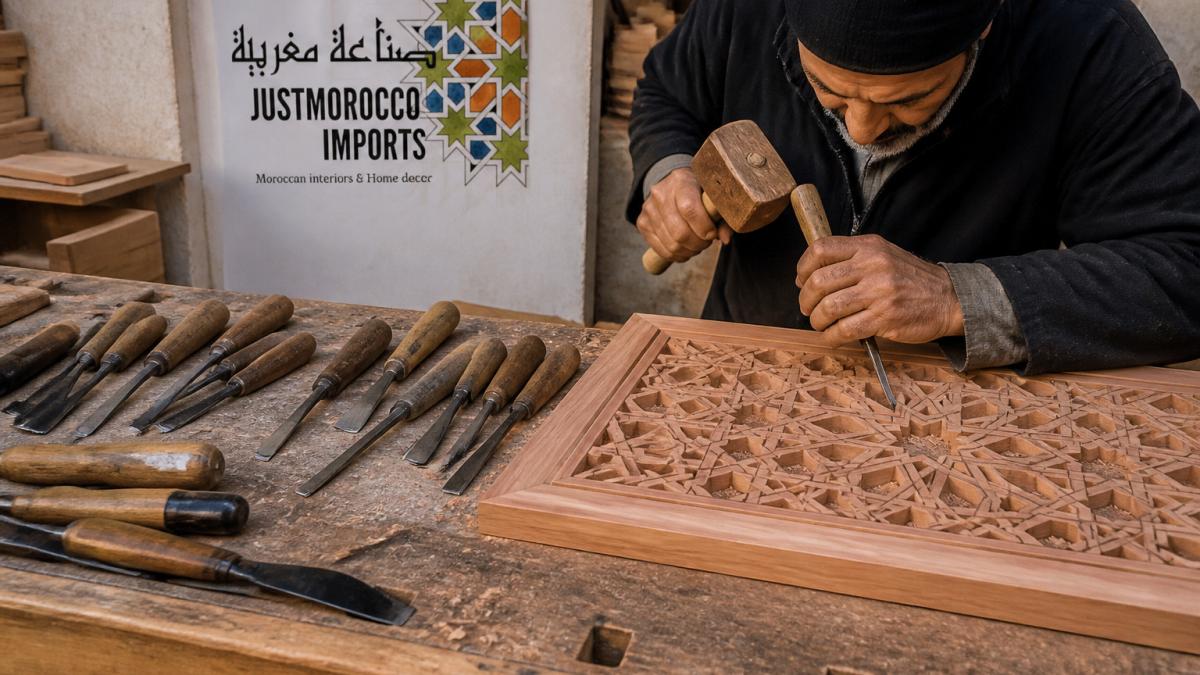
Wood selection and preparation. The carver starts with stock that has been air-dried and, for architectural work, often quarter-sawn to reduce movement across the panel. Cedar is widely used for doors and ceilings, and walnut and oak appear in furniture and structural elements. Before layout, the face is planed flat and the edges squared so the geometry will read correctly.
Design transfer. Moroccan geometric layouts are built rather than traced freehand. The carver strikes a centerline and a baseline, then uses a compass and straightedge to divide the panel into a symmetrical grid. Circles struck from grid intersections generate the star polygons, and the arch or border outlines are drawn from the same construction. On repeat work, a thin template or a pricked outline is used to transfer the pattern to fresh stock, which keeps matching panels consistent.
Roughing out. The background is removed first, not the motif. Gouges of increasing sweep are used to establish depth around the border and then across the field, leaving the design standing in relief. This is the step where power routers or drills are now sometimes used to hog out waste, but the depth is deliberately left slightly proud so the hand tools can true it.
Carving the relief. Chisels of varying widths cut the geometric and floral elements. Straight chisels define the star edges and border lines; skew and fishtail chisels clean the corners and undercut the arabesque stems so they read as separate from the ground. Relief depth is kept consistent across the panel, and the carver works from the outer border inward so the frame is set before the interior detail is refined.
Pierced and openwork carving. For screens, transoms, and some door panels, the background is cut completely through rather than lowered. This requires the pattern to be structurally self-supporting, so the layout is adjusted before cutting and the piece is worked from both faces to avoid tear-out.
Finishing. Fine tools remove tool marks in low-relief areas, and the surface is then smoothed selectively rather than sanded uniformly, because sanding can soften the crisp edges that define the geometry. Traditional finishes are thin and reversible; oil or wax is preferred over heavy film finishes on historic work.
Smithsonian Center for Folklife and Cultural Heritage, Moroccan craft traditions
The carving process follows a fixed sequence, and each stage has its own tools and purpose.
| Step | What to do | Key tool or material |
|---|---|---|
| Wood selection and preparation | Plane the face flat and square the edges | Air-dried stock, often quarter-sawn |
| Design transfer | Divide the panel into a symmetrical grid with compass and straightedge | Compass, straightedge |
| Roughing out | Remove the background first, leaving the motif in relief | Gouges of increasing sweep |
| Carving the relief | Cut geometric and floral elements, working outer border inward | Straight, skew and fishtail chisels |
| Pierced carving | Cut the background fully through, working from both faces | Self-supporting pattern layout |
| Finishing | Remove tool marks selectively rather than sanding uniformly | Oil or wax over heavy film finishes |
Moroccan Geometric Wood Carving: How Star and Arch Patterns Are Built
Geometric carving rests on a simple principle: a grid of circles and lines generates star polygons, which are then cut into the wood. The eight-pointed star is especially common in doorway and panel designs.
Horseshoe arches frame many panels, with smaller star motifs nested inside. A hand-carved Moorish door shows these star and arch layers in a finished panel. Our Hand-Carved Moroccan Double Doors | Andalusian Alhambra Style, 98"x56" show this layering clearly, with arabesque lines surrounding each central star, sold at $8,200.00.
Here is how most carvers approach a panel:
- Divide the panel into a symmetrical grid
- Draw the star or arch outlines from that grid
- Carve the outermost border first to set the frame
- Work inward, keeping the relief depth consistent
Moroccan Thuya Wood Marquetry and Its Place in the Craft
Thuya marquetry is a separate branch of the craft, in which small pieces of thuya wood are cut and fitted into a host surface to form patterns. Its dark, figured grain creates contrast that carved relief cannot achieve on its own.
Hand-Carved Moroccan Double Doors | Andalusian Alhambra Style, 98"x56" →
This technique is often seen on tables and smaller furniture rather than architectural elements.
Marquetry demands precise cutting and tight joints, so quality varies widely between makers. When comparing pieces, check that the inlay sits flush with the surface and that the pattern repeats symmetrically.
Regional Styles Within Morocco: Fez, Marrakech, Essaouira and the Atlas
Regional differences in Moroccan carving are real but they are best read as workshop and architectural traditions rather than hard borders. The clearest way to compare them is by what the local building stock demanded, which woods were at hand, and how densely the ornament was packed onto the panel.
Fez. Fez has the deepest continuous record of dense panel work, tied to its medina architecture, mosque interiors, and the carved ceilings and doors of its historic houses. The local tradition favors tightly packed geometry, fine-scale arabesque, and calligraphic bands, with cedar as the dominant wood. Workshop organization here is strongly apprenticeship-based, and the density of the ornament reflects a market that rewarded detailed panel work for interior display.
Marrakech. Marrakech carving tends to combine geometric ornament with bolder scale and more color, reflecting the city's role as a southern capital with palace and garden architecture. Painted and gilded carved ceilings and doors are more common in the local repertoire, and the relief is often read at a distance rather than at arm's length.
Essaouira. The coastal tradition is lighter and more open in composition, which fits both the available timber and the city's history as a trading port where workshops served a mixed local and export market. Openwork and simpler geometric frames appear more often than the dense Fez-style panel.
Atlas communities. In the Atlas and pre-Saharan regions, carving tends toward bolder, simpler forms cut from local timber, with painted geometric decoration on doors, chests, and roof elements. The work is often structural and domestic rather than monumental, and the ornament is scaled to be read across a courtyard or from a passing path.
How to use these distinctions. Treat them as tendencies, not rules. Artisans have always moved between cities, and a Marrakech workshop may produce Fez-style panels on commission. The reliable test is the object itself: wood species, relief depth, density of ornament, and whether the piece was made for architecture or for furniture.
The Metropolitan Museum of Art, Islamic art and architectural woodwork
Wood Species, Sourcing and Conservation of Historic Carving
Species choice shapes both appearance and longevity. Cedar is prized for its workability and aroma, while walnut offers a deep, even tone. A cedar-carved table shows these qualities in a finished object. Oak provides strength for structural elements.
Conservation depends on keeping the wood stable. Avoid placing carved pieces in direct sun or near heating vents, since rapid drying causes splitting along grain lines. Periodic dusting with a soft brush protects relief detail better than wet cleaning.
How Authentic Moroccan Carved Furniture Is Made Today
Authentic pieces show irregular tool marks, slight variation between matching elements and natural wood movement. You can see how these marks appear on a finished piece in the Atlas Berber cabinet. A piece that looks identical to dozens of others may be machine-stamped rather than carved.
If you are looking to source authentic pieces abroad, Custom furniture imports from Justmorocco can help bring Moroccan furniture to your door.
Choosing Handcrafted Moroccan Carved Pieces for Your Home
Start by deciding where the piece will live. A carved cabinet shows how this decision plays out at furniture scale. Large doors and entry panels make a strong statement, while coffee tables and cabinets suit living spaces where daily use matters.
Match the scale of the carving to the room. Dense, heavily relief-carved pieces work best as focal points, while simpler geometric panels blend into eclectic interiors.
Our Handmade Moroccan Carved Wooden Coffee Table, Andalusian Art, priced at $2,420.00, shows how carved detail can anchor a living room without overwhelming it. For larger projects, our Authentic Moroccan Hand-Carved Cedar Double Doors, 95" W x 118" H, sold at $42,000.00, illustrate the scale possible with architectural carving.
Confirm dimensions, shipping costs and finish options before ordering.
Frequently Asked Questions
What is the history of wood carving in Morocco?
Wood carving in Morocco blends Berber craft traditions with Islamic and Andalusian decorative art that arrived with Moorish influence. Carved cedar and thuya wood were used for doors, ceilings, screens and furniture in mosques, palaces and homes. Artisans passed techniques down through family workshops, and many of those methods, such as hand-chiseled geometric relief and hand-cut marquetry, are still practiced today. Regional workshops in cities like Fez and Marrakech developed distinct styles over time.
What woods are traditionally used in Moroccan carving?
Traditional Moroccan carving uses cedar, walnut, oak and thuya wood. Thuya, a fragrant aromatic wood from the Atlas region, was prized for marquetry and fine decorative work. Cedar is common for doors and large architectural panels because it holds up well and resists insects. Walnut and oak appear in furniture and carved detail. Sourcing and conservation of these species matter today, since many old-growth stands have declined.
How are geometric patterns carved into Moroccan wood?
Artisans first lay out the pattern using compass and ruler on the wood surface, often building star and arch motifs from repeated geometric grids. They then outline the design with fine chisels and carve the background back to create relief. Interlacing arabesque lines and eight-pointed stars are typical. The work is done largely by hand, which is why the finished patterns show fine tool marks and slight variation from piece to piece.
How can you recognize authentic Moroccan carved woodwork?
Authentic hand-carved pieces show irregular tool marks, slight asymmetry and depth variation that machines do not produce. Look for hand-cut joinery, natural wood grain and wear consistent with age. Real thuya marquetry has fine, hand-fitted inlays rather than printed or glued veneer. Ask the seller where and by whom the piece was made, and whether the carving was done by hand.
