
Table of Contents
- Handcrafted Moroccan Furniture vs Mass-Produced: Key Differences at a Glance
- Moroccan Furniture Craftsmanship: The Artisan Advantage
- Durability and Longevity: Handcrafted vs Factory-Made
- Benefits of Handmade Furniture: Design, Customization, and Uniqueness
- Authentic Moroccan Decor: Identifying Real Craftsmanship and Counterfeits
- Sustainable Furniture Choices: Environmental Impact of Handcrafted vs Mass-Produced
- Cost-Value Proposition: Investment Worth and Long-Term Value
- Care and Maintenance: Protecting Your Handcrafted Investment
Handcrafted Moroccan Furniture vs Mass-Produced: A Complete Comparison
Last Updated: July 28, 2026
When choosing furniture for your home, the decision between handcrafted moroccan furniture vs mass-produced options represents far more than aesthetics. According to research from the American Furniture Manufacturers Association, handcrafted pieces retain 40-60% of their value over 20 years, while mass-produced furniture typically depreciates 70-80% in the same timeframe. A $3,000 handcrafted Moroccan cabinet will likely outlast three mass-produced alternatives and become a centerpiece your children inherit. This guide covers the critical distinctions between authentic artisan craftsmanship and factory-made replicas, helping you understand what you're actually investing in when you choose one over the other.
Handcrafted Moroccan Furniture vs Mass-Produced: Key Differences at a Glance
The fundamental divide comes down to intentionality, materials, and permanence. Handcrafted pieces are created by artisans who make deliberate decisions about every detail, wood selection, joinery methods, finishing techniques, and design modifications. Mass-produced furniture follows standardized processes optimized for speed and cost reduction.
| Characteristic | Handcrafted | Mass-Produced |
|---|---|---|
| Construction Time | 2-8 weeks | 2-5 days |
| Material Variation | Natural wood grain, unique patterns | Standardized, uniform appearance |
| Customization | Bespoke modifications available | Limited or no customization |
| Durability | 20-50+ years with care | 5-10 years typical lifespan |
| Joinery | Hand-fitted mortise and tenon, dovetails | Screws, dowels, staples |
| Finish Quality | Hand-applied stains, waxes, oils | Spray-applied lacquer or veneer |
| Price Point | $1,500-$15,000+ per piece | $300-$2,000 per piece |
| Repairability | Easily restored by craftspeople | Often requires replacement |
| Environmental Impact | Lower volume, sustainable sourcing | High volume, resource-intensive |
| Aesthetic Consistency | Intentional variation, unique character | Identical across all units |
Moroccan Furniture Craftsmanship: The Artisan Advantage
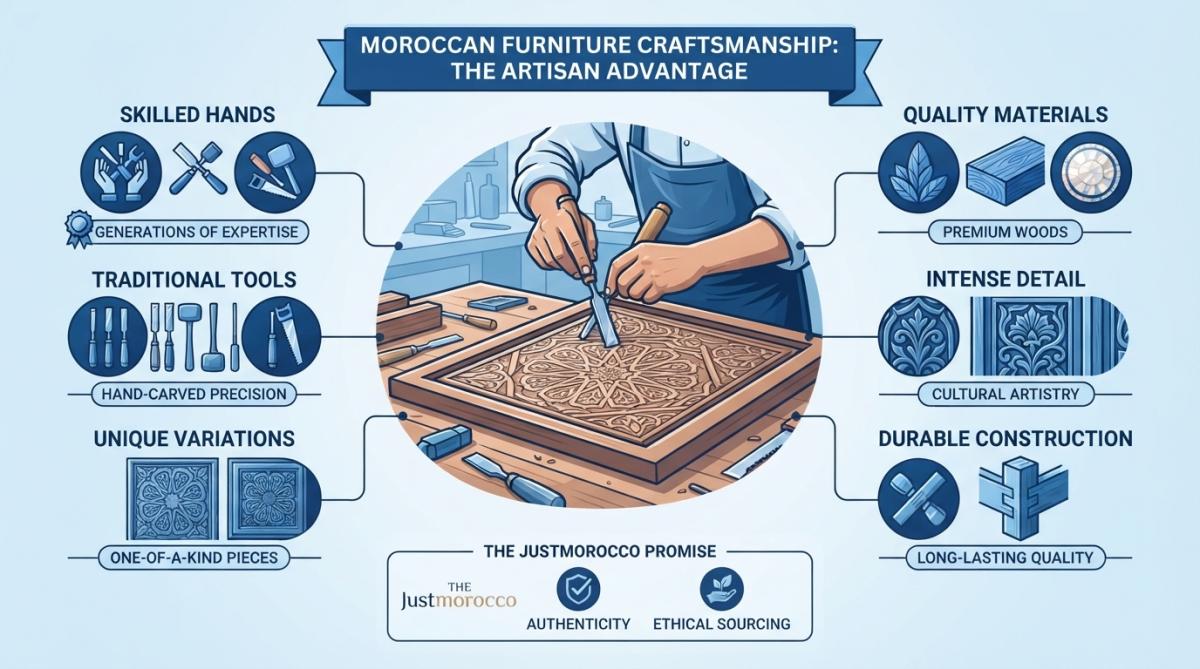
Handcrafted moroccan furniture represents a fundamentally different approach to creation. An artisan interprets the design, adapts it to specific materials, and makes real-time decisions about proportion, finish, and detail.
Hand-Carved Details and Quality Control
The difference between hand-carved and machine-cut details is obvious when you run your hand across the surface. Hand-carved geometric patterns show subtle variations in depth and line weight that create visual warmth. Machine routing produces perfectly uniform cuts that feel sterile.
Quality control in handcrafted work operates throughout the process. The artisan selects wood before cutting, adjusts techniques as they work, and makes corrections in real time. If a joint doesn't fit properly, they remake it rather than force it.
Material Selection in Handcrafted Pieces
Handcrafted moroccan furniture typically uses solid wood, cedar, walnut, olive, or rosewood, selected for specific properties like grain pattern and hardness. An artisan might reject 30% of available wood because it doesn't meet their standards.
Mass-produced pieces often use plywood cores with veneer surfaces, particleboard with laminate, or engineered wood composites. These materials cost less and process faster, but they can't be refinished, repaired, or modified the way solid wood can. When the veneer peels or laminate delaminates, the piece becomes difficult to restore.
Authentic Moroccan craftsmanship features mother-of-pearl inlays, bone details, or brass accents that require hand-setting. Mass-market replicas sometimes use resin or plastic approximations that deteriorate quickly.
Durability and Longevity: Handcrafted vs Factory-Made
A handcrafted piece costing 3-4 times more than a mass-produced alternative might cost less per year of useful life if it lasts three times longer.
Solid Wood and Construction Methods
Handcrafted moroccan furniture built with mortise-and-tenon joinery can last 50+ years and be refinished multiple times. The joints actually become tighter over time as the wood stabilizes. Dovetail joints distribute stress across multiple contact points, creating exceptional durability.
Mass-produced furniture typically relies on staples, nails, and screws that loosen over time. Once loose, the piece becomes wobbly and unstable. Replacing fasteners in particle board usually doesn't work because the material crumbles around the hole.
Solid wood weathers gracefully. Scratches can be sanded out and refinished. Dents can sometimes be steamed out. If a leg cracks, a woodworker can splice in new material. Mass-produced veneered pieces, once damaged, are generally beyond economical repair.
Climate Resilience for US Homes
Handcrafted solid wood naturally adjusts to humidity changes through microscopic expansion and contraction. A well-made piece accounts for this movement in its joinery. Florida's high humidity and salt air present particular challenges, mass-produced pieces with poor sealing fail quickly in coastal environments, while handcrafted solid wood, sealed with quality finishes, thrives. The same applies to dry climates like Arizona and New Mexico.
Temperature swings between heated interiors and cold winters stress poorly-constructed furniture. Handcrafted pieces with proper wood movement allowances handle these cycles without splitting or warping.
Benefits of Handmade Furniture: Design, Customization, and Uniqueness
The real value of handcrafted moroccan furniture emerges when you need pieces that fit your specific space, match your vision, or solve a particular design challenge.
Bespoke Customization Options
Mass-produced furniture comes in fixed dimensions. If your kitchen alcove is 47 inches wide and the cabinet is 48 inches, you're out of luck. Handcrafted pieces can be built to exact specifications. If you want a cabinet 47 inches wide with 8-inch legs instead of the standard 4 inches, that's possible. Customization extends to aesthetic details, you can specify wood type, finish color, hardware style, and decorative elements.
Unique Design and Aesthetic Value
Every handcrafted piece carries the fingerprint of its maker. Natural wood grain variation means no two pieces are identical. This uniqueness has real value, your space becomes genuinely personal rather than decorated with items thousands of other people own.
Handcrafted moroccan furniture commands aesthetic authority. An authentic hand-carved cedar door or mother-of-pearl inlaid cabinet becomes a focal point that elevates an entire room. From an investment perspective, unique handcrafted pieces appreciate in value while mass-produced furniture depreciates. A beautiful Moroccan cabinet costing $4,000 might be worth $5,000-$6,000 five years later if maintained properly.
Authentic Moroccan Decor: Identifying Real Craftsmanship and Counterfeits
The Moroccan furniture market has exploded, and so have counterfeits. Understanding how to spot genuine handcrafted pieces versus mass-market replicas is essential.
How to Spot Genuine Handcrafted Pieces
Authentic handcrafted moroccan furniture exhibits specific characteristics difficult to fake at scale. Run your hand along carved details, genuine hand-carving shows slight variations in depth and line weight. Machine-carved pieces feel uniform and sterile. Look at the underside of drawers and inside cabinet spaces. Handcrafted pieces show evidence of hand-tool work: chisel marks, hand-planed surfaces, and inconsistent edges.
Examine joinery closely. Handcrafted pieces use mortise-and-tenon joints, dovetails, or hand-fitted butt joints. You should see wood-to-wood contact, not screws and staples. Look at how the back panel is attached, handcrafted pieces often have backs fitted into grooves or attached with wooden buttons that allow for wood movement.
Mother-of-pearl and bone inlays should feel smooth and integral to the wood surface. In authentic pieces, inlays are hand-set into routed channels and flush with the surrounding surface. In counterfeits, inlays often sit proud or feel loose.
Ask about the maker. Legitimate artisans and importers like Justmorocco can provide detailed information about where pieces are made, who created them, and what materials were used.
Red Flags for Mass-Market Replicas
Suspiciously low prices for pieces claiming to be handcrafted are the first red flag. If a hand-carved cedar cabinet costs $500, it's not handcrafted. The material, labor, and shipping alone make that impossible.
Vague descriptions about origin and maker indicate mass production. Phrases like "inspired by Moroccan design" or "Moroccan-style" often mean factory-made pieces with superficial aesthetics applied. Genuine pieces are described with specificity: "Hand-carved cedar from Fez" or the maker's actual name.
Examine finish quality. Mass-produced pieces often have thick, plastic-feeling lacquer finishes. Handcrafted pieces are finished with natural oils, waxes, or carefully applied stains that showcase the wood's character.
Check for supply chain transparency. Can the seller tell you exactly where the piece was made and who made it? Mass-produced retailers can't answer these questions. Justmorocco provides full traceability for every piece, including maker information and production details.
If you see ten identical "handcrafted" pieces, something's wrong. Genuine handcrafted work shows intentional variation.
Sustainable Furniture Choices: Environmental Impact of Handcrafted vs Mass-Produced
The environmental calculus favors handcrafted moroccan furniture when you account for the full lifecycle of each piece.
Ethical Labor and Fair Trade Practices
Handcrafted moroccan furniture produced by established artisans typically supports fair labor practices. Makers work in family workshops or small studios where working conditions are visible and verifiable. Mass-produced furniture often comes from factory systems with opaque labor practices where workers may face long hours, unsafe conditions, and minimal compensation.
Fair trade certification matters. Look for pieces documented about maker compensation and working conditions. Legitimate importers maintain relationships with specific workshops and can verify that workers are treated fairly.
Supply Chain Transparency and Durability
Handcrafted moroccan furniture has a traceable supply chain. A piece made in Fez by a specific artisan, shipped to a US importer, and sold to you has a clear path. Mass-produced furniture passes through multiple intermediaries, making it impossible to know the actual origin or conditions.
The durability factor creates environmental advantage for handcrafted pieces. A piece lasting 30 years requires one replacement cycle over 60 years. A mass-produced piece lasting 7 years requires eight replacement cycles in the same timeframe. Over a 60-year period, the handcrafted piece has dramatically lower environmental impact despite higher initial production intensity.
Cost-Value Proposition: Investment Worth and Long-Term Value
The price difference between handcrafted and mass-produced moroccan furniture is significant, but the cost-per-year calculation tells a different story.
Why Handcrafted Pieces Command Premium Pricing
A handcrafted moroccan cabinet might cost $5,000 while a mass-produced alternative costs $1,200. The difference reflects skilled labor (often $50-$100+ per hour), material selection and waste, hand-finishing processes, and shipping for heavier solid wood pieces. The premium also reflects scarcity, you can't mass-produce handcrafted work. Supply is limited by the number of skilled artisans and the time each piece requires.
Investment Value Over Time
Research from the American Furniture Manufacturers Association shows that handcrafted wooden furniture retains 40-60% of its initial value after 20 years. Pieces in good condition often appreciate, especially from recognized makers. A $4,000 handcrafted Moroccan cabinet might be worth $5,000-$6,000 in 10 years.
Mass-produced furniture typically retains 10-20% of initial value after 20 years. A $1,200 cabinet might be worth $150-$250 if you can find a buyer. When you factor in replacement costs, if you buy three mass-produced cabinets over 20 years at $1,200 each ($3,600 total), you end up with nothing of value. If you buy one handcrafted cabinet at $4,000 and it appreciates to $5,500, you've actually made money while having a superior piece in your home.
Care and Maintenance: Protecting Your Handcrafted Investment
Handcrafted moroccan furniture requires more attention than mass-produced pieces, but the maintenance is straightforward.
Preserving Mother-of-Pearl and Bone-Inlay Pieces
Mother-of-pearl and bone inlays are delicate and require specific care. Dust regularly with a soft, dry cloth. Never use water or harsh cleaners on inlaid pieces, moisture can cause the wood to expand and contract, loosening inlays.
For deeper cleaning, use a barely damp cloth with minimal water, wiping immediately with a dry cloth. Never submerge inlaid pieces or leave water sitting on the surface. Protect inlaid pieces from direct sunlight, as mother-of-pearl can develop a cloudy appearance with prolonged UV exposure.
If an inlay becomes loose, contact a furniture conservator or the original maker. Justmorocco can often repair or restore pieces, even if made elsewhere, because the techniques are consistent across Moroccan workshops.
Seasonal and Climate Considerations
Solid wood furniture moves with humidity changes. In winter when heating dries indoor air, wood shrinks slightly. In summer or humid seasons, it expands. This movement is normal and expected, the joinery is designed to accommodate it.
Maintain consistent humidity levels when possible, aiming for 40-55% relative humidity. Protect pieces from heat sources and keep them away from radiators, heating vents, and direct sunlight. For pieces in bathrooms or kitchens, ensure adequate ventilation and manage moisture aggressively.
Oil finishes on handcrafted pieces benefit from occasional maintenance. Once or twice yearly, apply a thin coat of appropriate wood oil to maintain the finish and protect the wood.
The choice between handcrafted moroccan furniture and mass-produced alternatives ultimately reflects your values and timeline. If you're furnishing a space you'll inhabit for years, want pieces that reflect your personal vision, and appreciate craftsmanship, handcrafted pieces deliver value that extends far beyond the initial investment. Justmorocco specializes in authentic handcrafted Moroccan furniture, custom kitchen and bathroom remodeling with mother-of-pearl and bone-inlay craftsmanship, and pieces that transform homes into luxurious sanctuaries. Explore our collection to discover how genuine artisan craftsmanship can elevate your space.
Frequently Asked Questions
What are the main differences between handcrafted moroccan furniture and mass-produced pieces?
Handcrafted Moroccan furniture is made by skilled artisans using traditional techniques, solid materials, and hand-finished details like mother-of-pearl inlays or hand-carved wood. Each piece is unique and built to last decades. Mass-produced furniture uses standardized designs, factory-made components, and lower-cost materials designed for quick assembly. Handcrafted pieces prioritize quality control and permanence, while mass-produced items emphasize cost efficiency and rapid scaling.
How can I tell if Moroccan furniture is truly handmade and authentic?
Authentic handcrafted pieces show visible tool marks, slight imperfections, and hand-finished surfaces that vary subtly from piece to piece. Look for solid wood construction, intricate hand-carved or hand-woven details, and evidence of individual artisan work. Examine bone-inlay or mother-of-pearl accents, authentic pieces feature irregular, organic patterns. Request documentation of the artisan's work and supply chain transparency. Avoid pieces with perfectly uniform details, plastic components, or vague origin claims, which signal mass-market replicas.
Is handcrafted moroccan furniture more durable than mass-produced alternatives?
Yes, handcrafted Moroccan furniture typically offers superior durability due to solid wood construction, superior joinery, and meticulous quality control. Artisans select premium materials and build pieces designed for longevity, often lasting 20+ years with proper care. Mass-produced furniture often uses veneers, particleboard, or lower-grade wood joined with staples or weak adhesives, resulting in shorter lifespans. However, durability depends on material quality, construction methods, and maintenance. Handcrafted pieces require proper climate control and seasonal care, especially in humid US regions like Florida.
What are the benefits of handmade furniture for custom kitchen and bathroom projects?
Handmade furniture allows bespoke customization tailored to your specific layout, dimensions, and aesthetic preferences. Artisans can adapt designs to work with architect plans, incorporate unique materials like custom tilework or inlays, and create one-of-a-kind pieces that reflect your vision. Mass-produced options force you into standardized sizes and designs. For high-value projects like kitchen remodels, handcrafted pieces offer tailored solutions that blend traditional artistry with modern functionality, ensuring your investment aligns perfectly with your space and style.
Are handcrafted moroccan pieces worth the investment compared to mass-produced furniture?
Handcrafted Moroccan furniture represents a long-term investment due to durability, uniqueness, and aesthetic value. While pricing depends on customization, materials, and delivery, handcrafted pieces retain value over time and often appreciate as statement pieces in your home. Mass-produced furniture depreciates quickly and requires replacement within 5-10 years. Consider handcrafted pieces if you prioritize longevity, authenticity, and supporting ethical artisans. For temporary décor or budget-conscious projects, mass-produced options may suffice, but handcrafted pieces deliver superior permanence