
Table of Contents
- What Is Eclectic Kitchen Design?
- Eclectic Kitchen Design Ideas That Showcase Custom Cabinetry
- Custom Cabinetry for Eclectic Homes: Defining the Style
- Bespoke Kitchen Cabinetry Makers: What to Look For
- Custom Kitchen Remodeling Projects: From Layout to Installation
- Mixing Colors and Textures in Eclectic Cabinetry
- Custom Cabinetry vs. Stock Options: What Works for Eclectic Homes
- The Role of Hardware in Eclectic Cabinetry Design
- Balancing Modern and Antique Elements in Custom Cabinetry
- Choosing Materials for Bespoke Cabinets
- Maximizing Storage in Small Eclectic Spaces
- Contrasting Island Designs for Eclectic Kitchens
- Budgeting for Bespoke vs. Semi-Custom Cabinetry
- Sustainable Material Sourcing for Custom Cabinets
- Maintenance and Longevity of Eclectic Cabinetry Finishes
- Frequently Asked Questions
Last Updated: September 11, 2026
What Is Eclectic Kitchen Design?
Eclectic kitchen design is the deliberate blending of styles, eras, and materials into one cohesive space, rather than following a single design rulebook. It thrives on contrast: a hand-carved cabinet beside a sleek appliance, antique brass next to matte black, old-world charm meeting modern functionality. This guide from Justmorocco focuses on the piece most eclectic kitchens live or die by: custom cabinetry for eclectic homes.
The approach has grown steadily as homeowners move away from matching suites and toward rooms that look collected rather than bought in one trip. A common mistake is treating "eclectic" as a license to mix anything. It isn't. The best eclectic kitchens follow an internal logic, and that logic is what separates a designed room from a cluttered one.
Below, we break down the rule that governs successful mixing, what to look for in bespoke kitchen cabinetry makers, and how to budget, source, and maintain one-of-a-kind cabinetry. The throughline is simple: in eclectic design, custom cabinetry is not a background element. It is the anchor that lets everything else be bold.
The 3-5-7 Rule for Mixing Styles
The 3-5-7 rule is a proportion guideline for eclectic interiors: roughly three dominant materials, five secondary textures or finishes, and seven accent details across the room. It keeps variety from tipping into visual noise.
Applied to cabinetry, that means three primary materials (for example, stained wood, painted wood, and a stone or metal surface), five secondary textures such as brass, glass, rattan, ceramic tile, and leather pulls, and seven smaller accents like hardware, trim, and inlay details. Proportion and scale matter as much as the count. A single oversized hand-carved piece can carry more visual weight than three small ones.
Eclectic Kitchen Design Ideas That Showcase Custom Cabinetry
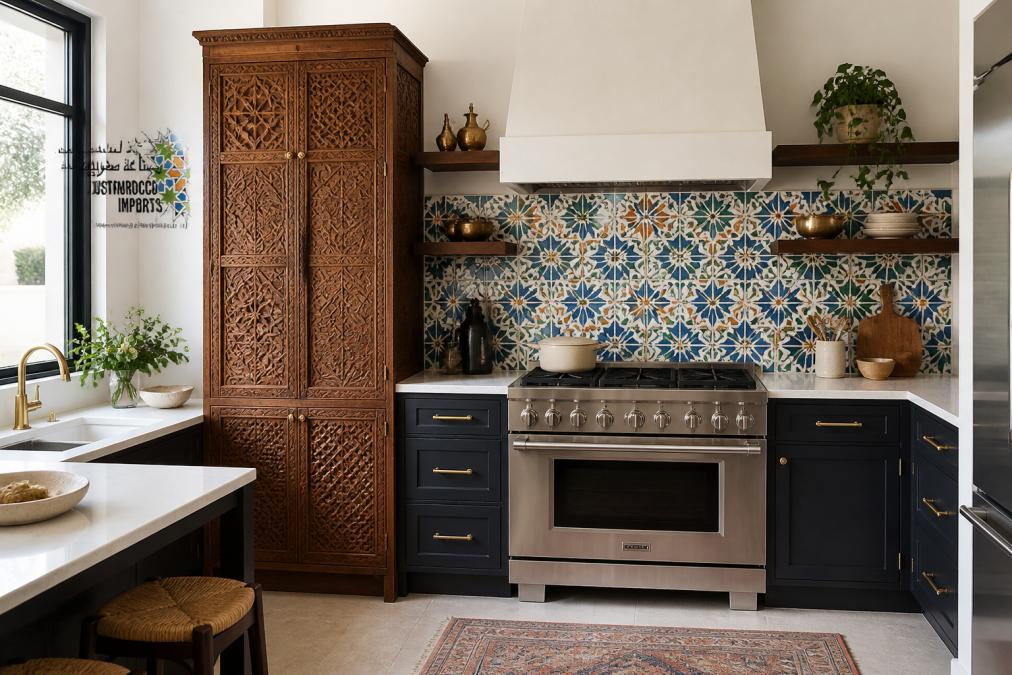
The strongest eclectic kitchen design ideas give custom cabinetry a clear job: to be the room's statement, not its backdrop. Designers who work in this style tend to start with one hero cabinet, then build the palette and materials around it.
Three approaches consistently work well:
- The collected look. Pair a vintage or antique-inspired cabinet with contemporary flat-front lowers. The contrast reads as intentional when the two share a color thread.
- The layered-texture look. Combine carved wood, zellige tile, and mother-of-pearl or bone inlay in one run of cabinetry, keeping the cabinet silhouette simple so the surfaces do the talking.
- The color-block look. Give upper and lower cabinets different finishes, then unify them with matching hardware and a single countertop material.
What most guides miss is that these ideas only hold together when the cabinetry is genuinely custom. Stock cabinets limit you to standard widths and a fixed finish menu, which is exactly what flattens an eclectic room. For a closer look at how a hand-carved statement piece changes a kitchen, see Justmorocco's Marrakech riad kitchen cabinets.
Mixing Colors, Textures, and Materials
Mixing works when one variable leads and the others follow. Choose a lead, usually color or material, and let texture and hardware support it rather than compete.
A practical sequence:
- Pick a base color for the largest cabinet run.
- Add one contrasting finish on a secondary run or island.
- Introduce texture through tile, inlay, or a woven element.
- Finish with hardware that ties the two finishes together.
Custom Cabinetry for Eclectic Homes: Defining the Style
Custom cabinetry for eclectic homes is cabinetry designed around a specific room's proportions, storage needs, and mix of styles, rather than selected from standard sizes and finishes. The defining trait is that no single style dominates. The cabinetry borrows from several traditions and unifies them through craftsmanship and consistent detailing.
This is where the technical side matters more than the mood board. A cabinet that mixes a carved door profile with a modern slab door still needs consistent reveal lines, matching hardware spacing, and a shared finish sheen. Get those wrong and the room looks improvised. Get them right and the eclecticism looks curated.
For homeowners commissioning work, the practical difference between custom and stock shows up in three places: dimensions that fit awkward walls and ceilings, finish and color matching across materials, and storage built for how you actually cook. Those three factors, not the style label, are what make the investment worthwhile.
Bespoke Kitchen Cabinetry Makers: What to Look For
The best bespoke kitchen cabinetry makers combine handcraft skills with the project management to deliver on time and to spec. Ask about both, because a maker can be a superb craftsperson and still be a poor fit for a full kitchen renovation.
Evaluate makers on four fronts:
- Craft evidence. Ask to see in-progress work, not just finished photos. Hand-carved detail and inlay work are visible at the bench stage.
- Material sourcing. Ask where the wood, tile, and inlay materials come from and how they are selected.
- Measurement and drawings. A serious maker produces shop drawings for your approval before cutting anything.
- Communication cadence. Custom work spans months. You want a maker who gives scheduled updates, not silence followed by a delivery date.
Questions to Ask Before You Commission
Ask these before you pay a deposit:
- Can you work from my architect's or designer's plans, and do you produce your own shop drawings?
- What is the lead time from approved drawings to delivery, and what could extend it?
- How do you handle a piece damaged in transit, and who insures it?
- Which finishes hold up in humid or coastal climates?
- Can you match a custom stain or color to an existing element in my home?
- What is the warranty on craftsmanship and finish?
Custom Kitchen Remodeling Projects: From Layout to Installation
Custom kitchen remodeling projects follow a sequence, and knowing it protects both your timeline and your budget. The order is: design consultation, measurement, shop drawings, material selection, fabrication, finishing, shipping, and installation. Each stage has a dependency, you cannot finalize a finish before the material is chosen, and you cannot fabricate before drawings are approved. When homeowners ask why handcrafted cabinetry takes months, this chain is the answer. Carving, inlay, and custom color matching are slow by nature, and rushing them shows in the final piece.
What most guides skip is the money and the mechanics. Here is what actually drives cost and schedule on an eclectic custom-cabinet project.
Where the Budget Actually Goes
On a bespoke cabinetry commission, the split typically lands in four buckets. Exact figures vary by maker, region, and design complexity, but the pattern is consistent:
- Materials, the cabinet body, door stock, inlay (mother-of-pearl, bone, brass), and finish products. Exotic or reclaimed stock and hand-set inlay push this line up fastest.
- Labor, hand-carving, joinery, inlay setting, and hand-finishing are the largest single line on most ornate pieces. A carved door front can take several times the bench hours of a plain slab door.
- Finishing, custom stain matching, lacquer or conversion varnish, and the cure time between coats. This is where schedule slippage usually originates.
- Logistics, crating, freight, insurance, and installation labor. Oversized islands and tall pantry columns require custom crating and sometimes a lift at delivery.
Ask for a quote that separates these four lines. A single lump-sum number hides where the cost sits, which makes it nearly impossible to adjust the design later without a surprise. If you need to trim, the honest lever is usually inlay coverage and carving density, not the cabinet box.
Permitting and Trade Sequencing
Cabinetry itself rarely requires a permit, but the work around it often does. If your remodel moves plumbing, adds or relocates electrical circuits, changes gas appliance locations, or alters structural walls, those scopes typically require permits and inspections through your local building department. Confirm who on your team pulls them, the general contractor, the cabinet maker, or you.
The sequencing mistake that costs the most time is treating cabinetry as a finish item instead of a long-lead item. A realistic overlap looks like this:
- Lock layout and materials first, before any demolition.
- Release the cabinetry to fabrication while rough plumbing and electrical are still open.
- Schedule inspections before drywall closes the walls.
- Set the cabinets after flooring is installed but before countertop templating.
- Template the countertop only after the base cabinets are set and leveled, stone fabricators need the actual installed cabinet footprint.
When cabinetry lead time runs in parallel with the trades instead of stacking on top of them, a project that would take six months serially can compress meaningfully. The single biggest cause of a stalled kitchen is a cabinet delivery that arrives after the countertop was already templated against a guess.
Decision Checkpoints You Should Not Skip
- Approved shop drawings before cutting. Dimensioned drawings are your last cheap chance to catch a wrong width, a door swing that hits an appliance, or a reveal line that will not line up.
- A physical finish sample before full production. Screens and photos distort stain and sheen. Approve a sprayed sample on the actual wood species.
- A pre-delivery walkthrough of the room. Confirm doorways, stair turns, and elevator dimensions can pass the largest piece. An island that will not fit through the door is a very expensive problem.
| Stage | Typical Duration | What You Approve |
|---|---|---|
| Design consultation | 1-2 weeks | Style direction, layout goals |
| Measurement and drawings | 2-4 weeks | Dimensioned shop drawings |
| Material and finish selection | 1-2 weeks | Wood, tile, inlay, custom stain |
| Fabrication and finishing | 8-16 weeks | Progress updates |
| Shipping | 1-3 weeks | Delivery and insurance terms |
| Installation | 1-2 weeks | Final fit and hardware |
Mixing Colors and Textures in Eclectic Cabinetry
Color and texture do different jobs, and treating them separately keeps a busy room calm. Color sets the mood; texture adds depth without adding visual noise.
A workable method is to limit yourself to two cabinet finishes and let texture carry the rest. One finish can be a solid painted color, the other a stained or natural wood. Texture then enters through carved door fronts, inlay, glass panels, or a contrasting countertop. Custom color matching lets you pull a tone directly from an existing floor, tile, or piece of furniture so the cabinetry feels native to the house.
Texture layering also solves a common problem: a room with strong color but flat surfaces can still feel two-dimensional. Carved detail and varied sheen give the eye something to travel across.
Custom Cabinetry vs. Stock Options: What Works for Eclectic Homes
Custom cabinetry is the better choice for eclectic homes in most cases, because eclectic design depends on non-standard proportions and mixed finishes that stock lines cannot supply. Stock cabinets come in fixed widths and a limited finish range, which forces the room toward uniformity.
That said, stock is not always wrong. A hybrid approach works well: use stock or semi-custom boxes for hidden storage and utility runs, and invest custom budget in the visible statement pieces. This keeps costs controlled while preserving the design impact where it counts.
| Factor | Custom | Stock |
|---|---|---|
| Dimensions | Built to your room | Fixed standard sizes |
| Finish options | Custom stain and color matching | Limited factory finishes |
| Mixed styles | Fully supported | Difficult to combine |
| Lead time | Longer | Shorter |
| Best for | Statement runs, odd spaces | Hidden storage, tight budgets |
The Role of Hardware in Eclectic Cabinetry Design
Hardware is the cheapest way to change a cabinet's character, and in eclectic design it is also the tie that binds mismatched finishes. When two cabinet runs use different colors or materials, matching hardware gives the eye a repeated element that reads as intentional. But hardware is also a mechanical system, and the specification details most guides skip are exactly the ones that determine whether your cabinets still feel solid in ten years.
The Specification Details That Matter
Bore spacing. Knobs use a single hole. Pulls use two holes set at a standard center-to-center distance, the common sizes are 3 inches, 3¾ inches (96 mm, the metric standard most imported pulls use), 5 inches, and 6¼ inches (160 mm). Once you drill, you own that spacing. If you plan to change pulls later, choose a spacing that is widely stocked, or accept that a change means filling and refinishing holes. On a hand-carved or inlaid door, filling holes is not a cosmetic fix, it can mean reworking the face.
Weight rating and hinge type. A solid hardwood door with inlay is heavy. Soft-close concealed hinges are rated by door weight and width, and an under-rated hinge sags within a year. For tall pantry columns and oversized carved doors, specify hinges rated for the actual door load, and consider a third hinge on doors over roughly 40 inches tall. Drawers follow the same logic: a deep pot drawer loaded with cast iron needs a heavy-duty slide, not a standard 75-pound-rated one.
Finish durability. Not all brass is the same. Lacquered brass holds a bright finish but can chip at the edges, exposing raw metal. Unlacquered brass develops a living patina that many eclectic kitchens want, but it will darken unevenly where hands touch most. Matte black is typically a powder coat or a plated-and-coated finish; powder coat resists chipping better than thin plating. Aged bronze and oil-rubbed bronze are usually lacquered over a darkened base, so they behave like lacquered brass over time.
Mixing Metals Without It Looking Like a Mistake
Eclectic kitchens can carry two metals, but the ratio should not be even. Pick one dominant metal for the majority of hardware, cabinet pulls, hinges visible on exposed barrels, and appliance trim, and let a second metal appear only in small, deliberate doses: a faucet, a light fixture, a single accent run. The dominant metal is what the eye reads as the room's rule; the second metal is the exception that proves it.
A reliable pairing pattern is warm-plus-neutral or cool-plus-neutral: brass with matte black, or polished nickel with aged bronze. Two strong warm metals (brass and copper) or two strong cool metals (chrome and polished nickel) tend to read as indecision rather than intent.
Scale, Placement, and Function
- Scale to the door. A small knob on a large carved door looks undersized; a long bar pull on a narrow drawer front overhangs and catches. As a rule of thumb, pull length should be roughly one-third of the drawer or door width.
- Placement consistency. On a run of drawers, center the pull horizontally and align the vertical position across the stack. On doors, place knobs near the opening edge, opposite the hinge. Inconsistent placement is the fastest way to make custom cabinetry look improvised.
- Function first. A pull that is beautiful but awkward to grip will annoy you daily. Test the grip: can you hook two fingers and pull with a loaded drawer? Bar pulls and cup pulls generally outperform small knobs on heavy drawers.
- Backplate or no backplate. Backplates protect the finish around the hole and add a period detail, but on a busy inlaid or carved face they add visual clutter. Use them on plain painted doors, skip them on ornate ones.
Hardware as the Through-Line
When two cabinet runs use different colors or materials, matching hardware is what makes the mix read as one room. Repeat the same metal, the same scale, and the same placement logic across both runs, and the eye stops noticing the finish difference as a conflict and starts reading it as a deliberate palette. That is the whole job of hardware in an eclectic kitchen: it is the repeated note that turns a collection of pieces into a composition.
Balancing Modern and Antique Elements in Custom Cabinetry
Balance comes from contrast in the right ratio, not from equal parts. A common approach is to let antique or antique-inspired cabinetry occupy the visual focal point while modern elements handle function and quiet space.
In practice, that means a hand-carved or inlaid cabinet as the hero, paired with clean-lined modern appliances, a simple countertop, and unadorned flooring. The antique element provides old-world charm; the modern elements give the room modern functionality and keep it from feeling like a period reproduction.
The mistake is adding antique detail everywhere. When every surface is ornate, nothing stands out and the room feels heavy. Restraint around the hero piece is what makes it read as a deliberate choice.
Choosing Materials for Bespoke Cabinets
Material choice drives both the look and the lifespan of bespoke cabinets, so it deserves more attention than the finish sample. Start with the cabinet body, then the door, then the inlay and hardware.
Solid hardwoods hold up best for door frames and structural parts. Painted finishes suit a modern-eclectic look and hide minor wear well; stained and natural finishes show the grain and reward good craftsmanship. For inlay work, mother-of-pearl and bone are traditional and striking, but they need a maker who knows how to set them so they stay flat over time.
Climate matters. In humid or coastal conditions, wood movement is real, and the finish and joinery need to account for it. Ask any maker how their construction handles seasonal expansion.
Maximizing Storage in Small Eclectic Spaces
Storage in a small eclectic kitchen comes from going vertical and using every odd corner. Custom cabinetry wins here because it can be built into spaces that stock sizes cannot fill.
Practical moves:
- Run cabinets to the ceiling for a tall pantry or display column.
- Use a corner for a custom carousel or deep pull-out rather than a dead blind corner.
- Build shallow cabinets into a recess or beside a fridge for spices and small items.
- Choose a contrasting island or peninsula with storage underneath instead of a freestanding table.
The design payoff is that storage becomes part of the aesthetic. A tall, hand-carved pantry column can be the room's most striking feature and its most useful one.
Contrasting Island Designs for Eclectic Kitchens
A contrasting island is the fastest way to add eclecticism without touching the main cabinet run. Give the island a different finish, material, or silhouette from the perimeter cabinets and the room gains a focal point.
Three proven approaches: a stained wood island against painted perimeter cabinets; a stone or tile-clad island against wood; or a carved or inlaid island front against plain surrounding cabinetry. Keep the countertop and hardware consistent between island and perimeter so the contrast reads as designed.
An island is also where custom cabinetry earns its keep, because the dimensions rarely match a standard size. Building the island to the room's exact proportions and the cook's preferred working height is a detail stock options cannot match.
Budgeting for Bespoke vs. Semi-Custom Cabinetry
Budgeting for bespoke cabinetry starts with deciding which runs are seen and which are hidden. Bespoke costs more because of labor: hand-carving, inlay, custom color matching, and one-off construction all take time, and that time is the price.
A workable budget strategy is to tier your cabinetry. Spend bespoke budget on the visible statement pieces, the island, and any hand-carved or inlaid fronts. Use semi-custom or stock for concealed storage, utility runs, and closets. This preserves the design where it shows and controls cost where it does not.
Get a written quote that separates materials, labor, finishing, shipping, and installation. A single lump-sum number hides where the cost actually sits, which makes it hard to adjust the design later without surprises. Because Justmorocco's cabinetry is quoted per project, the exact figure depends on dimensions, materials, and finish, and your design consultation is where those numbers get pinned down.
Sustainable Material Sourcing for Custom Cabinets
Sustainable sourcing for custom cabinets comes down to knowing where the wood and inlay materials originate and how they are handled. This is a topic most design guides skip entirely, yet it affects both the environmental footprint and the long-term story of the piece.
Ask makers three questions: where the timber is sourced, whether reclaimed or responsibly harvested wood is available, and how offcuts are used. Reclaimed wood is a strong fit for eclectic design because it arrives with natural variation and history, which is exactly the character the style is chasing. Traditional handcraft methods also tend to be lower-waste than factory production, since pieces are cut to fit a specific room rather than trimmed from standard sizes.
For buyers who care about provenance, a maker who can describe the source of each material is also a maker who can stand behind the finished piece.
Maintenance and Longevity of Eclectic Cabinetry Finishes
Eclectic cabinetry lasts when the finish is matched to the room's conditions and maintained on a simple schedule. Handcrafted and inlaid pieces are not fragile, but they do reward basic care.
- Dust carved and inlaid surfaces with a soft, dry cloth rather than a wet one.
- Wipe painted and stained finishes with a damp cloth and mild soap, then dry immediately.
- Keep humidity stable where you can, since swings in moisture are harder on wood than steady humidity.
- Re-tighten hardware periodically, especially on doors that get daily use.
- Address small chips or lifting inlay early, before moisture gets behind the finish.
The longevity of a bespoke piece is one of its real advantages. A well-built cabinet can be refinished and re-hardwared decades later, which is not true of most stock cabinetry.
An eclectic kitchen asks a lot of its cabinetry: it has to carry mixed styles, unusual dimensions, and finishes that most stock lines cannot produce. That is exactly the kind of work Justmorocco does, from hand-carved and mother-of-pearl inlay pieces to full custom kitchen and bathroom remodeling, alongside custom furniture imports for homeowners who want the same craftsmanship beyond the kitchen. Our team builds cabinetry to your room's real measurements and your architect's plans, with authentic Moroccan craftsmanship and direct shipping to California, Texas, New York, and Florida. Explore the Marrakech riad kitchen cabinets and the rest of our custom collection, or start a design consultation with Justmorocco to turn your layout into a one-of-a-kind kitchen.
Frequently Asked Questions
How do you balance custom cabinetry with an eclectic design style?
Balance comes from anchoring the space with a cohesive element, such as a consistent color palette or a repeated material like brass hardware, while letting other pieces vary in style and era. For example, pair a sleek, modern island with ornate, hand-carved upper cabinets. The key is to repeat at least one design thread, whether it is a wood tone or a geometric motif, so the room feels intentional rather than chaotic.
What materials work best for eclectic kitchen cabinetry?
Solid woods like oak, walnut, or mahogany offer durability and take stain well for custom color matching. For an eclectic look, mix in metal accents like brass or iron, and consider glass-front doors to break up visual weight. Hand-painted finishes or natural wood grain can both work, as long as they tie into your overall color palette.
Can custom cabinetry incorporate traditional Moroccan architectural elements?
Yes. Moroccan design offers rich inspiration: carved wood panels, geometric tile insets, and mother-of-pearl inlays can all be integrated into cabinet doors and drawer fronts. These details add old-world charm while maintaining modern functionality. Working with a maker experienced in both custom cabinetry and Moroccan craftsmanship ensures the proportions and finishes are authentic.
How do you mix textures and finishes in eclectic kitchen design?
Start by selecting a dominant finish, such as matte wood, then layer in contrasting textures like glossy tile, woven rattan, or aged metal. For example, pair smooth, painted cabinets with a rough-hewn stone countertop and a hammered metal sink. The goal is to create visual interest without overwhelming the eye; limit yourself to three main textures per view.
What are the benefits of bespoke cabinetry for unique architectural layouts?
Bespoke cabinetry is built to your exact space, so it can accommodate odd angles, sloped ceilings, or irregular walls that stock cabinets cannot fit. This maximizes storage and creates a seamless look. It also lets you choose every detail, from door style to hardware, ensuring the cabinetry suits your eclectic aesthetic and functional needs.
How much does custom cabinetry for an eclectic kitchen typically cost?
Costs vary widely based on size, materials, and complexity. When budgeting, factor in design fees, shipping, and installation. Requesting a detailed quote from a maker like Justmorocco helps you compare options accurately.