

Table of Contents
- Custom vs. Semi-Custom vs. Stock Cabinets: What's the Real Difference?
- Average Cost of Custom Kitchen Cabinets Explained
- Material Quality and Durability: What You're Paying For
- Design Flexibility and Space Optimization
- Kitchen Cabinet ROI: Will Custom Cabinetry Pay Back?
- Lead Times and Installation: The Timeline Factor
- Environmental Impact and Sustainability Considerations
- The Hybrid Approach: Blending Custom and Semi-Custom
- Is Custom Cabinetry Worth It for Your Kitchen?
- Frequently Asked Questions
Last Updated: September 26, 2026
Custom vs. Semi-Custom vs. Stock Cabinets: What's the Real Difference?
When you're planning a kitchen remodel, the cabinet decision shapes everything else. Is custom cabinetry worth the cost? That depends on what you're comparing it to and what your kitchen actually needs. The three main options, stock, semi-custom, and custom, sit at different price points and offer different levels of control. Understanding the real differences helps you decide whether custom cabinetry cost is justified for your project.
Stock cabinets are factory-made in standard sizes. Semi-custom cabinets offer limited modifications within a set range. Custom cabinetry is built to your exact specifications. Each tier serves a different kitchen and a different budget. The key question isn't which is "best", it's which matches your layout, timeline, and how much personalization matters to you.
Stock Cabinets: Speed and Affordability
Stock cabinets arrive ready to install. They come in preset dimensions and finishes. You pick from what's available, arrange them in your space, and that's your kitchen. Installation happens fast because there's no waiting for fabrication.
The trade-off is obvious: no flexibility. Your kitchen layout must fit the standard sizes. If you have an awkward corner or a gap that doesn't align with standard widths, you either leave dead space or fill it with filler panels. Stock options work well for straightforward rectangular kitchens with conventional layouts.
These cabinets use particle board or plywood construction. Hardware is basic. Finishes are limited to what the manufacturer stocks. You're not paying for customization because you're not getting any. The speed and low cost make sense for renters, quick flips, or kitchens where aesthetics matter less than function.
Semi-Custom Cabinets: The Middle Ground
Semi-custom cabinets split the difference. The cabinet box comes from a factory, but you can modify door styles, finishes, and hardware within the manufacturer's options. You can adjust depth or height in small increments. Some semi-custom lines offer storage solutions stock cabinets don't include.
Lead times are longer than stock but much shorter than full custom. You're waiting weeks instead of months. The cost sits between stock and custom, higher than off-the-shelf but substantially lower than bespoke work.
This approach works for kitchens with minor layout challenges. You can adapt the cabinets enough to fit your space without the premium of full customization. Semi-custom cabinetry gives you more design flexibility than stock while keeping the project timeline and budget reasonable.
Custom Cabinetry: Full Control and Craftsmanship
Custom cabinetry is built specifically for your kitchen. Every dimension, material choice, and detail is yours to decide. You work with a designer or cabinet maker who translates your vision into a finished product.
This is where custom cabinetry cost becomes significant. You're paying for design consultation, precision fabrication, and often higher-quality materials. Lead times stretch to several months. The cabinet box might be solid wood or plywood, but the construction quality and attention to detail exceed factory standards.
When you choose custom, you're not just filling space, you're creating a kitchen that reflects your aesthetic and solves your specific layout challenges. For homeowners seeking distinctive design, custom furniture imports offer access to handcrafted pieces that blend traditional artistry with modern functionality that elevate your kitchen beyond standard options.
| Cabinet Type | Lead Time | Design Flexibility | Material Quality | Installation Complexity |
|---|---|---|---|---|
| Stock | 1-2 weeks | Minimal | Standard particle board | Simple |
| Semi-Custom | 4-8 weeks | Moderate | Plywood or veneer | Moderate |
| Custom | 8-16 weeks | Maximum | Solid wood or premium plywood | Varies |
Average Cost of Custom Kitchen Cabinets Explained
Custom cabinetry cost depends on several factors: the size of your kitchen, material choices, hardware, and the level of detail in the design. There's no universal price because each project is built to order.
Most custom cabinet projects involve a cost per linear foot calculation. This gives you a baseline before accounting for special features, premium materials, or complex installations. Understanding what drives the cost helps you make informed decisions about where to invest and where to simplify.
Price Per Linear Foot Breakdown
Linear foot pricing varies widely depending on construction quality, materials, and finish. Basic custom cabinetry runs lower. Premium finishes, solid wood construction, and intricate detailing push costs higher.
The price per linear foot is a starting point, not a final number. A kitchen with 30 linear feet of cabinets costs more in total than one with 20 linear feet, but the per-foot rate often decreases at higher volumes. Island cabinetry, specialized storage, and architectural details add to the total.
Your layout matters. A galley kitchen with cabinets on two walls costs less overall than an L-shaped kitchen with more total footage. An open kitchen with a large island requires more cabinetry and more design work.
Hidden Costs You Need to Know
Custom cabinetry cost extends beyond the cabinet price. Installation labor is significant, especially for complex layouts. Your contractor needs to prep the space, remove old cabinets, handle plumbing and electrical work around the new installation, and manage finishing details like trim and caulk.
Design consultation fees may apply if you're working with a cabinet maker or designer. Some charge hourly rates; others include design in the cabinet price. Clarify this upfront.
Hardware upgrades add cost. Soft-close hinges and dovetail drawer construction cost more than basic hardware. If you want authentic Moroccan brass or hand-forged iron hardware, expect premium pricing.
Backsplash, countertops, and flooring are separate line items. Many homeowners underestimate how much these finishing elements cost relative to the cabinets themselves. According to the National Kitchen and Bath Association, cabinetry typically represents 30-40% of a kitchen remodel budget, with the remainder split among countertops, appliances, flooring, and labor.
Shipping costs apply if your cabinets are built off-site and transported to your home. For specialized handcrafted cabinetry, protecting artisan pieces during transit requires professional packing and often insurance.
Material Quality and Durability: What You're Paying For
When you choose custom cabinetry, you're often choosing better materials and construction methods than stock alternatives. The difference shows up in how well your cabinets perform over time.
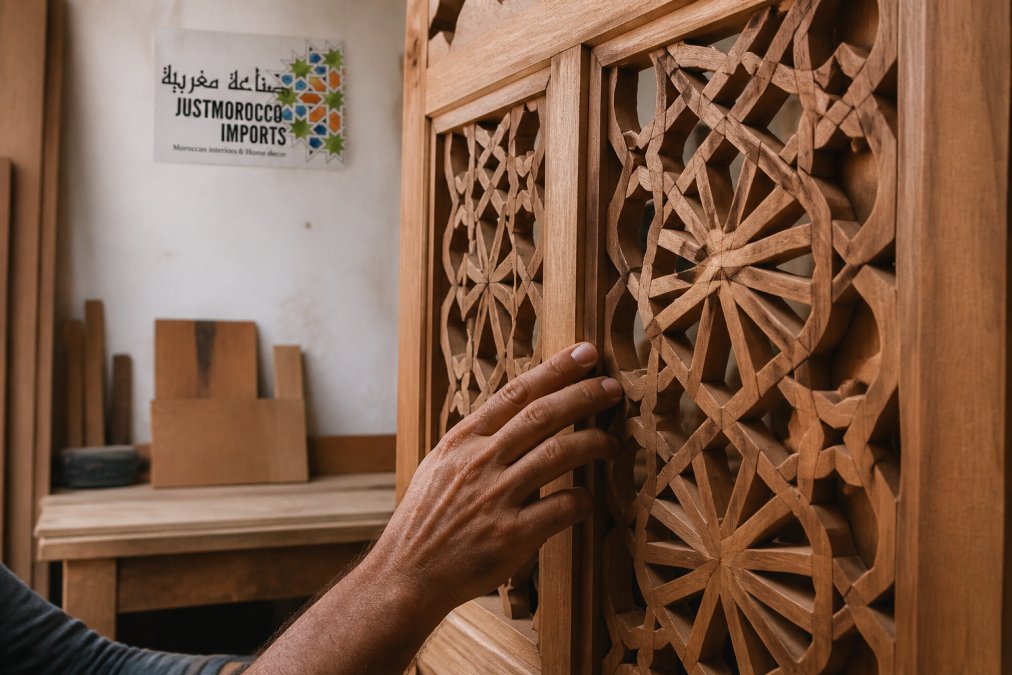
Solid Wood vs. Plywood Construction
Solid wood cabinets are built from boards joined together. They're durable and can be refinished or repaired easily. Solid wood expands and contracts with humidity, which is why proper finishing is critical.
Plywood construction uses engineered sheets with wood veneer. It's stable, resists warping, and works well in humid climates. Premium plywood holds up as well as solid wood for most kitchen applications. The difference is mainly aesthetic and personal preference.
Particle board is cheaper but less durable. It swells when exposed to moisture and can't be repaired like solid wood or plywood. Most custom cabinetry uses plywood or solid wood, not particle board.
The material choice affects longevity. A solid wood cabinet can last 20-30 years or longer with proper care. Plywood cabinets perform similarly. Particle board cabinets typically need replacement after 10-15 years. When evaluating custom cabinetry cost, consider how many years the cabinets will serve your home.
Hardware and Finish Quality
Cabinet hardware, hinges, handles, drawer slides, makes a difference in daily use. Soft-close hinges prevent slamming and last longer than standard hinges. Dovetail drawer construction holds up better than simple butt joints. These details add cost but improve durability.
Finish quality determines how well your cabinets resist moisture, staining, and wear. A properly sealed finish protects the wood underneath. Cheap finishes chip easily and expose the material to water damage. Premium finishes used in traditional Moroccan design create a protective layer that ages beautifully.
Hand-applied finishes, common in custom work, often outperform factory spraying. Craftspeople take time to sand between coats and apply multiple layers. This process is slower and more expensive but produces a more durable result.
Design Flexibility and Space Optimization
Custom cabinetry solves layout problems stock cabinets can't. Awkward corners, sloped ceilings, odd wall angles, these challenges disappear when cabinets are built to fit your exact space.
This flexibility extends beyond fitting the room. You can incorporate specialized storage: pull-out spice racks, deep drawers for baking sheets, wine racks, or appliance garages. Semi-custom lines offer some of these options. Custom work opens up possibilities limited only by your imagination and budget.
Marrakech riad kitchen cabinets →
Space optimization matters in smaller kitchens. Every inch counts. Custom cabinetry maximizes storage by using full height, corner space, and awkward angles. The result is more usable storage in the same footprint.
Design flexibility also means your cabinets match your aesthetic. Whether you want carved panels with intricate geometric patterns, modern minimalist lines, or traditional shaker doors, custom is the only option that delivers exactly what you envision.
Kitchen Cabinet ROI: Will Custom Cabinetry Pay Back?
The question isn't just whether custom cabinetry is worth the cost, it's whether you'll recover that investment when you sell your home.
Kitchen remodels return about 50-60% of their cost at resale, depending on the market and the quality of the work. Custom cabinetry, being a major component, directly affects this number. The return depends on whether future buyers see the cabinets as an asset or an oddity.
Resale Value and Home Equity Impact
Homes with updated kitchens sell faster and command higher prices. Custom cabinetry signals quality and care. Buyers see well-made cabinets as a feature they don't need to replace immediately. This perception adds value.
However, highly personalized design can work against you. If your custom cabinetry reflects your specific taste but doesn't appeal to mainstream buyers, the resale value may not reflect your investment. The sweet spot is custom cabinetry that solves real problems (better storage, perfect fit, higher quality) while maintaining broad appeal.
Location matters. In design-forward markets where buyers value craftsmanship and unique aesthetics, custom cabinetry commands premium resale value. In conservative markets focused on neutral, timeless design, the premium is smaller.
Long-Term Maintenance and Repairability
Custom cabinets built from quality materials and solid construction last longer than stock alternatives. This longevity is part of the value proposition. A cabinet that functions well for 25 years costs less per year than one that needs replacement after 15 years.
Repairability is an advantage of custom work. If a drawer slide fails or a hinge breaks, replacement parts can often be sourced or custom-made. Stock cabinet parts become harder to find as models are discontinued. Solid wood cabinets can be refinished or repaired by a skilled craftsperson. This extends the life and maintains the investment.
Maintenance requirements vary by material and finish. Solid wood requires periodic conditioning to maintain the finish. Plywood with a sealed finish needs less maintenance. Handcrafted designs with traditional finishes require care appropriate to the materials, something to factor into long-term ownership costs.
Lead Times and Installation: The Timeline Factor
Custom cabinetry doesn't happen overnight. Understanding the timeline helps you plan your remodel and manage expectations.
Lead times for custom cabinets typically range from 8 to 16 weeks, depending on the complexity of the design and the current workload of the cabinet maker. Some specialized craftspeople have longer lead times. Artisans creating hand-carved, bespoke pieces may require 12-20 weeks or longer.
Installation adds another 1-3 weeks, depending on your kitchen's complexity. Removing old cabinets, prepping the space, and installing new ones takes time. If plumbing or electrical work is needed, the timeline extends.
Planning ahead is critical. If you need your kitchen remodeled by a specific date, custom cabinetry might not fit your timeline. Semi-custom or stock cabinets are faster alternatives. Communicating your deadline upfront with your cabinet maker or designer ensures you understand whether the project can meet your schedule.
Environmental Impact and Sustainability Considerations
Custom cabinetry built from sustainably sourced materials has a lower environmental impact than mass-produced alternatives. When you commission a custom piece, you can specify materials and request documentation of their origin.
Solid wood from responsibly managed forests is a sustainable choice. Plywood made from fast-growing species reduces pressure on old-growth forests. Some cabinet makers use reclaimed wood or salvaged materials, further reducing environmental impact.
The longevity of custom cabinetry matters environmentally. A cabinet that lasts 25 years has a lower per-year environmental cost than one replaced every 10 years. Quality construction and repairability extend the useful life, reducing waste.
Handcrafted cabinetry often emphasizes traditional methods. Balancing aesthetic and cultural preferences with environmental concerns is part of the decision-making process.
The Hybrid Approach: Blending Custom and Semi-Custom
Not every kitchen requires full custom cabinetry. A hybrid approach uses semi-custom cabinets for the bulk of the kitchen and custom elements for specific challenges or design features.
For example, you might use semi-custom base and wall cabinets for standard storage, then commission custom pieces for an island, a unique corner solution, or accent cabinetry with distinctive design elements. This approach reduces cost and timeline while still delivering custom solutions where they matter most.
The hybrid method works well when you have one or two specific design goals, like incorporating handcrafted, artisan-inspired doors in key areas while keeping the rest of the kitchen functional and affordable. You get the aesthetic impact and personalization without the cost of fully custom throughout.
Is Custom Cabinetry Worth It for Your Kitchen?
Custom cabinetry cost is justified when your kitchen has specific needs that stock or semi-custom cabinets can't solve. If your layout is challenging, if you have a clear design vision, or if you prioritize durability and craftsmanship, custom is worth the investment.
Custom cabinetry is less critical if your kitchen layout is straightforward, if you're selling soon and want to minimize investment, or if your budget is tight. In these situations, semi-custom or stock cabinets deliver good value.
The decision comes down to three factors: your kitchen's specific requirements, your design priorities, and your timeline. If your kitchen demands custom solutions and you can invest in quality craftsmanship, the cost pays off in function, durability, and satisfaction. If your needs are simpler, semi-custom or stock options serve you well.
When custom cabinetry aligns with your kitchen's actual needs, whether that's solving layout challenges, incorporating distinctive artisan design elements, or maximizing storage in an awkward space, the investment makes sense. Exploring options through specialized sources like custom furniture imports can help you discover handcrafted cabinetry that transforms your kitchen into a luxurious, functional space reflecting authentic craftsmanship.
Custom cabinetry cost is an investment in your home's functionality, aesthetics, and long-term value. The decision requires honest assessment of your kitchen's needs, your design goals, and your budget. When custom cabinetry solves real problems and reflects your vision, the cost is justified.
Frequently Asked Questions
Is custom cabinetry really worth the investment for a kitchen remodel?
Custom cabinetry is worth the investment if your kitchen layout requires non-standard dimensions, you prioritize durability over decades, or you want design elements that reflect your personal style. Stock and semi-custom options suit tight budgets and standard layouts. The decision hinges on how long you plan to stay in your home, your budget flexibility, and whether your space has awkward angles or specialized storage needs that stock cabinets cannot address.
What is the average cost of custom kitchen cabinets per linear foot?
Custom kitchen cabinetry typically costs between $150 to $300+ per linear foot, depending on materials, finish complexity, and hardware. This includes the cabinet box, doors, and basic installation labor. Premium options with solid wood construction or hand-carved details can exceed $300 per linear foot. A 10-foot run of custom cabinets ranges from $1,500 to $3,000+, making a full kitchen remodel a significant investment.
How do custom, semi-custom, and stock cabinets compare in durability?
Custom cabinetry typically offers superior durability because it uses solid wood, dovetail drawer joints, and premium hardware like soft-close hinges. Semi-custom cabinets fall in the middle with plywood construction and mid-range hardware. Stock cabinets use particle board and basic hinges, making them prone to warping and wear within 5-10 years in humid kitchens. Custom pieces built with solid wood and quality materials can last 20-30 years or more with proper maintenance.
Will custom kitchen cabinets increase my home's resale value?
Custom cabinetry can increase resale value by 50-60% of the project cost if the design appeals to future buyers and matches the home's overall aesthetic. However, highly personalized or niche designs (such as ornate Moroccan styles) may appeal to a narrower buyer pool. Neutral, well-crafted custom cabinets in solid wood tend to recover investment better than trendy or overly specialized options. Consult your real estate agent about design choices that balance personal preference with broad market appeal.
How long does a custom kitchen cabinet project take from design to installation?
Custom cabinetry projects typically take 12-16 weeks from initial design to installation, including design approval, fabrication, and delivery. Lead times vary based on complexity, material sourcing, and the craftsperson's workload. Rush options may be available but often increase costs. Planning ahead is essential if you have a specific move-in date or seasonal deadline for your kitchen remodel.