

Table of Contents
- What Makes Moroccan Mosaic Fountains Authentic
- Handcrafted Zellige Tile Fountains: Understanding Traditional Craftsmanship
- Top Moroccan Mosaic Fountain Sellers and What Sets Them Apart
- How to Maintain Moroccan Mosaic Fountains Year-Round
- Outdoor Garden Water Feature Installation Essentials
- Verifying Authenticity Before You Buy
- Choosing the Right Moroccan Mosaic Fountain for Your Space
- Conclusion
Last Updated: August 7, 2026
What Makes Moroccan Mosaic Fountains Authentic
moroccan mosaic fountainsAuthentic moroccan mosaic fountains are hand-cut and hand-assembled using traditional zellige tile techniques refined over centuries in Morocco's medinas. The difference is immediate: authentic pieces feature irregular tile sizes and subtle color variations, with geometric patterns following traditional Moorish design principles. Mass-produced alternatives use uniform tiles and predictable patterns that lack handmade character.
Justmorocco mosaic tile fountains specializes in sourcing authentic moroccan mosaic fountains with hand-chiseled mosaic tiles featuring distinct Andalusian and Moorish patterns, designed for both indoor and outdoor applications.
Handcrafted Zellige Tile Fountains: Understanding Traditional Craftsmanship
Zellige, hand-cut geometric tilework, represents one of Morocco's most revered crafts. Each tile is individually cut from clay, glazed with traditional formulas, and assembled by master artisans into intricate patterns that can take weeks to complete.
Traditional zellige fountains begin with clay sourced from specific Moroccan regions, hand-shaped, dried, and fired in kilns that achieve the characteristic glaze finish. The assembly process requires specialized knowledge: artisans must understand water flow, grout setting, and structural integrity. A skilled craftsperson reads the tiles instinctively, adjusting patterns to accommodate the fountain's basin and pump system.
Fountains crafted in Fez, Morocco's traditional tilework center, carry particular prestige. The "Zellige de Fès" certification indicates handmade construction using methods passed down through generations. When evaluating handcrafted options, look for color variations within glaze colors, slight size differences between tiles, and organic rather than perfectly symmetrical patterns. Uniform, machine-perfect fountains likely came from factories.
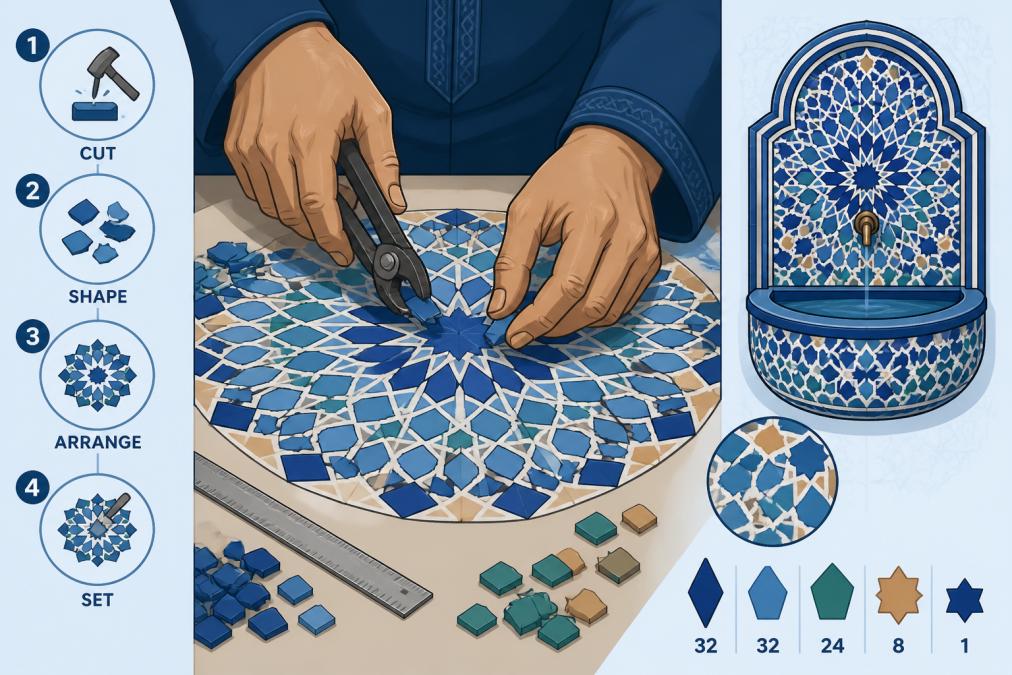
The market includes direct artisans, specialty importers, and marketplace platforms, each offering different advantages for customization, price, authenticity verification, or delivery speed.
Justmorocco: Custom Design and Authentic Craftsmanship
Justmorocco offers custom Moroccan mosaic fountains with hand-chiseled tiles and distinct Andalusian Moorish patterns. The brand integrates with custom kitchen and bathroom remodeling services, coordinating fountain selection with other Moroccan architectural elements for cohesive design. Fountains suit both indoor and outdoor use, with direct shipping to California, Texas, New York, and Florida.
Zelligery: Traditional Zellij Tiles with Included Pumps
Zelligery focuses on handcrafted mosaic fountains made with traditional Moroccan Zellij tiles. Every purchase includes a water pump for immediate use. Their custom order option allows you to specify dimensions, color palettes, and pattern details, while pre-designed fountains offer faster delivery.
Artezanya Tile specializes in handmade mosaic fountains crafted in Fez with Zellige de Fès certification, verifying traditional methods by historic medina artisans. The brand offers wall and floor fountains with extensive customization for dimensions, colors, and patterns. Fountains are supplied ungrouted in sections, requiring professional installation.
Justmorocco: Nationwide Shipping
Justmorocco offers Moroccan and Moorish mosaic fountains with in-stock and custom-sized options, shipping nationwide. Their strength is variety, with multiple design styles and custom sizes available.
Marketplace Options: Salima shop Etsy
Etsy hosts multiple sellers offering handmade fountains directly from artisans, providing access to unique pieces with varying quality and shipping policies. Chairish curates vintage and antique Moroccan fountains for collectors seeking historically significant pieces. casbah decor carries a wide variety with several in-stock items for faster availability.
| Seller | Sourcing | Customization | Best For | Lead Time |
|---|---|---|---|---|
| Justmorocco | Direct artisans | Extensive custom design | High-end renovation projects | 4-8 weeks |
| Salima shop | Traditional Zellij artisans | Custom available | Buyers wanting included pump | 2-6 weeks |
| casbahdecor | Fez artisans (certified) | High customization | Luxury installations | 6-10 weeks |
| Moroccan furniture decor | Moroccan artisans | Custom sizes available | Nationwide buyers | Varies |
| Etsy | Individual artisans | Varies by seller | Unique, one-of-a-kind pieces | Varies |
| Chairish | Vintage/antique sources | Not customizable | Collectors seeking history | Varies |
| Artezanya | Traditional artisans | Custom and in-stock | Faster availability preferred | 2-4 weeks |
How to Maintain Moroccan Mosaic Fountains Year-Round
Maintaining a moroccan mosaic fountain requires understanding how water, temperature, and weather affect tilework and mechanical components. Use distilled water when possible to prevent mineral deposits, or add a water softener tablet. Clean the basin monthly by draining completely and wiping tiles with a soft cloth.
For outdoor fountains in freezing climates, drain completely before the first freeze, as trapped water will crack tiles. Remove and store the pump indoors, and cover with breathable fabric (never plastic). In warm coastal climates, rinse weekly with fresh water and clean the pump intake monthly to prevent algae growth and mineral buildup.
Pump maintenance is critical. Clean the intake monthly of debris and mineral deposits. If water flow decreases, the pump intake needs cleaning. Replace pump filters annually. Inspect grout lines seasonally for cracks and seal minor ones with waterproof grout sealant.
Outdoor Garden Water Feature Installation Essentials
Installing a moroccan mosaic fountain requires attention to placement, water supply, drainage, and electrical considerations. Choose a spot visible from main living areas with partial shade to reduce algae growth and evaporation. The location must be level to prevent tilting that stresses tilework.
Plan water supply and drainage before installation. Your fountain needs access to a water source for initial filling and periodic top-ups. Plan for drainage so overflow won't damage nearby structures. Electrical access is essential for the pump: most fountains require a standard outdoor outlet within 10-15 feet. Use a GFCI outlet for safety.
The fountain's base must be stable and level. For soil installation, create a level foundation using landscape fabric, sand, and compacted soil. For patio installations, ensure the surface is completely level. Professional installation is recommended for large or custom fountains.
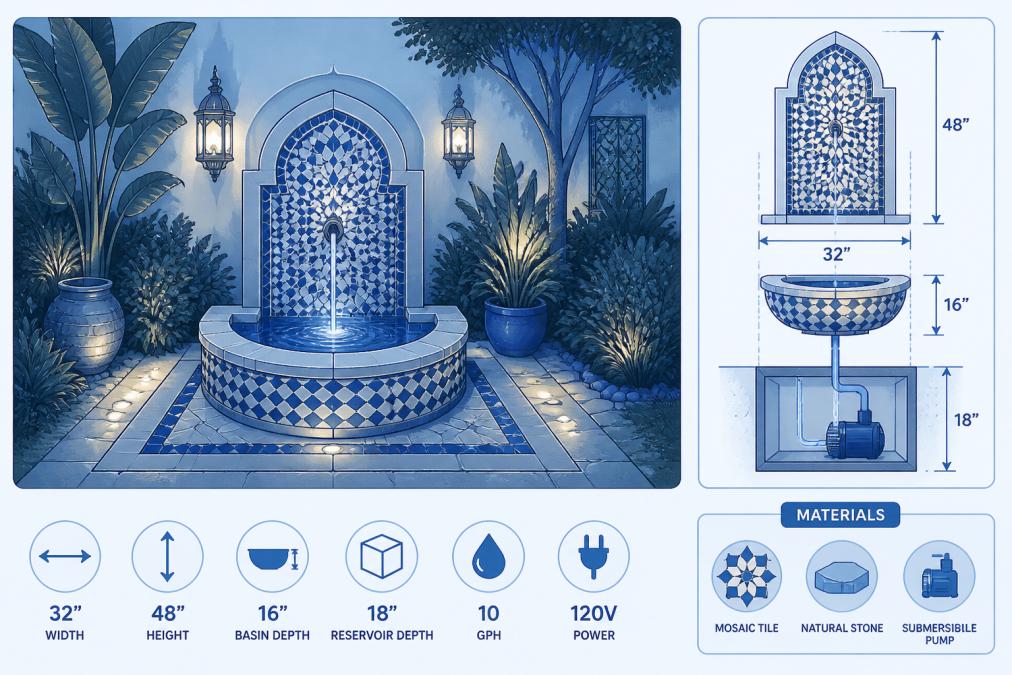
Before turning on the pump, fill the basin completely and check for leaks. Let the fountain run for 24 hours to ensure all connections are secure. Monitor water level daily during the first week to establish your evaporation rate.
Verifying Authenticity Before You Buy
Authenticating a moroccan mosaic fountain requires examining specific details that distinguish genuine handcrafted pieces from mass-produced imitations.
Examine tile work closely. Authentic zellige tiles show subtle variations in color, size, and glaze finish. Run your fingers across the surface: authentic tiles have slight irregularities and texture variations. Uniform, perfectly smooth tiles suggest factory production. Hand-cut edges show tool marks and slight irregularities, while factory tiles have perfectly clean edges.
Check grout lines. Handmade fountains have grout lines that vary slightly in width as artisans accommodate natural size variations. Factory fountains have perfectly uniform grout lines. Examine the fountain's back if possible for evidence of hand assembly.
Ask about origin. Reputable sellers should specify where the fountain was made and by whom. Fountains from Fez with Zellige de Fès certification carry documented authenticity. Request high-resolution photos of the front, back, and sides. Check the weight: authentic zellige fountains are heavy due to thick ceramic tiles and substantial basins.
Verify seller reputation through reviews from previous buyers, particularly regarding durability and accuracy to product photos. Sellers with long histories and consistently positive reviews are more likely selling authentic pieces.
Choosing the Right Moroccan Mosaic Fountain for Your Space
Selecting the right fountain depends on space dimensions, climate, design aesthetic, and maintenance capacity.
Size considerations: Measure your installation area carefully, accounting for the fountain's footprint plus space for water splashing and maintenance. A fountain should occupy 5-10% of visible floor space in a courtyard or garden.
Wall fountains versus floor fountains: Wall fountains attach to existing structures and save floor space, ideal for small patios. Floor fountains are standalone focal points. Wall fountains typically require less water and pump power.
Design style: Geometric patterns suit modern interiors and contemporary gardens, while floral designs work well in traditional or eclectic spaces. Consider your home's existing aesthetic.
Climate suitability: Humid coastal climates require more frequent maintenance. Arid climates evaporate water faster but face fewer moisture issues. Cold regions require annual winterization.
Customization options: Custom fountains allow matching tile colors and patterns to your design scheme, taking longer and costing more but delivering unique integration.
Budget reality: Authentic handcrafted fountains represent significant investment. Determine your budget and discuss options with sellers who can work within your price range.
Conclusion
Buying an authentic moroccan mosaic fountain online requires understanding the difference between handcrafted zellige work and mass-produced imitations. Justmorocco offers custom Moroccan mosaic fountains with hand-chiseled tiles and distinct Andalusian patterns, designed for both indoor and outdoor use. The brand's specialty in custom kitchen and bathroom remodeling means you can coordinate your fountain with broader design elements, with direct shipping to California, Texas, New York, and Florida.
When you choose a fountain from a seller who can document the artisan's work, verify the origin, and stand behind the craftsmanship, you're investing in a piece that will enhance your space for decades. Learn more about authentic Moroccan tile craftsmanship and traditional zellige techniques to deepen your understanding before making your purchase decision.
Frequently Asked Questions
How can you tell if a Moroccan mosaic fountain is authentic?
Authentic Moroccan mosaic fountains feature hand-cut zellige tiles with slight variations in size and color, uniformity signals mass production. Look for artisan signatures or certifications like Zellige de Fès, which guarantees craftsmanship from Fez, Morocco. Examine the backing: genuine pieces use reinforced clay or plaster bases, not plastic. Ask sellers for photos of the artisan at work, documentation of origin, and detailed descriptions of materials. Avoid fountains with perfectly uniform tiles or suspiciously low prices compared to competitors.
What is zellige tile and why is it used in Moroccan fountains?
Zellige (also spelled zellij) refers to hand-cut geometric mosaic tiles traditionally crafted in Morocco using centuries-old techniques. Each tile is individually cut and glazed, creating intricate interlocking patterns that are both visually striking and structurally sound. Moroccan fountains use zellige because these tiles are weather-resistant, colorfast, and designed to withstand constant water exposure. The geometric and floral patterns are integral to Moorish architectural design, making zellige fountains authentic expressions of Moroccan cultural heritage and artistry.
Are Moroccan mosaic fountains suitable for outdoor use in the US, including coastal climates?
Yes, authentic handcrafted Moroccan mosaic fountains are designed for outdoor use and can withstand US weather conditions, including humidity and temperature fluctuations. However, in coastal areas with salt air or extreme freeze-thaw cycles, proper maintenance becomes critical. Ensure the fountain has adequate drainage to prevent water pooling, apply protective sealant to grout annually, and drain the basin before winter in freezing climates. Choose fountains with reinforced bases and weather-resistant glazing. Consult with sellers about climate-specific recommendations for your region before purchasing.
How do you maintain a Moroccan tile fountain during winter?
In winter, drain the fountain completely and turn off the water pump to prevent ice damage to internal plumbing and tile expansion. Cover the fountain with a breathable tarp to protect from debris and excessive moisture while allowing air circulation. In freezing climates (below 32°F regularly), this step prevents water from freezing inside tiles and causing cracks. Clean the fountain thoroughly before draining, removing algae and mineral deposits. Store removable decorative elements indoors. In spring, refill slowly, inspect for damage, and restart the pump. Regular winterization extends the life of your handcrafted fountain significantly.
Do Moroccan mosaic fountains require professional installation?
Installation complexity depends on the fountain type. Pre-assembled fountains with integrated pumps can often be positioned by homeowners with basic plumbing knowledge. However, custom or ungrouted zellige fountains (supplied in sections) typically require professional installation to ensure proper alignment, grouting, waterproofing, and plumbing integration. Professional installers understand the specific needs of handcrafted pieces and can assess your site for drainage, electrical access, and structural support. For high-value custom projects, professional installation protects your investment and ensures optimal performance and longevity