

Table of Contents
- How to Identify an Authentic Moroccan Rug Before You Buy
- Why Buy Moroccan Rugs Online?
- Moroccan Rug Prices: What to Expect in 2026
- Top Online Stores for Moroccan Rugs: A Comparison
- Vintage Moroccan Rugs: Where to Find One-of-a-Kind Pieces
- What to Check Before Buying a Handmade Moroccan Rug Online
- The True Cost of Moroccan Rugs: Shipping, Duties, and Returns
- Caring for Your Moroccan Rug: Cleaning and Durability
- Ethical Sourcing: Supporting Artisans and Fair Trade
- Choosing the Right Moroccan Rug for Your Room
- Frequently Asked Questions
Last Updated: October 8, 2026
How to Identify an Authentic Moroccan Rug Before You Buy
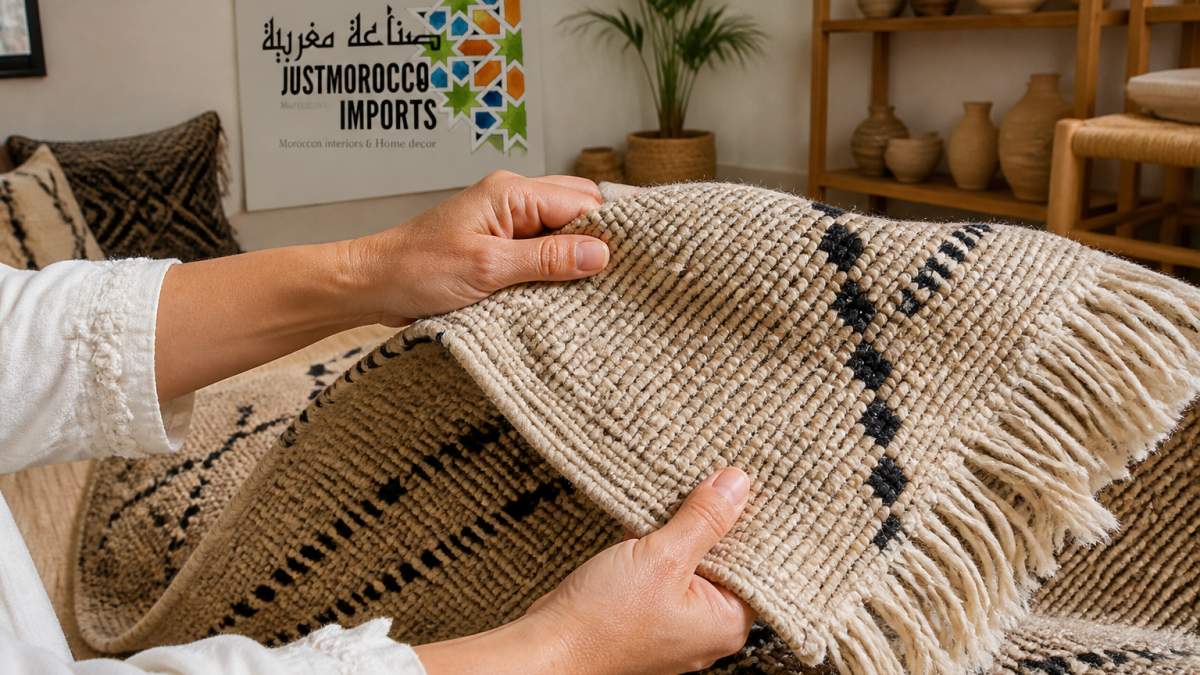
An authentic Moroccan rug is a hand-knotted or handwoven textile made by Berber artisans, and knowing the best places to buy authentic Moroccan rugs online starts with verifying it by examining the knots, weave density, and natural materials on the back of the rug. Machine-made copies look similar from the front but reveal uniform, synthetic construction when flipped over. At Justmorocco, we have handled thousands of rugs from the Atlas Mountains, and the differences become obvious once you know what to check.
Here is what separates a genuine piece from a mass-produced imitation:
- Knot density and irregularity. Hand-knotted rugs show slight variations in knot size and spacing. Perfect uniformity signals machine production.
- Natural dyes with abrash. Authentic rugs often display subtle color shifts called abrash, which come from plant-based dyeing. Synthetic rugs have flat, consistent color.
- Wool texture. Real wool feels slightly oily and warm. Synthetic fibers feel slick or plasticky.
- Fringe construction. On handmade rugs, the fringe is part of the warp threads, not sewn on afterward.
- Back inspection. The reverse side should show the knot pattern clearly. If the back looks like felt or canvas, it is not hand-knotted.
The U.S. Federal Trade Commission's textile labeling rules require accurate fiber content disclosure, so any reputable seller should provide material details upfront. If a listing avoids stating whether a rug is wool, cotton, or synthetic, treat that as a warning sign.
Why Buy Moroccan Rugs Online?
Buying Moroccan rugs online gives you access to a far wider selection than any local showroom, often at lower prices because you are purchasing closer to the source. The best places to buy authentic Moroccan rugs online connect buyers directly with imported pieces rather than through multiple middlemen.
The practical advantages are straightforward:
- Selection. Online retailers carry hundreds of one-of-a-kind pieces. A local store might have a dozen.
- Price transparency. You can compare listed prices across multiple sellers in minutes.
- Detailed photos and measurements. Good sellers photograph rugs from multiple angles and list exact dimensions.
- Direct shipping. Many importers ship anywhere in the country, including to California, Texas, New York, and Florida.
The tradeoff is that you cannot touch the rug before buying. That makes return policies and detailed product photography essential. We always recommend reviewing a seller's return terms before committing to a purchase.
Moroccan Rug Prices: What to Expect in 2026
Moroccan rug prices range from a few hundred dollars for small vintage pieces to several thousand for large antique or highly detailed hand-knotted rugs. The price depends on size, age, knot density, materials, and whether the piece is one-of-a-kind.
Here is how pricing breaks down across common categories:
| Rug Type | Typical Size | Price Range | Best For |
|---|---|---|---|
| Small vintage low-pile rugs | 82" x 41" | $380-$420 | Hallways, bedrooms |
| Mid-size hand-knotted tribal rugs | 82" x 61" | $600-$850 | Living rooms, entryways |
| Large Boujaad or Azilal pieces | 98" x 56" | $1,200-$1,400 | Living rooms, dining areas |
| Antique Taznakht rugs | 54" x 120" | $1,800+ | Statement pieces, collectors |
Smaller vintage rugs offer the most accessible entry point. A handwoven patchwork rug at 82" x 41" can cost less than a mass-produced area rug of similar size, while still being a genuine one-of-a-kind piece.
Larger hand-knotted rugs with dense patterns command higher prices because they take longer to produce. A Boujaad rug with rich pile texture and complex geometric motifs represents months of work by a single weaver.
Top Online Stores for Moroccan Rugs: A Comparison
Most guides tell you to "buy from a specialist" and stop there. That is not useful when you are staring at ten browser tabs. Below is a side-by-side comparison of the retailer categories you will actually encounter, scored on the criteria that determine whether you get a genuine rug at a fair total price: selection depth, authenticity verification, price band, shipping, returns, and best-for use case.
| Seller Type | Selection | Authenticity Verification | Typical Price Band | Shipping | Returns | Best For |
|---|---|---|---|---|---|---|
| Direct-from-source specialist importers | Curated, one-of-a-kind, 50-500 pieces | High, provenance, back photos, material disclosure | $380-$1,800+ | Free to $150+ depending on size | Varies; 7-30 days common | Buyers who want verified origin and a single point of contact |
| Artisan marketplaces (co-op style) | Large, rotating | Medium-High, seller profiles, some provenance | $200-$2,500 | Calculated by weight | Platform-mediated | Buyers who want to compare many weavers |
| General marketplaces | Very large | Low, mixed new, vintage, and machine-made | $50-$2,000 | Varies widely | Platform-dependent | Bargain hunters willing to vet carefully |
| Furniture retailers | Limited | Medium, brand-level standards | $200-$1,500 | Often free over a threshold | Standard retail 30 days | Buyers matching an existing furniture set |
| Auction and estate sites | Unpredictable | Medium-High, condition reports vary | Varies widely | Buyer-arranged or quoted | Usually final sale | Collectors chasing rare vintage pieces |
How to read this table. The two columns that matter most are authenticity verification and returns. A seller with strong provenance but a final-sale policy is a poor fit for a first-time online buyer. A seller with a generous return window but no back photos is a gamble on a $1,200 rug.
What "authenticity verification" means in practice. A specialist importer should be able to send you, before purchase: a photo of the rug's back showing individual knots, a stated fiber composition, the region or cooperative where it was woven, and the approximate age if it is vintage. If a listing cannot produce those four items, treat the authenticity claim as unverified regardless of how the photos look.
Price band caveats. The bands above reflect listed prices, not delivered prices. A $600 rug with $180 shipping and a 15% duty lands closer to $870. Always ask for the delivered total before comparing sellers, see the cost section below.
Shipping and returns are where sellers separate. Free shipping on a 98" x 56" rug is a meaningful concession because oversized textile freight is expensive. A 30-day return window on a one-of-a-kind rug is generous; a 7-day window with buyer-paid return shipping is not. Read both policies in full before you commit.
U.S. Customs and Border Protection import guidelines require proper documentation for imported textiles, which means legitimate importers maintain a paper trail that marketplace resellers often lack. Ask any seller whether they import directly or resell; the answer tells you how much provenance they can actually verify.
A practical shortlist method. Open three tabs: one direct-from-source specialist, one artisan marketplace, and one general marketplace. Search the same size and style across all three. Compare delivered price, return window, and whether each listing provides a back photo and stated fiber content. The seller that answers all three questions without a follow-up email is usually the one worth buying from.
Vintage Moroccan Rugs: Where to Find One-of-a-Kind Pieces
Vintage Moroccan rugs are previously owned pieces, typically 20 to 80 years old, that show the patina and character of age while retaining structural integrity. They are found through specialist importers, estate sales, and occasionally through auction houses.
The appeal of vintage pieces comes down to three things:
- Character. Decades of use soften the wool and mellow the colors in ways that new rugs cannot replicate.
- Rarity. Each vintage rug is genuinely one of a kind. No two are alike.
- Value. A well-preserved vintage rug often costs less than a comparable new piece.
Taznakht rugs from the Atlas Mountains are particularly sought after. These handwoven, all-wool carpets feature quilt-like geometric designs and rich, naturally dyed colors. A vintage Taznakht at 54" x 120" makes a striking statement piece for a large room.
When buying vintage online, ask for detailed photos of any wear, repairs, or thinning areas. Honest sellers document condition issues clearly.
What to Check Before Buying a Handmade Moroccan Rug Online
Before buying a handmade Moroccan rug online, verify five things: material composition, exact dimensions, construction method, return policy, and shipping insurance. Skipping any of these checks increases the risk of disappointment.
Use this checklist before you commit:
- Material stated as wool, cotton, or a specific blend (not "synthetic")
- Exact measurements in inches or feet, including fringe
- Construction described as hand-knotted, handwoven, or flatwoven
- Return window and conditions clearly stated
- Shipping insurance included for the full purchase value
- Multiple photos showing front, back, edges, and any wear
- Seller contact information available
The Better Business Bureau's online shopping guidance recommends checking seller reviews and complaint history before making any significant online purchase. For rugs in the $500+ range, this step takes two minutes and can save considerable frustration.
A common mistake is buying based on a single styled photo. Rugs photographed in professional interiors can appear larger, brighter, or more uniform than they are in person. Request a photo of the rug laid flat in natural light if one is not already provided.
The True Cost of Moroccan Rugs: Shipping, Duties, and Returns
The sticker price is rarely the price you pay. A Moroccan rug bought online can carry three additional costs, shipping, import duties, and return shipping, and each one varies enough that two sellers listing the same rug at the same price can differ by hundreds of dollars at checkout. Here is how each cost actually works.
Vintage Berber carpet low pile moroccan handwoven patchwork rug →
1. Shipping. Oversized textile freight is priced by dimensional weight, not just actual weight. A 98" x 56" rug rolled and boxed can exceed the carrier's oversize threshold, which is why shipping on large pieces commonly runs from free (absorbed by the seller) to several hundred dollars. Small low-pile rugs at 82" x 41" ship far more cheaply. Before comparing two sellers, ask each for the delivered total on the specific rug you want, not the general shipping policy.
2. Import duties. Textiles imported into the country are subject to duty based on declared value and fiber content. Wool and cotton classifications carry different rates, and the rate applies to the declared value plus certain shipping costs. U.S. Customs and Border Protection publishes current duty rates for textile imports. Two things to confirm with any seller:
- Is the rug already in the country, or will it ship from abroad?
- If it ships from abroad, are duties included in the quoted price, or billed separately on delivery?
A rug that ships domestically has already cleared customs, so duties are baked into the price. A rug shipping from abroad may arrive with a separate bill. This single question can change your total by 10-20%.
3. Return shipping. This is the cost buyers overlook most often. Returning a large rug requires the same oversize freight as the original shipment, and the buyer frequently pays it. On a 98" x 56" piece, return shipping can run $100 or more, sometimes approaching the cost of a small rug. Before buying, confirm in writing:
- Who pays return shipping
- Whether returns are accepted for change of mind or only for defects
- How long you have to initiate a return, and whether the clock starts at delivery or shipment
- Whether the rug must be returned in original packaging
A worked example. Suppose you are comparing two $1,200 rugs:
| Cost Component | Seller A (domestic stock) | Seller B (ships from abroad) |
|---|---|---|
| Rug price | $1,200 | $1,200 |
| Shipping | Free | $140 |
| Duties | Included | ~$120 (billed on delivery) |
| Delivered total | $1,200 | ~$1,460 |
| Return window | 30 days, seller pays return | 14 days, buyer pays return |
| Cost to return | $0 | ~$140 |
Seller A is $260 cheaper on delivery and $140 cheaper if you return it. On identical sticker prices, the total-cost gap is roughly $400. That is the difference transparent cost guidance makes.
Payment protection. Pay with a method that offers dispute resolution, a major credit card or a platform with buyer protection. If a rug arrives damaged or materially different from the listing, a chargeback or platform claim is your leverage. Sellers who only accept wire transfers or peer-to-peer payment apps remove that protection, which is a meaningful risk on a four-figure purchase.
Damage claims. Inspect the rug within the seller's stated window and photograph the packaging and the rug before unwrapping fully if the box shows damage. Most carriers require damage claims to be filed within a short window, often a few days, so do not let the rug sit in the box.
Caring for Your Moroccan Rug: Cleaning and Durability
Moroccan rugs are durable when cared for properly, and many handwoven pieces last for decades with minimal maintenance. Wool rugs in particular resist dirt and wear better than synthetic alternatives.
Basic care involves:
- Regular vacuuming. Use suction only, without a beater bar, to avoid damaging the fibers.
- Rotate periodically. Shifting the rug every few months prevents uneven wear from foot traffic and sunlight.
- Address spills immediately. Blot with a clean cloth. Do not rub, which pushes stains deeper into the pile.
- Professional cleaning every few years. For wool rugs, use a cleaner experienced with handmade textiles.
Low-pile rugs are easier to clean than high-pile shaggy styles. A vintage low-pile Berber carpet at 82" x 41" works well in high-traffic hallways because dirt does not work its way deep into the weave.
Avoid machine washing. Never put a handmade rug in a washing machine, even on a gentle cycle. The agitation will distort the weave and shrink the fibers.
Ethical Sourcing: Supporting Artisans and Fair Trade
Ethical sourcing means buying from sellers who pay weavers fairly and can trace rugs back to specific communities. This matters both for the artisans and for you, because ethically sourced rugs come with verification that mass-produced copies cannot provide.
Berber weaving is a traditional craft passed down through generations. When you buy from an importer who works directly with weaving cooperatives, more of your money reaches the people who made the rug.
Questions worth asking any seller:
- Where was this rug made, and by whom?
- Is the seller working directly with weaving communities?
- Can they describe the dyeing and production process?
At Justmorocco, we source our rugs directly from Berber weavers in the Atlas Mountains. Each piece carries details about its origin, including the tribe or region where it was made. The same direct-from-source approach extends to our custom furniture imports, which are brought in from the same Moroccan workshops.
Choosing the Right Moroccan Rug for Your Room
The right Moroccan rug depends on the room's function, foot traffic, and existing color palette. Matching these three factors prevents the most common buying mistakes.
Here is a simple decision framework:
- High-traffic areas (hallways, entryways): Choose low-pile or flatwoven rugs. They resist crushing and clean easily.
- Living rooms: Medium-to-plush hand-knotted rugs add warmth and comfort underfoot.
- Bedrooms: Soft wool rugs in calming tones work best. A vintage low-pile piece at 82" x 41" fits alongside most beds.
- Dining rooms: Flatwoven or low-pile rugs allow chairs to slide easily.
- Statement spaces: Large Boujaad or Azilal rugs with bold geometric patterns anchor the room.
Consider the rug's colors against your existing furniture and walls. Moroccan rugs often feature vibrant hues, from hot pink and magenta to saffron orange and turquoise blue. A colorful rug can serve as the focal point of a neutral room or complement an already rich palette.
Size matters as much as style. Measure your space before shopping, and remember that a rug should extend at least a few inches beyond the furniture sitting on it. Our team at Justmorocco can help match dimensions to your layout if you send room measurements.
Choosing the right Moroccan rug comes down to verifying authenticity, understanding the real cost, and matching the piece to your space. The challenge is finding a seller who provides genuine provenance, fair pricing, and reliable shipping. Justmorocco imports directly from Berber weaving communities, offers one-of-a-kind pieces from $380 to $1,800, and provides free shipping on select rugs with full details on every listing. Browse our collection to find a handcrafted piece that brings authentic Moroccan character to your home.
Frequently Asked Questions
How can I tell if a Moroccan rug is authentic?
Check the back of the rug for irregular knots and a visible weave, which indicate hand-knotting. Authentic rugs often have slight imperfections and color variations from natural dyes. Ask for provenance details like the tribe or region. Justmorocco provides such information, ensuring you buy an authentic piece.
What is the typical price range for Moroccan rugs?
Moroccan rug prices vary widely based on size, age, and craftsmanship. Vintage rugs can start around $380 for smaller pieces, while larger antique rugs may exceed $1,800. Justmorocco offers a range from $380 to $1,800, with free shipping on many items, providing transparent pricing for authentic rugs.
Where can I buy vintage Moroccan rugs online?
Vintage Moroccan rugs are available on specialized sites like Justmorocco, which curates one-of-a-kind pieces. Look for detailed photos and descriptions that mention age and condition. Justmorocco's collection includes vintage Berber rugs with unique patterns, ensuring you find an authentic vintage piece.
What should I check before buying a handmade Moroccan rug online?
Before buying, verify the rug's materials (wool, cotton), dimensions, and return policy. Check for clear photos of the rug's front and back. Read customer reviews and ask about shipping insurance. Justmorocco offers detailed product pages and free shipping on many rugs, making your online purchase secure.